New strategies for knowledge work in the era of AI browsers: When the world is no longer waiting for you to search, where should we go?
✍️Originally published in “Technice Island”
Do you still remember that shocking moment when you first opened your browser and entered a URL or keyword? A webpage instantly pops up on the screen, and knowledge seems to pour out of the void, leaving us in awe. At that moment, the dream of having information at our fingertips came true. For more than two decades, the usage behavior of “open a browser → enter keywords → click search” has long become our ingrained muscle memory, a daily ritual that is almost without thought. However, this process is now being completely rewritten by a silent but turbulent change.
In the past few months, the AI industry has set off an unprecedented wave: many leading AI companies have launched their own browsers. For example, OpenAI released Atlas, Perplexity launched Comet, and The Browser Company brought Dia. The names of these products sound romantic like distant stars, but the strategic intentions behind them are clear and sharp - to redefine the interaction between humans and knowledge. This is not only a product competition, but also a profound revolution in how we think and work. AI browsers are preparing to subvert the most mundane but most dependent core behaviors we rely on every day. Yes, it’s searching.
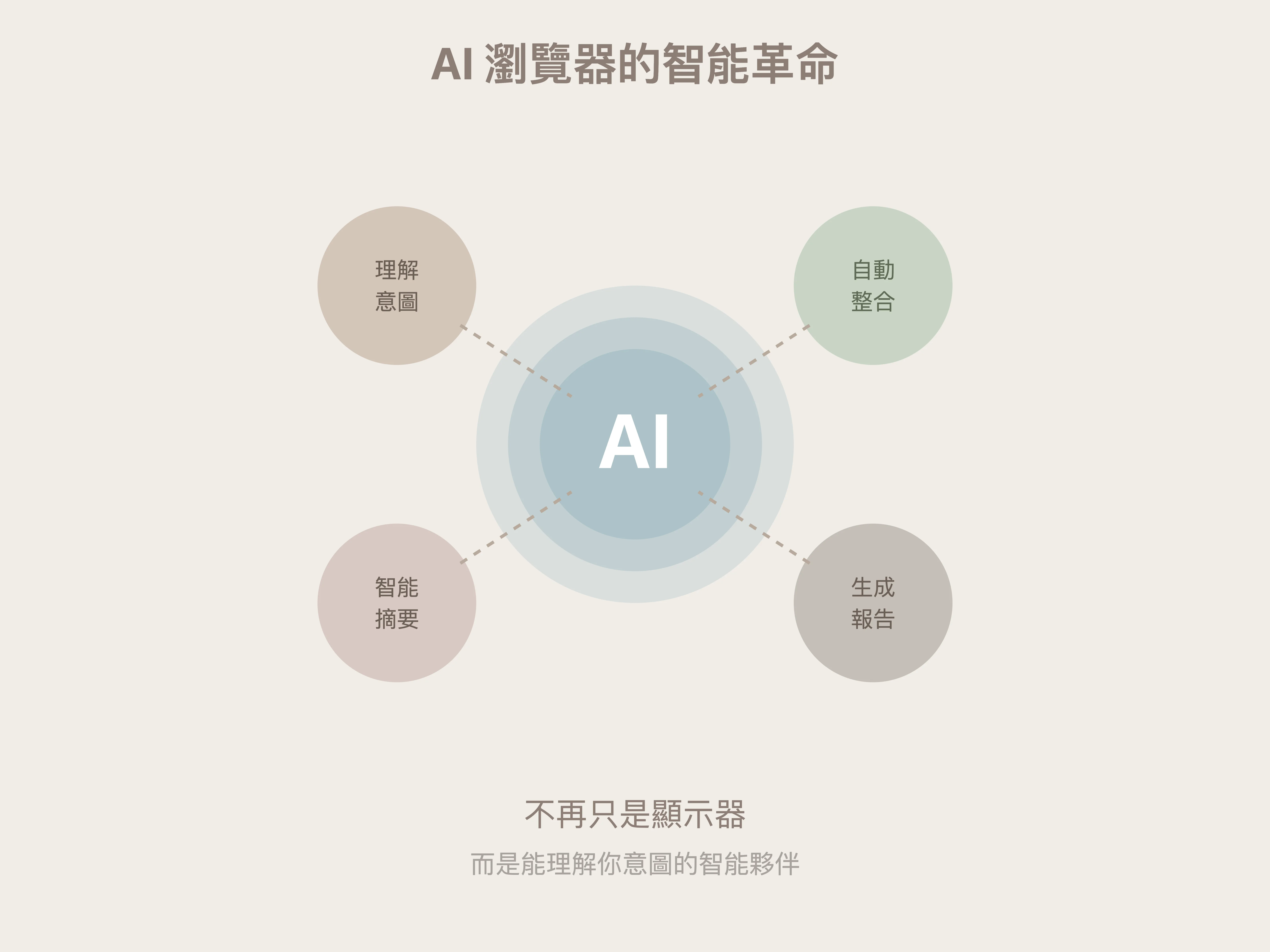 ▲The intelligent revolution of AI browser. (Photo/Provided by Zheng Weiquan)
From passive search to intelligent partner
Think back to the operating logic of traditional browsers: you only need to enter a few keywords, and the engine throws out a long list of result links. What follows is a long journey of salvage - opening web pages page after page, reading lengthy content, filtering useful information and organizing notes, and even being interrupted by advertisements and irrelevant content from time to time. This whole process is like casting a net to fish in the vast ocean of information: occasionally you will catch pearls, but more often than not you will be delayed by seaweed and garbage, and it will take a lot of time to distinguish the authenticity.
The emergence of AI browser has completely overturned this passive and inefficient model. Take OpenAI’s Atlas as an example. It is no longer just a mechanism for displaying web content, but an intelligent partner that can understand your intentions.
You can directly say to it: “Please help me compare the three main trends of Taiwan’s AI education market in 2025, including the latest data, authoritative sources and visual charts.” Atlas will not only search for online information, but also automatically integrate, summarize, cross-reference, and finally even generate a draft of a complete and ready-to-use briefing outline. You no longer have to wait for hours, you can get results in just minutes.
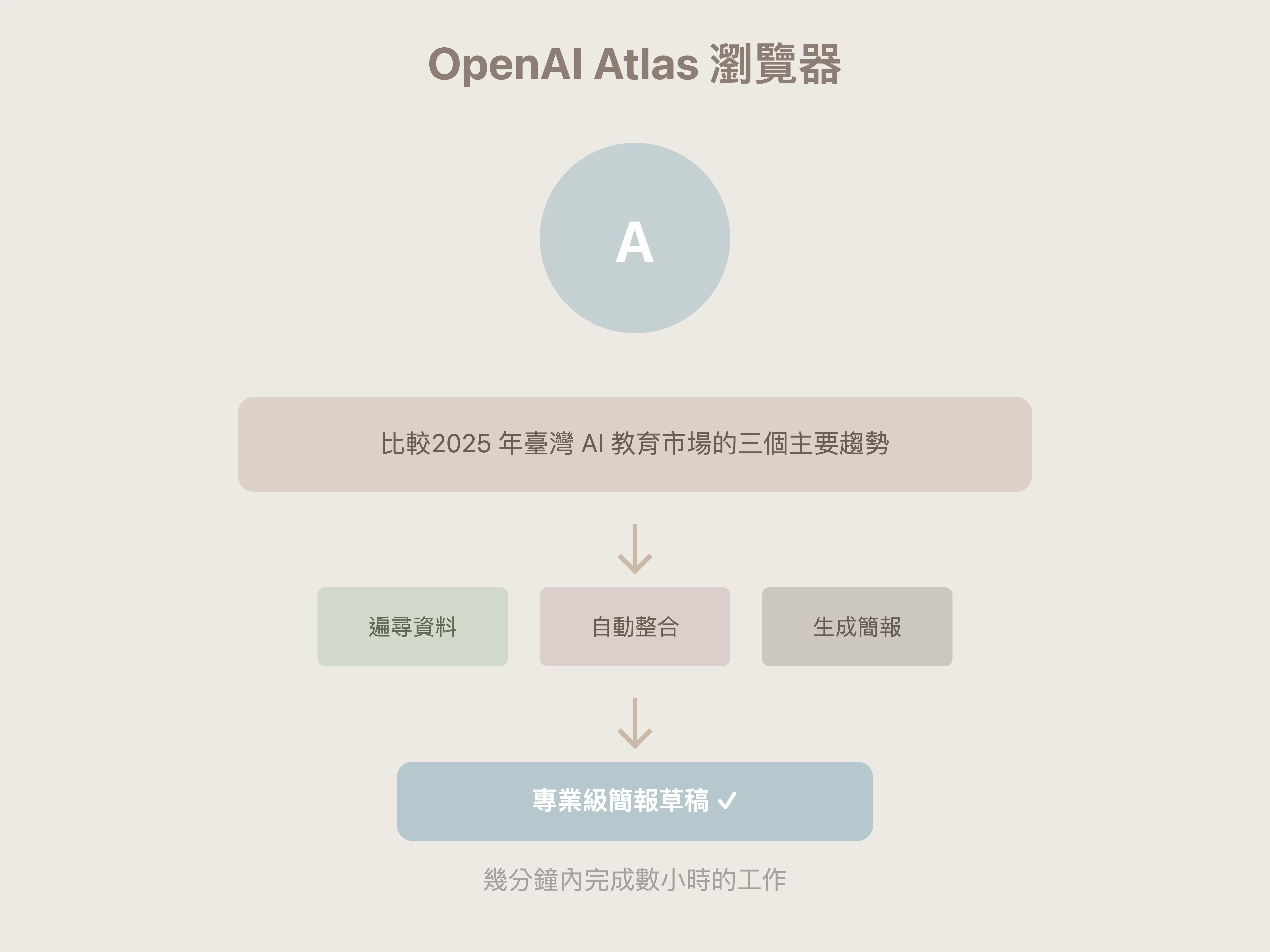 ▲ OpenAI Atlas browser. (Photo/Provided by Zheng Weiquan)
Perplexity’s Comet sublimates search behavior into an ongoing conversation. When you read a web article, rich annotations (such as relevant background knowledge, authoritative reference sources, or statistical data verification) will instantly appear in the sidebar, and even a summary of the key points of the article and further reading suggestions will be automatically generated. You no longer need to painfully switch between a dozen pages, just ask: “What are the loopholes in the views of this article?” Comet will help you find logical loopholes and provide counter-evidence information. The entire network seems to be compressed and integrated by it, turning it into your exclusive knowledge backup.
The Browser Company’s Dia is more forward-looking and ambitious, trying to create a complete thinking studio. Dia seamlessly integrates browsers, note-taking tools, AI analysis assistants and personal knowledge bases, allowing you to instantly annotate, analyze, archive and correlate any web page. Imagine: you read a report on AI education, and Dia will automatically extract key data into your project notes, link to related reading history, and suggest follow-up research directions. Your entire brain seems to be outsourced to a second brain that never tires and has a super memory.
The core consensus of these three AI browsers is that they no longer regard search as a purely technical behavior, but regard human thinking itself as the core of the product. Having said that, our generation of knowledge workers is becoming the first early adopters and beneficiaries of this revolution.
Three major motivations for AI companies to seize browser access
Seeing this, you may want to ask me: Why are these AI companies rushing out to grab browser access? Admittedly, facing this sudden wave of browser craze, you may be confused: Don’t AI companies already have powerful chatbots, API services and mobile apps? Why do you have to make a browser yourself? The answer actually lies not in the technical level, but in the deep game of power structure.
First, the restart and upgrade of the entrance battlefield. History tells us that whoever controls the first entry point for users every day will control the world. Back then, Google relied on its search engine to become a portal to knowledge, Apple relied on its App Store to control the mobile ecosystem, and Microsoft relied on its Office suite of software to dominate enterprise productivity. Nowadays, AI companies see the same opportunity, which is to create a thinking portal. As long as users start working, studying or researching from the AI browser every day, they can collect the most realistic and abundant usage scenario data, thereby establishing an unshakable AI ecological closed loop. Imagine that in the future, ChatGPT will no longer passively wait for instructions. Instead, it will proactively present today’s key summaries and project progress suggestions when you turn on your computer based on your reading track, work notes, and conversational context over the past month. AI browsers such as Atlas, Comet and Dia are the outposts of this entry war, posing a direct challenge to Google’s more than two decades of dominance.
Second, the upgrade of data fuel and memory mechanisms. For these AI companies, user behavior data is the most precious fuel. Atlas’ “browsing memory” function can record all the websites you have browsed, click preferences and dwell time, and can even analyze the context of topics you care about, and then provide highly personalized answer suggestions. But the truth behind this convenience is: every time you read and every click is silently converted into training material for the AI model. We have exchanged personal behavior data for unprecedented efficiency. This is an invisible data contract.
Third, the deconstruction of the search economy and advertising ecology. The most profound impact comes from the disruption of business models. Traditional search relies on results page advertising and SEO traffic to monetize, but the AI browser gives answers directly, completely bypassing the intermediate link. If you ask “Which Taipei accounting firm’s services are best for small and medium-sized enterprises?” AI will directly compare the service items, customer reviews and charging standards, and recommend the option that is most suitable for you.
Think about it carefully, will you still have the patience to click on ten websites to compare prices slowly? For content creators and marketers, this is red alert: the keywords of the future will no longer be written to the Google algorithm, but will convince AI models. For ordinary working people, information acquisition has become faster and more accurate, but it is also more concentrated in a few AI giants, forming a knowledge bubble filtered by algorithms. The world you see may no longer be the open Internet, but a refined version of reality tailored by AI for you.
From search master to question master
In the AI era, our knowledge and skills must be upgraded as soon as possible, from being search experts in the past to asking questions. You must know that the essence of AI browser is not only an upgrade of tools, but also a complete reorganization of human thinking logic. In the era of Google, search power is the standard for competitiveness in the workplace; but in the era of AI browsers, questioning ability is the core skill that determines victory or defeat.
When AI becomes your all-weather knowledge partner, every problem is equal to a precise mission design. If you simply ask: “Help me find AI education materials,” it will give you a bunch of links at most; but if you carefully design the question: “Please analyze the three core challenges of Taiwan’s AI education market in 2025, combine the latest policies of the Ministry of Education and the practical cases of three leading startups, and propose specific strategies for small and medium-sized enterprises to introduce AI training.” AI will generate a complete report that includes data analysis, policy interpretation, case comparison, and action suggestions.
I would like to remind everyone that asking questions is no longer a simple inquiry, but has become an advanced writing art, a structured communication skill, and a task-oriented thinking design.
Looking at the past knowledge workflow, it is actually one-way linear: search → filter → organize → output, each step is time-consuming and laborious. The AI browser transforms this into a dynamic cycle: question → intelligent generation → manual verification → iterative correction → immediate action. This not only improves efficiency, but also realizes a knowledge production model co-created by humans and machines.
In other words, this requires knowledge workers to master three new core capabilities: task design capabilities (let AI understand your real needs), output verification capabilities (distinguish AI’s self-confidence errors), and insight refining capabilities (extract unique human wisdom and judgment from large amounts of information).
However, convenience does not equal thinking. Although the AI browser seems to be able to complete complex research in a few seconds, it also brings hidden dangers, that is, thinking inertia. Just think, when the answer is at our fingertips, it is easy for us to be satisfied with the apparent correctness and skip comparison, criticism and association. The real winners in the workplace must regard AI as a thinking accelerator rather than a thinking substitute: use it to complete information integration and preliminary analysis, but key value judgments, strategic choices and creative thinking still need to return to human dominance.
Three essential core strategies for knowledge workers
Facing this wave of change, how should general knowledge workers respond? Let me help you extract three core strategies that every working person must establish in the next three years.
Strategy 1: Establish a task-oriented thinking framework. Ditch the old habit of haphazard searches and reframe the problem around specific tasks. For example:
From “I want to learn about AI education” → “Compare the business models, user acquisition costs and monetization strategies of three new AI education startups in Taiwan” From “Please help me organize the information” → “Generate a 20-page PPT briefing, including market size forecast in 2025, customer pain point analysis and three successful introduction cases.” Through this precise task orientation, AI can be upgraded from a search tool to a professional colleague, and the output can directly correspond to your work goals.
Strategy 2: Develop the critical habit of “three questions to verify” AI’s answers are often ridiculed as “serious nonsense”, and professionals must establish a systematic verification mechanism:
- Source credibility: Where does the data come from? Is the original source authoritative?
- Situational integrity: Are Taiwan’s local cultural differences and time decay effects considered?
- Sensitivity test: If the question method or keywords are changed, will the answer be completely different?
Only information that can withstand multi-dimensional verification is worthy of being included in decision-making. Verification capability is the watershed for truly mastering AI.
Strategy 3: Create a personalized knowledge operating system. The winners in the future workplace are no longer just information collectors, but knowledge architects. Therefore, we all need to build a personal productivity system that integrates across tools:
Browse for understanding (Atlas, Comet) → Knowledge archiving (Notion, Hetabase, Obsidian) → Content generation (Claude, ChatGPT) → Human editor review → Final output (report, briefing or article)
Through such a closed-loop process, AI can become an extension of your brain, rather than simply replacing the brain. Your core competitiveness will shift from who collects the most to who can integrate it the most and interpret it the most uniquely?
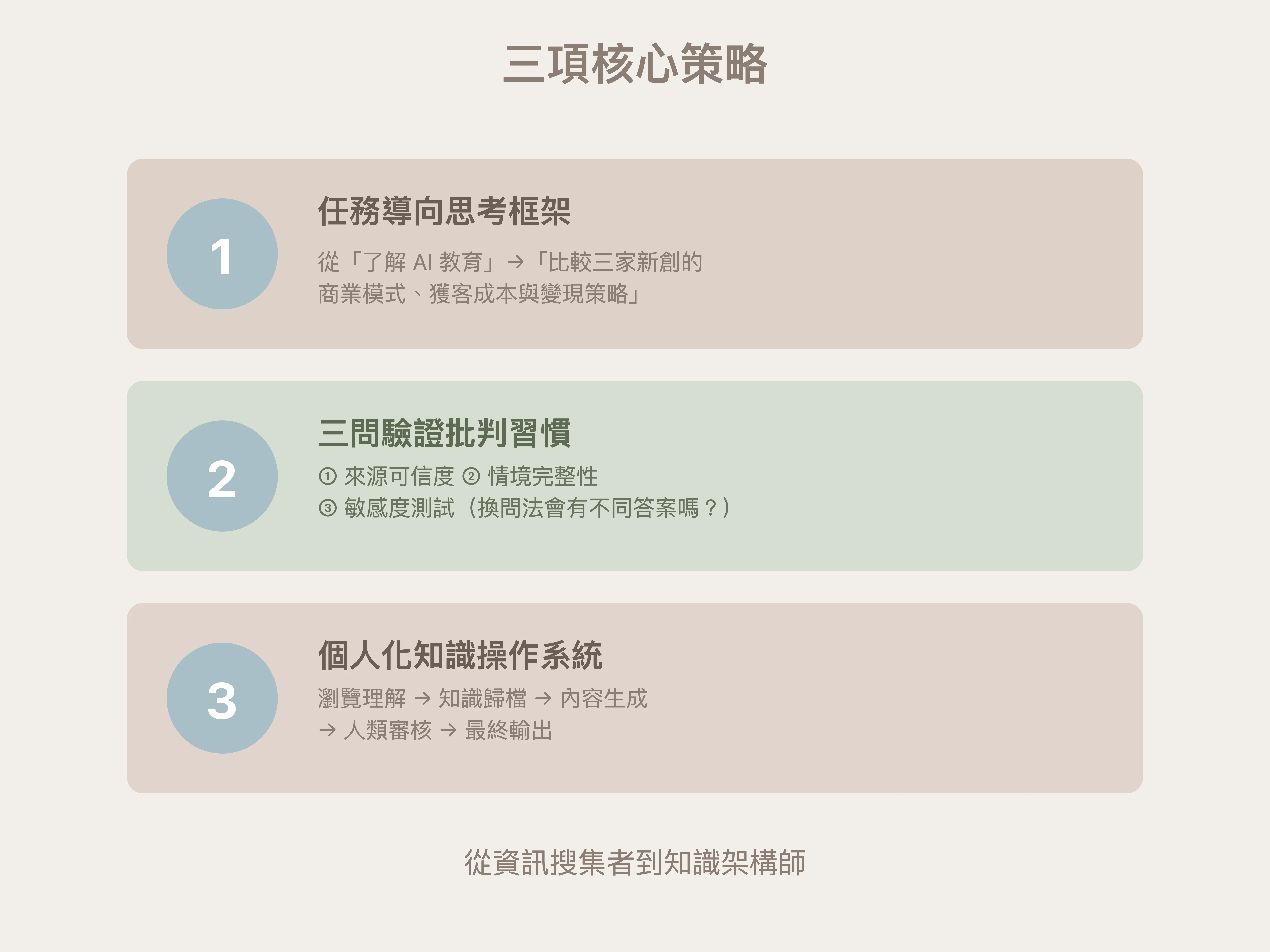 ▲Three core strategies. (Photo/Provided by Zheng Weiquan)
Hidden dangers and risks behind convenience
Overall, the AI browser is like a double-sided blade, with a dark shadow hidden behind the halo of convenience. Just imagine, every technological leap is a tug-of-war between convenience and risk. Of course, AI browser is no exception.
First, be aware of the erosion of privacy boundaries. Because they will deeply record your reading trajectory, stay preferences, and search context, while providing an amazing personalized experience, they may also become a hidden danger to corporate data security. Especially when used in public environments such as companies, the risk of sensitive information leakage must be assessed and solutions such as enterprise version or local deployment must be considered.
Secondly, we must also be careful of the cognitive trap of algorithmic bubbles. Because AI continues to optimize recommendations based on your usage habits, the more you use it, the better it will understand you, but it will also become harder to access dissenting views, forming an information cocoon. This is not a good thing for policy makers and creators, and is likely to lead to blind spots and even unintended consequences. The solution is to deliberately maintain “multi-source reading”: browse 3-5 authoritative media with different positions every week to break the comfort zone of the algorithm.
Finally, thinking about muscle atrophy is a big crisis! When AI can complete sorting, comparison and summary in real time, people tend to fall into the illusion of efficiency and mistakenly believe that speed is good. But real productivity is not to reduce thinking, but to enlarge the depth and breadth of thinking. AI can certainly help us find all the answers, but only we can judge which answers are worthy of belief and how to connect them into insights.
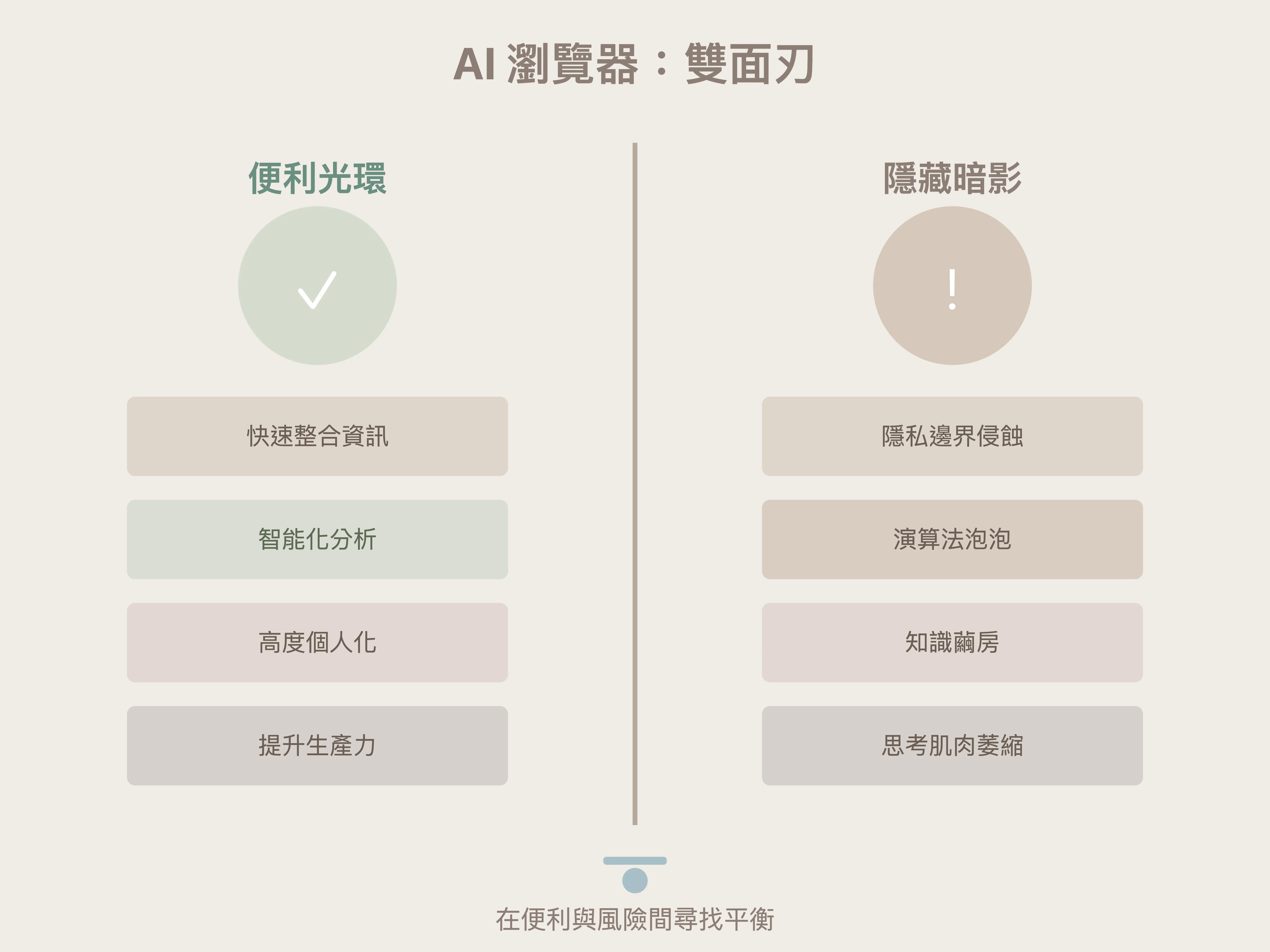 ▲ AI Browser: Double-sided Blade. (Photo/Provided by Zheng Weiquan)
It seems to me that as the world begins its search for humanity, we must all learn to frame meaningful questions. In other words, in this era of AI browsers, we have evolved from passive information hunters to active knowledge architects. This is an exciting turning point, but it is also full of challenges: the search has been sublimated from simply finding information to a complete closed loop of “design issues → intelligent navigation → verification and correction → action generation”.
In the next three years, the real winners in the workplace will not be professionals who know how to use AI tools, but experts who know how to make AI an extension of their own thinking. They master four golden abilities, including: precise questioning, rigorous verification, deep integration and original creation.
The time series is about to enter 2026. The new entrance to knowledge is no longer the browser bookmarks or mobile phone desktop, but hidden deep in your brain - the core of thinking that continues to learn, has the courage to experiment, and always maintains critical doubt. When AI begins to search the entire world for us, the only thing we need to ensure is that we are still open to learning and continue to learn how to think about the world.
📖 深入探索相關主題