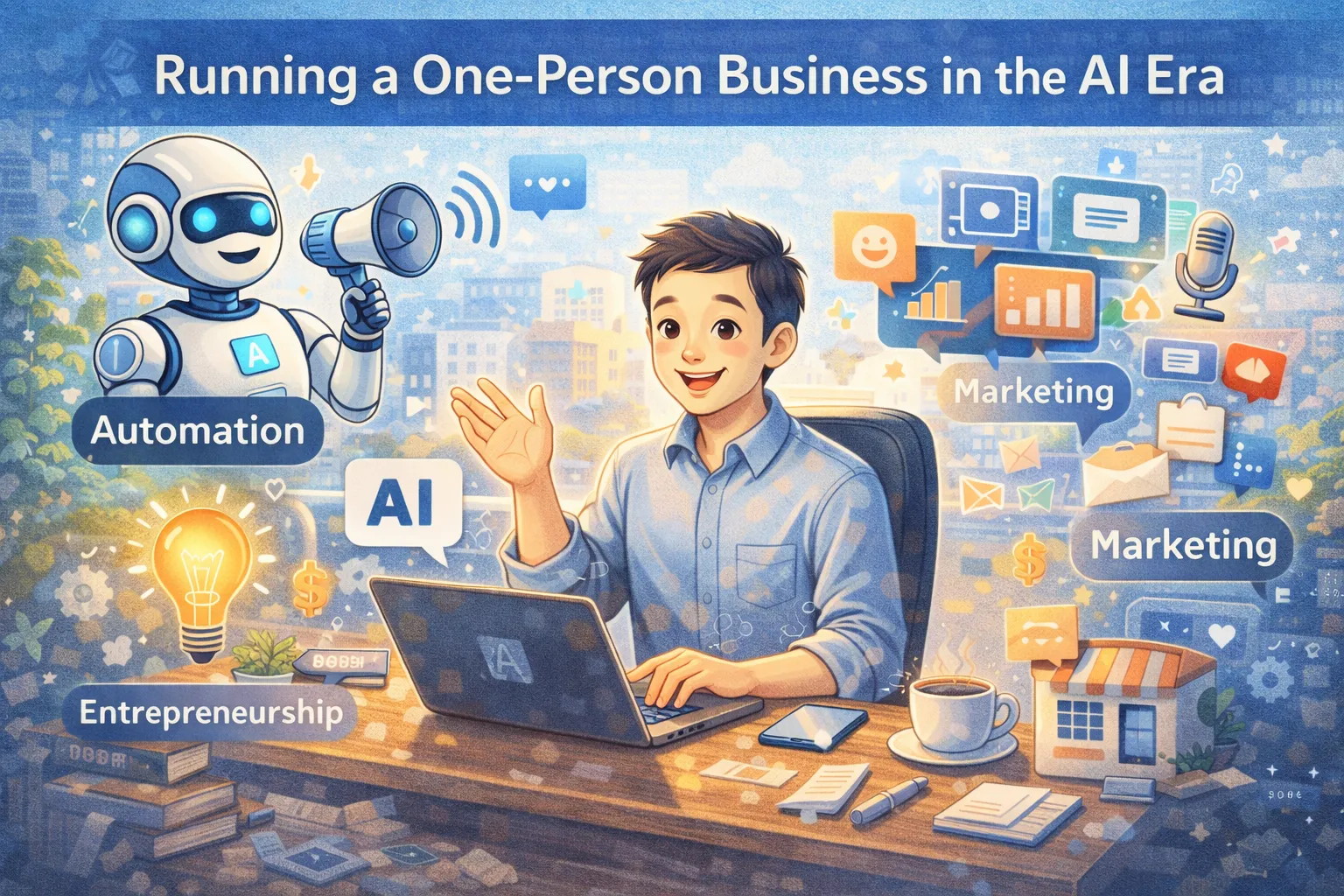
Reading experience of "One-person Company Management in the AI Era": Start your entrepreneurial journey with the price of a cup of coffee
Recently, I read a book that I am looking forward to very much - “[One-person Company Management in the AI Era] (https://www.books.com.tw/exep/assp.php/vista/products/0011047058?utm_source=vista&utm_medium=ap-books&utm_content=recommend&utm_campaign=ap-202603)”.
作者洪儒明是台大校友,我们有一些共同朋友,也因此早就听闻他对「一人公司」这个主题有着深入的研究与实践。 The subtitle of this book is very attractive to me: “Reject the all-in gamble and start your entrepreneurial journey with the price of a cup of coffee.”
In this era when the AI wave is sweeping across all walks of life, I think this book comes at the right time.
Why does the concept of “one-person company” particularly resonate with me?
In fact, I have been running a “one-person company” model for several years. From serving as the editor-in-chief of “Digital Times” magazine, to later starting a business, receiving training, writing columns, and studying for a doctoral degree, I have increasingly realized that large scale is not necessarily a good thing.
Traditional business logic tells us that if a company wants to grow, it must expand. To expand, you need to hire more people, rent a larger office, and take on more projects. But if you go down this road, you will find that you are getting busier and busier, but you may not necessarily earn more, let alone have more time.
In a one-man company, one person does not do everything, but one person controls the entire system.
This is the core concept that I want to share with you most after reading this book.
Key myths dispelled by Hong Ruming
I read a concept mentioned in the book several times:
Entrepreneurship is not gambling, but using the minimum cost to verify whether your idea can create value for others.
This sentence hits home to many people’s misunderstandings about entrepreneurship. Everyone thinks that starting a business means spending a lot of money, quitting your job, and burning everything. But Hong Ruming tells us that this “All-in” mentality is the most dangerous.
In the AI era, the barriers to starting a business have been significantly lowered. You don’t need millions of dollars, a team of ten people, or even the ability to program. What you need is:
- An idea that can solve a problem
- Be willing to continue learning and iterate
- Make good use of AI tools to amplify your output
According to Tianxia Magazine, there are already stay-at-home dads and college students starting businesses based on AI, earning millions of dollars a month. This is not a myth, it is a fact that is happening.
What does a one-person company look like in the AI era?
Let me illustrate this using a concrete framework. In the process of running [SOLO Freeman Academy] (https://solo.tw), I developed the “SOLO Methodology”, which just echoes the views in Hong Ruming’s book:
S — Set up
who are you? Who do you want to serve? This is the starting point of a one-person company.
Instead of thinking about “what product do I want to sell” first, clarify “what problem can I solve for whom?” Hong Ruming emphasized in the book that only by clear positioning can every subsequent step be saved effort.
O — Operate (system operation)
Build your customer acquisition and delivery system.
Being a one-person company does not mean doing everything yourself. What you need are automated tools, standardized processes, and reusable systems. From event registration, list collection to content marketing, every aspect can be systematized.
L — Leverage (leverage amplification)
Amplify output with tools and automation.
This is the biggest bonus in the AI era. What used to take three people to do can now be done by one person plus AI. Not to replace you, but to amplify you. The book mentions that the real leverage is not to work overtime, but to allow every effort to be replicated and accumulated.
O — Outgrow (beyond growth)
From “one person busy” to “one person business”.
This is the most critical step. After many people start a business, they find that they have just changed a boss—from the previous supervisor to the current customer. But a true one-person company must be able to break through personal ceilings and establish a scalable business model.
The three views that moved me most about this book
1. Start a business with the price of a cup of coffee
Hong Ruming uses this metaphor to make starting a business less scary. A cup of coffee costs about one hundred yuan. Are you willing to spend this money to try it?
This change in mindset is important. It’s not “I want to risk everything”, but “I’m willing to experiment with the minimum cost.” If you fail, take it as tuition; if you succeed, continue to expand.
2. Reject “All-in” gambling
The book emphasizes repeatedly that entrepreneurship is not a zero-sum game. You don’t need to quit your job to start a business, you can slowly accumulate it in your time off work. You don’t need to give up a stable income to pursue your dreams. You can use the “barbell strategy” – trying to innovate while maintaining stability.
This progressive way of starting a business is especially suitable for people with family responsibilities and financial pressure. Not everyone can be a “crazy entrepreneur”, but everyone can be a “smart one-person company operator.”
3. AI is the best co-founder
I feel the same way. I have deeply realized the power of AI in the process of using AI to assist in writing, doing research, organizing materials, and even designing courses.
But Hong Ruming reminds us that AI is not omnipotent. It’s a tool, not an answer. You still need to have your own judgment, unique perspectives, and real experience. AI can help you speed up, but you still have to decide the direction yourself.
💡 **Want to turn AI into your digital co-founder? **
If you also want to use AI to build your own digital products, welcome to join my Vibe Coding Practical Workshop. This is not about teaching you to write programs, but about using AI to turn ideas into truly usable tools - giving your one-man company more weapons to use.
Three specific suggestions for those who want to start
After reading this book, if you also want to embark on the road of one-person company, I have three suggestions:
1. Start with “solving the problem”, not “selling the product”
Many people’s first thought when starting a business is: “What do I want to sell?” But Hong Ruming tells us that we should first ask: “Who can I help solve what problem?”
The more specific the problem, the more valuable the solution. Don’t think about serving everyone, focus on serving a small group of people first.
2. Establish a “minimum viable system” rather than a “perfect business plan”
Instead of spending three months writing a business plan, spend three days building a simple service and then start selling it. Market feedback is more important than you think.
My own SOLO Freeman Academy also started like this - having a simple idea first, and then adjusting it as I went. Looking back now, there is a huge difference between the first version and the current version, but if I was obsessed with “perfection” at the beginning, I might not have started yet.
3. Treat AI as an amplifier, not a substitute
AI can help you write the first draft, do research, and organize information. But the final judgment, unique perspective, and real experience still depends on you.
I often say that the most valuable thing in the AI era is not “knowing how to use AI”, but “knowing what to do with AI”. Everyone can use the tools, but not everyone has the strategies.
Conclusion: One-person company is a way of life
After reading “One-person company management in the AI era”, my biggest feeling is: a one-person company is not only a business model, but also a way of life.
What it stands for is: You have a choice. You decide what to do, who to work with, when to work, and where to work. This kind of freedom cannot be bought with money.
But freedom is not free. It requires you to have a clear positioning, a systematic approach, a continuous learning mentality, and the courage to face uncertainty.
This book by Hong Ruming gives us a map. I’m not telling you “you will definitely succeed”, but telling you “how you can start”.
If you are also thinking about your future work and lifestyle, I highly recommend you read this book. Then, for the price of a cup of coffee, start your experiment.
Extended reading:
- Dan Koe: To build a one-person company business model, how to productize yourself?
- A cruel watershed in the AI era: Why has the income of 95% of freelance workers been cut in half, while the income of 5% has doubled?
- When AI-feeling articles are flying everywhere: It’s not that you don’t write well enough, but that you are too easily replaced
📚 Book purchase link: “One-person company management in the AI era”