Embracing the AI Era: Entering the Dilemma in 2025 and Looking ahead to the New Era of Agents in 2026
✍️Originally published in “Technice Island”
If you were to choose a keyword of the year for 2025, I guess AI would be the most popular candidate keyword. Speaking of AI, in Taiwan’s workplace it is no longer a question of whether to fully introduce it, but a question of what exactly you have done with it and whether you can turn it into results. From AOI (Automated Optical Inspection) in the factory to document processing, meeting summaries and customer service responses in the office, AI is not just a patent for technology companies, but has begun to penetrate into the daily processes of all walks of life.
1. Current Situation Inventory: Popularization does not mean maturity
If you look around the world, you will find that it is normal for professionals around the world to use AI. But if you think about it further, you will find that improving efficiency is a huge problem. According to a survey conducted by McKinsey, the proportion of enterprises that have introduced AI into at least one business function is already very high, but there are still only a few that can truly promote AI from small-scale testing to company-wide scale. This gap happens to be the most noteworthy part of Taiwan’s industry.
High adoption rate, low effective adoption
In the past two years, I have often had the opportunity to teach in public sectors and enterprises. After class, I chatted with business executives, and they often said: “We have introduced AI!” However, when I continued to ask whether the process was really rewritten, whether the results were quantified, and whether it was spread across departments, the answer began to become vague. Taiwanese companies are very good at purchasing tools or importing various advanced equipment, but they are not necessarily good at changing processes, redistributing rights and responsibilities, and inventorying data until it can be used by models. To use a simple metaphor, everyone knows the importance of health and has bought gym memberships. However, after a year and a half, there are still only a few people who have actually built muscles.
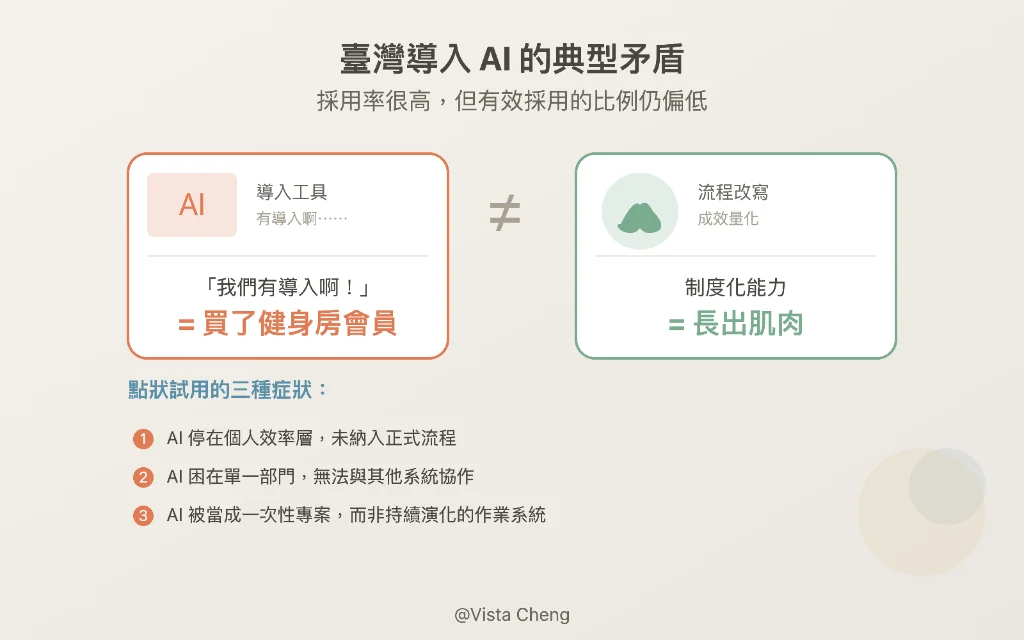 ▲Typical contradictions in Taiwan’s introduction of AI. (Photo/Provided by Zheng Weiquan)
This state of seeming to be introduced but actually stuck at a point trial usually shows the following three symptoms: AI is stuck at the personal efficiency level but is not included in the formal process; AI is trapped in a single department and is not connected to other systems; AI is treated as a one-time project rather than a continuously evolving operating system.
The industrial gap continues to expand
To be fair, manufacturing is still the first industry to see performance. Well, the reason is simple! This is because the industry’s pain points are clear, data is standardized, and investment recovery is easy to calculate. Large manufacturing companies use AI vision and simulation platforms to improve defect identification accuracy, resulting in quantifiable efficiency gains. When AI is directly embedded into a company’s production line and employees follow the new process, quality will improve.
But when the scene cuts to the service industry and small and medium-sized enterprises, the difficulty is completely different: data are scattered, processes are not standard, IT manpower is insufficient, and the introduction cost is a big problem. Although the government will launch an AI coaching program for the commercial service industry at the end of 2025, setting the introduction scale and talent training as specific goals in an attempt to bring more stores on board, the current results remain to be seen.
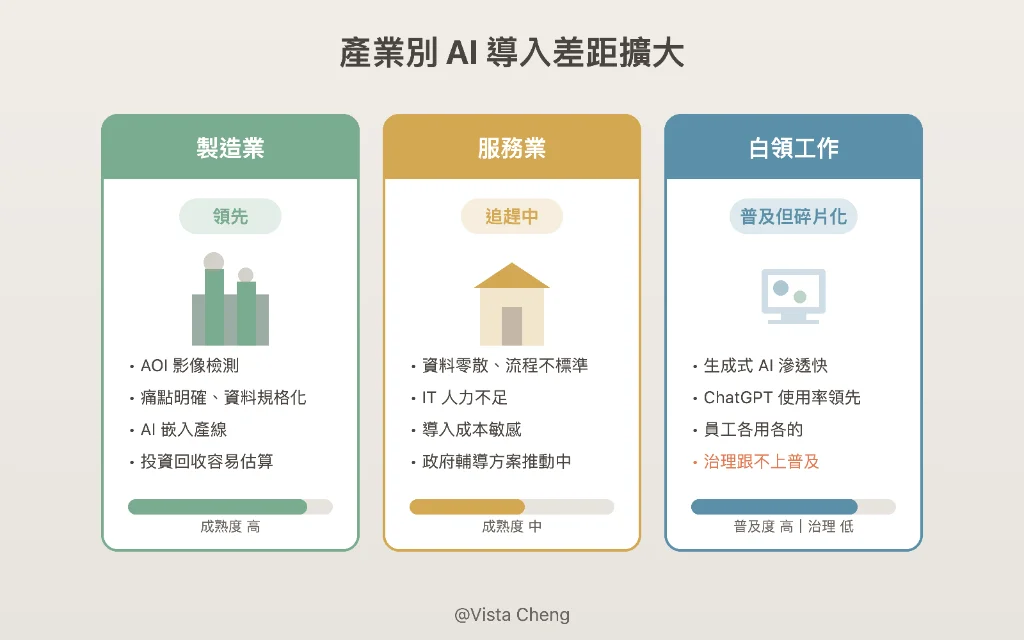 ▲ The gap in AI introduction among industries widens. (Photo/Provided by Zheng Weiquan)
As for generative AI, which white-collar workers are most exposed to, it is popularized very quickly and managed very slowly. Employees each use their own AI. Although work efficiency is improved, the organization must bear unknown risks. Some companies even use the banner of “All in AI” but are reluctant to pay for employees’ AI paid accounts.
Personal use: Efficiency and stress rise at the same time
From a personal perspective, the most obvious change in 2025 is that AI makes the output of various paperwork faster, but it also creates a competition in speed. The briefing you originally spent a whole afternoon putting together can be produced by others as a first draft in an hour. The copywriting you originally polished slowly through experience can be produced by others using AI in ten versions and then refined.
As a result, a new divide will soon emerge in the workplace: What the boss cares about is no longer whether employees can use AI, but whether you can use AI to make better judgments and produce higher-quality works? According to Workday’s latest “AI Agent Era: Artificial Intelligence Workplace Collaboration Trends” global survey, 88% of Taiwanese employees are willing to collaborate with AI agents, but only 16% are willing to accept AI agents as managers, reflecting that companies still have room to explore how to leverage human strengths while effectively introducing AI.
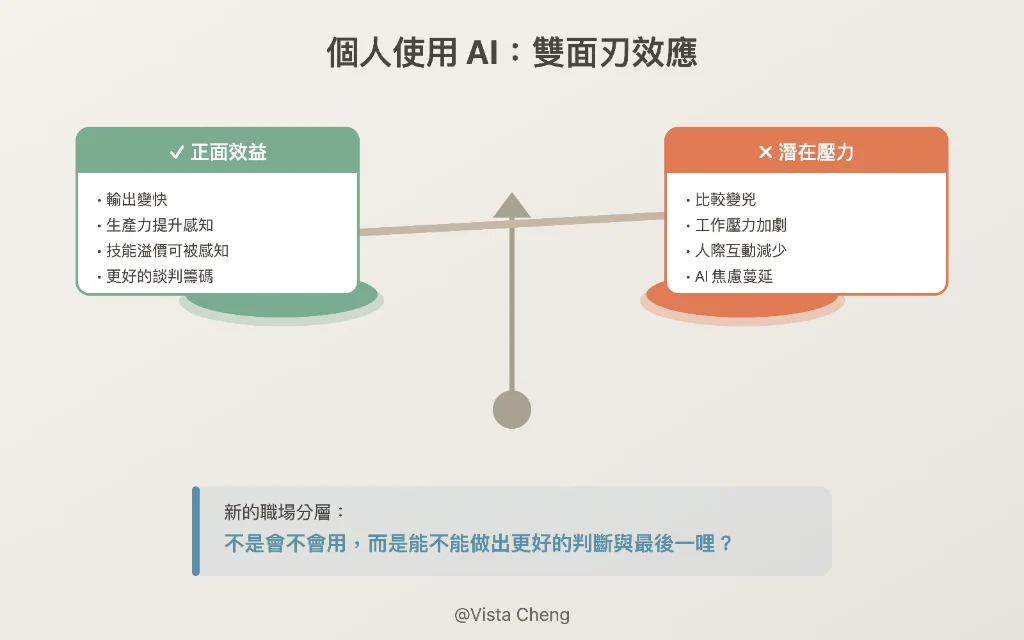 ▲Personal use AI: double edge effect. (Photo/Provided by Zheng Weiquan)
Four core challenges
- Talent and division of labor: What the industry lacks is not talented engineers, but bridgers who understand business, processes, data, risks, and how to integrate AI into processes. There are many small and medium-sized enterprises in Taiwan, and they are still used to dividing responsibilities by departments, which makes it easy for AI to be trapped in a certain organization.
- Data governance and information security: The popularity of generative AI has made data outflow from an issue of the IT department to a daily choice for every employee. Information governance and regulatory compliance have become issues that enterprises urgently need to pay attention to.
- Performance Gap and ROI Illusion: Many companies have done a lot of PoC (Proof of Concept), but only a few can enter the state of production that can be replicated, diffused and audited. You know, adoption does not equal scale. What is really difficult is making AI a daily routine for an organization.
- Job design and employment structure: After companies adopt AI on a large scale, certain entry-level or routine tasks may be reduced in the future. That is, supervisors will cut tasks into a hybrid model where AI does the first draft and real people do the judgment and responsibility. In other words, corporate human resources departments must realize that the talent cultivation path must be redesigned, and the traditional core cycle of “selection, training, employment, and retention” must be upgraded.
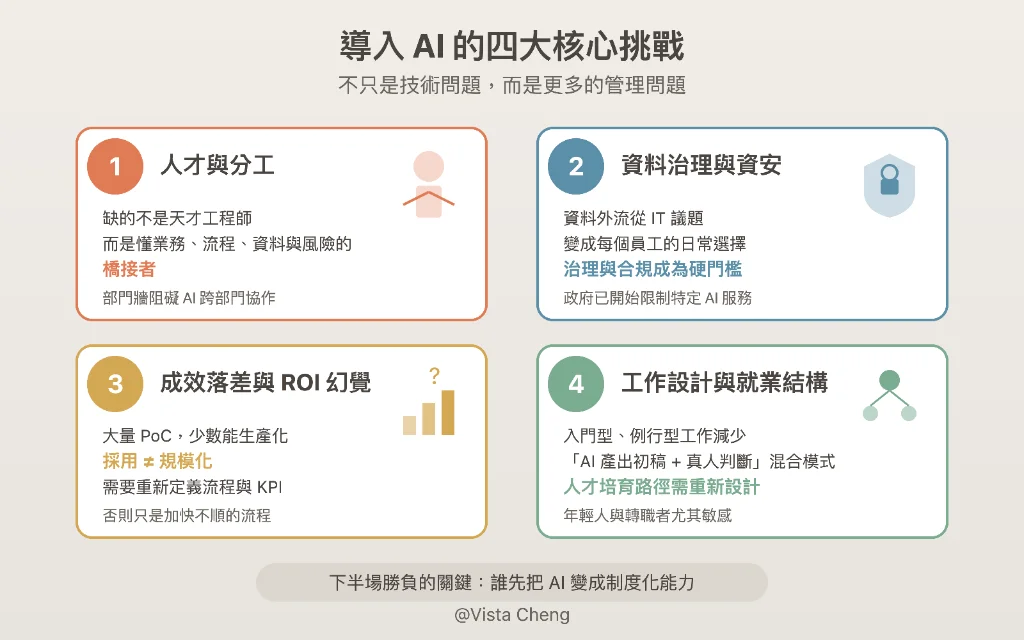 ▲ Four core challenges in introducing AI. (Photo/Provided by Zheng Weiquan)
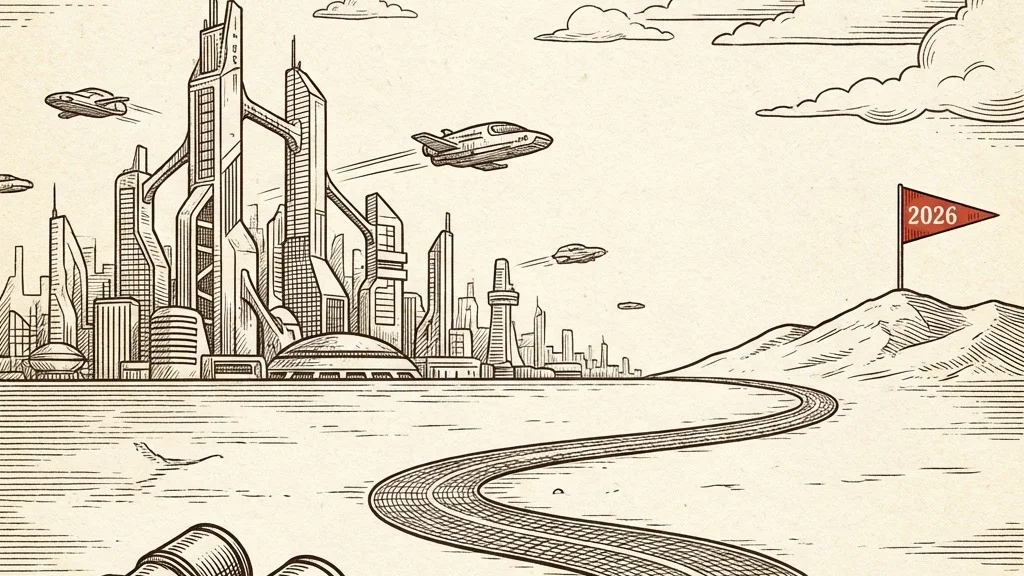
2. Looking forward to 2026: Agent-based AI rewriting work
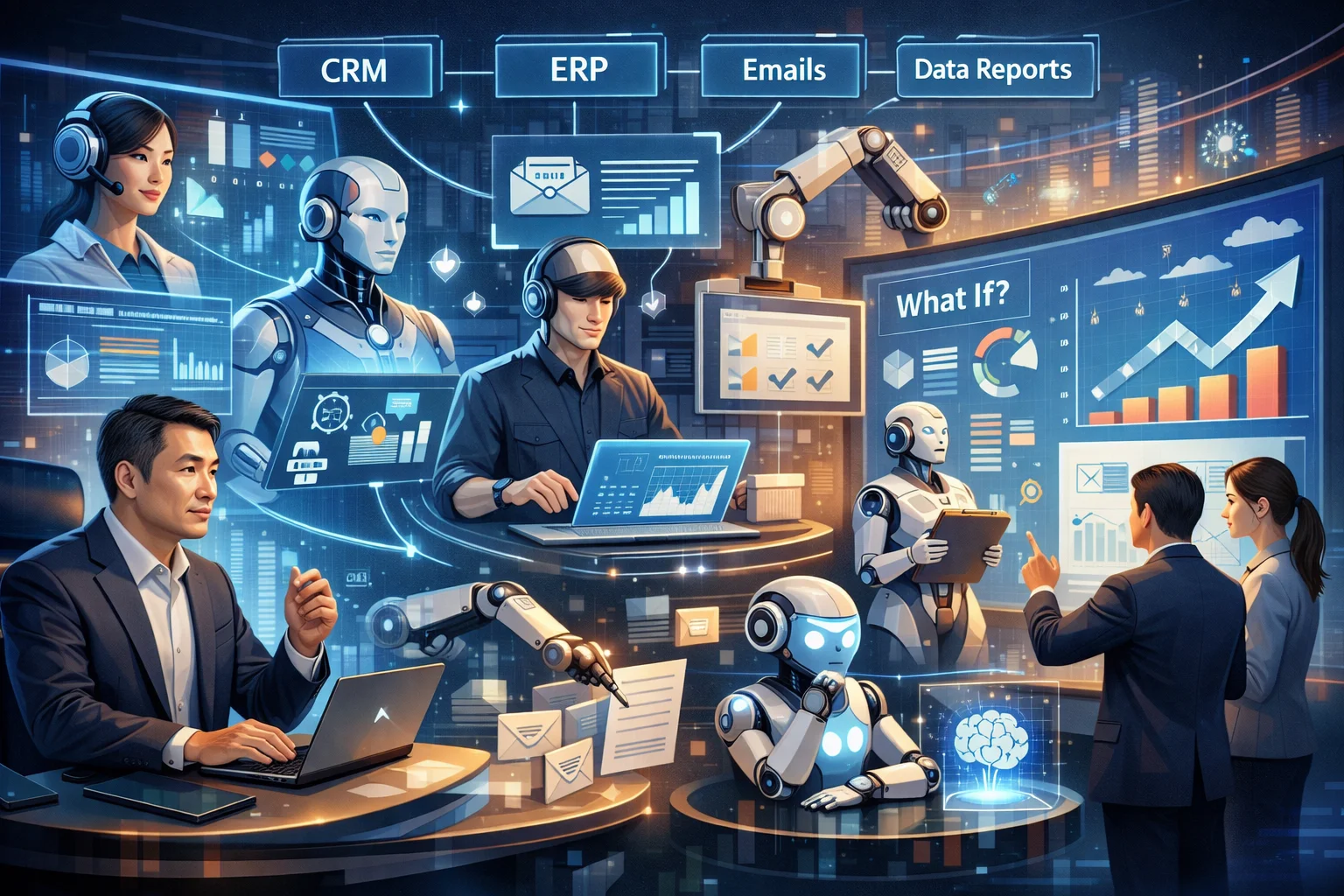
If I were to use one sentence to describe the key changes that are most likely to occur in 2026, I think AI will change from you instructing it to work to it actively helping you conceive and run processes. Having said that, this is the core of agent AI: it does not just reply to you with a sentence, but can dismantle tasks according to goals, connect tools, complete steps and report results, and even iterate independently within the scope of authorization.
When talking about AI trends in 2026, Microsoft clearly mentioned that AI agents will become digital colleagues; in other words, small teams can complete projects with the assistance of AI that would otherwise require larger organizations.
Big environment thrust
Judging from the overall figures, Taiwan’s tone next year may still be steady growth after a high base period. The Taiwan Institute of Research recently released economic forecasts, significantly revising the economic growth rate to 7.25% in 2025 and 3.46% next year. The Taiwan Institute of Technology believes that the effects of tariffs will be fully apparent next year, and the AI craze may cool down. The economy must be viewed with caution next year.
However, AI hardware demand, export orders and supply chain momentum are unlikely to disappear in the short term, but will continue to drive corporate investment.
However, external uncertainty will also amplify the importance of internal efficiency of enterprises. When the market faces volatility and competition intensifies, companies need to turn AI into predictable productivity. This will accelerate the introduction of AI in 2026 to a governance type, which means more care about how to move data, how to control permissions, how to pursue errors, how to divide responsibilities, and how to estimate results?
Three necessary upgrades for individuals
As we enter 2026, there will be a clear divide in AI capabilities in the workplace: on one side are those who treat AI as a faster typewriter, and on the other side are those who treat AI as a work system. The former can indeed deliver faster, but it can easily be tied; the latter can produce higher-quality strategies and more implementable processes in the same time.
- Upgrade 1: Questioning and defining abilities. Can you turn a vague request from a supervisor into a task that AI can perform? As agent-based AI becomes more prevalent, defining tasks will become more like a management skill: You’re not just giving instructions, you’re assigning work, setting standards, specifying output formats, and arranging validation steps.
- Upgrade 2: Verification and Responsibility Ability. AI will certainly become stronger, but it will not be responsible for you. In 2026, your value in the workplace will be more focused on how you judge right from wrong and how you take responsibility for decisions? In other words, trustworthy AI, governance frameworks and risk control will become more important.
- Upgrade 3: Collaboration and influence capabilities. When AI handles a large number of routine tasks, human work will be more focused on cross-department collaboration, communication, persuasion and consensus-building. In summary, AI may make your output faster, but whether you can get others to pay for it and make the organization willing to adopt it will determine your promotion and influence.
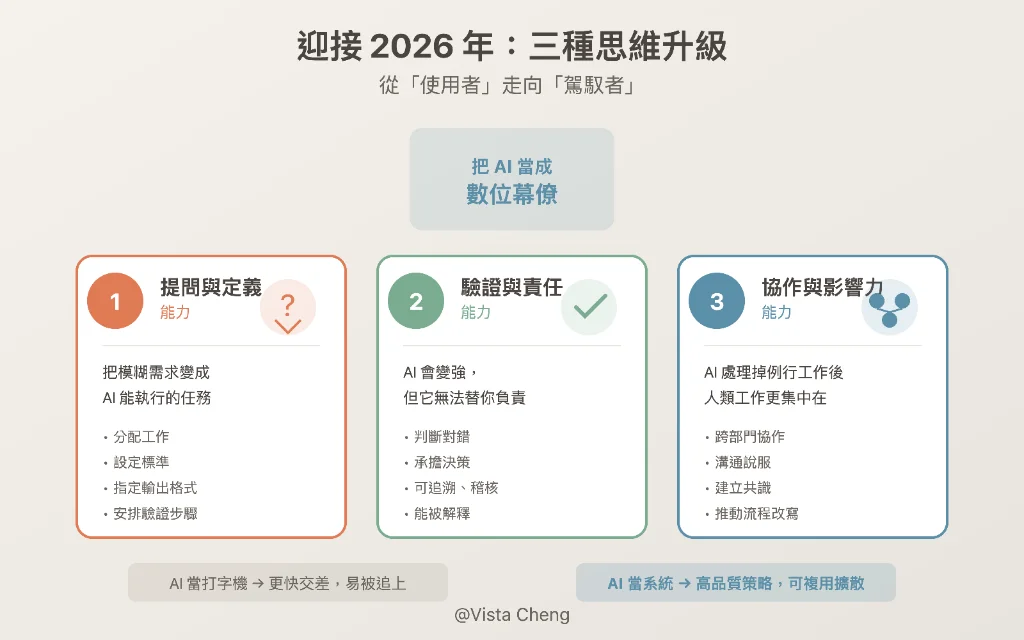 ▲ Welcome 2026: Three thinking upgrades. (Photo/Provided by Zheng Weiquan)
Must-do system construction for the organization
For many companies, most of the problems in introducing AI in 2026 will arise in the management field, rather than purely technical issues. According to my observation, companies will increasingly care about the following three things:
- Establish common AI work practices. When people from different departments and functions are using AI, if there are no common norms, AI may make the organization’s operations more chaotic. For example, the internal regulations of enterprises or public departments must at least answer: What data cannot be uploaded to the cloud? Which tasks require manual review? Which output requires citing sources? What decisions should not be made by AI alone?
- Turn AI into replicable process assets. Organizations that really run fast are because they have templated successful practices: they have precipitated good prompt words into SOPs, organized good data structures into knowledge bases, designed good review processes into checklists, and then encapsulated good agency processes into reusable task chains.
- Redesign work and talent cultivation paths. When AI can write the first draft of a plan and run routine tasks, then company executives must answer: How should newcomers learn? What kind of job do newcomers do? How does a supervisor lead new people? How to avoid the hollowing out of newcomers who only know how to use AI but don’t understand its principles? Therefore, next year will force small and medium-sized enterprises to upgrade their training from simply teaching tool operations to teaching methods and logical thinking.
Upgrade your thinking and rewrite your working methods
Looking back on 2025, I think AI in Taiwan’s workplace is progressing quite quickly and has completed the transition from novelty to daily use. Looking forward to 2026, AI will likely become a semi-automated digital workforce in the industry, allowing small teams to achieve results that only large teams could achieve in the past. Having said that, while this will certainly create new opportunities, it may also amplify new risks.
But we must also face it honestly: popularization of AI does not mean maturity, small-scale testing does not mean large-scale testing, and being able to use AI tools does not mean being able to manage AI.
Therefore, the key to whether you can turn opportunities into results in the end is actually very human. Please think carefully: have you turned AI into a replicable work method? Has your company turned AI into a system rather than just a tool? More importantly, have you upgraded from being able to use AI to being able to define, verify and be responsible?
The advent of AI is not to replace humans, but to force humans to evolve. If you treat AI as a digital partner, you will move faster; if you treat AI as a digital colleague, you can improve your efficiency; only if you treat AI as a system that needs to be managed, you will go long and steady!