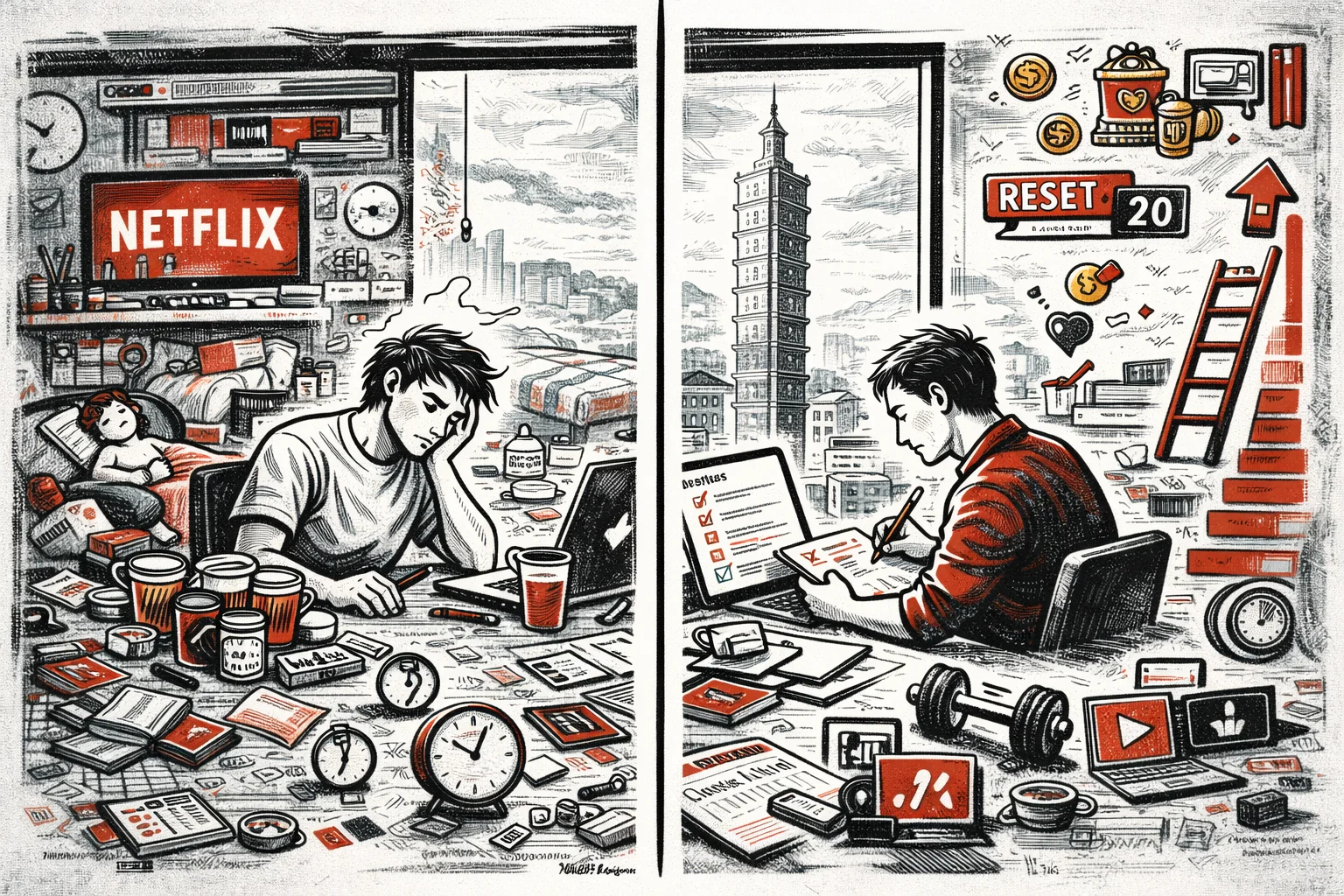
Dreams are not written for the future, they are written for you today: Experience from listening to Brother Fu’s "50 Dreams in Life"
While watching the live broadcast last night, I snickered silently in my heart: What best demonstrated Brother Fu’s spirit in this sharing was not that he talked about 50 dreams, but that he showed the spirit of an engineer from the very beginning and brought the system to the table.
He first confirms whether everyone has received the letter? If not, don’t forget to fish it out from the junk mail box; then take out the new e-newsletter system for a test run on the spot; even the seemingly chatty paragraphs like more than 1,500 people signed up today, and I guess only half of them are online, are actually demonstrating one thing - dreams are not created by emotions, but by processes.
I would like to give my experience from this lecture to my friends who also want to change but are often stuck. Because what Brother Fu shared on the surface was a dream; at the core, it was a very pragmatic philosophy of self-management: treat life as a project first, only then can you have a chance to turn dreams into results.
The question “me in five years’ time” is actually cruel, but very effective.
Brother Fu said that he entered the construction site at the age of 21 and worked as a construction site director for 5 years. At the age of 25, he began to think: “What will I look like in five years?” This sentence sounds very ordinary, but I think it is extremely cruel, because it forces you to do something that many people dare not do: use the appearance of a supervisor to predict your future.
He put it very bluntly: Looking at the supervisor in front of him, that is probably who he will be in five years. Do you like it? If you don’t like it, you have to change it.
What struck me particularly was what Brother Fu added: two years after he left, the original company actually collapsed. In other words - even if you don’t change, the environment will force you to change, but that kind of change is usually more painful.
This sharing is like a reminder to me:
Dreams are not used to decorate life, they are actually a kind of “risk management”.
When you write down the direction you want to go, you are preparing an extra path for yourself. Otherwise, the road is often forced to take turns.
What should I do if my family doesn’t support me? Brother Fu’s answer is very mature: replace impulse with a sense of responsibility first
Brother Fu talked about two career changes: construction site → insurance industry, insurance industry → entrepreneurship as a lecturer. Every time he asked his mother, she conservatively said not to change. This experience made me feel very sad, because in the process of growing up, I also changed many runways.
I love that he didn’t make this an inspirational drama. Brother Fu did not say the kind of chicken soup for the soul that sounds very inspirational: “My family stops me, but I still have the courage to pursue my dream.” Instead, he added the key conditions:
- Before changing jobs for the first time, he part-timed for 10 months to make sure he could do it;
- Before starting his second business, he also spent nearly a year preparing in parallel.
What this paragraph is actually about is: Your future does not need to be influenced by your family, but you must use actions to reduce the risk.
Otherwise, if you think you are chasing your dream, your family who loves you may only see that you are taking risks to bet on the future.
I often see a very common stumbling block at consultant sites: I clearly want to do something, but I collapse when I am opposed to it, because I am not sure whether I can do it.
The solution demonstrated by Brother Fu is very practical: first produce deliverable results, and then support from family, relatives and friends may gradually appear.
Evolving from 12 dreams to 50 dreams: there is actually a psychological mechanism behind it
He first wrote down a dozen dreams around 2000, such as: learning saxophone, going to Washington DC, publishing a book, crossing Sun Moon Lake, climbing Jade Mountain, and cycling around the island… Some of them were later completed, and some were delayed for 26 years (such as climbing Jade Mountain and circling the island).
I think there is a very important insight here:
Unfinished does not mean that the dream is useless; on the contrary, it means that the dream will help you reveal the truth of your life.
Just like climbing Yushan Mountain, it is a weekend trip for many people, but for him it has not been unlocked for many years - the reason is not ability, but time and situation do not allow it, because he wants to take his daughter to complete it together. This reminds me: Many people think that they procrastinate because what they want is not the thing itself, but the meaning behind the thing.
If you also have that kind of dream that is obviously not difficult but has never been achieved, don’t be too quick to scold yourself. You can ask first:
Is it because I’m holding off on doing it because I’m actually waiting for a better script?
I heard the part about the trough very deeply: Don’t build your dreams when things are going well, but take action when you can’t hold on.
Brother Fu talked about the lowest point in his life: there were only 5 students in the open class in the early days of starting a business, his family was sick, the relationship with his girlfriend was under pressure, his dog was gone, his car was stolen… Hearing this, I was actually a little moved.
My life is also very difficult, but there will always be a bright future. Many people will tell you that the stories of successful people are difficult to copy, but when listening to Brother Fu talk about his past experiences, it really feels like an ordinary person has actually gone through it.
Then he said that he went to fortune telling, asked gods for divination, went up the mountain, and finally came home, took out post-it notes and filled the bookcase with them, and wrote down 50 dreams in life.
At that moment I suddenly understood: Dreams are not romance, but self-help.
What you lack most when you are at a trough is not more truth, but finding the coordinates of where you want to go.
The second you write down your dream is like lighting a small lamp in the dark - you may not be able to walk out immediately, but at least you won’t go around in circles.
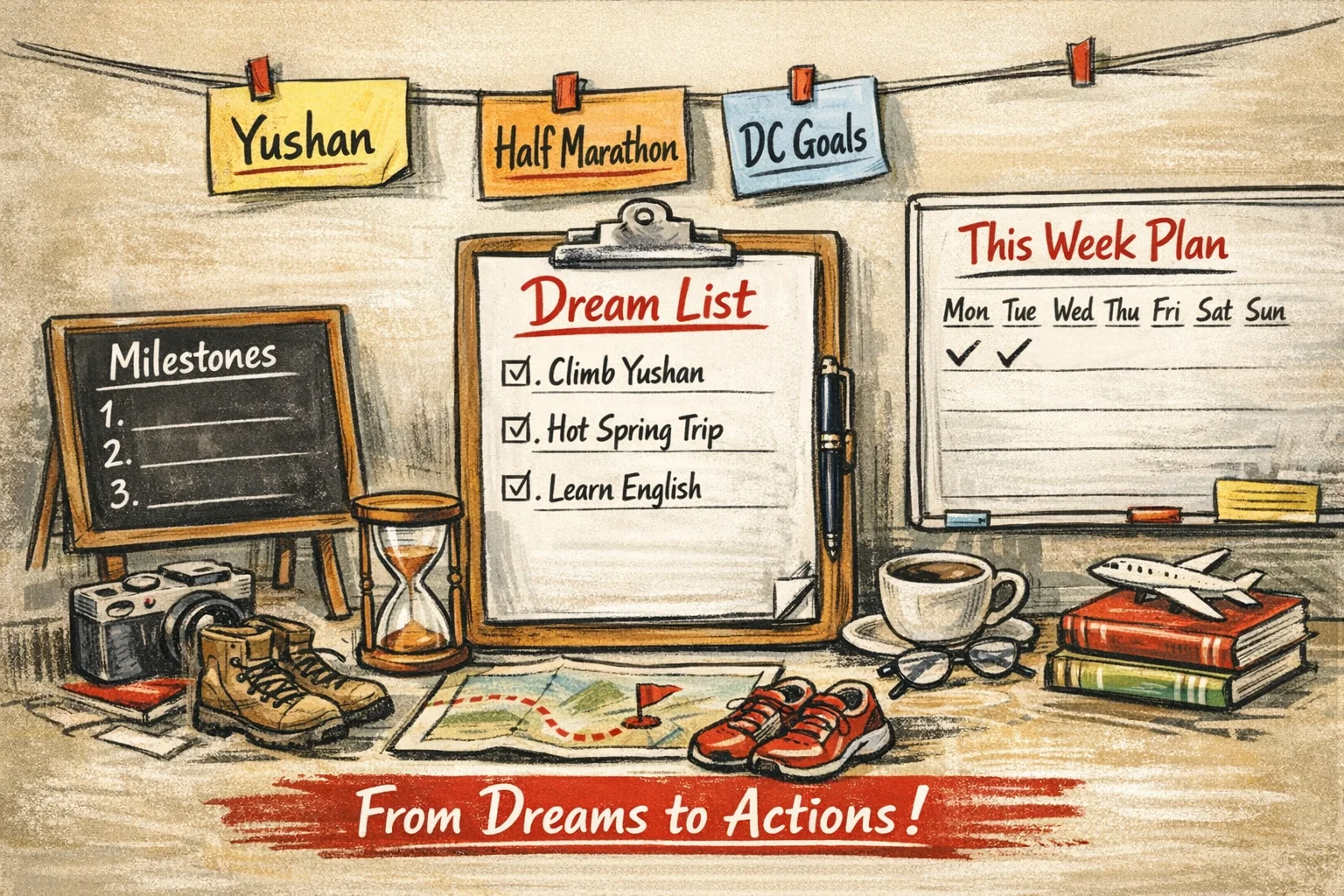 ▲ A dream is not chicken soup for the soul, but a set of converters from wish fulfillment to schedule
What excites me most is not the 80% achievement rate, but the dismantling of dreams into executable granularity.
Fogo took stock of the 10 years with the 2015 version of 50 Dreams, completing 40 so far. This number is certainly impressive, but what I care more about is: his ambition can be quantified, but measured with granularity.
For me, who used to be a product manager, Fu Ge’s approach is very similar to that of product or project management:
- Write 50 dreams first (don’t be afraid of too many, open your imagination first)
- Pick 5 out of 50 every year
- Condensed into 3 annual highlights -Write a weekly plan every week -Write down the 3 most important things every day
- Use Pomodoro to divide your attention into 25-minute units
You see, this is not chicken soup for the soul at all, it is a set of converters from wish fulfillment to schedule.
I create content, write books, and also perform consulting projects for companies. What I fear most is when clients spread their hands and say with a grimace: “I really want to do it, but I don’t know what to do today?”
Fu Ge’s system deals with the most common gap: the dream is too big and today is too small.
The reason is simple. If you don’t break down your dreams into smaller pieces, each day will always be swallowed up by a bunch of unexpected chores.
The “Magic Lamp Test” is funny, but very useful: it forces you to write your dreams more like dreams
He complained that many people write about their dreams, but in fact they are just writing a running account, or recording their habits: drinking water every day, reading a book every week, learning English every day…
He said if the magic lamp giant stood in front of you, would you make a wish “I drink water every day”? Of course not.
This metaphor is humorous, but it actually teaches us: write your dreams as results, not as methods.
- Not “exercise every day”, but “be healthy and physically fit enough to complete a half marathon”
- Not “Learn English every day”, but “Be able to complete a full English speech/Conversate freely with foreigners”
- It’s not “read a book every week”, but “become a person who can export opinions in a certain field”
Well, if you write your dream correctly, you will know what your hard work will look like.
Three action proposals I take away (I will actually do them)
Finally, I want to turn this sharing into three actions of my own:
Action 1: Write 50 items before the Lunar New Year. Don’t seek perfection, seek completion.
First use quantity to drive yourself and open your heart. Don’t try to write beautifully from the beginning. It’s normal to be unable to write because you haven’t negotiated with yourself for too long. As a result, last night I wrote out 50 life dreams.
Action 2: Immediately select from 50 and only make 3 this year
Don’t be greedy. 3 pieces is fine. The reason is simple, because being able to do it is more important than being able to write it. Brother Fu said that he should pursue three big dreams in one year and thirty in ten years. This is a rhythm that can be used for long-distance running.
Action 3: Take apart one of your dreams and take the first step this week
Not next week, not next month, but this week.
Even if it’s just opening a file, making a phone call, finding a coach, buying a plane ticket, or signing up for a class… as soon as you turn the first step into an executable task, you are already breaking up with your past self.
My favorite phrase from Brother Fu is “Don’t be a dick anymore”
At the end of many speeches, we are inspired by what the speaker shared. However, the end of the short-term passion is that it will be the same the next day. Brother Fu also knew it, so he kept shouting in the end: “No more.”
After listening to it, I was actually very impressed:
The real difference is never “how much you listen”, but “whether you are willing to start doing a little bit”.
You don’t need to become a new person all at once, you just need to be more responsible every day than you were yesterday.
If I had to sum up this sharing in one sentence, I would say:
Dreams are not written for the future, they are written for you today to decide where you want to spend your time next?
Dear friends, let’s work hard together!
Further reading:
- From Chaos to Conquest: A personal transformation blueprint to completely turn your life around
- Effective time management: eat the frog first
- AI as my editor: A writer’s experiment in human-machine collaboration