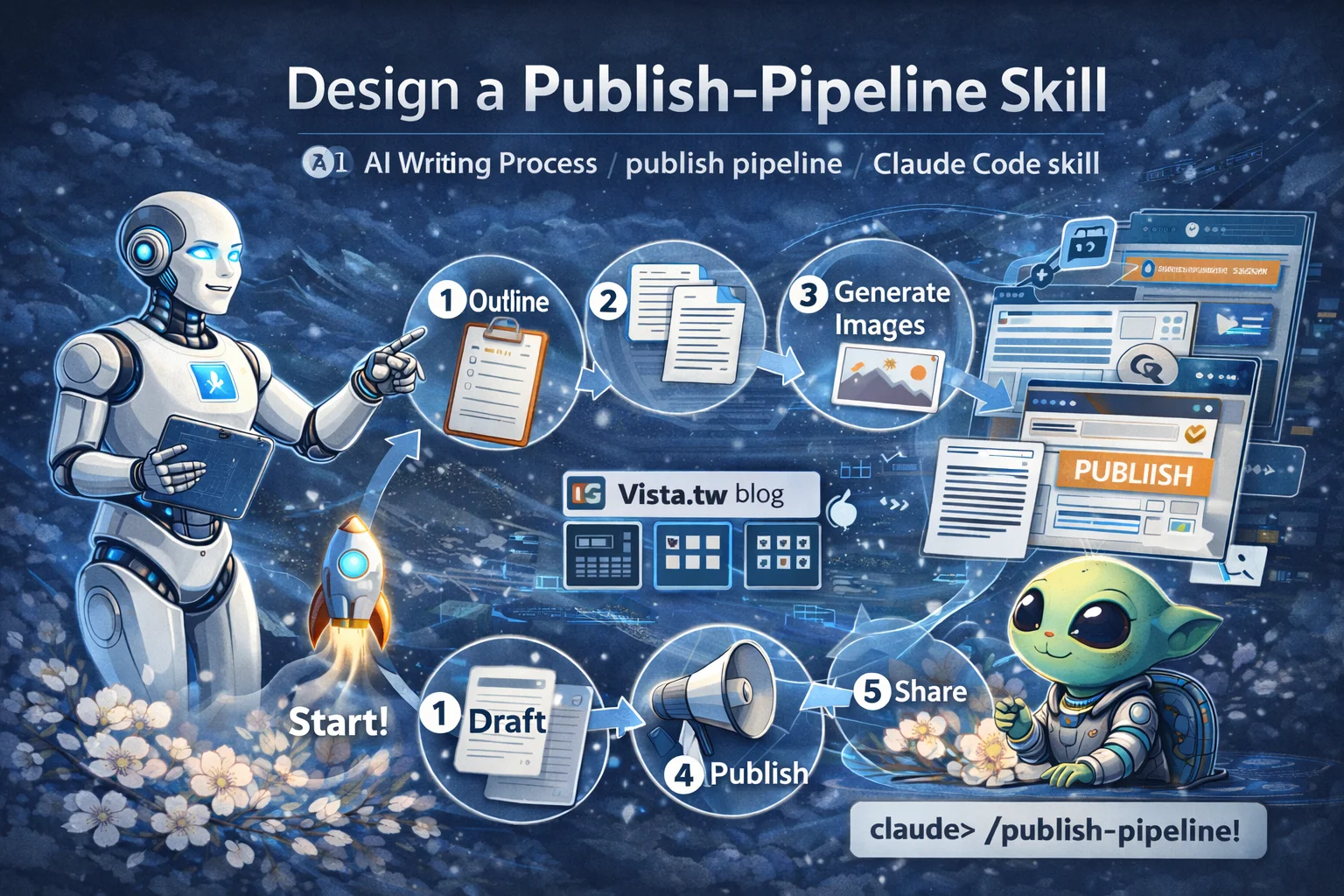
How I designed an AI publishing pipeline: 6 stages to shorten article writing from 4 hours to 40 minutes
Have you ever calculated how long it takes to publish an article yourself, from the idea to the actual launch? I designed an AI writing process to compress this time from half a day to 40 minutes.
According to the Orbit Media 12th Annual Blogger Survey, writing a blog post in 2025 will take an average of just under three and a half hours. This number is rising year by year, and it does not include SEO optimization, social distribution, image processing and other trivial matters before and after release. Taking this into account, it often takes half a day for an article to go from being conceived to actually reaching readers.
But what’s more noteworthy is that most people’s time is not spent where it is most valuable. Researching, thinking, and polishing ideas—these links that determine the gold content of an article are the easiest to compress.
If AI could handle the legwork for me, would I be able to spend all my time thinking about ideas and telling stories?
Recently, I lectured and taught outside for three days in a row - on Friday I taught two online classes for the School of Public Service and Human Resources, on Saturday I went to [School of Communication, National Chengchi University] (/blog/ai-meets-communicators-nccu-ema) to share, and on Sunday I helped friends create web pages and make e-book list magnets. I was exhausted when I got home every day. I turned on the computer and wanted to write my own article, but I didn’t even have the energy to research the information.
For me, writing articles is not difficult, but sometimes I am too tired and have no energy left.
The bottleneck of a person’s career is often not ability, but the allocation of time and energy. I can write, teach, and consult, but I can’t do everything at the same time. So I spent a few weeks designing an AI publishing pipeline, splitting the article writing process into six stages. 4 of the stages are completed by AI autonomously, and I only need to intervene at 2 key nodes.
In this article, I want to dismantle the design ideas of this system for you to see.
Let’s clarify one thing first: this is not about letting AI write articles for you.
When I talk about the AI publishing pipeline, many people’s first reaction is: So all your articles are written by AI?
No.
I previously wrote an article 〈When AI-feeling articles are flying all over the sky〉, which talked about the content battlefield in the AI era that has changed its scoring standards. Neatness, integrity, and smoothness are no longer moats, because AI has flattened them. What is truly irreplaceable is the friction mark, the cost of your stance, the verifiability of your approach, and the authenticity of your tone.
The design principle of this assembly line is based on this understanding: let AI do the assembly line and leave your manpower to the forge. **
Opinions, stories, judgments—these are Forge jobs that only I can do. Research organization, format processing, SEO optimization, community rewriting - these are assembly line tasks, and AI can do them quickly and well.
For example, the chef determines the aesthetic judgment of the menu, seasonings, and presentation; the kitchen assistant is responsible for washing, cutting, and preparing ingredients. Both are indispensable, but the division of labor must be clear.
Why do we need pipeline instead of one-time prompt?
You may ask: Wouldn’t it be better to just give ChatGPT a Prompt and let it write an article?
Yes, but quality and efficiency will be compromised.
**A single Prompt cannot handle multiple tasks. ** Research and writing are completely different modes of thinking, as are SEO optimization and literary polishing. Cramming it all into one Prompt is asking someone to be a reporter, a writer, an editor, and a marketer all at the same time—doing each role half-assedly.
**You have no checkpoints. **If the direction of the article generated once is wrong, you have to start it all over again. A staged process allows you to make adjustments as soon as the first draft is complete, with subsequent stages building on the revised foundation.
**You cannot reuse. ** The prompt for today’s teaching article will not apply when writing an opinion article tomorrow. But each stage of the pipeline is an independent module and can be combined freely.
This concept is called Separation of Concerns in software engineering. Each module is only responsible for one thing and do it best.
6 stages of design logic
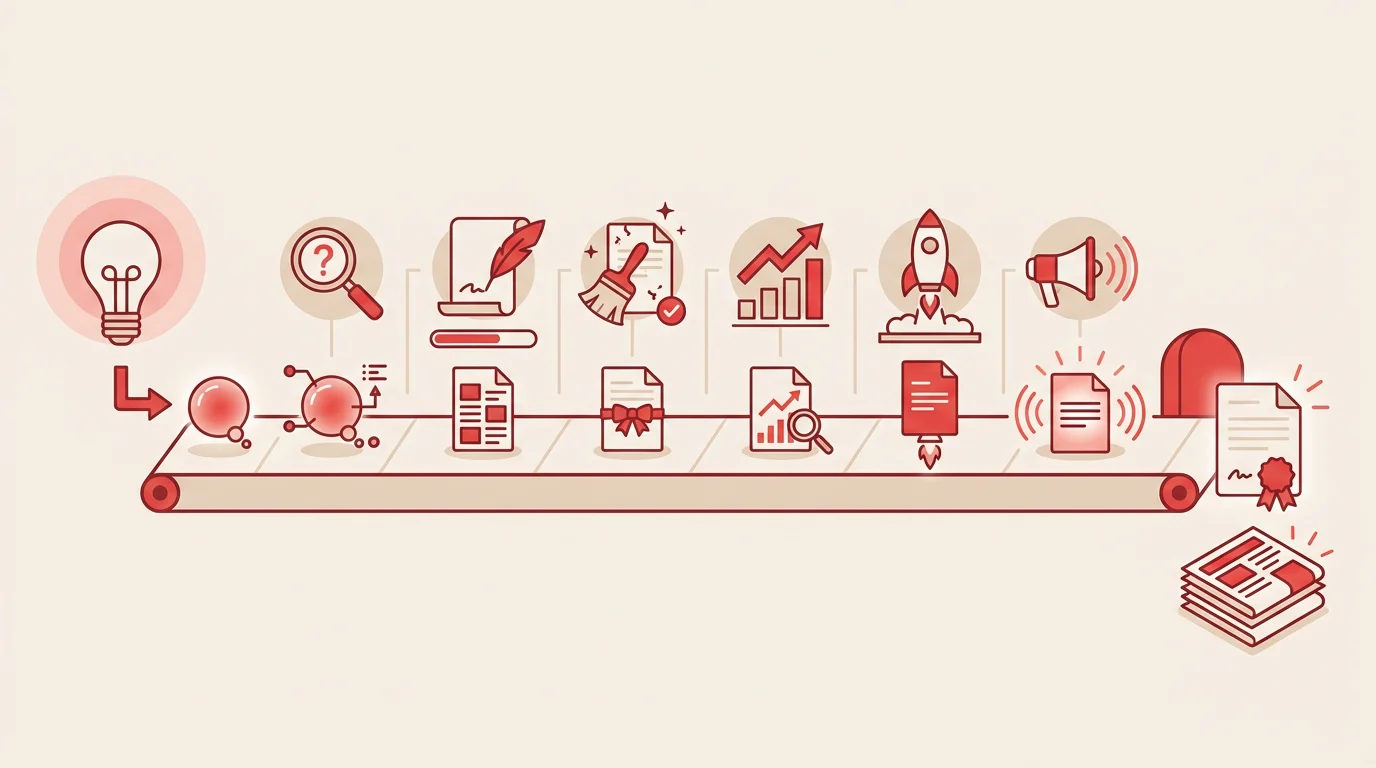 ▲ 6-station pipeline from ideation to distribution: Research → Writing → Polishing → SEO → Deployment → Distribution
Stage 1: Research (AI Autonomy)
What to do: Search 5-10 sources on your topic, extract key facts and figures, and organize them into a concise research summary. Also search existing articles on my website to find old articles that can be linked to each other.
Why it’s designed this way: Research is the most time-consuming step but is increasingly skipped. Let AI do this first, and what I get is not a blank piece of paper, but a package of materials that has been sorted out.
Design Principle: Research abstracts should be limited to 500 words or less. Too long will interfere with subsequent writing - information overload is more dangerous than insufficient information.
Stage 2: Writing (AI-led → human review)
What to do: Produce a complete first draft based on the research abstract and outline. Includes article structure, opening story, argument development, and conclusion.
Why Checkpoint: This is the first critical node. Once the direction of the article is distorted, no matter how much polishing is done later, it will not be able to save it. I will look at three things here: whether the core ideas are correct, whether the argument is logical, and whether there are important aspects missing.
Design Principle: When AI writes the first draft, it will be loaded into my Writing Style File - the tone, word usage habits, and sentence rhythm are all clearly standardized. The first draft produced in this way is already 70-80% like what I wrote.
Stage 3: Editing (AI independent) - the most critical part of the entire system
What to do: The three-pass polishing method. The first pass scans and replaces AI flavor terms—empty beginnings, formulaic transitions, and false intimacy. The second pass marked the places where I needed to fill in my personal story. The third pass is the final calibration against the style file.
Why this is the most critical link: The biggest problem with articles written by AI is not that they are poorly written, but that they are written too much like AI. It reads correctly but without feeling, smooth but empty - just like what I described in that article, a cup of coffee without caffeine.
AI can imitate spoken language, but it is difficult to imitate the costs you have spent and the traces of time you have passed. Therefore, the core of the drafting stage is not to correct typos, but to find those nodes that need to be infused with real experience - your cost list, scenario list, decision list - and then leave marks for you to fill in yourself.
This is the key design of the entire system: **AI is responsible for polishing the article to 80 points, but the 15 points from 80 to 95 must come from real friction marks and stance costs, which only I can make up for. **
Give an example. A while ago, I used this system to write an article about AI and communicators. There was a paragraph in the first draft of AI that read: “AI is changing the rules of the game in the communication industry, and practitioners need to embrace new technologies.” The structure is correct and the logic is okay, but it reads empty. Later I changed it to: When I was giving a speech at National Chengchi University’s EMA, a student in the on-the-job class raised his hand and asked me - “Teacher, are we traditional media people going to be eliminated?” At that moment, the classroom was quiet for three seconds. The same point of view, but with the addition of time, scene, and those three seconds of silence, the entire text comes alive.
Design Principle: AI flavor scoring target ≤ 3/10. If you exceed it, you have to run again.
Stage 4: SEO optimization (AI autonomous)
What to do: Check whether the title contains keywords, whether the meta description is of appropriate length, whether the H2 structure contains secondary keywords, whether internal and external links are sufficient, and whether the image alt text is complete.
Why let AI be autonomous: SEO is a highly rule-based job that requires little to no human judgment. What needs to be done is clear, and if it can be done, it can be done.
Design Principle: SEO optimization must never sacrifice readability. If it makes the sentence awkward to stuff in keywords, then don’t stuff it in.
Stage 5: Deployment (AI autonomous)
What to do: Confirm that the image format is correct (WebP), git commit, git push, and perform incremental build and deployment.
Why let AI be autonomous: The deployment process is a fixed SOP and does not require human intervention at all. I even wrote a dedicated deployment check skill to ensure that the same steps are followed every time.
An important detail: My site has over 8,500 files and it takes 5-8 minutes to build at full capacity. So I specially designed an incremental build script to build only the changed parts, which takes about 40-60 seconds to complete. This small detail makes the entire assembly line feel much faster.
Stage 6: Community distribution (AI output → human selection)
What to do: Rewrite published articles into versions for 5 platforms - Facebook (story type), LinkedIn (professional insight type), X/Twitter (refined sentences), Threads (easy conversation type), and e-newsletter (traffic type).
Why is this the last checkpoint: The language sense and audience expectations of each platform are different. AI can produce the first version, but I need to choose which ones to publish, how to publish them, and when to publish them. This is a marketing judgment, not word work.
Implementation architecture: built with Claude Code Skills
The underlying technology of this pipeline is Claude Code’s Skill system. Skill is a Markdown file stored in the project directory, which defines how AI can complete specific tasks step by step.
/publish-pipeline [theme]
Enter this line of instructions, and the AI will automatically go through the entire process.
The structure looks like this:
publish-pipeline (general commander)
├── deep-researcher (Stage 1: Research Methodology)
├── blog-writer (Stage 2: Writing specifications + style)
├── content-refiner (Stage 3: Remove AI flavor)
├── seo-optimizer (Stage 4: SEO Checklist)
├── deploy-checker (Stage 5: Deployment SOP)
└── content-distributor (Stage 6: Multi-platform rewrite)
Each sub-Skill is an independent module that can be used alone or linked together by publish-pipeline. This is the power of separation of concerns - each module only does one thing, but combined it is a complete production line.
Three design decisions that are still correct looking back
In the process of designing this system, there were several decision points that made me hesitate.
Decision 1: Only have 2 checkpoints, not 6
At the beginning, I wanted to set up checkpoints at each stage to confirm step by step. But after actually running it several times, I found that too many checkpoints interrupted the rhythm of the process. Later, I only kept two: confirmation of the direction of the first draft (after Stage 2) and filling in personal stories (after Stage 3). At other stages, the AI’s judgment is good enough.
**Principle: People only intervene where judgment is needed and not where execution is needed. **
Decision 2: Use file management for writing style instead of using Prompt to describe each time
When many people use AI to write, they will write a long description in the prompt, please use a warm and friendly tone. There are two problems with this approach: it requires rewriting every time, and it tends to drift.
My approach is to write the style definition into a separate Markdown file (writing-style-profile.md), which records the tone, person, sentence structure, and word usage conventions in detail. AI will automatically load this file every time you write.
It’s like a brand manual—rather than stating the brand ethos verbally at every meeting, it’s written down as a document and everyone follows it.
Decision 3: Support mid-entry and quick mode
Not every article needs to go through 6 stages. Sometimes I already have a draft in hand and just need polishing and SEO; sometimes it’s time-sensitive content and doesn’t require in-depth polishing.
So I designed two elastic mechanisms:
- Enter midway: You can specify to start from any stage
- Quick Mode: Skip the polishing stage and go directly from writing to SEO
The entire system is not a rigid process, but a set of toolboxes that can be flexibly scheduled.
Actual effect
After running this system for about a month, the output rhythm has changed significantly:
But the most valuable change is not speed, but a structural shift in the allocation of time.
Before, 70% of my time was spent doing non-creative things like formatting, deploying, and distributing. Now, I spend 80% of my time doing research, thinking, and writing my opinions. In the words of that article: I finally moved the manpower from the assembly line to the forge.
**The value of the system is not to allow you to do more, but to allow you to spend time on irreplaceable things. **
Take today as an example, I used this pipeline to produce two articles. During the entire process, AI automatically completed the research, first draft, SEO inspection and deployment. I only spent time doing two things: confirming the direction of the first draft, and filling in my own teaching field experience. Putting the two articles together, my manual time is about less than half an hour. If it were done in the past, just one article would take an hour or two.
You can also build your own pipeline
You don’t need to copy my architecture. If you want to build your own AI release pipeline, start with these steps:
-
Record your current process first. List each step you take to publish an article, labeling which ones are judgments and which ones are executions.
-
Automate the most painful part. Don’t build the entire line at once, hand over the most time-consuming part to AI first. For most people, research and community distribution are the best places to start.
-
Create your style profile. Spend 30 minutes writing down your writing style (voice, idioms, structural preferences) and this profile will significantly improve the quality of any subsequent AI output.
-
Design checkpoints, but not too many. 1-2 is enough. People are responsible for direction, and AI is responsible for execution.
-
Create your irreplaceable material library. Cost list, scenario list, decision list - these three lists are the fuel for you to remove the AI smell, and are also the key raw materials for the entire pipeline to eventually produce human-like content.
If you are already using Claude Code, you may wish to consider using the Skill system to implement it. If you are not familiar with it, you can refer to the Vibe Coding article I wrote before to learn how to use natural language to collaborate with AI for development.
Write at the end
I have always believed that one person can have the production capacity of an entire content team. But the premise is not to work harder, but to design the system smarter.
This publish pipeline changed my understanding of writing. The core of writing is never typing. It’s observation, thinking, judgment, and storytelling.
When you leave things other than typing to the system, you will have time to think and speak well.
而那些好好想过、好好说出来的东西,才是读者真正想看的。
If you also want to build your own AI content production system, not only to write faster, but to leave time for really important thoughts and opinions, welcome to join my AI content production system workshop. I will take you from scratch to design an assembly line that belongs to you.