
I am also a biter and vampire clan
Recently, due to my job, I have begun to pay attention to things related to the moon. Although the moon has wax and wane differences, I have a special preference for the full moon. I participated in painting competitions when I was young. For me, the ”○” symbol has always been the moon, not the sun. At that time, I especially liked the weird combination of moonlight in the dark night and fluorescent raincoats. As for why I had such a weird color preference, I only remember it now in retrospect. It must be the experience of going to a convenience store to buy tea eggs in the middle of the night on a rainy day.
The moon has a special meaning to me, because I have been a loyal viewer of cult films (Note 1) about vampires and werewolves since I was a child, not to mention Freddy in “The Night of the Night” and Jason in “Friday the 13th” who are serial killers who come to kill you instead of the moon. They are my best companions on summer nights besides beer. Those faceless murderers who appear when the moon is dark and the wind is high, that is, when the moon is covered by dark clouds, most of the murders are done without distinguishing between good and bad. Their consistent behavior pattern is to kill, kill, kill. There are no so-called good guys or bad guys in this type of movie (are they the bad guys if we go camping together or have a party at a friend’s villa?). The only difference is the difference between dying early and dying late, although generally speaking, timid people die faster.
The horror aesthetics of zombie movies
Zombies (or zombies) are another more special type of cult. The one that impressed me most was the one created by George A. Romeo in 1968. “Night of the Living Dead” (Note 2) directed by Romero, the living zombies are just a group of people (no! It’s a group of corpses) without will at first, attacking and biting straight towards someone. They are not powerful and not fast, but because they are contagious, all the people bitten by the living zombies will become living zombies again and join them. This feels like a kind of collective bullying (I became a member because I was afraid of being beaten again). Surrounded by living corpses, the survivors could only stay in the house, waiting for rescue, listening to the news, and slowly consuming food and water. But with limited resources and unlimited desire for survival, there must be constant conflicts in a small space. Therefore, the living corpse movie as a whole was like watching a group of people commit suicide slowly, like a group of rats in front of you gradually approaching your feet from the sewer, but! But they always keep a distance. You confront them with weapons at first, then doze off and suddenly wake up, and finally decide to drag your tired body towards the group of rats.
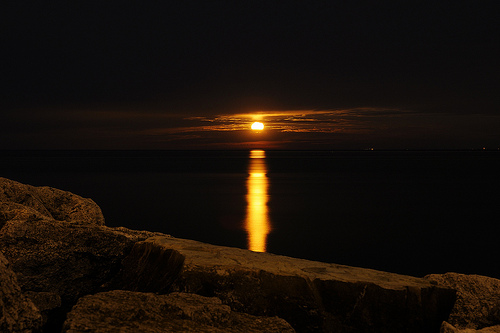
Moon rising: A Day After Supermoon. Photo by kaybee07
From Western zombies to Eastern zombies
In my movie-watching experience, the cultural phenomenon corresponding to Eastern (or Chinese-language movies) should be the zombie movies that were very popular in Hong Kong in the 1980s. Represented by Lin Zhengying’s “Zombie Taoist” series. Zombies in movies always wear Qing Dynasty official uniforms and stretch their arms forward. They usually jump forward, but the arms of living zombies can be extended at will and walk in a similar to human form. Moreover, as long as you stick the talisman on the zombie’s forehead, you can make the zombie sleep without moving. If you are chased by a zombie, you only need to stop breathing, and the zombie will not notice you. According to Chinese notebook novels, the legend of zombies appears most frequently in western Hunan, and it is said that it may originate from the local legend of exorcism. The modern theory is more inclined: because the local roads are narrow and can only accommodate one person walking, in order to transport the deceased, the two corpse drivers actually used two long bamboos to pass through a row of corpse sleeves to carry the corpse on their shoulders. The two ends were then carried by strong men like sedans. However, because the corpse drivers were dressed in black at night, It is naturally difficult to see, and because bamboo is elastic, when the corpse is carried by the corpse chaser, the corpse will swing up and down, so the image of zombies jumping with outstretched hands appears. At night, it looks like a group of people stretching their hands and jumping forward with straight knees. Therefore, the legend of corpse chase spread like wildfire.
With the recent “Evil Dead”, zombie movies have evolved from the chronic fear of the past to a feast of visual pleasure. With the blessing of 3D technology, giant screen IMAX and nine-headed beauties, the game adaptation has allowed the zombie corps to start to stand on the sunny stage openly and become a strong movie in theaters. The image of Chinese zombies has begun to approach Western vampires. For example, in the 1998 Hong Kong ATV TV series “A Date with a Zombie”, zombies have been portrayed as invincible characters like supermen and have various superpowers. They have changed their previous image of wearing clothes and started to wear fashionable clothes and fall in love with humans. What’s more important is that the original role of collecting monsters and slaying evil spirits has adapted to the urban atmosphere of Hong Kong and changed from a Taoist man with an eyebrow, Mao Xiaofang, to a hot model, Ma Siu Ling. After “The Twilight Saga”, not only were vampires not afraid of the sun, but werewolves also joined the “human world” to talk about love triangles. The originally forbidden blood-eating demon began to become the idol of boys and girls. This should be something the founders of Underworld never expected.
Note 1: According to Tang Zhenzhao, cult films refer to films that are loved and respected by supporters in a small circle. They can also be called non-mainstream films, experimental films, and alternative films. It is not a movie genre, nor is it a movie style. It is characterized by small production, cheap B-level movies, a vulgar, low-level, artificial, exaggerated image style, and the integration of science fiction, horror, music, animation, comedy and other elements (see Tang Zhenzhao, Hong Kong movie Blood and Bone). Note 2: “Night of the Living Dead” is an independent black-and-white horror film directed by George A. Romeo in 1968. The director made the film at a low cost of US$114,000. However, when the film was re-released in theaters more than ten years later, it earned approximately US$12 million in box office revenue in the United States and an estimated US$30 million in global box office. “Night of the Living Dead” was strongly criticized at the time for its overly realistic content. Thirty years later, the U.S. Library of Congress listed the film with other films in the National Film Registry on the grounds of “historical, cultural, or aesthetic importance” (see Wikipedia).