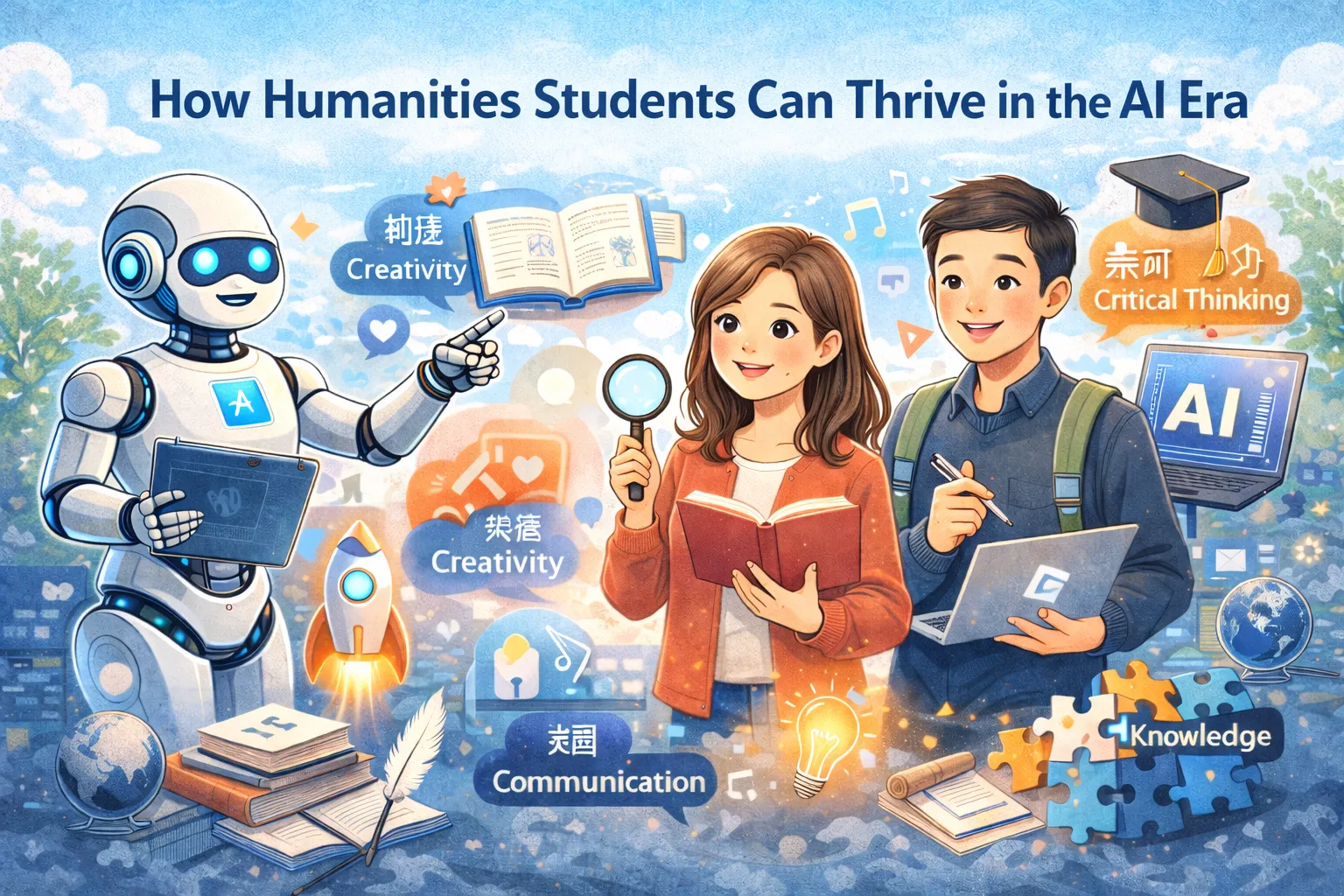
How can liberal arts students gain a foothold in the AI era? Your strengths are stronger than you think
In recent years, I have often had the opportunity to teach in the Chinese, Taiwanese, or Foreign Languages departments of universities. Every time I interact with those cute college students, I can always feel the uneasiness in their eyes.
“Teacher Vista, I am studying in the Chinese Department. Now even the translation job is almost taken away by AI, what else can I do?”
This is a question a student asked me privately after the workshop last month. There was anxiety in her tone, and a bit of reluctance.
I’ve heard this question more and more frequently recently. Not only students and practitioners in the Chinese Department, but also in the Department of Foreign Languages, History, Sociology, and Philosophy are all asking similar questions: In the age of AI, do liberal arts students still have a future?
My answer is: yes, and it may be better than you think.
In fact, humanistic heritage is very important in modern society. Even if you want to collaborate with AI, communication and expression skills are indispensable. But the premise is that you have to put down a wrong assumption first.
That assumption that makes liberal arts students anxious is actually wrong.
The anxiety of most liberal arts students comes from a widely circulated statement: “AI will replace repetitive knowledge work, and liberal arts students will bear the brunt.”
这话听起来很有道理,实际数据也确实令人不安。 According to reports, the share of translation jobs has dropped by 64% over the past decade, from 1.1% to 0.4%. Many universities around the world are eliminating humanities departments. From Leiden University in the Netherlands to West Virginia University in the United States, humanities enrollment and employment are shrinking.
But there is a key logical flaw here: what is replaced is not the identity of “liberal arts student”, but “output that can be standardized.”
The reason why translation work has been affected is not because it belongs to the liberal arts, but because the task of “converting language A into language B” has been made “usable” by AI. The same logic also applies to simple copywriting, basic data collection, and standard report generation.
In other words, what is really being replaced is the work of the “execution layer” rather than the ability of the “thinking layer”.
The core value of liberal arts training lies in the thinking level.
The three hidden advantages of liberal arts students are even more scarce in the AI era
Let me break down what liberal arts training gives you, and why these things become more valuable in the AI era.
First, critical thinking: the ability to question that AI cannot do
The core of liberal arts training is not to memorize knowledge, but to learn to question knowledge.
When you read a paper, your first reaction is not “So that’s the case”, but “Are there any loopholes in this argument?”, “What is the author’s position?”, “Under what conditions is this conclusion valid?”
This way of thinking is the hardest thing for AI to do.
AI can generate content that seems to make sense, but it doesn’t actively doubt itself. It doesn’t ask “Is this answer really right?”, let alone “Wait, you asked the wrong question.”
当 AI 能够快速产出大量「看起来还不错」的内容时,能够分辨好坏、找出问题、提出更好问题的人,就变得格外珍贵。
Deloitte’s 2025 survey found that both younger generations and business owners are placing increasing emphasis on soft skills, particularly critical thinking and adaptability. Because in the AI era, there are many people who can operate tools, but there are very few people who can judge the quality of the tools’ output.
Second, the ability to deal with ambiguity: finding direction in gray areas
Liberal arts students are often criticized for “there is no standard answer to what they learn.” But this is actually an advantage.
We live in a world full of ambiguity. There are no right answers to business decisions, there are no formulas for interpersonal relationships, and social issues are too complex to be simplified. Liberal arts training is to cultivate your ability to “still make judgments when there are no standard answers.”
When you read history, you learn to “understand events from multiple perspectives”; when you read philosophy, you learn to “still be able to reason when concepts are vague”; when you read literature, you learn to “understand the underlying meaning and emotional context.”
These capabilities have become even more important in the AI era. Because AI is good at dealing with clearly structured problems, it is often at a loss when faced with situations that are fuzzy, complex, and require trade-offs.
McKinsey predicts that demand for social and emotional skills will grow 14% in the United States by 2030. This is no accident. When machines can handle more and more “clear” tasks, “ambiguous” areas become the home of humans.
Third, the power of human stories: links that cannot be copied by algorithms
AI can write grammatically correct and well-structured articles. But it cannot write a story that people will remember.
Why? Because the core of the story is not information, but connection. It’s the readers who see your experience and are reminded of their own situation; it’s the audience who hears your struggles and feels, “It turns out I’m not the only one like this.”
This connection comes from real life experience, from unique perspectives, and from those imperfect but sincere expressions. And these are what liberal arts training is best at cultivating.
The data speaks for itself: By 2025, the demand for “storytelling” related jobs will grow by more than 100%. There is even a position of “Chief Storytelling Officer” in Silicon Valley, with an annual salary of up to $300,000. Because companies have discovered that in the era of information explosion, people who can tell complex things into moving stories are truly scarce resources.
Specific path: Where can liberal arts students go?
Okay, after talking about the advantages, let’s talk about the actual career path.
According to my observations and research, the following directions are particularly suitable for people with a liberal arts background:
1. AI Product Manager
What this role requires is not writing programs, but understanding user needs, designing product logic, and coordinating different teams. Communication skills, empathy, logical thinking—all are strengths of liberal arts training.
2. Prompt Engineer
What are the core competencies for this emerging position? Precise language, sensitivity to context, understanding the limitations of AI and guiding it to produce better results. People from departments of Chinese and foreign languages actually have a natural advantage in doing this.
3. Content Strategist
AI can generate content, but deciding “what content to generate”, “what angle to use” and “how to establish brand tone” all require human judgment. Moreover, removing the AI flavor and injecting brand personality is the core work of content strategists.
4. AI Trainer
Large language models require humans to evaluate, annotate, and optimize output. What these jobs require is sensitivity to language, understanding of cultural context, and judgment of quality.据报导,中国的 AI 大厂正在以月薪 3 万人民币的水平,招聘有人文背景的 AI 训练师。
5. Cross-disciplinary consultant
The ethical issues, social impacts, and organizational changes brought about by AI all require people who can connect technology and humanities to deal with them. People with backgrounds in philosophy, sociology, and communication have a unique entry point in this field.
Three things you can do starting today
If you have a liberal arts background and want to find your place in the AI era, here are my suggestions:
1. Learn to use AI, not avoid it
AI is a tool, not an enemy. Think of it as leverage to amplify your strengths rather than to replace your threats. Learn to use ChatGPT to make the first draft, use Claude to do research and organize, and use various AI tools to improve efficiency. When you become familiar with the capabilities and limitations of AI, you will be able to better understand where your value lies.
2. Cultivate abilities that “AI cannot do”
Critical thinking, creative thinking, interpersonal connections, and judgment of ambiguous problems—these are all things that AI cannot replace at this stage. Deliberately practice these abilities so that you can have an irreplaceable position in the era of “human-machine collaboration”.
3. Establish a visible professional image
In the AI era, “who you are” is more important than “what you know”. Because skills can be copied, but personal brand cannot be replaced. Start writing, sharing ideas, and building a portfolio. Let others know your unique perspective and professional judgment.
Conclusion: The spring of liberal arts students may have just begun
The AI era is not the end of the world for liberal arts students, but an opportunity to reposition themselves.
Those seemingly “useless” trainings - reading a lot, debating over and over again, finding answers in ambiguities - are becoming the most valuable abilities. Because when machines can do “not bad”, the value of human beings lies in “really good” and “unique”.
And this is exactly what liberal arts training has always taught.
Extended reading:
- A cruel watershed in the AI era: Why has the income of 95% of freelance workers been cut in half, while the income of 5% has doubled?
- When AI-feeling articles are flying everywhere: It’s not that you don’t write well enough, but that you are too easily replaced
- Precision questioning skills in the AI era