The key to success in precision marketing: using OKR to drive digital transformation
✍️ Originally published in “Economic Daily
At the beginning of the new year, looking back on the past digital marketing, we have witnessed a profound change led by the OKR (Objectives and Key Results) framework. This set of management methods originated from Intel and the company’s former CEO Andy Grove pioneered it in the 1970s. It emphasized setting inspiring goals (Objective) and paired with quantifiable key results (Key Results). It was later introduced by John Doerr Google has taken the world by storm and has become the core engine of today’s digital marketing teams.
Combined with a modern performance management system, OKR not only allows marketing to shift from intuitive delivery to data-driven precise execution, but also demonstrates strong adaptability in the wave of AI, privacy regulations and sustainability awareness.
From goal setting to strategy cycle
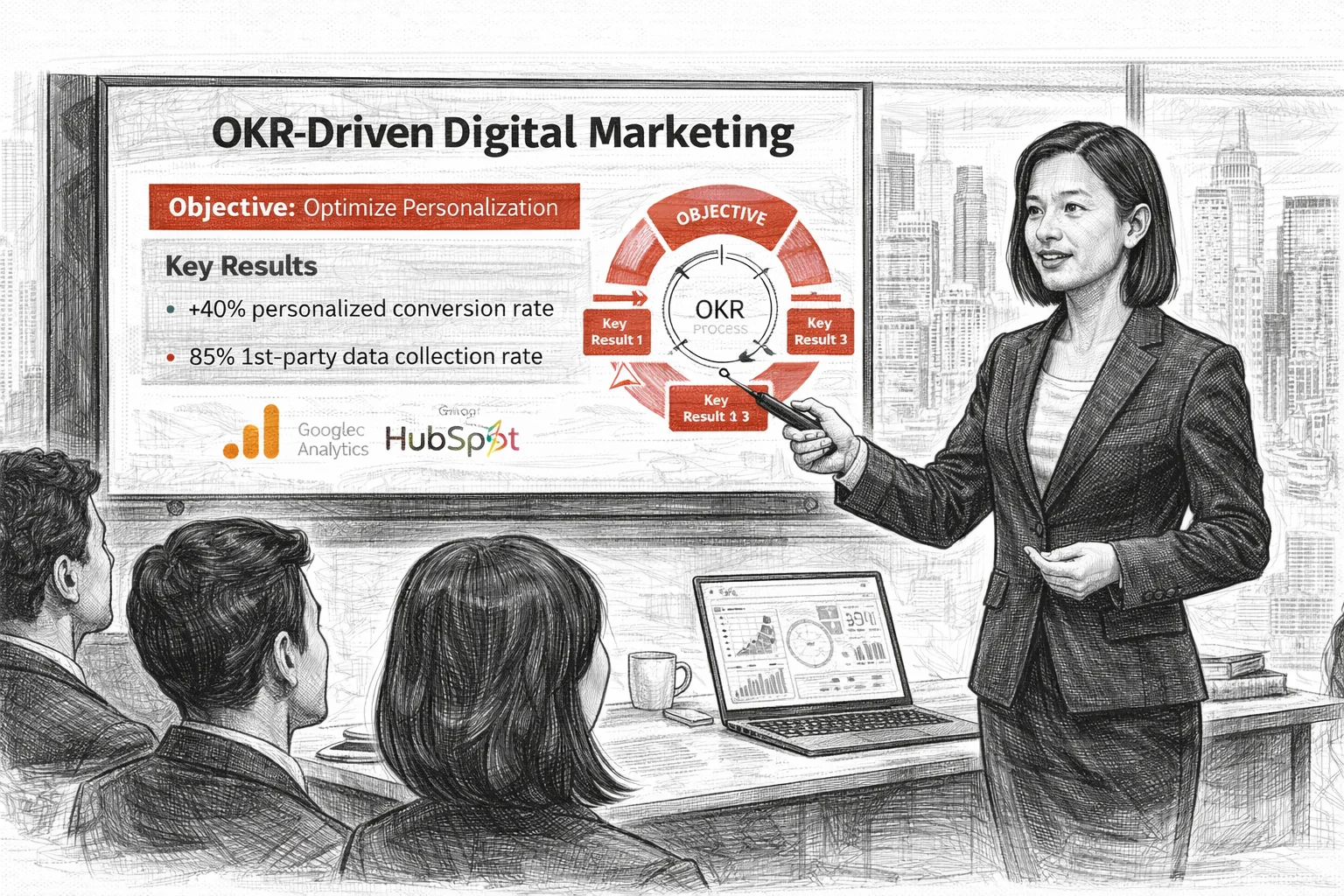
Looking back on 2025, the application of OKR in digital marketing has evolved from simple goal setting to a complete strategic cycle. Many brands use “create a seamless personalized experience” as their annual objective, with key results such as “increase personalized content conversion rate by 40%” or “first-party data collection rate by 85%”.
Performance management plays a key role here, ensuring execution stays on track through quarterly check-ins, real-time KPI monitoring and cross-team feedback. This approach allows marketing budgets to be allocated more efficiently and avoids wasting resources on inefficient channels.
OKR’s dynamic iteration closed loop
OKR emphasizes that goals need to be inspiring, clear, and traceable, combined with continuous feedback from performance management and A/B testing to form a dynamic iteration closed loop. The marketing team often integrates SMART principles into Key Results and tracks progress in real time through Google Analytics, HubSpot and AI analysis platforms.
For example, in the field of content marketing, the Objective might be “Establish industry thought leadership” and the Key Results are set to “Grow organic traffic by 55%” and “Exceed 150,000 LinkedIn interactions.” Through monthly performance reviews, the team can instantly optimize content themes and distribution strategies based on data, turning creation from guesswork to scientific decision-making.
Brand Practical Case: Nike’s Sustainability Commitment
For example, Nike is building better solutions for all athletes and the planet as we fight climate change. The large-scale results of these adjustments and innovations are the way to achieve the goal - to reuse 100% of the waste in the extended supply chain instead of sending it to landfills. It is hoped that at least 80% will be reused to make Nike products or other commodities.
This case reminds us that OKR must be dynamically aligned with the external environment to be effective in the long term.
Policy adjustments under privacy regulations
Of course, 2025 will also be challenging. As privacy regulations continue to tighten and third-party cookies may be phased out, many teams face data bottlenecks when setting Key Results. Performance management plays a key role at this time, helping brands recalibrate their strategies by introducing zero-party data (users proactively share preferences) and consent-based collection.
好比某家知名媒体品牌起初设定「触及人数翻倍」的 Objective,但因合规限制仅达成 65%。 Through a continuous learning cycle, they adjusted to “voluntarily share 50% of user growth” to create a more sustainable personalization model.
Looking forward to 2026: A new era of AI-driven marketing
Looking forward to 2026, as generative AI and predictive analytics mature, Objective will be more forward-looking, such as: “realizing the era of zero-click discovery led by AI agents”, and Key Results include “AI search visibility increased by 60%” and “synthetic data-driven personalized conversion rate reaches 30%.”
Performance management will incorporate AI automated reporting and agent-based workflows, allowing teams to move from execution to strategic oversight. In terms of methodology, special emphasis is placed on balancing human creativity and AI efficiency to avoid homogenization of content while strengthening authenticity and trust.
Embrace a smarter digital marketing era
Overall, from the review of 2025 to the outlook of 2026, the OKR framework originated from Intel has been perfectly integrated with modern performance management and has become the key to success in digital marketing. It not only brings measurable results, but also continues to evolve in the wave of AI and sustainability.
Looking to the future, let us embrace the new era of smarter, more responsible and more influential digital marketing with the spirit of OKR.
Extended reading:
- It’s not that you don’t work hard enough, it’s that the value proposition is not attractive enough
- Copywriting power is your “cashability”: before turning ChatGPT into a godly teammate, you must first make yourself stronger