The beauty and sorrow of PM: In the AI era, will product managers be replaced or forced to upgrade?
Many people only know me as a lecturer, consultant and writer, and I have worked as a reporter and editor in several media, but they don’t know that I have also been a product manager (PM). Therefore, I have always had an indescribable emotion towards the position of product manager.
It’s not because the salary of a product manager is higher, or because the name “Product Manager” printed on the business card looks very powerful and seems to take care of a lot; it’s because what a product manager does is inherently very fascinating – you have to translate back and forth between the language of users, the language of business and the language of engineering, and then make a decision that can be verified, delivered and tested by the market when the information is incomplete, the schedule is cruel, and everyone thinks they are right.
This job not only has glory, but also grievances. Beauty and sadness have always been two sides of the same coin.
But in the past two or three years, AI has almost rewritten the underlying structure of all white-collar jobs - engineers, marketing planning, designers, customer service, data analysis, and of course product managers. What’s even more embarrassing is that the abilities that product managers were proud of in the past, such as writing specifications, doing analysis, communicating and coordinating across departments, and promoting projects, etc., now seem to be able to be done by AI for you, or even help you do a lot unknowingly.
So, the question arises: Is the role of product managers declining, or is it becoming more important and being given more tasks?
A friend who was a PM once complained to me that his supervisor asked him not only to do the planning, but also to actually develop the software! Well, on the surface this may seem like a supervisor messing around, but deeper it actually reflects a new reality: when the threshold for making something drops, organizations will redefine who is responsible for making it happen.
And this is the core of what today’s article wants to talk about: In the era of AI, where should product managers go?
Current situation and challenges: PM’s job has not become less, but has become more like a mixed martial arts
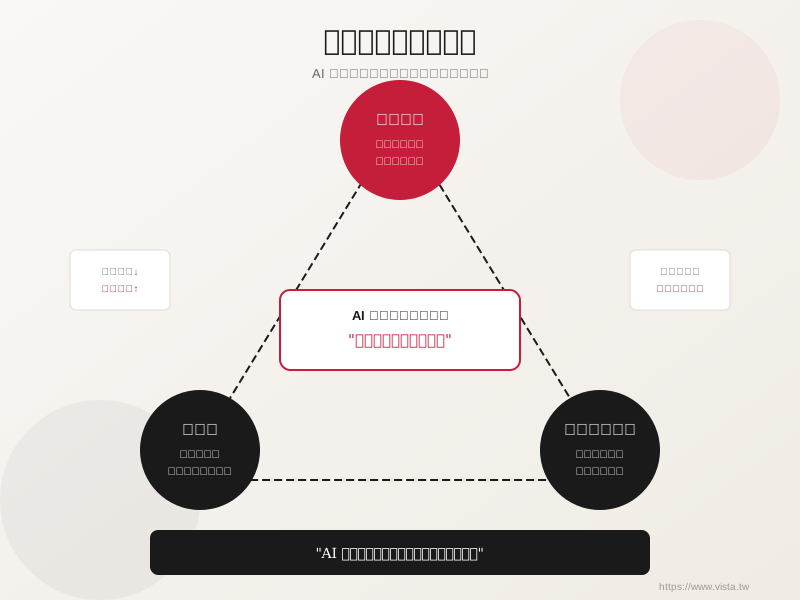 *▲ PM’s core value: Find a balance between users, business and technology. *
If I were to ask my opinion, I would be cautiously optimistic about the future of PM. The reason is simple, because AI will replace output, not judgment; it will automate processes, not responsibilities.
But if this sentence only stops at the slogan stage, it means that it is not said at all. So, I think the real challenge is: the work content of PMs is undergoing the following three structural changes.
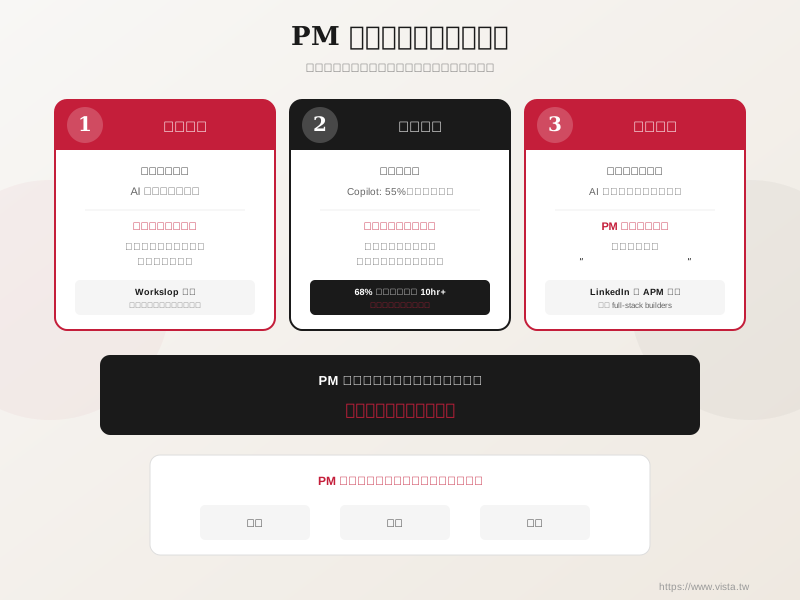 *▲ Three major structural changes faced by PMs in the AI era: output explosion, speed improvement, and responsibility drift. *
1) Output explosion: It has become easier to produce documents, but it is more difficult to take into account the quality of decision-making.
In the past, a PRD, Roadmap, competitive product analysis or user interview summary required the PM to spend a lot of time organizing, writing and proofreading. What now? AI can help you produce a first draft in minutes.
The problem is: just because the speed of document production is getting faster, it doesn’t mean that the overall quality or the products developed are better. Simply put, you get a bunch of stuff that looks complete but is actually quite empty. This phenomenon has recently been called “workslop”: AI generates content that appears to be complete but of insufficient quality, and ultimately becomes a burden for colleagues to spend time cleaning up. “Business Insider” has also reported on the spread of “workslop” in white-collar jobs, and some people even spend a lot of time [fixing the chaos caused by AI output] (https://www.businessinsider.com/workslop-oozing-americas-white-collar-offices-generative-ai-2025-9).
What are PM’s pain points? Not only do you have to produce and plan product content, you also have to identify the authenticity of the content and take responsibility for decision-making. When everyone can use AI to produce beautiful briefings or seemingly complete product specifications, the value of PM is no longer that I write more and can communicate with engineers, but that I understand the market and customers better and make more accurate judgments.
2) Speed improvement: Development has become faster, but the bottleneck has moved to organizational friction
McKinsey’s research points out that on some tasks, generative AI can allow software developers to complete their work nearly twice as fast. GitHub has also compiled research and practical observations, mentioning that tools like Copilot can bring significant efficiency improvements in specific situations, such as “55% faster completion of tasks” and other indicators. MIT’s field experiments also provide more conservative but closer to on-site evidence: Copilot can improve output (such as the number of PRs completed per week) by approximately 7% to 22% under different organizational scenarios.
You see, with the assistance of AI tools, writing programs is indeed faster - but this does not mean that delivering products is proportionally faster.
The “State of Developer Experience Report 2025” report released by Atlassian points out a cruel contradiction: almost all developers feel the time savings brought by AI, and 68% of them say they save more than 10 dollars per week. hours; but at the same time, organizational inefficiencies (including waiting, communication, finding information, collaboration, etc.) can also eat up these hours.
For PMs, this sentence translates into vernacular: the faster the project, the faster decision-making, alignment and trade-offs will be magnified into the main bottleneck. And these are the tasks that PMs are most easily blamed for, but the most difficult to quantify.
3) Responsibility drift: When AI lowers the threshold for making prototypes, PMs are pushed closer to output.
I know a lot of PMs are under a lot of pressure lately! As AI makes it easier to make things, company executives will inevitably start asking:
Then why don’t you make a version yourself first?
“Business Insider” reported at the end of 2025: LinkedIn simply axed the originally well-known Associate Product Manager (APM) program and launched the Associate Product Builder (APB) program, which is to cultivate the so-called [full-stack builders](https://medium.com/as-a-product-designer/%E7%95%B6-linkedin-%E9%96%8B%E5%A7%8B%E6%8E%A8%E5%8B%95-%E5%85%A8%E7%AB%AF%E5%BB%BA%E9%80%A0%E8%80%85-% E4%B8%80%E5%A0%B4%E6%AD%A3%E5%9C%A8%E7%99%BC%E7%94%9F%E7%9A%84%E7%94%A2%E5%93 %81%E8%81%B7%E6%B6%AF%E9%9D%A9%E5%91%BD-cace74d59d84)——People who are better at making products, designing, and making things at the same time. During the same period, “Business Insider” also reported that Meta internally asked PMs to use AI-assisted vibe coding to quickly make prototypes and directly show them to senior management.
It can be seen that this is not the willfulness of a single supervisor, but a broader trend: PM is being pushed from the role of coordinator to builder.
PM can be cautiously optimistic about the future, but only if you upgrade to a new species
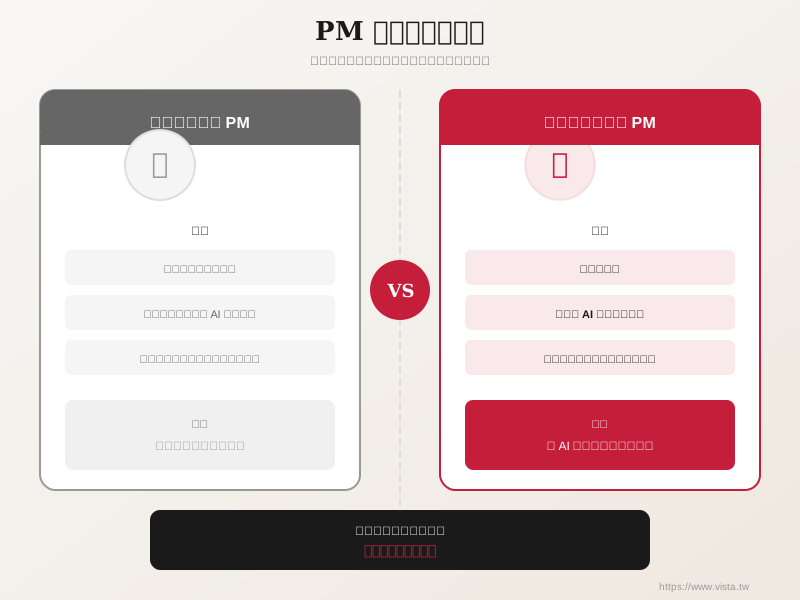 *▲ PM is splitting into two types of people: coordinators stuck in the old world, and builders who can turn AI into leverage. *
Having said that, the reason why I am cautiously optimistic is because the core value of PM has never been that I can write technical documents or that I can chair meetings.
In my impression, the core value of PM comes from doing the following three things:
- Define the problem: What problem is being solved and why it is worth spending time to solve?
- Making trade-offs: When resources are limited, what to do first and what to do next
- Reduce uncertainty: Use experimentation and iteration to keep the team moving in the right direction
AI can help you organize data faster, write interview summaries more beautifully, and list A/B testing hypotheses more completely - but it is difficult for AI to take on one thing for you: “Who is responsible if something is wrong?”
Moreover, the more we enter the AI era, the more counter-intuitive a phenomenon will appear: when the output cost approaches zero, the judgment cost will become higher. Because you will be faced with a lot of options that all seem reasonable, and you have to choose one to bet on.
Therefore, the PM position will not disappear, but it is likely to be split into two types of people:
- One type is a PM who is still stuck in the old world: he can write, speak, and hold meetings, but his delivery speed cannot keep up with the pace of the AI era.
- The other type is a PM who can turn AI into leverage: not only can he plan, but he can also use AI to make prototypes, generate data, and conduct market verification.
And this is the new species I’m talking about.
Functional transformation: from handing over the baton to running for a while and then handing over the baton
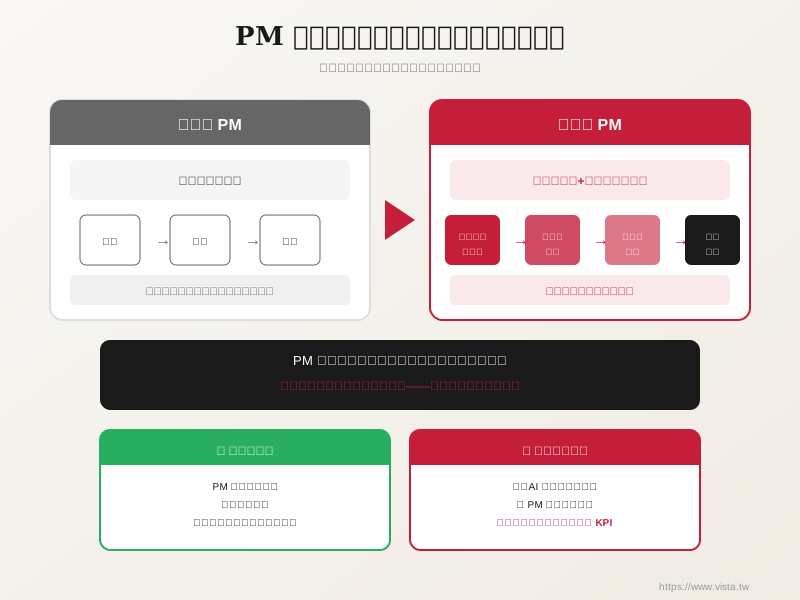 *▲ From “writing specifications and handing over the baton” to “running for a while before handing over the baton”: The role of PM is changing. *
If you can’t understand, I can put it more plainly:
(a) In the past: PM wrote the specifications and gave them to engineers
PMs in this era are a lot like architects: drawing, planning, aligning, and making sure everyone works according to the drawings. You don’t necessarily have to get the hammer yourself, but you do want to make sure that the final house is habitable.
(b) Now: PM may have to make a working prototype first, or even do part of the development
PMs in this era are more like designers and construction foremans: you need to be able to use the lowest cost to run through the key assumptions first and make something testable so that users or internal staff can quickly provide feedback.
Please note: this does not mean that the PM becomes an engineer. To be more precise: PM must have the ability to turn ideas into verifiable prototypes. You may not be building the prettiest, most complete, or most scalable system, but you’re building something that quickly allows the truth to emerge.
Having said that, this is also why some PMs are asked by their supervisors to make software: if the supervisor has a normal mind, what he really wants is that you don’t just hand over an imaginative draft, but something that can be verified.
But there’s a dangerous line here:
- Healthy trend: PM has prototype capabilities, shortens the iteration cycle, and allows engineers to use their efforts in truly verified directions.
- Unhealthy Drift: The company uses “AI is very convenient” as an excuse to let the PM take over engineering responsibilities, but does not provide resources, change the process, or adjust KPIs. In the end, the PM is quickly exhausted.
Therefore, the key to judgment is often not whether you should do something, but whether you are doing something at the right level?
If the supervisor asks the PM to develop, is it reasonable?
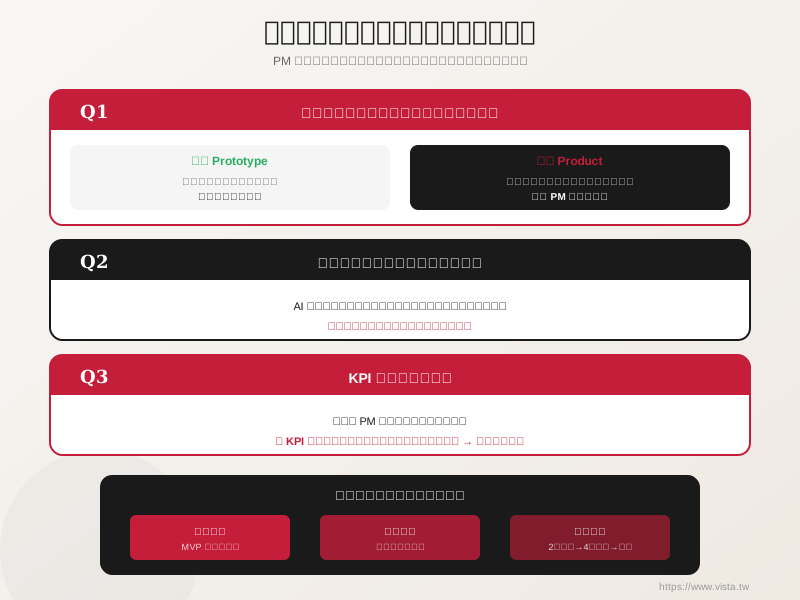 *▲ Three key questions to determine whether a supervisor’s request is reasonable. *
I will use three questions to help you determine whether this is the right development?
Question 1: Does the company want you to make a prototype or a product?
- Prototype: used to verify requirements, processes, and value propositions. It can be rough, but fast.
- Product: It must be maintainable, scalable, monitored and audited for information security. Of course, this is not a responsibility that the PM can shoulder alone.
If the supervisor cannot explain clearly, the PM should take the initiative to explain clearly:
“I can make a testable prototype within two weeks, but if it is to be put into operation, engineers must be responsible for the architecture, information security, monitoring and maintenance.”
Question 2: After you are done, who will be responsible for the technical debt?
AI is very good at helping you piece things together, but it can also easily bury technical debt. If the company wants you to deliver a system that will work for a long time, then be sure to clarify responsibilities.
Question 3: Have the KPIs been adjusted or converted accordingly?
If you have to do the work of a PM and an engineer at the same time, but your supervisor still uses KPIs such as the number of requirements delivered, completeness of specifications, or cross-department coordination to evaluate you when evaluating your performance, you will die in an ugly way.
Therefore, I would suggest that the PM discuss this matter in a project mode:
- Clear Scope: To what extent is MVP
- Clear roles: What parts of the project will be taken over?
- Clear rhythm: two weeks of prototype, four weeks of verification, and then decide whether to productize it
To judge whether a PM is mature, the key is not how well you plan product specifications, but whether you can clearly define tasks and directions?
Suggestions and Guidelines: For those of you who are doing PM, or want to get involved in PM - I will upgrade like this
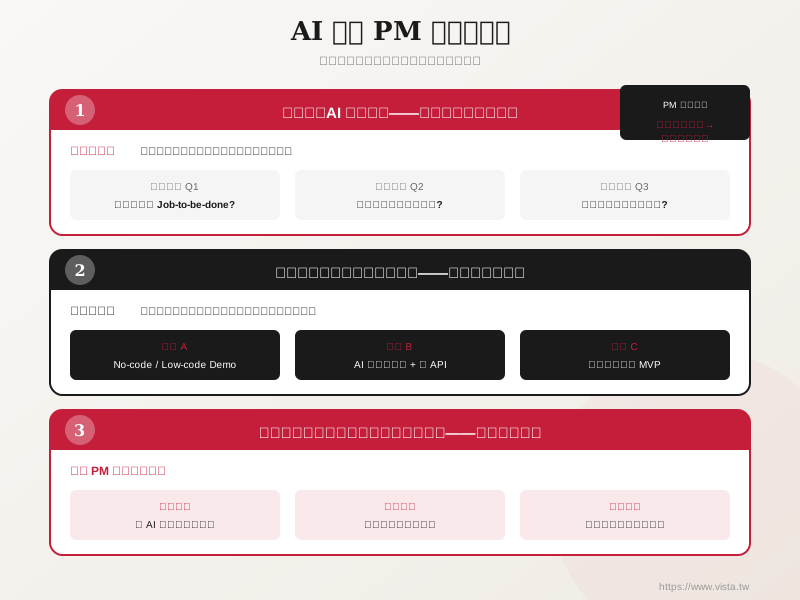 *▲Three levels of capabilities that PMs must develop in the AI era: accurate judgment, prototype implementation, and human-machine collaboration. *
I would divide PM capabilities in the AI era into three layers of muscles. You don’t need (and it’s really difficult) to become omnipotent overnight, but you need to know which area you should train on?
Level 1: AI makes you faster, but you must first become more accurate
Core Competencies: Problem definition, priority, indicator design and trade-off logic.
AI can help you list a bunch of OKRs, indicators, and Roadmaps, but you need to be able to answer:
- Does this metric really represent value?
- If I don’t do this function, will I die?
- What are the assumptions behind this decision? How to verify?
My suggestion is: treat AI as a debate opponent and force yourself to practice three questions every day:
- What is the job-to-be-done behind this requirement?
- What is the minimum verifiable version?
- What would be the earliest sign of failure?
第二层:你要会做可验证原型,让你从会议里走出来
Core competencies: Rapid prototyping, process design and basic technical literacy (you don’t need to be brilliant at writing, but you need to know enough to use it).
You don’t have to be a senior engineer, but you need to be able to do at least one of the following:
- Use no-code / low-code to make a running Demo
- Use AI assistance to write simple front-end pages + string API
- Build an MVP with ready-made services (Auth, DB or analytics tools)
Why? Because this will change your position in the organization: you will no longer just be the person who makes the demands, you will become the person who can implement the assumptions.
Of course, this also echoes the current international workplace trend: organizations increasingly prefer builder-type talents who can cross domains, and even directly reshape the training system.
The third level: You must be able to design a feedback loop for human-machine collaboration. This will be the next moat.
It’s true that AI tools are increasingly acting like agents. What agents lack most is not ability, but feedback. Research by the St. Louis Fed pointed out: In the November 2024 survey, people who used generative AI saved about 5.4% of their working hours on average, which is about 2.2 hours based on a 40-hour week; but on average (including non-users), the overall saving was about 1.4% of their working hours. What this number tells us: The benefits of AI will not explode automatically, it needs to be properly designed to amplify.
Therefore, the most important capabilities of PMs in the future will be:
- How do you get AI to learn the right things in your product?
- How do you define success and failure?
- How do you design user feedback, annotation, evaluation and iteration processes?
In other words: PM will evolve from writing requirements to someone who trains the system.
The trend I see is not the disappearance of PMs, but the re-division of labor
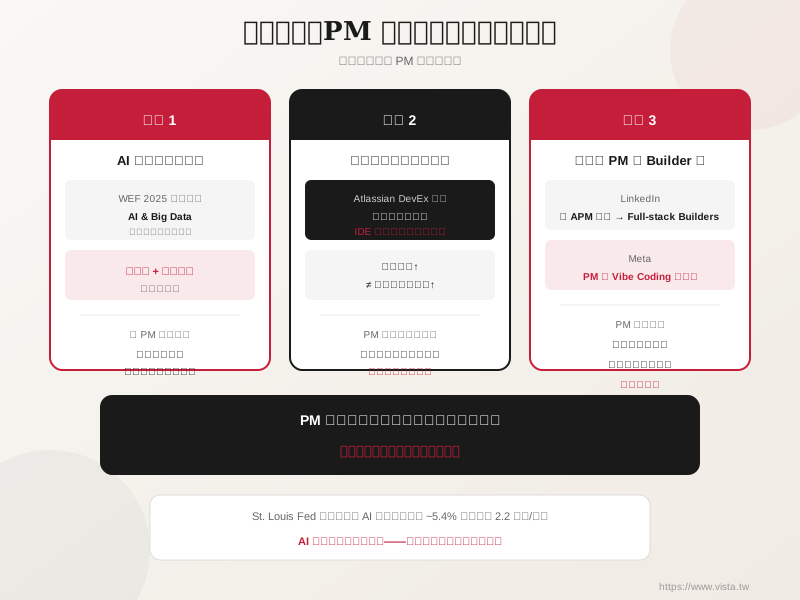 *▲ Three major international trends are taking place: AI skills have become the basis, the bottleneck lies in collaboration, and companies promote PMs to become builders. *
Finally, take note of these three ongoing trends:
Trend 1: AI skills have become the basic foundation of the workplace, and curiosity and learning ability have become more critical.
The World Economic Forum (WEF)‘s “Future of Jobs Report 2025” pointed out that skills such as AI and big data will be one of the fastest-growing skills in the next few years, and the importance of “curiosity and lifelong learning” also continues to rise. What this means for PMs: You don’t need to know everything from the start, but you can’t stop learning, and you can’t just stand on the shore and comment on the waves.
Trend 2: Engineering efficiency is improving, but the real bottleneck lies in collaboration and process
Atlassian’s “State of Developer Experience Report 2025” report points out that a lot of time is still consumed in friction and inefficiency outside the IDE. Therefore, the value of PM will focus more on: alignment, trade-offs, process design, and preventing the team from taking wrong paths. You are not weakened, you are actually pushed to a more core place - it’s just that that place is more difficult and requires more maturity.
Trend 3: Enterprises are pushing PM towards builder
LinkedIn reshapes talent training, and Meta makes PMs vibe coding. These cases all illustrate that PMs do not have to write deeply, but they must be able to create verifiable versions of value at a lower cost and faster speed.
Beauty and sadness are still there, but you can choose to forge sadness into a more beautiful yourself
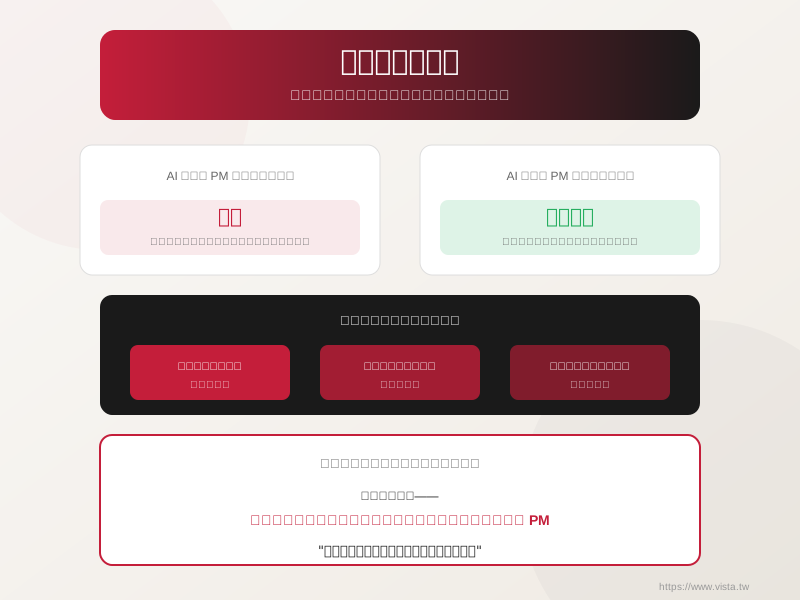 *▲ The beauty and sadness are still there, but you can choose to upgrade yourself to a new species. *
If you ask me: Will it be harder for PMs in the AI era?
I would say, definitely.
Because you have to know more, you have to do more, you have to deliver earlier, iterate faster and make more precise decisions, and you have to deal with the chaos brought about by AI that seems to be complete but actually needs humans to clean up.
But if you ask me: Is it still worth being a PM in the AI era?
I also have to say, it’s more worth it.
Because in a world where output is getting cheaper, good judgment will become more and more expensive; in an era where everyone can produce beautiful documents, people who can clearly define problems, quickly dig out the truth, and lead the team in the right direction are even more scarce.
Therefore, my cautious optimism is not a comfort, but a requirement: you can miss the era when you can hand over the baton as long as you write the specifications; but you should upgrade yourself to a PM who can not only define the direction, make prototypes, and design iterative feedback loops.
Honey, that’s not being forced to do more.
That is how you regain your dignity and value in the new era.
Further reading
- Lecturer’s Digital Asset Management Technique: Use AI to turn teaching experience into a compounding system
- Profit Awakening of Knowledge Workers: From Cash Flow Thinking to Survival Rules in the Micro-Organization Era
- Podcast note-taking: 6 steps to build a content flywheel with Podwise + Anytype