Refuse to be a digital sharecropper: Why do you need to use Vibe Coding to build a digital headquarters in 2026?
Today in 2026, as a content creator, lecturer or personal brand operator, you have probably been chased by the same anxiety - you are obviously working hard every day: posting regular posts on the fan page, writing long articles in the grid, and making beautiful limits and carousels on Instagram; the tracking number is not bad, it has even exceeded tens of thousands, and it looks glamorous and decent.
But only you know: in the dead of night, the question that really hurts you is not “whether I work hard enough”, but - will everything I do stay in the end?
The content, interactions, touches, and trust you accumulate bit by bit are like building a castle with sand on the beach. When the tide comes, you can only pray. Many times, we think we are managing fans, but in fact we are renting land for farming.
The harsh truth: we are just a few sharecroppers
Well, let’s talk about a cruel fact first: the things we accumulate on the platform are often not our own assets, but the illusion that the platform allows us to temporarily possess.
It is conceivable that this situation will become more and more serious. All your efforts may be determined by a button at any time.
Any time social media adjusts its algorithm, your reach may drop from 10% to 1%. The article you thought was well written yesterday, if it is not promoted today, it will be like it never existed. What’s even scarier is that you don’t even know what you did wrong? You can only make wild guesses and gamble on your luck next time with more content.
You think you are writing, but in fact you are catering to the machine’s appetite: the title should be more sensational, the pace should be faster, the emotion should be more exciting, the video should be shorter, and the copy should be more like an advertisement. Over time, your style is smoothed, your tone is corrected, and you are trained by the platform into a version that is easier to distribute.
Hey, do you remember the nameless station? Remember Google+? The history of the rise and fall of platforms has repeatedly reminded us of one thing: any platform may burn out overnight.
When a giant decides to downsize, revise or shift, or even go offline directly, the digital assets you have accumulated for many years, such as articles, photos or messages, or even the special topics you have put a lot of effort into, may disappear overnight.
Why do you need “Digital Headquarters”?
This isn’t so much a content creator’s anxiety disorder as it is a structural dilemma.
We are all Digital Sharecropping. This means that we farm on other people’s land, pay traffic taxes, and support users and advertisers for the platform, but the land may be taken back by the landlord at any time. And the most ridiculous thing is: the more successful you are, the tighter you are likely to be.
因为你一旦靠平台的流量吃饭,你就更不敢离开;你愈不敢离开,就愈必须迎合平台;你愈迎合演算法,就愈有可能失去自己;你愈失去自己,就愈难把粉丝变成真正的长期客户与社群。
This is not a single problem, but a systemic dilemma. For those who want to build a personal brand, I think what you need is not “a website” but a digital headquarters.
It’s not just “I should have a place to post my articles”, but I must regain digital sovereignty and establish my own Digital HQ.
The so-called “digital headquarters” is not a fancy term, but the core base for all your content, products, lists, communities, and business models. In other words, the platform can be the front line, but the headquarters must be in your hands. In this headquarters, you can do three things that the platform will never give you:
1. Data sovereignty: the content is not placed with others, but is stored in your hands
Articles, images, code, materials or product pages, etc… can all be saved in your own repository (such as GitHub) or a space you control. You can backup, migrate, and version manage without being restricted by any platform policies. This means: every article you write is a real asset that can be accumulated, rather than a consumable that can only be touched by gambling.
2. Design freedom: you can create your own atmosphere
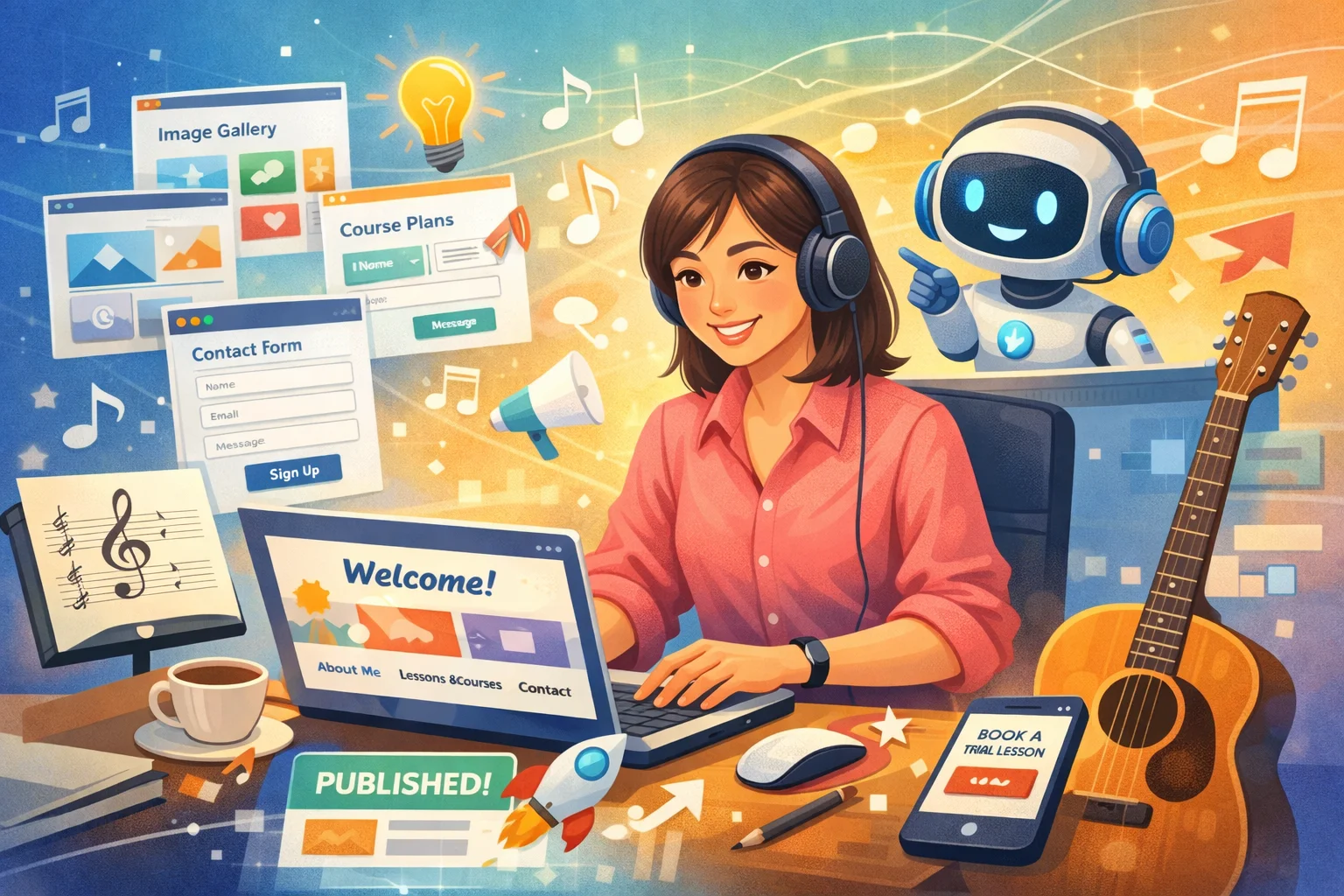
Do you want a handsome photo when you open the homepage? Do you want readers to feel like entering an elegant art gallery once they land on your website, and your carefully produced content feels like curating an exhibition? Whether it’s a waterfall photo wall, an interactive content directory, a hacker style with gold characters on a black background, or a minimalist academic style with blank spaces - whatever you want, you can do it with the help of AI.
This is not about showing off skills, but about branding: when the reading experience becomes unique, the memory will become stronger.
3. Scalability: Your business model is no longer limited by platform functions
Today you want to write a blog, tomorrow you want to sell digital products, the day after tomorrow you want to open appointment consultations; you want to make a member area, a course sales page, a marketing funnel, a list collection, and a dedicated dashboard - your own website is like Lego bricks. You can constantly stack new modules so that your business can grow in your own system instead of growing in someone else’s rules.
Vibe Coding: The hammer that breaks high walls
I know that the real wall has always been there, and that is coding and technical issues. If you have ever thought about having your own website, you have probably hit the wall called Coding. To be honest, we all know that “there are specializations in the industry”, and what content creators fear most is not learning, but losing the direction of learning.
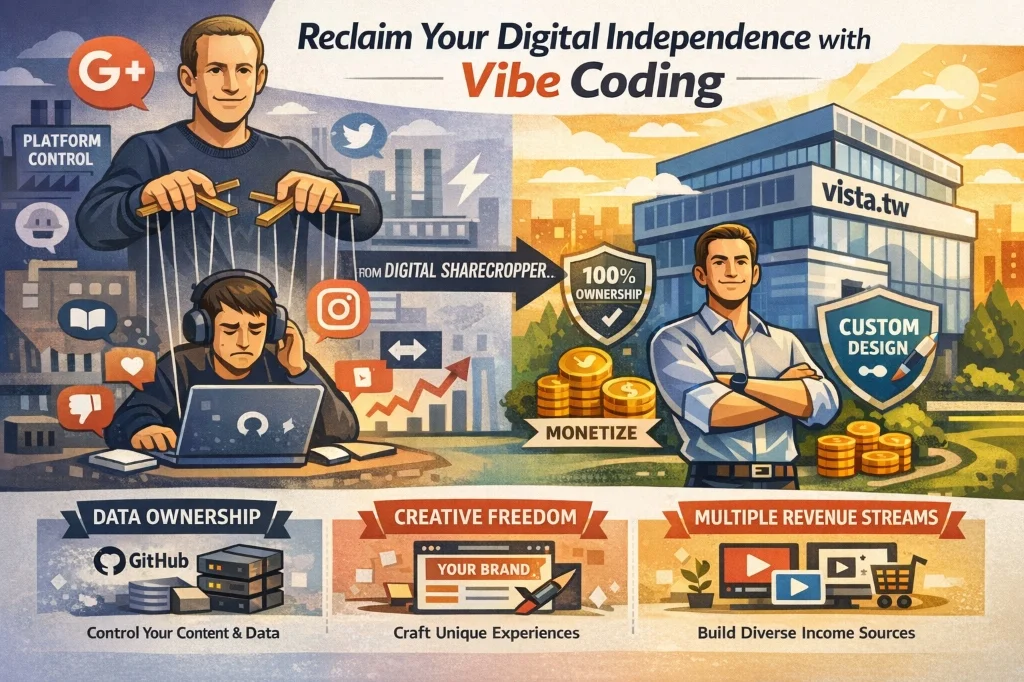
Around 2025, as the programming capabilities of large language models (LLM) gradually matured, a new development paradigm emerged: Vibe Coding (Ambient Programming).
Vibe Coding is like a hammer that breaks high walls, allowing you to design websites with directorial thinking.
Andrej Karpathy is the person who pushed AI-assisted coding to the altar. He once half-jokingly said: He currently uses prompt to generate most of his code, and he is mainly responsible for confirming the results of vibe, right? This sentence hits home because it speaks to a key shift: from grammar-oriented to results-oriented.
In traditional coding, we are like bricklayers, we must lay each brick by hand. This means that you have to know how to write every syntax, how to debug every error, and how to connect every file. If you are not fully trained, your attention can easily be eaten up by details. Even if there is one missing semicolon in the code, an error may occur.
However, now with Vibe Coding, everyone can get close to programming. You are like a film director. The key is that you must be able to clearly describe the images and feelings you want.
You don’t need to know how to wire lights or how to choose lenses. You looked at the screen and said:
- “It’s too crowded here, I need more space.”
- “This button is too cold, change it to a warmer texture.”
- “The first picture on the screen should have an atmosphere that will attract you as soon as you walk in.”
- “The reading rhythm of the text should be like a column, not like an instruction manual.”
New core capabilities for creators
In the world of Vibe Coding, your core ability is no longer memorizing grammar, but two things:
- Accurately describe your vision (what experience, process, and atmosphere do you want)
- Judge whether the results are good or bad (make decisions like a chief editor, a director, or a curator)
You will find that these two things happen to be the best abilities of content creators.
It is true that Vibe Coding is not omnipotent, and the code written by AI may still make errors. However, this is a good starting point for beginners.
When you start using Vibe Coding to build your own digital headquarters, what you are building is not just a website. You are turning your content from exposure on the platform into a cumulative asset; turning your fans from traffic distributed by algorithms into lists and relationships that you can control; turning your brand from a standard layout into an atmosphere and experience that is instantly recognizable.
Of course, I must say: various social platforms are still important, but their role may slowly change: they are no longer your only home, but the entrance to your kingdom. Your real home will be in your own headquarters.
This is my experience in building a personal website recently. Anyone who is interested is welcome to communicate with me. I am a novice myself, but in the process of Vibe Coding, I not only learned a lot of professional knowledge about programming and website operation, but also gained a lot of fun and sense of accomplishment.
Further reading
- Find your keywords: Use AI to hone the core elements of your personal brand
- Facing the advent of the era of generative artificial intelligence: An AI action guide for professionals
- Let ChatGPT plan your personal brand development plan