Reading "The Underlying Mindset of Top Sales": Sell Products, Sell Methods, or Sell the "Only-You" Trust?
*▲ Fan Yongyin’s “The Bottom-Level Thinking of Top Sales”: dismantle sales into a methodology that can be replicated and amplified. *
In an era when AI is changing everything, why should we read a sales book?
Many people believe that by 2026, AI can already help write proposals, produce briefings and conduct customer analysis. Sales seems to be being swallowed up by automation. However, Fan Yongyin (Da Fan)‘s book “The Bottom-Level Thinking of Top Sales” brings us back to a more fundamental question: When everyone can use AI to create beautiful content, why should customers buy from you?
In fact, this problem does not only belong to salesmen. It’s a question that writers, lecturers, consultants, entrepreneurs, or knowledge workers face every day. Fan Da has accumulated 25 years of foreign sales experience and has served as PTC, CA, HP, Siemens, SAP, and as general manager of Clarivate Analytics in Taiwan and Greater China. With such qualifications, what he writes is not sales skills, but a set of underlying methodologies that can be dismantled, copied and amplified.
 *▲ The central thesis in one line: whether you sell products or sell trust decides whether you are “the only one”. *
Core comparison: four watersheds between ordinary business and top business
The book opens with a very clear set of contrasts. I think these four sentences can become the standard for judging almost any people-oriented profession:
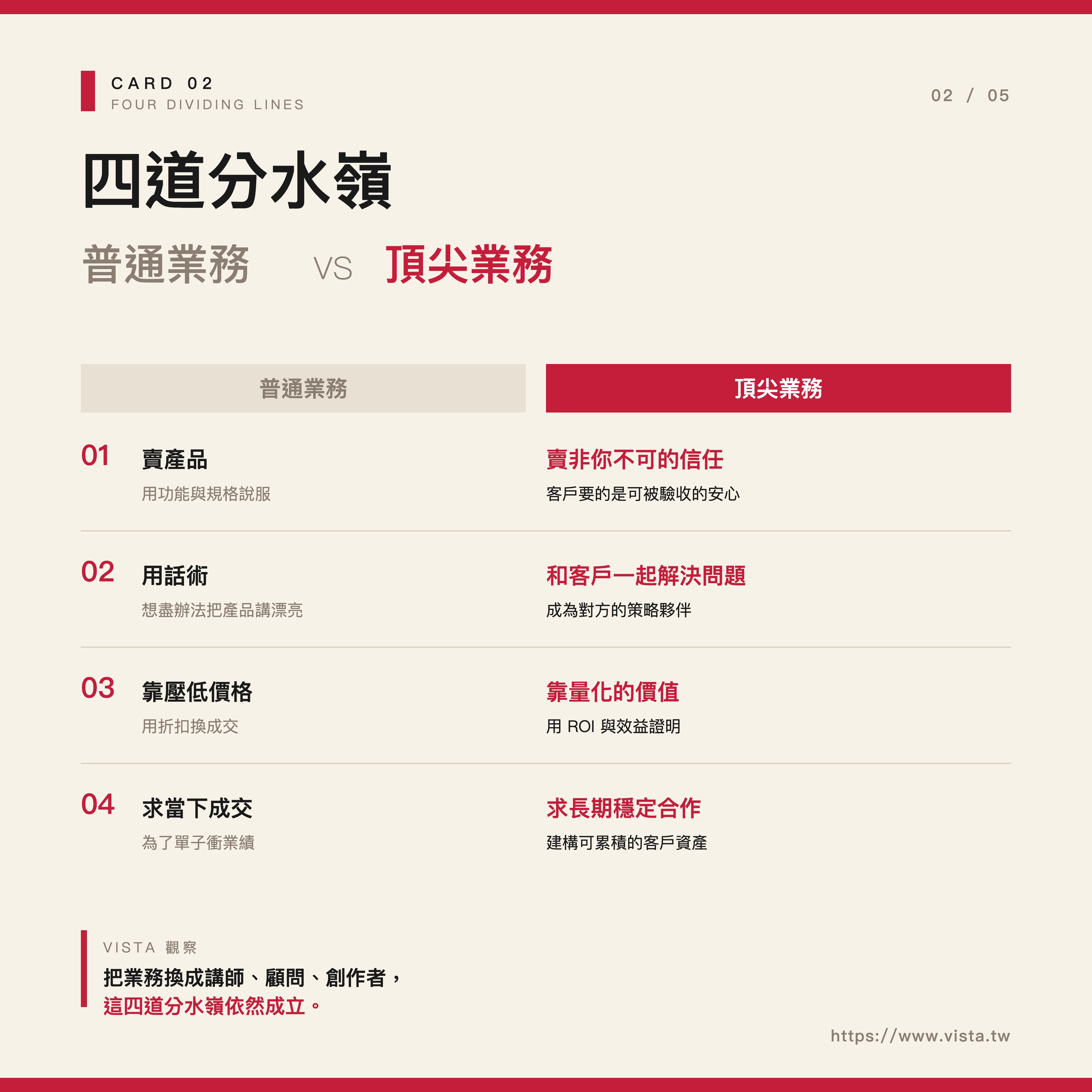 *▲ Four watersheds: products, words, price, immediate transaction vs. trust, joint problem solving, quantifiable value, and long-term cooperation. *
Ordinary business sells products, top business sells the trust of “you have to do it”; ordinary business uses words, and top business solves problems with customers; ordinary business relies on lowering prices, and top business relies on value that can be quantified and accepted by customers; ordinary business seeks immediate transactions, and top business seeks long-term and stable cooperative relationships.
Change the business to lecturer, consultant, author, or coach, and these four sentences still hold true. That’s why I think this book shouldn’t be read within a sales framework—it’s actually a book about how professionalism evolves into trust.
Three key questions: WHY BUY, WHY YOU, WHY NOW
Fan Da proposed a very structured framework of three sales questions. I think this is the most worthy part of the book that is worth practicing repeatedly.
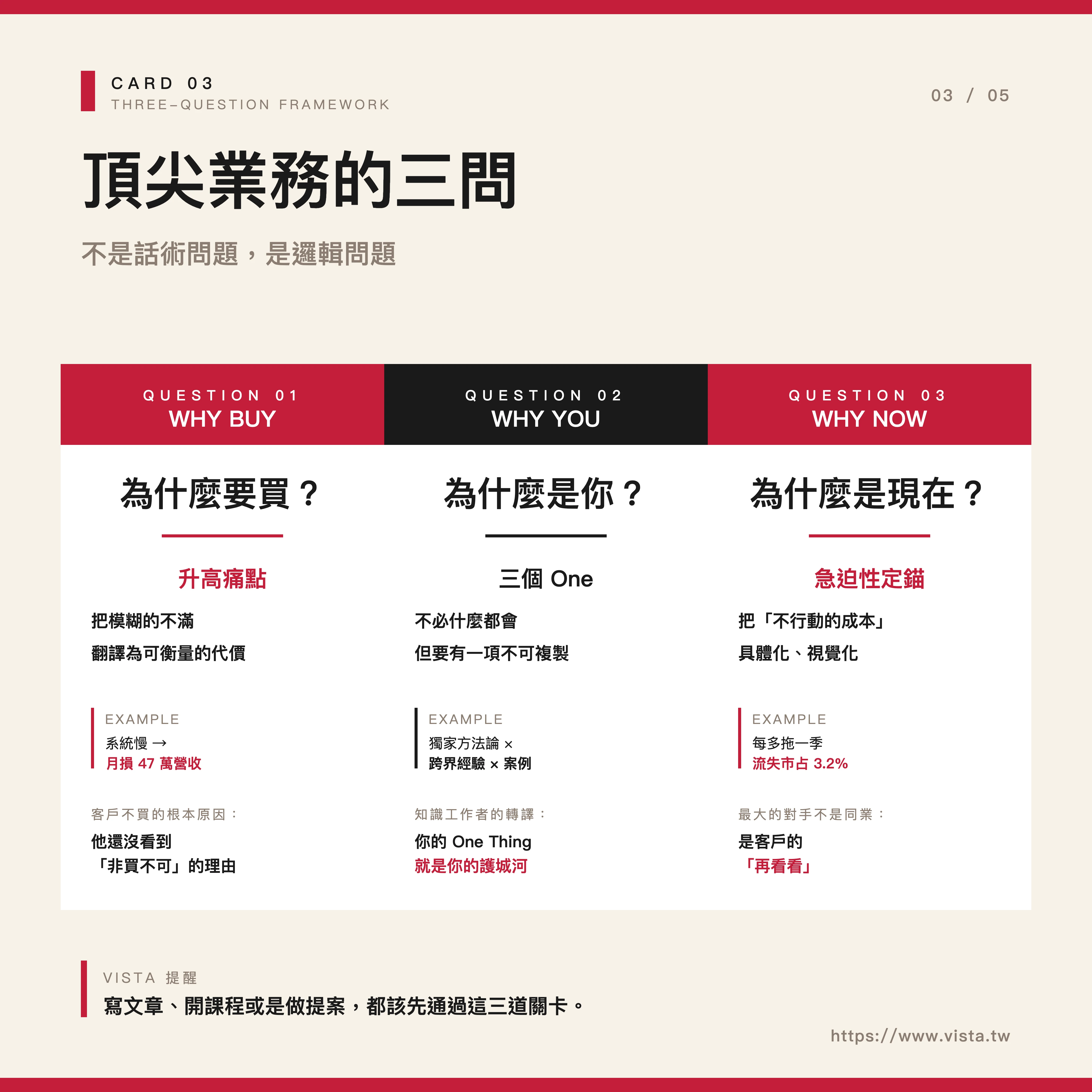 *▲ Three key questions constitute a complete sales logic: why buy, why you, and why now. *
WHY BUY: Why buy? When a customer says “Let’s take a look”, 90% of the time it’s not because of the budget, but because he hasn’t seen any reason to buy it yet. Fan Da emphasizes “raising pain points” - that is, translating customers’ vague dissatisfaction into clear and measurable costs. For example, if a customer only says “Our current system is a bit slow”, this is just a complaint; but if you can further quantify it as “the failure of customer service response due to system delays every month results in a loss of approximately 470,000 in revenue”, this becomes an issue that must be acted upon.
WHY YOU: Why you? Fan Da talked about the three moats of One - you don’t have to know everything, but you must have at least one ability that others cannot copy or copy. For knowledge workers, this means finding your One Thing: perhaps a unique methodology, a cross-disciplinary perspective that only you can bring together, or a career experience that no one else can replicate.
WHY NOW: Why now? Many sales cases end up not being closed, not because they lose to their opponents, but because they lose to delays. Fan Da emphasizes the use of “benefit measurement indicators” to anchor urgency - to make the cost of inaction concrete, so that customers can feel that time is burning money.
Write the specifications into the customer’s decision-making criteria - this is the smartest sales
Among Part 2, my favorite lecture is “Give Value: Turn Your Specifications into the Only Standard”. Well, the logic behind this is pretty neat. Traditional salespeople will work hard to prove “I meet the specifications” after customers put forward specifications; top salespeople will guide customers to write their own characteristics into the purchasing standards before customers have set specifications.
To be honest, this is actually the trick that content marketing and Personal Brand operators should learn the most. We often think that we have to cater to market standards, but a smarter approach is to make your methodology itself become the market standard by educating the market, expressing opinions, and accumulating cases. That’s exactly what creators like Alex Hormozi, Naval Ravikant, Dan Koe and more are doing. They are not selling, but redefining what is good.
🛠 Want your methodology to become a market standard? First have a website where it can be placed
Fan Da talks about “writing specifications into customer decision-making criteria”. The premise is that your opinions must be visible, quoted and searchable. If you don’t have a website that can carry your own methodology, you are welcome to participate in the “[Vibe Coding for Claude Code Practical Workshop] (https://www.solo.tw/courses/vibe-coding-claude-code)” designed by me - 3 hours of using AI and terminals, handing over the entire project to Claude Code, and creating the first website that can be launched, can display specifications, and can educate the market.
👉 Course starts on 6/27 (Saturday) · Small class size: 12 students · solo.tw/courses/vibe-coding-claude-code

Soft power: dining table, praise and companionship - the deal is hidden outside the conference room
PART 3 “Soft Power × Underlying Logic” particularly impressed me. Fan Da wrote: Negotiating cooperation is often not done in the conference room, but at the dining table. This sentence is even more worthy of reflection in the AI era. When all hard skills are automated, what can make people truly trust you is the soft power that is difficult to quantify—your empathy, your sense of humor, and your willingness to accompany customers to get things done.
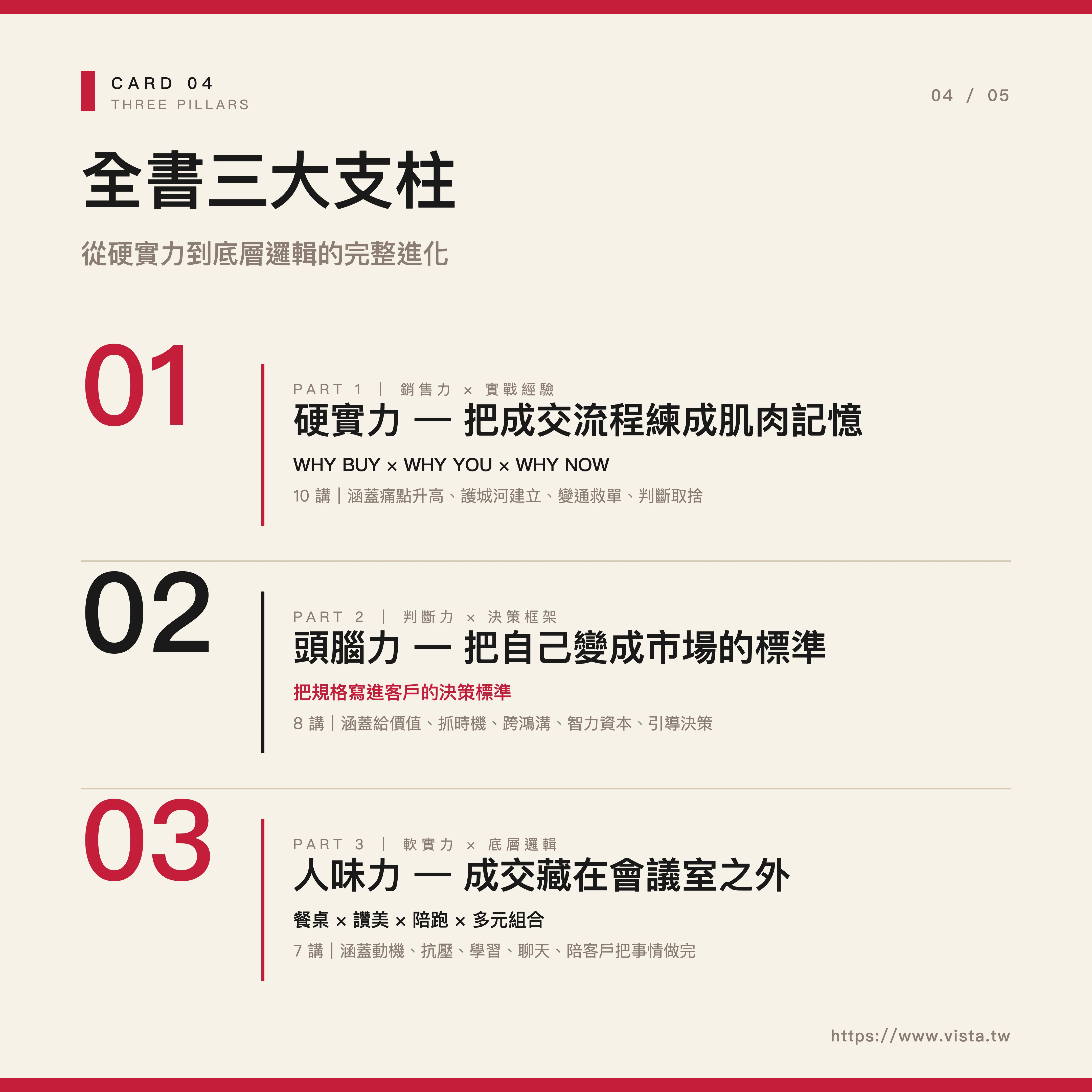 *▲ The four pillars of soft power: When all hard skills are automated by AI, the remaining ones are the most valuable. *
The concept in Lecture 25 of the book, “Being able to run with you: Go to the customer’s site and accompany him to get things done” is almost the underlying thinking of the most popular Coaching at Scale model. What clients never buy is just a plan, but the sense of security that someone will accompany me through this journey.
Three-tier migration of knowledge workers
If you are not a salesperson, what use is this book? I think at least three layers of migration can be done.
The first level is the migration of writers: when you write an article or publish a book, you are essentially selling an idea. The three questions of WHY BUY, WHY YOU, and WHY NOW can be used directly to test whether the opening of your content is valid. I also discussed this point of view in my previous book review “[One-Man Company in the AI Era] (/blog/ai-era-one-person-company-book-review)”: One person’s career is a long-term idea sales.
The second level is the transfer of lecturers: if students feel good after listening to a class, but they don’t seem to necessarily learn it, then WHY NOW is not done well. The method of quantifying pain points can be used to design the opening and enrollment copy of the course.
The third level is the migration of personal brand: your personal brand is your specifications. What you have to think about is not whether you can meet the market standards, but whether you can make the market standards move closer to you.
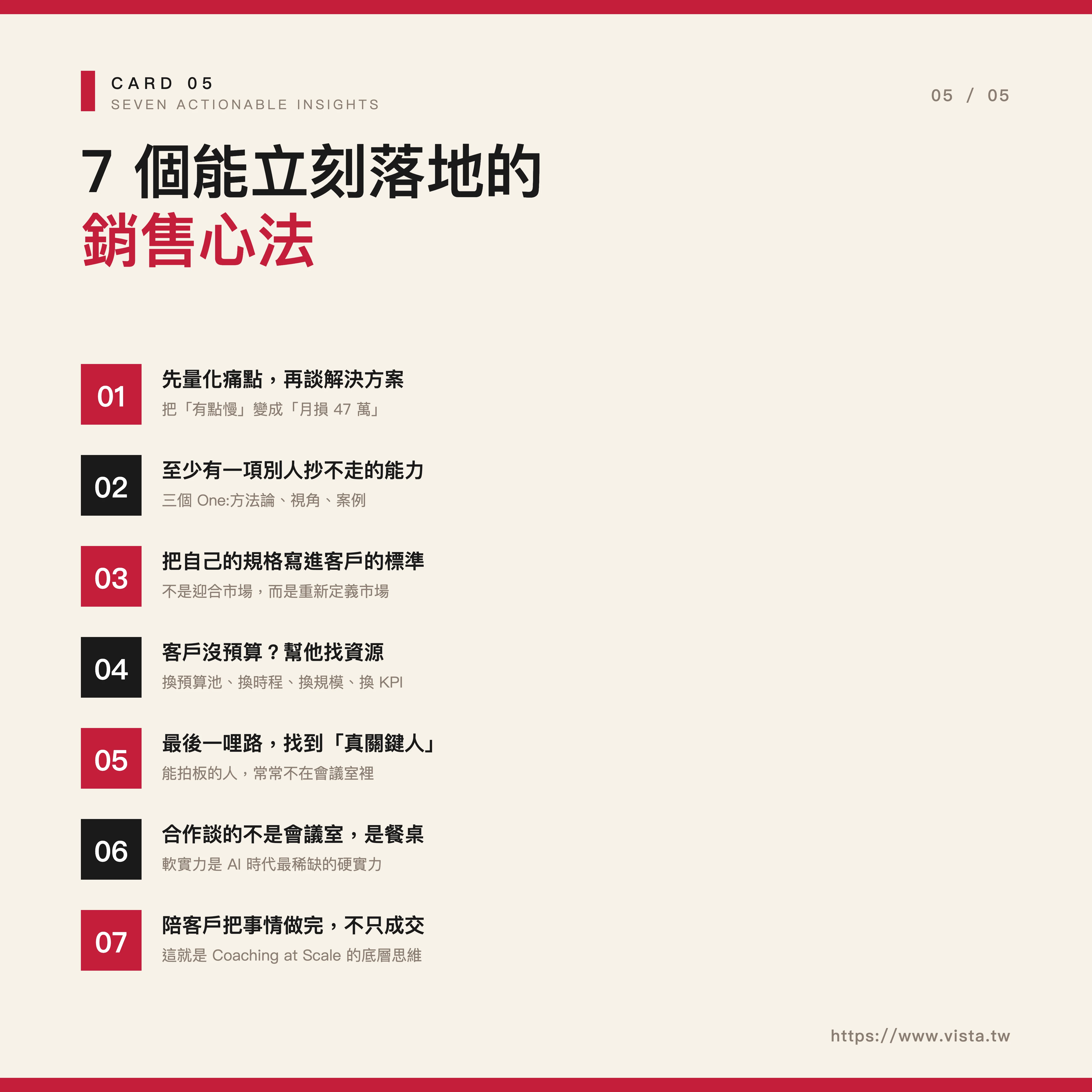 *▲ Seven distilled insights you can apply right away to proposals, landing pages, and course design. *
Conclusion: Sales is about translating trust into action
The deepest feeling after reading this book is that the so-called top is never the stacking of skills, but the upgrade of thinking. Fan Da reminds repeatedly in the book: Don’t think of yourself as a person who asks for help from your customers, but as a person who comes to help him solve problems.
When you no longer rush to sell, but focus on quantifying the customer’s problems, anchoring the urgency, and turning your own methodology into market standards - you will find that closing the deal no longer requires chasing, but comes naturally. This book is not so much for salesmen as it is for every worker who trades professionalism for trust. Although its title is about sales, what it is really talking about is an underlying methodology that allows professionals to be seen, trusted, and chosen.
📚 Book purchase link: “[The underlying thinking of top sales] (https://www.books.com.tw/products/0011050255?utm_source=vista&utm_medium=ap-books&utm_content=recommend&utm_campaign=ap-202605&brid=YWdncwHRWdD0RQZvC0f_d7y0gYeO)” (from blog)
🔗Extended resources:
- My own content creation workstation: content.tw
- One-person company operating system: solo.tw
- Personal works and introduction: vistacheng.com
- Business card and quick link: vista.st
- More reading experience: vista.tw/tags/Reading experience
📖 深入探索相關主題