The most underestimated superpower in the AI era: Logic - 9 practical inspirations from reading "The Three-Minute Logic Lesson"
Starting from an embarrassing internal corporate training
A while ago, I was invited to a technology company to conduct an in-house training on AI applications. Halfway through the course, a supervisor raised his hand and asked: “Teacher Vista, everyone in our team can now use ChatGPT, but the boss still calls back the written plan. What is the problem?”
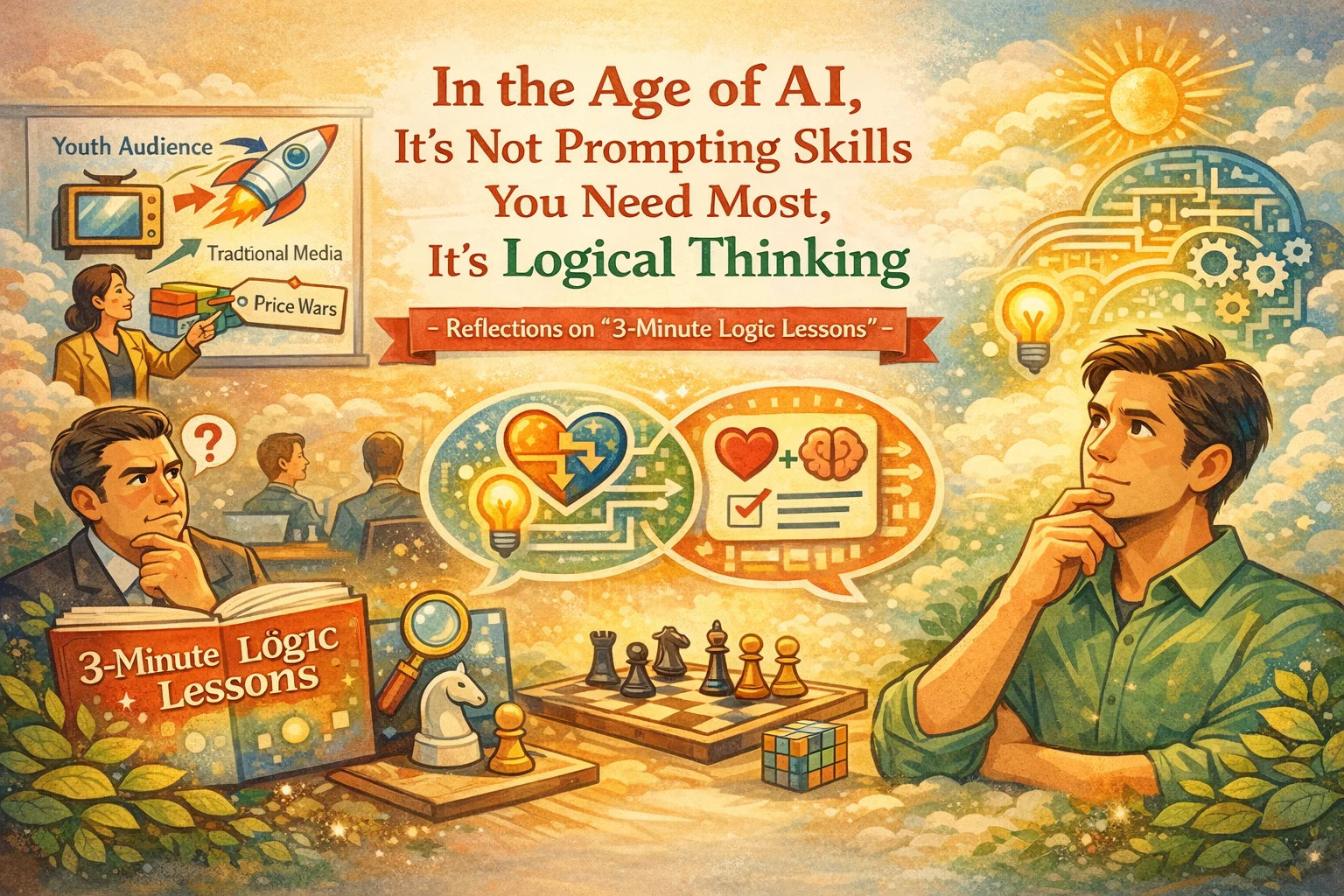
I asked him to project the project plan and spent three minutes browsing it. Frankly speaking, the text in that document is very smooth and the layout is beautiful - you can tell at a glance that AI helped polish the manuscript. But the problem is obvious: the logic is broken. Earlier, it was said that it would target young people, but later the marketing budget was all spent on traditional media. It was said that it would take a differentiated route, but in the end it returned to the old path of price war.
I told him at the time: “Your problem is not that the AI is not used well enough, but that the thinking you feed to the AI itself has loopholes.”
No matter how powerful the tools are, they cannot make up for the gaps in thinking. The clearer the logic you feed AI, the more accurate the results it will give you.
This matter has made me think about it for a long time. Later I read Jiang Weiwei’s “Three-minute logic lesson: debunk words, understand the situation, in AI “Eight Compulsory Courses for Cultivating Thinking Skills in This Times”, I string together my observations over the years and gain a more complete understanding.
Why do we need logic so much in this era?
Over the past fifteen years, I have worked as a corporate consultant in various industries and written more than a dozen books related to copywriting, marketing and AI applications. If you ask me, what is the most common workplace problem I have seen in recent years? My answer is not that I can’t write copy, or that I don’t understand digital marketing, but that most people lack basic logical thinking skills.
This may sound harsh, but I mean it.
Jiang Weiwei made a very precise statement at the beginning of the book: Logic is the essence of most problems. I feel the same way. Whether you are making a proposal, writing an article, making a major life decision, or even just debating with others on social media, whether you can speak clearly and think things through depends not on gorgeous rhetoric, but on solid logic.
What’s more, now is the era of AI. When AI can help you write fluent articles and help you generate professional-looking presentations, what is the most irreplaceable ability of humans? I think it is judgment and critical thinking - both of which are based on logic.
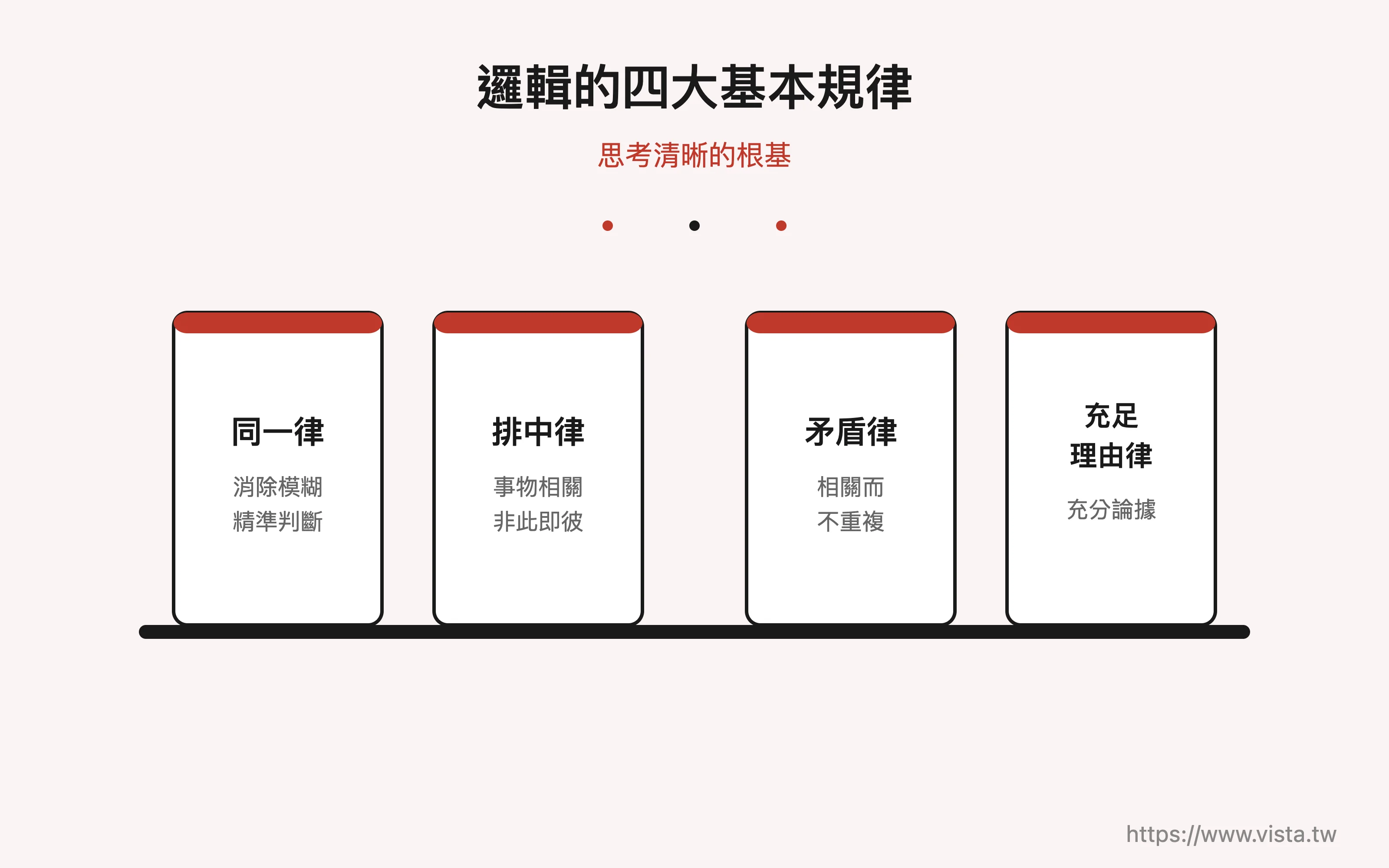 ▲ The law of identity, the law of contradiction, the law of excluded middle, and the law of sufficient reason—these four laws are the cornerstones of all logical thinking
What impressed me about this book
To be honest, there are quite a few books on logic. From Aristotle’s syllogisms to modern critical thinking textbooks, there is a thick stack on your bookshelf. But Jiang Weiwei’s “Three Minutes Logic Lesson”, there are a few things that particularly moved me.
It does not show off knowledge, but solves problems
Many logic books, when opened, contain propositional logic, predicate logic or truth tables… To be honest, for ordinary office workers or entrepreneurs, those things are too far away. Jiang Weiwei’s approach is different. He starts from the scenarios we encounter every day, such as: colleagues speaking ambiguously, people on the Internet secretly changing concepts, or bosses making decisions in black and white… You must be familiar with these scenarios, and he uses a logic framework to help you “translate” these phenomena into something that can be analyzed and dealt with.
When I was doing corporate training, what I was most afraid of was not being able to put it into practice - I talked about a lot of theories and the trainees thought they made sense, but they couldn’t use them when they got back to work. I feel that the author obviously has the same consciousness. He said in the preface that this book has only two questions to answer: What is logic? And how to use it in life? I appreciate this pragmatic attitude very much.
It values illogical thinking rather than deifying logic.
There is a chapter in the book that particularly stood out to me, that is, he talks about illogical thinking that cannot be ignored. Many people think that being logical means being a cold, rational robot. But Jiang Weiwei reminds readers: Perceptual thinking is equally important, and even more critical than logical thinking in some situations.
This is completely consistent with my experience over the years. I often tell students that good content creation people are not people who can only analyze data, but people who can freely switch between rationality and sensibility. You need logic to construct the skeleton of the argument, but you need sensibility to give it flesh and blood. An article with only logic reads like an instruction manual, and an article with only emotion reads like a diary. Content that truly touches people always contains both.
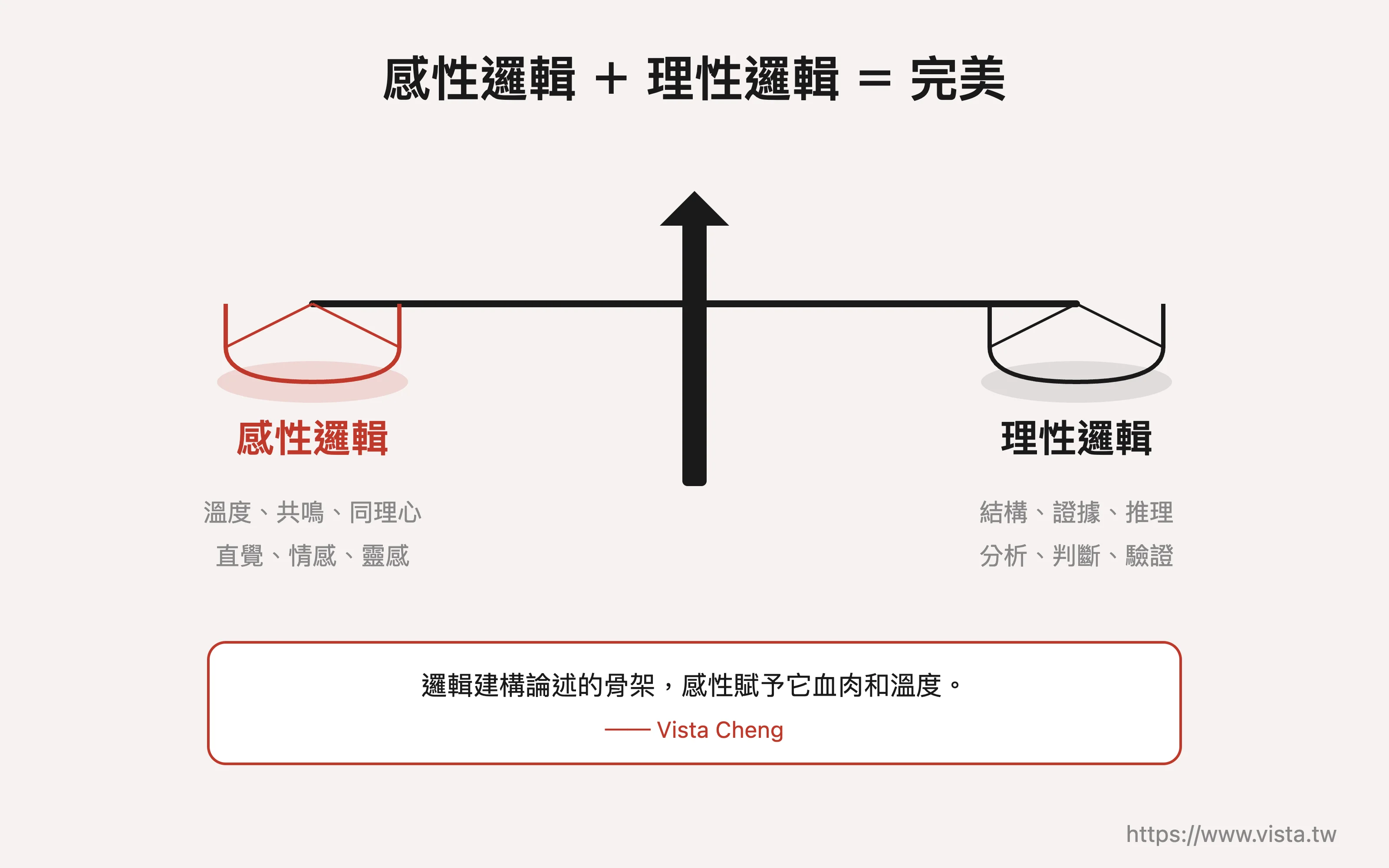 ▲ Only by combining emotional logic with rational logic can we create content that truly touches people’s hearts.
Jiang Weiwei used a good framework in Chapter 8: perceptual logic + rational logic = “perfection”. He doesn’t ask you to choose one or the other, but teaches you how to find a balance between the two. This kind of pragmatic and impartial attitude is actually not very common in popular works on logic.
Nine thinking patterns make me re-examine my teaching
Chapter 5 of the book introduces nine ways of thinking out of inertia: lateral thinking, tracking thinking, combination thinking, game thinking, reverse thinking, easy thinking, abstract thinking, divergent thinking and convergent thinking.
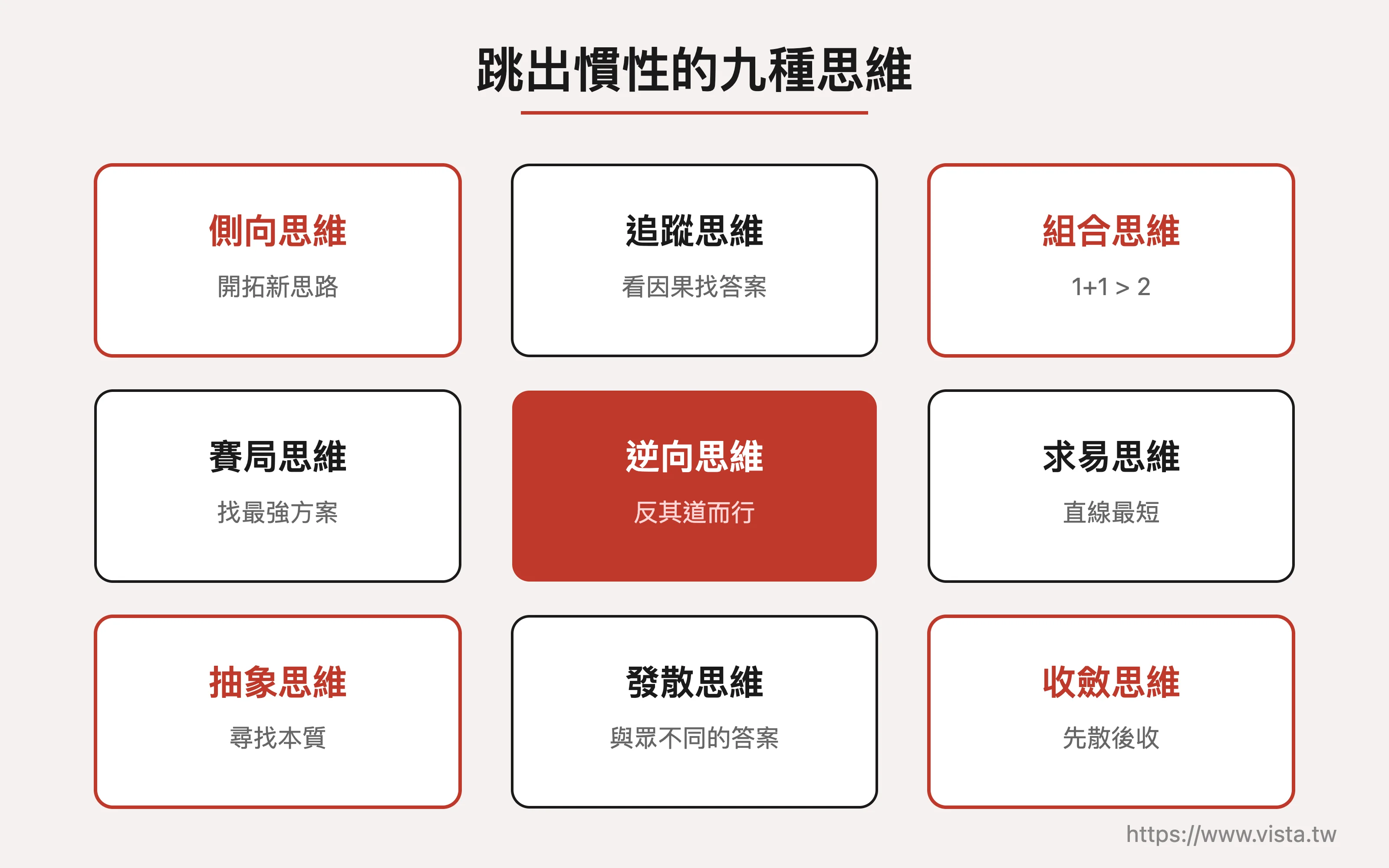 ▲ Nine ways of thinking outside the inertia to help you look at problems from different angles
To be honest, this is not the first time I have been exposed to these nine kinds of thinking, but Jiang Weiwei systematically put them together and provided specific cases, which made me re-examine my way of thinking in teaching and consulting work.
For example, “combination thinking” - let one plus one be greater than two. Isn’t that what I’ve been doing? Combining AI tools and content strategy can produce results far greater than either one alone. Another example is “game thinking” - finding the strongest plan. When I work as a digital transformation consultant for companies, I most often use this thinking mode: not only consider what I want to do, but also how competitors will react and how the market will change.
After reading this, I couldn’t help but write a line on the edge of the page:
A good thinking tool does not depend on whether it is new or not, but on whether you have truly internalized it into your daily decision-making. We have heard many truths, but the gap between hearing them and using them is beyond imagination.
Those ubiquitous logical traps in life
One of the parts of this book that resonated most with me was the logical fallacy discussed in Chapter 3. Jiang Weiwei sorted out six language traps, including repeated quotations, secret substitution of concepts, ambiguity, misuse of neutral words, etc.
 ▲ These six language logic traps you may encounter every day without knowing it
Let me share an experience of my own.
A few years ago, I saw a post on Facebook, to the effect of: “AI will replace all writing jobs, so learning to write is meaningless.” This sentence may sound reasonable at first, but if you think about it carefully, you will find that it is full of logical loopholes.
First, “all writing jobs” is too broad and an overgeneralization. AI can indeed handle certain types of writing tasks, such as news summaries and data reports, but can it replace in-depth reporting? Can it replace prose with personal life experience? Can it replace interview reporting that requires fieldwork and interpersonal interaction? It’s obviously not even close.
Secondly, the conclusion that “learning to write is meaningless” makes the mistake of “leading effects to causes” as mentioned in the book. Even if AI can handle some writing tasks, it does not mean that humans do not need writing abilities. On the contrary, the better you understand the logic and structure of writing, the better you can make use of AI as a tool and make it work for you.
Furthermore, this entire discussion is actually a typical “black and white” thinking - either AI will completely replace humans, or humans will not need AI at all. But how can the real world be so simple? The relationship between humans and AI has never been about “replacement” but “collaboration.”
 ▲ If someone tells you that there are only two approaches to a complex problem, don’t believe them
This is what Jiang Weiwei particularly emphasized in Chapter 7: rejecting the “black and white” way of thinking. He said it very well - if someone tells you there are only two ways to approach a complex problem, don’t believe him; if someone tells you there is only one way, then he is wrong.
In this era of information explosion, this kind of reminder is especially important. Social media is awash with extreme opinions, and everything is simplified into two opposing camps. But a true thinker should be able to see gray areas and oversimplified complexities.
The deep connection between logic and content creation
As someone who has been working in the field of content creation for a long time, I especially want to talk about the importance of logic from this perspective.
Many people think that writing articles depends on literary talent, inspiration and talent. But after teaching writing for so many years, I have become more and more certain of one thing: for people who write poorly, nine times out of ten, it is not a matter of literary talent, but a matter of logic.
Have you ever read that article - each paragraph seems to have something to say, but you read the whole article and have no idea what the author was trying to say? The reason is simple. The problem lies in the unclear logical relationship between paragraphs. Is it cause and effect? Is it a contrasting relationship? Is it a progressive relationship? Or is it a parallel relationship? If the author himself cannot figure it out, the reader will certainly be lost as well.
The four logical reasoning methods introduced by Jiang Weiwei in the book include: inductive reasoning, deductive reasoning, analogical reasoning and hypothetical reasoning. In fact, each of them can directly correspond to the writing method.
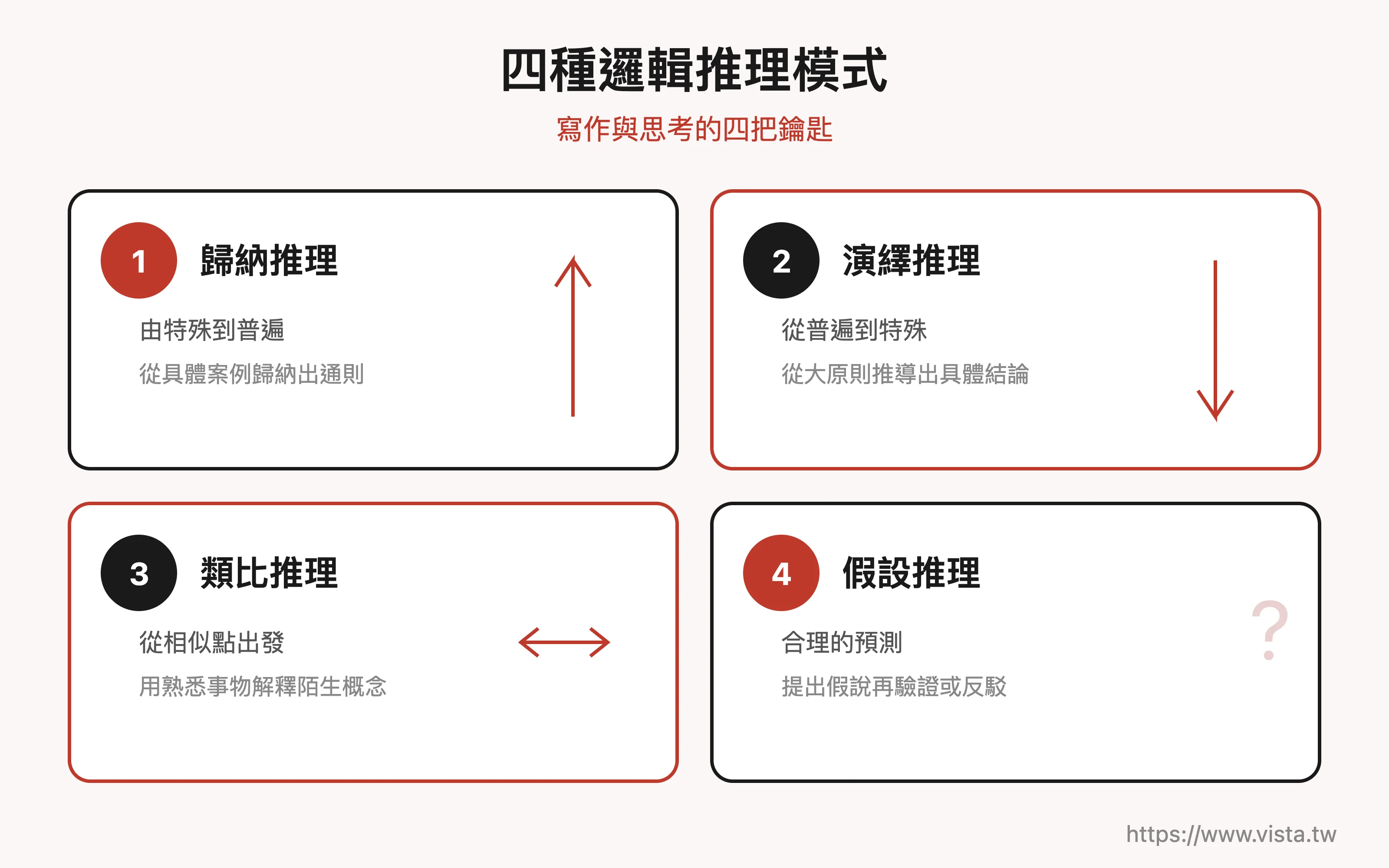 ▲ Induction, deduction, analogy and hypothesis - the four modes of reasoning are like four different lenses
Do you want to write an opinion piece that draws a general conclusion from several specific cases? That’s inductive reasoning. Do you want to start from a general principle and deduce what should be done in a specific situation? That’s deductive reasoning. Do you want to explain an unfamiliar concept using something familiar? That’s analogical reasoning. Do you want to propose a hypothesis and then support or refute it with evidence? That’s hypothetical reasoning.
▲ Induction, deduction, analogy and hypothesis - the four modes of reasoning are like four different lenses
Do you want to write an opinion piece that draws a general conclusion from several specific cases? That’s inductive reasoning. Do you want to start from a general principle and deduce what should be done in a specific situation? That’s deductive reasoning. Do you want to explain an unfamiliar concept using something familiar? That’s analogical reasoning. Do you want to propose a hypothesis and then support or refute it with evidence? That’s hypothetical reasoning.
You are not writing, you are constructing a discourse. The essence of writing is not to put words on paper, but to use words to organize your thoughts so that others can follow your logic.
I often tell students in the “Vista Writing Companion Program”: “You are not writing, you are constructing an argument.” The essence of writing is not to put words on paper, but to use words to organize your thoughts so that others can follow your logic and eventually be convinced by you, be moved by you, or have a new understanding of something.
The premise of all this is that your own logic must be tenable.
Logic in the AI era: why it’s more important than ever
I know many people may think: “There is already AI, why should I practice logic by myself? Can’t I just let AI do the thinking for me?”
Let me put it bluntly, this idea itself is a logical error.
AI is a tool, and the quality of the tool depends on the user. If you give the AI a prompt with confusing logic, what it will give you back is an answer that looks beautiful but actually cannot withstand scrutiny. Only when you give it a clear, logical, and hierarchical instruction can it really help you get things done.
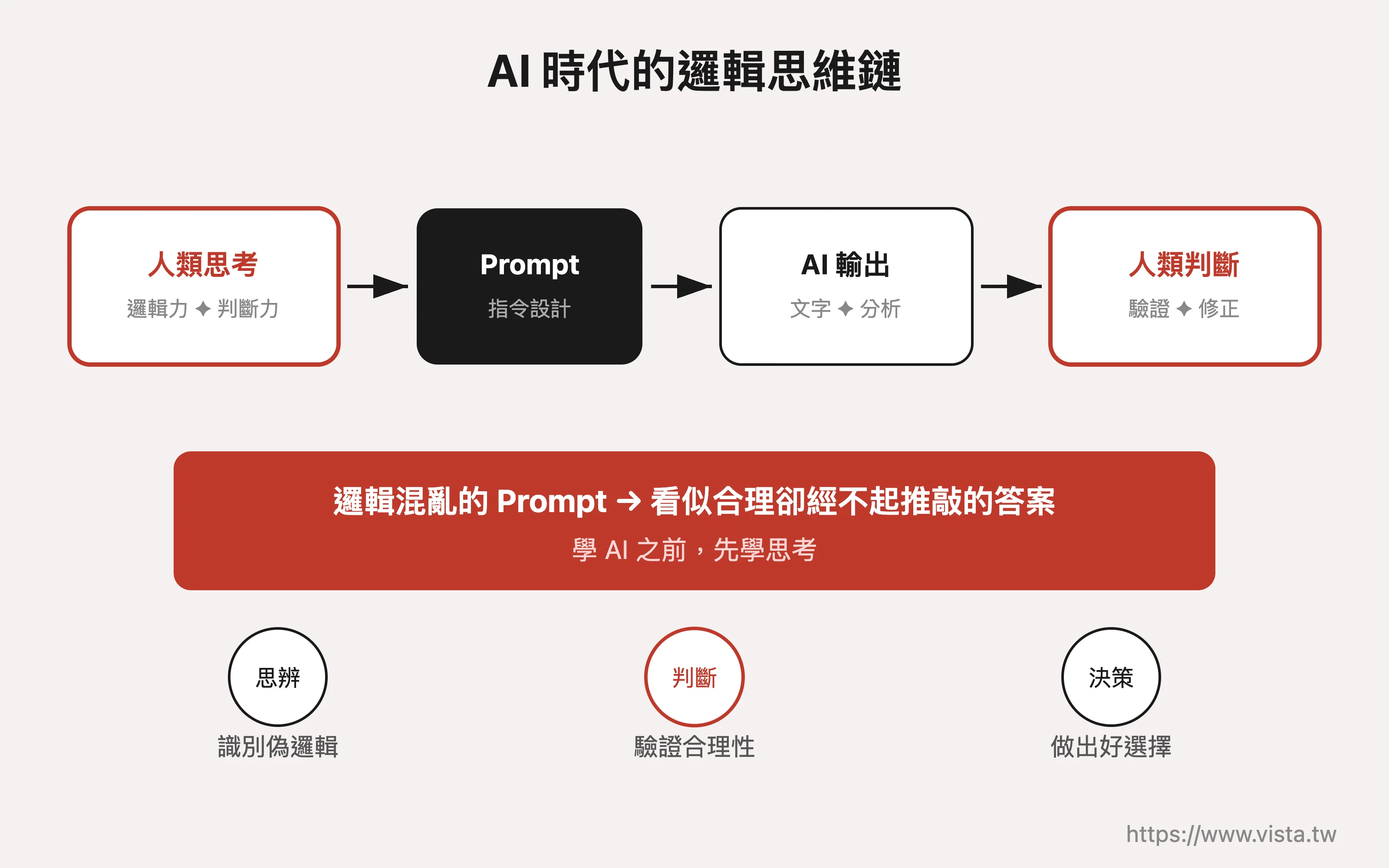 ▲ In the AI era, the logical thinking chain determines how much value you can get from AI tools
In the process of engaging in academic research, I have deeply realized one thing: the biggest risk of AI-generated content is not plagiarism, but pseudo-logic that seems reasonable but actually cannot withstand testing.
Simply put, because large language models work by predicting the next most likely token, they are inherently good at producing text that looks reasonable. But here comes the problem. There is a huge difference between what seems reasonable and what is really reasonable. The ability to distinguish between the two is logic.
Before learning AI, learn to think first. Or to be more precise, in the process of learning AI, you must simultaneously strengthen your logical thinking ability.
This is why I have been promoting a concept: before learning AI, learn to think first. Or to be more precise, in the process of learning AI, you must simultaneously strengthen your logical thinking ability. Otherwise, you just have an assistant who can talk a lot, rather than a partner who can help you make better decisions.
Although Jiang Weiwei did not discuss AI in depth in the book, his core proposition coincides with mine - in this era of overwhelming information, the most scarce thing is not information, but the ability to judge the authenticity of information and clarify the context of information. The core of this ability is logic.
🎯 **Want to create your own digital works? ** No programming background is required, just a willingness to try. My Vibe Coding Practical Workshop has helped professionals with non-technical backgrounds such as lawyers, writers, and university professors to use AI to create their own web page works in a short time. Will you be next? Learn more about the course
From forced logic to flexible thinking
There is a passage in the book that particularly touched me, that is, the part about forcing logical thinking.
Jiang Weiwei used the concept of obsessive-compulsive disorder to describe a common thinking pattern: repeated doubts, repeated confirmations, inability to trust one’s own judgment, and ultimately falling into a cycle of anxiety. He pointed out that people with mild obsessive logic will keep repeating the same modal particles when speaking; people with severe symptoms will continue to feel fear and always think about the worst.
I couldn’t help but smile bitterly when I read this. I thought, isn’t this the daily life of many workplace workers?
To be honest, I have seen too many cases like this. Some supervisors have to hold no less than three meetings a day to repeatedly confirm the progress of the same thing, making the entire team exhausted. Every time some entrepreneurs have to make a decision, they fall into an endless cycle of “but what if…” and end up not daring to do anything. Some writers clearly know that the first draft is very good, but they revise it dozens of times, and in the end they lose their original aura.
Behind these behaviors is actually a logical dilemma - they cannot find a good enough stopping point for their judgment. Every confirmation can’t really eliminate the anxiety, because the root of the anxiety is not that things have been done well, but that my thinking pattern prevents me from believing that things have been done.
In my opinion, the solution given by Jiang Weiwei is very practical: be aware of your own thinking patterns, and then deliberately practice changing from obsessive black-and-white thinking to a more flexible way of thinking. It’s not that you don’t confirm, but that you learn to trust your own judgment after confirming once.
Being good enough is an ability, not a compromise. Knowing when to stop requires good logical judgment in itself.
This is actually something I often emphasize when teaching AI applications: Don’t make infinite modifications just because AI can be modified and optimized infinitely. Being good enough is an ability, not a compromise. Knowing when to stop requires good logical judgment in itself.
The trap of repeating quotes – you probably make it every day
The chapter in the book about “repeated references and unclear definitions” is both funny and heartbreaking to read.
Jiang Weiwei gave a classic example: someone asked “What does a fox look like?” and another person answered “A fox is what a fox looks like.” This may seem like a joke, but if you think about it, do we often make the same mistakes in our daily communication?
In the workplace, I have heard too many conversations like this:
“What is the goal of this project?” “It is to do it well.”
“How do you think this copy should be modified?” “It just needs to be modified better.”
“What is our differentiated advantage?” “It’s what makes us different from others.”
Every answer is a perfect tautology. It sounds like you are answering a question, but actually says nothing.
 ▲ Use the “definition formula” to clarify vague concepts: defined concept = unique concept of a thing + the smallest genus concept
Jiang Weiwei provided a very useful definition formula: the defined concept = the unique concept of the thing + the smallest genus concept. To put it simply, you have to tell at the same time which category this thing belongs to, and how it is different from similar products? For example, “Humans are advanced animals that can make and use tools to work” - “Higher animals” is a category, and “can make and use tools to work” is a unique attribute.
This formula applies not only to academic writing, but also to daily communication. Next time someone asks you “What are the features of your company’s products?” try to use this framework to answer, and you will find that your expression will become much clearer immediately. If you are also interested in precision questioning, please refer to my previous article.
Three actions I took away from this book
The most fearful thing about reading is that after finishing reading, everything will remain the same. So, please allow me to share three specific action inspirations that I drew from this book.
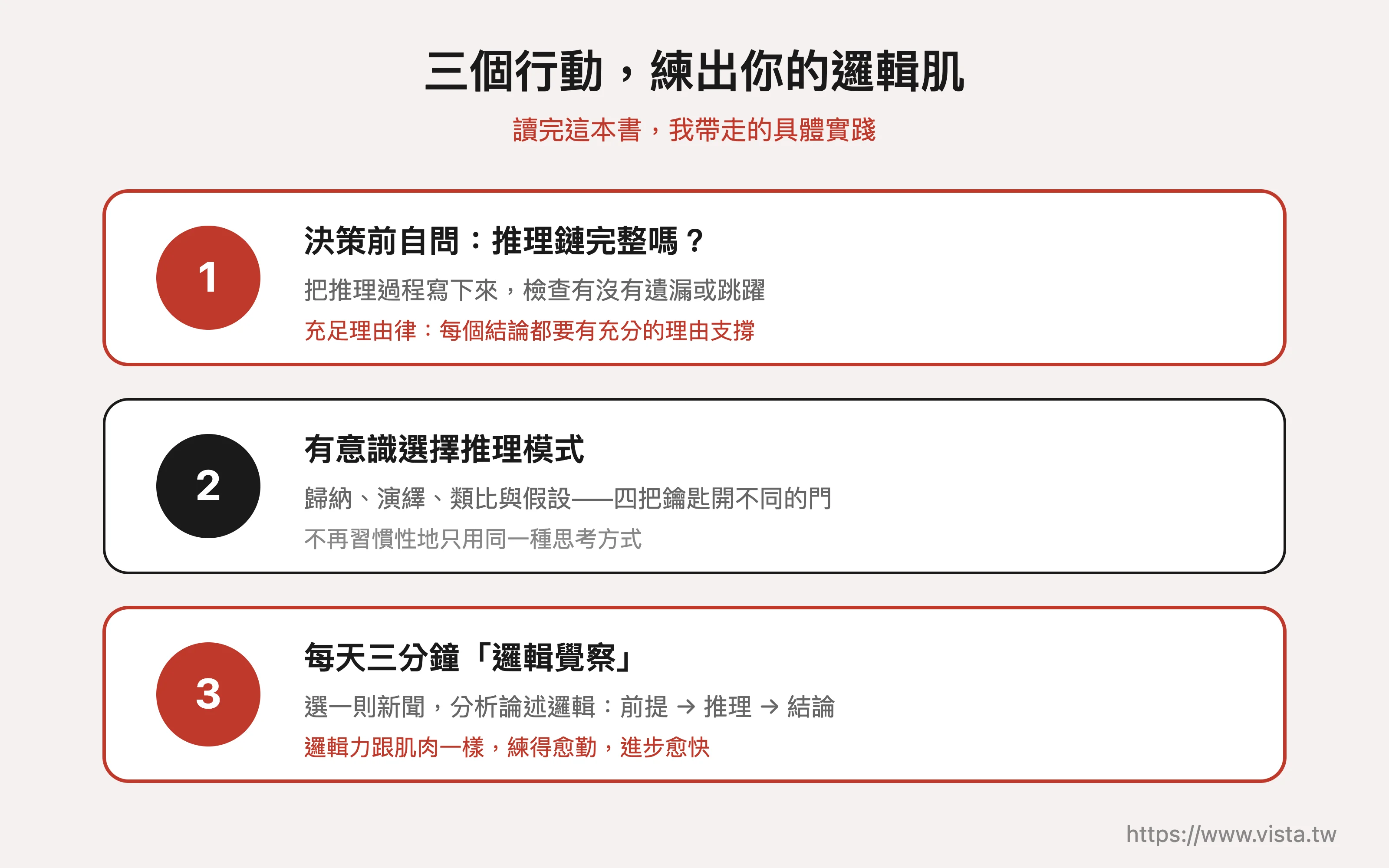 ▲ Three specific actions to help you change your logical thinking from “knowing” to “doing”
First, before every important decision, ask yourself: “Is my chain of reasoning complete?”
Jiang Weiwei introduced the “Law of Sufficient Reason” in the book - every conclusion you make should be supported by sufficient reasons. This sounds like common sense, but in reality, we often skip intermediate steps of reasoning and jump directly from feelings to conclusions. In the future, before making important decisions, I will deliberately write down my reasoning process to check for any omissions or jumps.
Second, use different reasoning modes more consciously when writing and teaching.
Induction, deduction, analogy and hypothesis - these four reasoning methods are like four different lenses, allowing you to look at the same problem from different angles. In the future, when preparing for courses or writing articles, I will more consciously choose the reasoning method that is most suitable for the current situation, instead of habitually using the same method. If you are also interested in how to improving writing through lateral thinking, you might as well find it for reference.
Third, spend three minutes every day practicing logical awareness
Jiang Weiwei put forward a great concept, which is three minutes of logic training every day. I plan to make this a daily habit. For example: every day when browsing the news or social media, select a message and spend three minutes analyzing its logic. What is its premise? What’s the conclusion? Does the intermediate reasoning hold up? Are there any pitfalls of misunderstanding, overgeneralization, or black and white?
This exercise doesn’t take a lot of time, but if you persevere, logical thinking will slowly become an intuition. Just like training a muscle, logic can also be trained, and the more frequently you practice it, the faster you will improve.
Written at the end: Logic is the power of gentleness
I want to end with an angle that you might not expect.
Many people think logic is cold and rational to the point of being ruthless. But I don’t think so. In my opinion, logic is actually a gentle force.
Because when you have good logic, you are less likely to be hijacked by emotions. You can stay calm when faced with conflicts, see the overall situation clearly when faced with choices, and not be blinded when faced with lies. You won’t make impulsive decisions because of fear, nor will you fall into obsessive thinking loops because of anxiety.
What’s more, you’ll become a better communicator. Because you know how to speak clearly, how to provide sufficient reasons for your opinions, and how to listen to other people’s arguments and find the logic. You don’t need to rely on your voice or power to convince others, you can rely on reason.
Isn’t this a kind of tenderness?
In the AI era, what we need is not more tools, but better brains. And practicing logic well is the most effective way to sharpen your brain.
This book “<a href=“https://www.books.com.tw/exep/assp.php/vista/products/0011043145?utm_source=vista&utm_medium=ap-books&utm_content=recommend&utm_campaign=ap-202602” target=“_blank” rel=“noopener” by Jiang Weiwei noreferrer”>Three Minutes Logic Lesson” not only has plain text and rich examples, but also has a clear structure. It is very suitable for readers without logic background to get started. Of course, it won’t make you a logic guru overnight, but it will plant a seed in your heart. As long as you are willing to spend three minutes a day irrigating, this seed will eventually grow into a stable and lush tree.
If you are at the decision-making point of whether to read this book, let me use the logic in the book to help you make a simple reasoning:
Premise 1: Logic is one of the core human abilities in the AI era.
Premise 2: This book can help you establish the foundation of logic in the least amount of time.
Conclusion: This book is worth your time.
Is this reasoning logically tenable? Well, I believe the answer is yes.
Extended reading:
- When AI makes answers cheap, what’s really valuable is whether your questions are accurate enough
- Content creation starts with thinking, observation and lots of practice
- Improving writing through lateral thinking: Take a thinking adventure
- Stop chasing tools! Build your own “unbeatable system” in the AI era
- Vibe Coding drives marketing superpower: Let AI be your digital creative partner
External Resources:
- Three-minute logic lesson - blog
- National Taiwan University Open Courses: Logic
- Jiang Weiwei - Baidu Encyclopedia