I use AI to build an entire content production line: let one article automatically turn into six outputs
I want to ask you a question first: How is the way you write with AI different now compared to a year ago?
If your answer is “Actually, it’s almost the same, except that Prompt is written a little better,” then this article may make you rethink something.
Because I have experienced a big change in the past six months. From a person who chats with AI to assist writing, he has become a person who uses AI systems to manage content. These two things sound similar, but are completely different in nature.
The former are stragglers and the latter are factory production lines.
An observation that made me change my approach
The starting point for change came from a very simple observation.
I looked back at my content output in the past six months and found a very wasteful pattern: writing the article itself is not slow for me, but after the article is published, it lies there quietly. If I wanted to share the same sentiment in a newsletter, I would have to write it all over again. Want to post to social platforms? Rewrite it again. Want to make a presentation to share with companies? Make it again.
I would make the same core idea four or five times, starting from scratch every time.
This is not a question of writing efficiency, it is a question of system design.
I began to think: Is it possible to build a system that allows me to input the core ideas and materials once, and the system can help me produce content in multiple formats and adapt to multiple platforms?
The answer is yes. And this system is already in operation.
The real breakthrough in efficiency is not to do one thing faster, but to automatically turn the results of one thing into ten things.
System overview: five-layer architecture from input to distribution
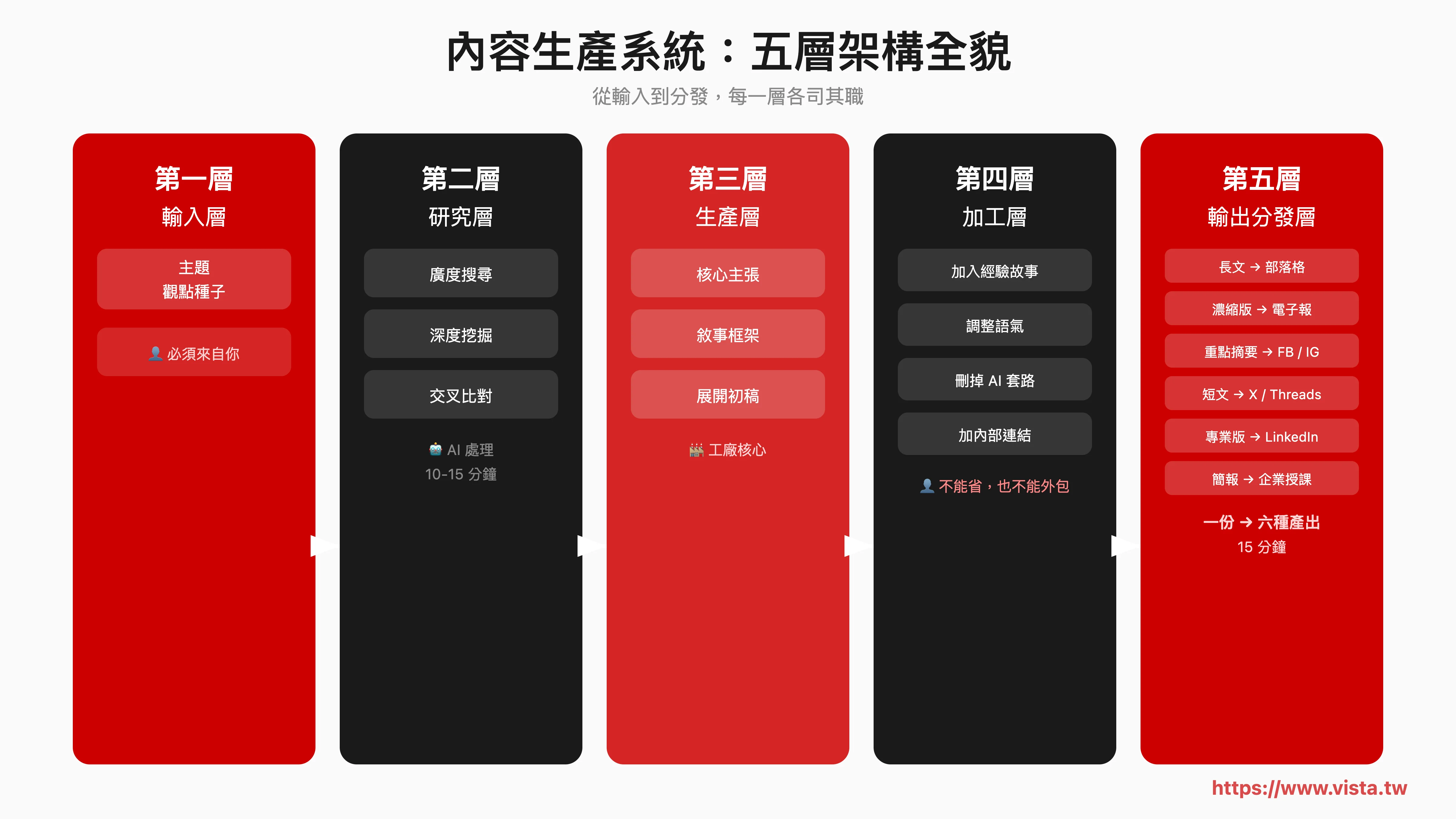 ▲ The five-layer architecture of the content production system: from the input of idea seeds to the distribution of multi-platforms, each layer performs its own duties
I broke the entire system down into five levels, with each level performing its own duties. Let me break it down for you layer by layer.
The first layer: input layer
The starting point of each piece of content is a topic plus the seeds of my own opinions.
The so-called seeds of ideas may be just a sentence, a question, or a phenomenon I observed at a teaching site or during a consulting project. For example, the seed of this article is: “The way most people use AI to write things has hardly changed in a year, but the AI tools themselves have evolved for several generations.”
I usually record these seeds by voice - when walking, taking the subway, taking a shower - and then let AI help me organize them into text and save them in Anytype. I have shared this habit in detail in the article AI Diary.
The point is: the core material of the input layer must come from yourself. Your experience, your observations, your judgment. These things are the raw materials for the entire factory. AI cannot make them, nor should they be made by AI.
Second layer: Research layer
After I have the topic and idea seeds, I need additional information to support the argument.
I leave this layer to Claude Code. It will do three things for me:
First, search in breadth. Collect the latest information, reports, research and cases online on the topic, and organize it into a structured summary.
Second, dig deeper. If a certain subtopic requires more in-depth academic support, it will help me search for relevant papers and professional literature and extract the key arguments.
Third, cross-comparison of viewpoints. 把我的观点种子和搜集到的资料放在一起,找出支持的证据、反面的论述,以及我可能忽略的角度。
The entire research layer can be completed in about ten to fifteen minutes, and the quality is stable. In the past, it would take at least one to two hours for me to do these things by myself, and I often missed important information due to distraction.
The third layer: production layer
This layer is the core of the entire factory - assembling research materials and my opinions into a complete article.
The process is like this:
- I first write down the core proposition of this article in two or three sentences based on the research materials and opinion seeds.
- Give Claude Code a narrative framework (the one I most commonly use is “Observation → Question → Analysis → Method → Story → Enlightenment”)
- It develops into a complete first draft based on the framework and materials.
There is a very important detail here: the narrative framework is defined by myself, not by letting AI play freely.
Why? Because the frame determines the skeleton of the article, the skeleton determines the reader’s reading experience. If you let the AI decide the structure, it will usually give you a very formulaic “what is X → benefits of X → how to do X → conclusion” pattern. If you read too many articles like this, readers will get bored.
After years of exploration in writing, I have developed several sets of narrative structures that I usually use, each suitable for different types of themes. These structures are my recipes, and the AI is responsible for producing them according to the recipe, but the recipe itself is mine.
The fourth layer: processing layer
After the first draft comes out, I enter the stage where I spend the most time: manual polishing.
I have dismantled this layer in detail in the article Content Production Line. To put it simply, it’s four things: add personal experience and stories, adjust to my own tone, delete the AI’s nonsense routines, and add internal links to old articles.
I would like to emphasize one point: this stage cannot be omitted or outsourced.
The soul of an article is injected at the processing layer. Without this layer, your article will not be fundamentally different from anything produced by anyone using the same AI tool. With this layer, readers will feel “this is written by Vista” instead of “this is written by AI”.
Factories can standardize production, but brands cannot. The processing layer is your brand injection point.
The fifth layer: output and distribution layer
This layer is where the efficiency of the entire system has been most significantly improved.
For a completed long article, I will let Claude Code help me convert it into multiple formats and lengths:
| Output format | Usage | Properties |
|---|---|---|
| Original long article (2000-3000 words) | Blog | Complete discussion, SEO friendly |
| Condensed version (1000 words) | E-newsletter | Retain the core points and add a personalized opening |
| Key summary (3-5 points) | Facebook / Instagram | Graphic card-style presentation, easy to share |
| Single point of view + hook (within 100 words) | X / Threads | Short and powerful, spark discussion |
| Rewritten from a workplace application perspective | Professional context, emphasizing practical value | |
| Teaching briefing (10-15 pages) | Corporate teaching / Workshop | Visual presentation, including interactive links |
 ▲ One content, six outputs: the same core point of view, adapted to the format and context of different platforms
One content, six outputs. What used to take time to produce separately can now be completed within fifteen minutes of finalizing the article.
This is not laziness. This is the logic of content flywheel: the same core point of view, using different packaging, reaches different audiences on different platforms. Your point of view hasn’t changed, it’s just that the way you express it fits the different context.
Fundamental differences between ChatGPT and Claude Code
After reading this, you may ask: Can’t these things be done with ChatGPT?
Yes, but the experience and efficiency are completely different.
It is true that ChatGPT can also do continuous tasks, but most of them rely on specific modes and tool chains; on the other hand, Claude Code has made this into its main product form and preset process.
Therefore, what Claude Code does is: all steps are executed continuously in the same task environment. After research, go directly to the outline. Once the outline is confirmed, start writing the first draft. After the first draft is written, convert the format, run the instructions, and push it all the way to release. There is almost no need for manual processing during the entire content production process.
On the other hand, ChatGPT can certainly do a good job in research, outline planning, and first draft writing; but if you are in a general chat usage situation, the process is easily fragmented, and you often have to copy and paste or string the process yourself. Only when you enable specific agents, tools, and connection capabilities can you get closer to the experience of running the entire project.
I have to say that I still like to use ChatGPT to generate ideas or organize my thoughts, but in the process of content production, Claude Code is like a full-time special assistant sitting next to me, with direct access to projects and terminals - as long as I give orders and give orders, it can deliver things smoothly along the same work line.
Therefore, there is no advantage or disadvantage between the two, but their original positioning is different.
💡 **Want to experience the complete process of using AI to build digital products from scratch? **
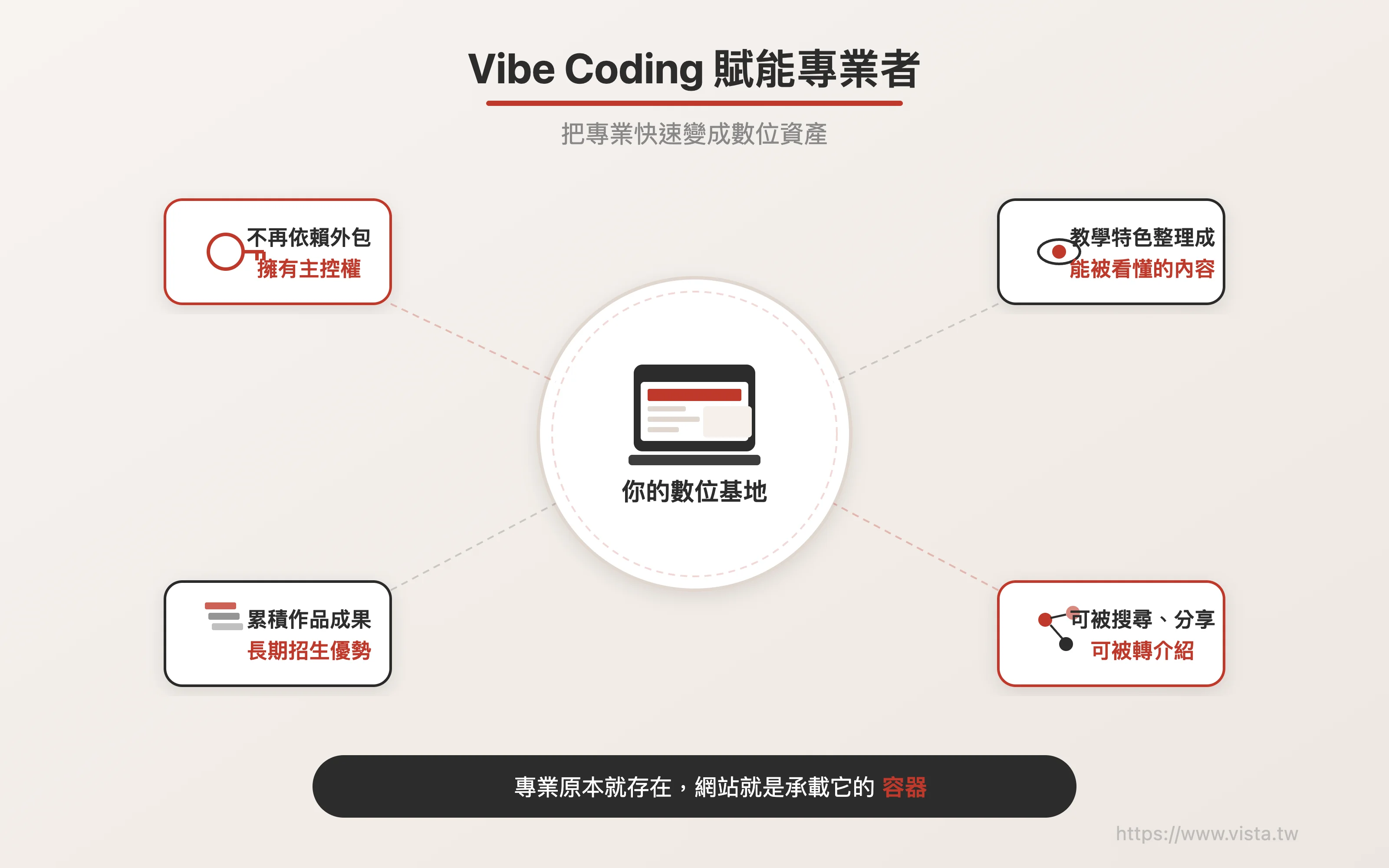
I have opened a Vibe Coding Practical Workshop, which will take you to use AI to turn the idea in your mind into a truly online work within 3 hours. There is no need for any programming foundation, as long as you bring your professional knowledge, you can feel the power of “one person is a team”.
Who is this system suitable for?
I’m going to be honest: this system isn’t for everyone.
If you only write one or two articles a month, you may not need such a complicated system. Just ask and answer with ChatGPT.
If you don’t plan to operate multiple platforms, then the output distribution layer will be of little value to you.
If you are still exploring your writing style and point of view, then what you need most at this stage is not efficiency tools, but a lot of practice and thinking. AI can speed up production, but it can’t find your voice for you.
But if you meet the following conditions, this system will save you a lot of time:
- You need to produce content regularly (at least one to two articles per week)
- You operate multiple platforms and need to adapt the same point of view to different formats
- You already have your own point of view and style, you’re just being slowed down by administrative work
- You are a lecturer, consultant or knowledge worker who needs to transform teaching content into various forms of output
If you meet at least two of the above criteria, then this system is worth your time to study.
A common worry: Won’t the content produced in this way be full of AI flavor?
 ▲ The key is not whether you use AI or not, but in which aspects you inject your own thinking and experience
This is the question I’ve been asked the most.
The answer depends on how you use it.
If you hand over all the upper five layers to AI and you are only responsible for clicking “Start”, the output will indeed taste very AI-like. Because it lacks the two most critical layers: the opinion seeds of the input layer (your original thinking) and the manual polishing of the processing layer (your voice and story).
But if you are like me and put enough effort into the input layer and processing layer, and AI will only help you handle the mechanical work in the middle - collecting data, developing the first draft, and converting the format - then the final content is still yours.
For example: a chef uses a food processor to chop, puree, and stir vegetables. No one will say that the dish was made by the food processor. Because the selection of ingredients, the proportion of seasonings, and the cooking heat are all the judgment of the chef. AI is your blender. It speeds up the process of preparing ingredients, but you still decide the taste of the dish.
What really determines the quality of content is not what tools you use to produce it, but what aspects you put your own thinking into.
From individual creator to one-person content team
I want to end by talking about the bigger picture.
In the past, it was almost impossible for one person to manage content for multiple platforms without hiring a team. You need a research assistant to help you find information, an editor to help you polish the manuscript, a designer to help you make graphics cards, and a community editor to help you rewrite versions for different platforms. These labor costs alone make most individual creators prohibitive.
But now, Claude Code, coupled with Skills and MCP, is essentially an AI-driven virtual content team. Research assistant, first draft editor, format conversion, multi-platform adaptation - it can play these roles. And you, as the editor-in-chief of this team, are responsible for the most important things: setting direction, point of view, and quality standards.
This is not talking about the future. This is what I do every day now.
You can be one person, but your productivity can be equal to a team. The premise is that you are willing to spend time building this system instead of continuing to chat with the AI in a question-and-answer manner.
 ▲ Upgrading from dialogue to system: the real transformation is not to change tools, but to change thinking
The real change is not to change a tool, but to change a way of thinking. The way you use AI should be upgraded from conversation to system, from fragmentation to structure, from one-time upgrade to replicability.
This is the real watershed in competitiveness in the AI era.
You can be one person, but your productivity can be equal to a team. The key is not how powerful the tool is, but how complete your system is.
Extended reading:
- When AI not only helps you write, but also helps you research, format and publish: the content production line I created with Claude Code
- Claude Code is not just a tool for engineers: five practical uses that amaze knowledge workers
- Anytype + Claude: Create an AI-driven second brain to make your notes come alive
- I no longer “write” a diary: AI lets me use “talking” instead, turning life into a database
- In the AI era, should you follow the trend and transfer knowledge, or delve deeper into originality?