
When articles about AI are flying everywhere: It’s not that you don’t write well enough, but that you are too easily replaced.
The articles you see on social media now may be full of AI flavor.
It is usually very neat: it starts with a resonant question “Do you also…?” in the middle, lists 3 to 7 key points in the middle, the tone is gentle but firm, the paragraphs are clean, and finally it is condensed into one or two powerful sentences.
You can’t say it’s bad, it’s even smooth and every section looks correct. But after reading it, you will feel an indescribable emptiness, like drinking a cup of coffee without caffeine. Although there is a lingering aroma, it is not refreshing.
 ▲ AI-sensing articles are like a cup of coffee without caffeine: fragrant, but not refreshing.
And this is the strangest phenomenon this year, and the most worthy of every creator to face up to: Articles full of AI are overflowing, the average content has increased, but the proportion worthy of being remembered has decreased.
We don’t actually hate AI, what we hate is the illusion of hard work
In the past, when you saw an article, regardless of whether you liked it or not, you would always silently assume that the author spent time and racked his brains in exchange for it.
He has read many books and even stepped into many pitfalls. Even if his writing style is ordinary, at least he can see the human touch. But, not anymore! When you see neat, smooth, and impeccable paragraphs, a question will pop up in your mind: Did he write this? Or was it written by ChatGPT?
What readers are disgusted with is not the tool, but the disguise.
What readers dislikes is not the tool, but a disguise:
- Use neat format to create a sense of depth
- Use golden sentences to create a sense of insight
- Use case adjectives to create a sense of experience
- Use contrasting sentence patterns to create a sense of thinking
You will feel that your feelings have been deceived, and you will hate that your precious attention has been deceived. Why are you in so much pain? The reason is simple, that’s because attention is more expensive than money today.
The real problem with AI sense is that it makes content fungible
The strongest point of AI is that it makes things that are pretty good very cheap.
Do you want to write an 1,800-word piece of career advice? Okay, done in two minutes. Need a 4500-word IT trends analysis? Okay, I can call it a day in five minutes.
Whether you want ten quotes, three cases, or two metaphors? All can be generated with one click.
 ▲ Everyone is producing similar things, but few are producing unique content that only he can write
As a result, a strange phenomenon began to appear in the content world: everyone is producing similar things, but few people are producing unique content that only he can write.
There is only one end for similar things, and that is to be treated as filler by the algorithm and as background sound that slides by by the reader.
There is only one end for similar things, and that is to be treated as filler by the algorithm and as background sound that slides past by the readers.
Having said that, this also explains why you are harder to remember even though your writing is better and more complete, just because your work falls into a world of averages.
The content battlefield in the AI era has changed its scoring standards
I used to be a media reporter. In the past, we competed on the amount of information, organization, structure and speed. But now, these are no longer moats, because AI has flattened them!
The real scoring standard has only four words: irreplaceable.
So what is irreplaceable?
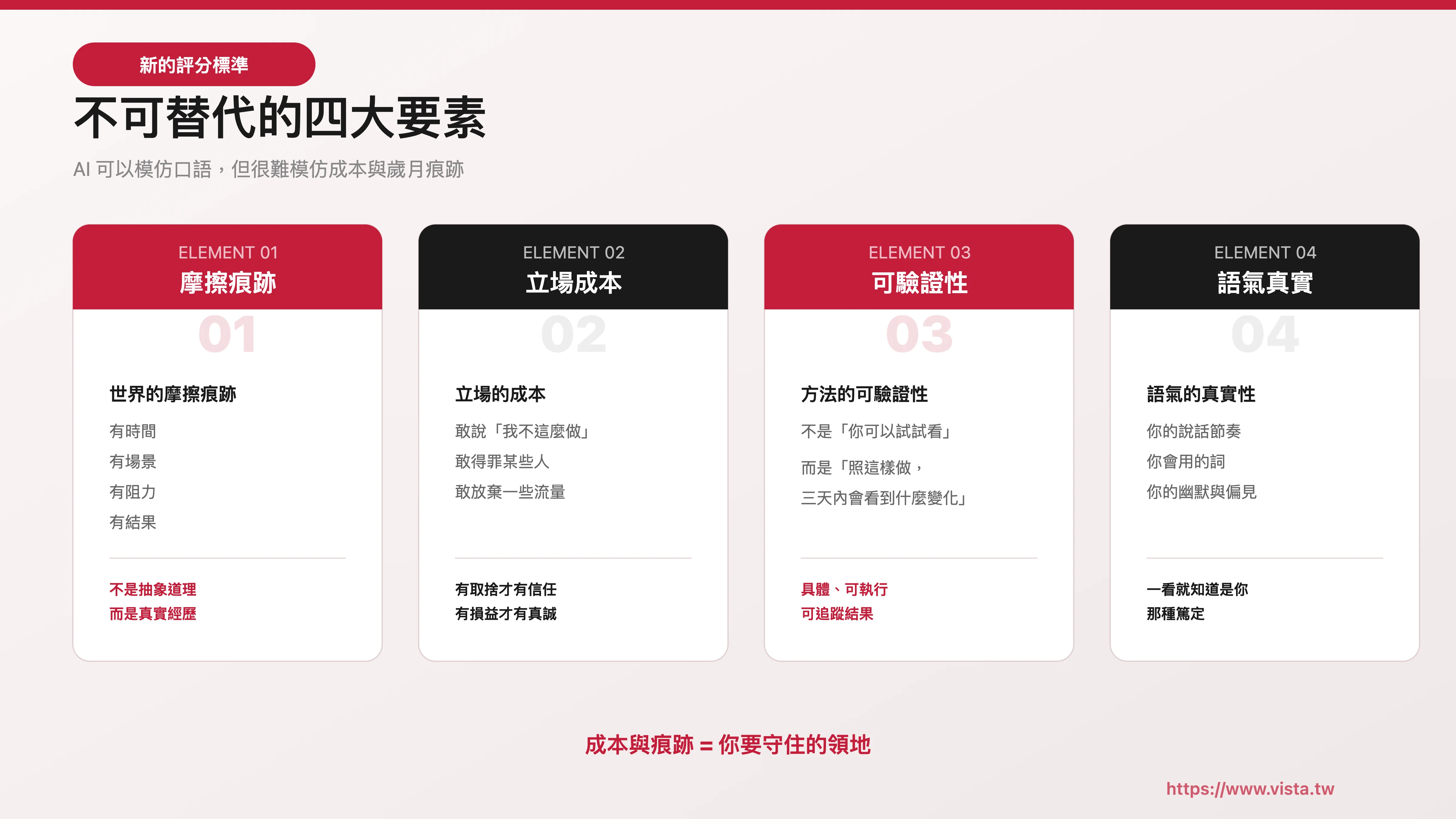 ▲ Friction marks, stance cost, verifiability, and authenticity of tone—these four elements are difficult for AI to imitate
1. Traces of friction in the world. There is time, there is a scene, there is resistance, and there is a result. It’s not an abstract principle.
2. The cost of standing. You dare to say “I won’t do that”, you dare to offend some people, and you dare to give up some traffic.
3. Verifiability of the method. It’s not “You can try it”, but “Just do this and you will see changes in three days.”
4. Authenticity of tone. It’s not just your colloquialism, it’s the rhythm of your speaking, the words you use, your humor and prejudice - the kind of determination that makes people know it’s you at a glance.
AI can imitate spoken language, but it is difficult to imitate the cost and time we have spent.
Seeing this, you should be able to understand: costs and traces are the territory you have to defend next.
Suggestions for creators: Don’t compete with AI for output, compete with AI for gold content
If you’re still trying to spell faster, more completely, or organize more clearly today, you’re probably just getting tired. Because you are comparing your physical strength with a machine that doesn’t complain about being tired and is willing to work overtime indefinitely.
 ▲ Put AI into your content production system, let it run the assembly line, and leave your manpower to the forge
As a writing coach, I would suggest that you think in a higher dimension and split the content into two types:
1) What AI can OEM: Substitutable content. Organization, summary, list, template, common sense teaching or concept popularization. This kind of content can be done, but the purpose is not to be remembered, but to try to pave the way: let new readers know what you have to offer in this field.
2) What Only You Can Do: Irreplaceable Content. Your case library, your failure history, your methodology, your reasons for decision-making or your paranoia about something. This kind of content is your brand asset, and it will become more valuable the more you write it.
What you have to do is not to reject AI, but to put AI into your content production system, let it run the assembly line, and leave your manpower to the forge.
What you have to do is not to reject AI, but to let AI do the assembly line and leave your manpower to the forge.
🤖 AI Content Production System Workshop: Let AI do the assembly line, you focus on the forging plant
Instead of worrying about being replaced by AI, it is better to learn to control AI. In this workshop, you will build your own content production system—let AI handle the fungible parts, leaving your time for the irreplaceable content that only you can create.
👉 Learn about the AI content production system workshop now
 ▲ AI Content Production System Workshop: Build your content production system and let AI become your best assistant
Action Blueprint: A set of content workflow that removes the sense of AI
Step one: Build your irreplaceable material library
You don’t have to rush to write an article first. Start by making three lists of at least 20 items each:
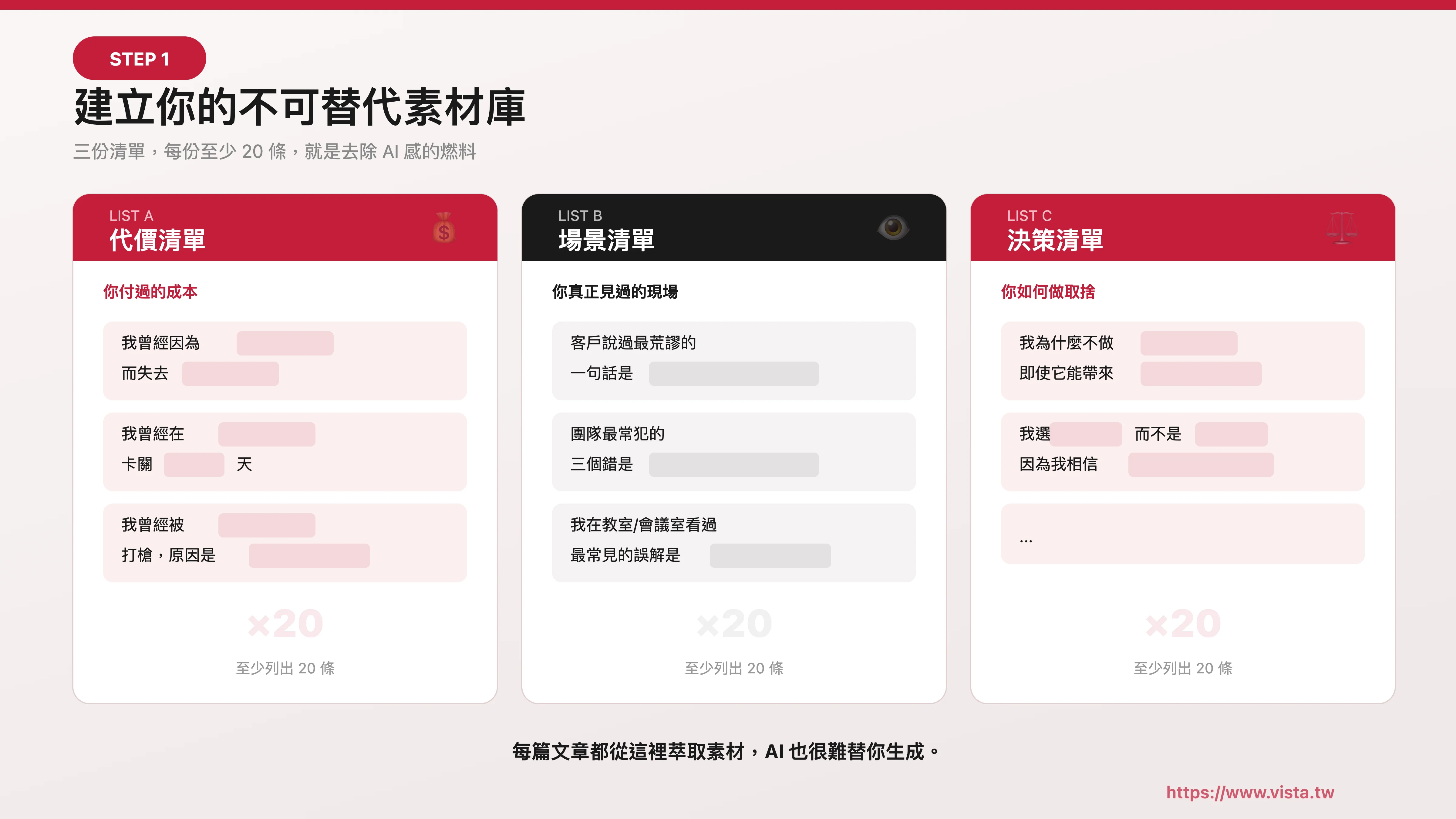 ▲ Cost list, scenario list, decision list—these three lists are the fuel to remove the sense of AI
A. List of costs (costs you paid). I once lost __ because of __; I once got stuck in __ for __ days; I once got shot by __ because of __.
B. List of scenes (scenes you have actually seen). The most ridiculous sentence a customer has ever said is __; the three most common mistakes teams make are __; and the most common misunderstanding I have seen in classrooms or conference rooms is __.
C. Decision Checklist (how you make trade-offs). Why don’t I do __, even if it can bring __; I choose __ instead of __ because I believe in __.
These three lists are the fuel to remove the sense of AI. For every article you write in the future, you can extract materials from here, and it will be difficult for AI to generate them for you.
Step 2: Change the routine of reasoning first to friction first
The biggest feature of AI-sensing articles is that they first make sense and then find cases to support it.
At this time, you may be able to do the opposite: give friction first to make sense.
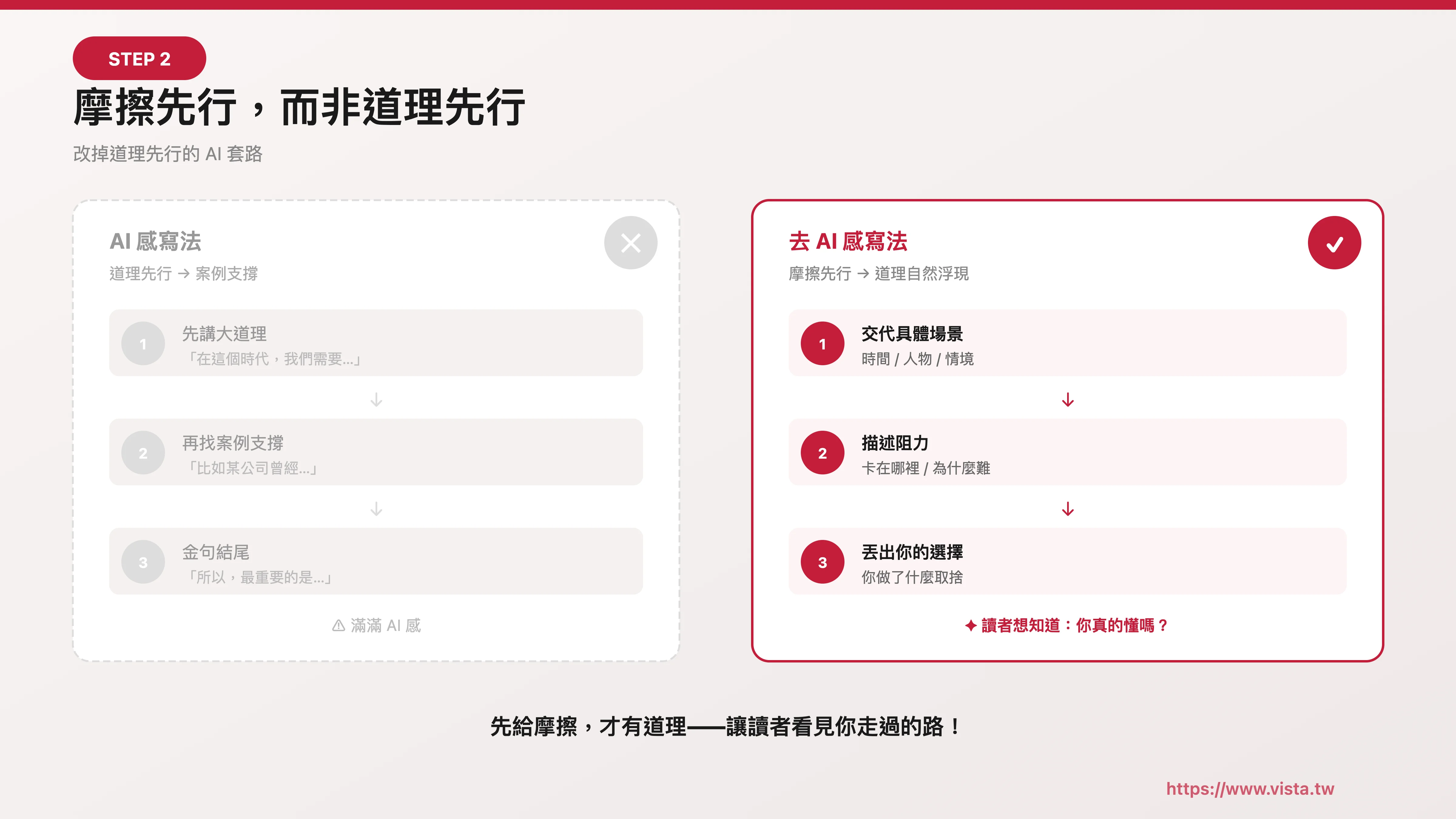 ▲ First explain the specific scene, describe the resistance, and present your choices - let readers know that you have really gone through this journey
At the beginning of an article, please do only these three things:
- Explain the specific scene (time/character/situation)
- Describe the resistance (where you are stuck and why it is difficult)
- Throw out your choices (what trade-offs did you make)
Those trends or big principles can be put aside first, because what readers want to know most now is do you really understand them? Have you ever walked this road before?
Step 3: Add a counter-evidence paragraph to give the article a position and cost
From my observation, AI is very good at writing that kind of best of both worlds.
But the reason why people will be remembered may be because you dare to deny it.
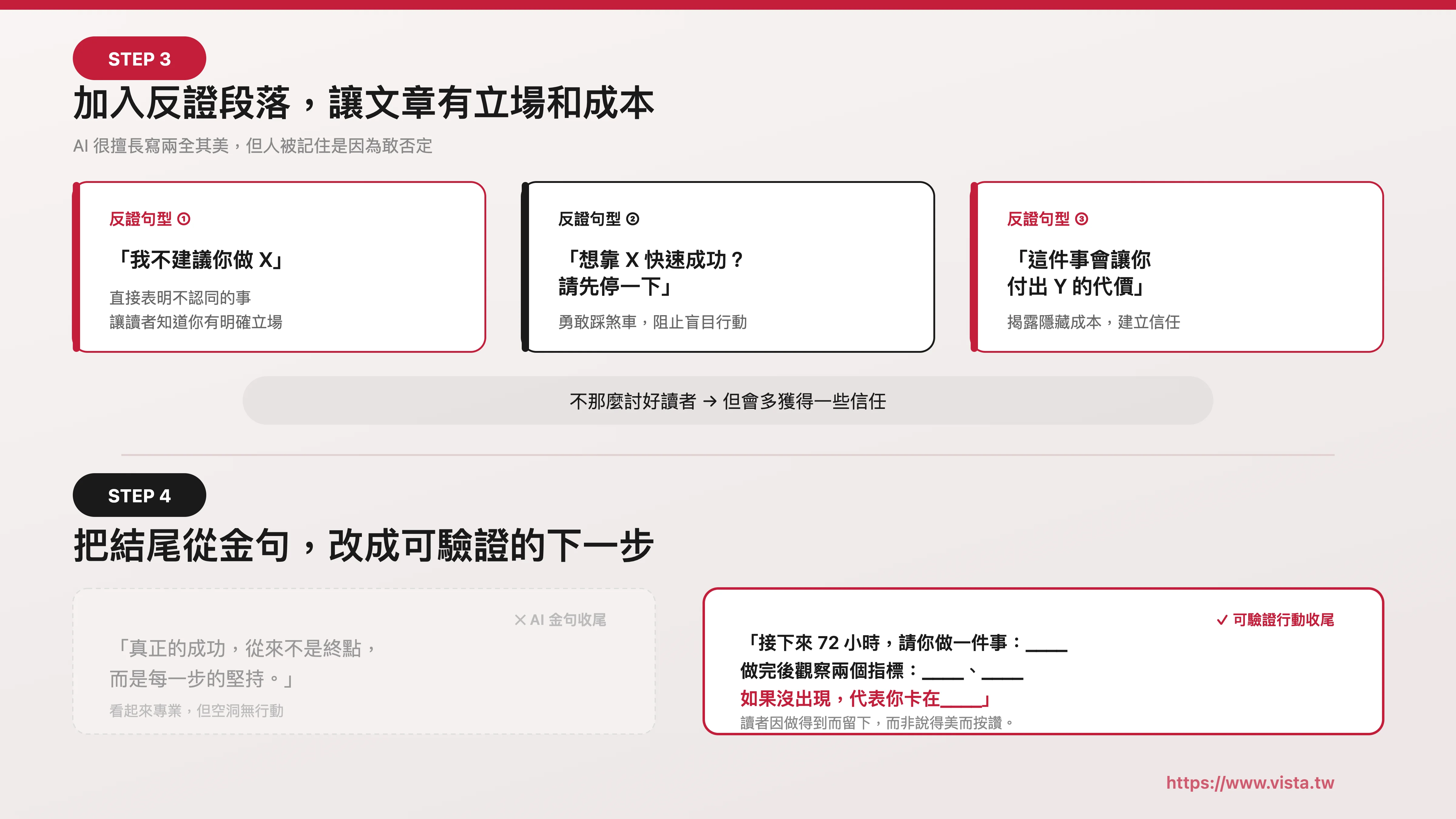 ▲ Only content that has a stand and cost can win the trust of readers.
Therefore, if the article adds this paragraph:
- I don’t recommend you do X
- If you want to achieve quick success with X now, I suggest you stop for a moment.
- This incident will actually cost you Y
Doing so may make you less palatable to readers, but it may gain you more trust. Everything has its pros and cons, just think about it clearly!
Step 4: Change the ending from a golden sentence to a verifiable next step
AI likes to end with a golden sentence, because it looks very professional, like the crystallization of insightful thinking.
At this time, you may wish to end it with action instead, and it must be verifiable.
Let me give you an example:
In the next 72 hours, please do one thing: create your “price list”. After you’re done, you’ll observe two indicators: the beginning of your article becomes more visual, and your reader interaction rate starts to increase. If it doesn’t appear, it means you are actually stuck in a situation where the material is not realistic enough.
Readers will stay because they can do it, not because they say it beautifully.
The real freedom of writing in the AI era is when you dare to leave your own footprints
I have always felt that AI brings not a creative crisis, but a crisis of self.
Because it forces you to face a cruel question: when neatness, completeness, and smoothness are no longer valuable, what do you have left?
What is left of you is the path you have really taken. A contradiction you are willing to admit. The price you are willing to pay. A stance you are willing to take.
And these are the reasons why readers are willing to give their attention to you.
Don’t let AI ghostwrite for you, think of AI as your assistant. Please leave your own footprints in the article. So, my suggestion is simple, that is, don’t think of AI as your article generator, but think of it as your little helper. Please leave your own footprints in the article. With a growth mindset, bravely write content that only you can write, and let every article become the crystallization of your input and output.
Further reading
- Writing Coach Vista teaches you how to write good and exciting articles
- Build an irreplaceable personal brand
- Content creation, starts with thinking and observation