How does the foreign sales team use AI? 5 ways to cut your workload in half

This article was originally published in “Vista Newsletter” No. 129: How does the foreign sales team use AI? 5 scenarios to cut your workload in half (opens in a new tab). Welcome to free subscription (opens in a new tab), one post a week, I will share with you how to make good use of writing and technological tools in the AI era to create your own influence.
Hi, I’m Vista.
In this e-newsletter, I want to talk to you about export sales.
The reason is that I was invited by the Digital Technology Center of the Foreign Trade Association (TAITRA) to serve as a speaker at the “AI Export Sales Practice 2026 (opens in a new tab)” lecture in Kaohsiung today (July 29) and in Taichung on August 5. The topic was “AI Armed Export Sales Team: 5 AIs that Halve Daily Workload” Application Scenario (opens in a new tab)”.
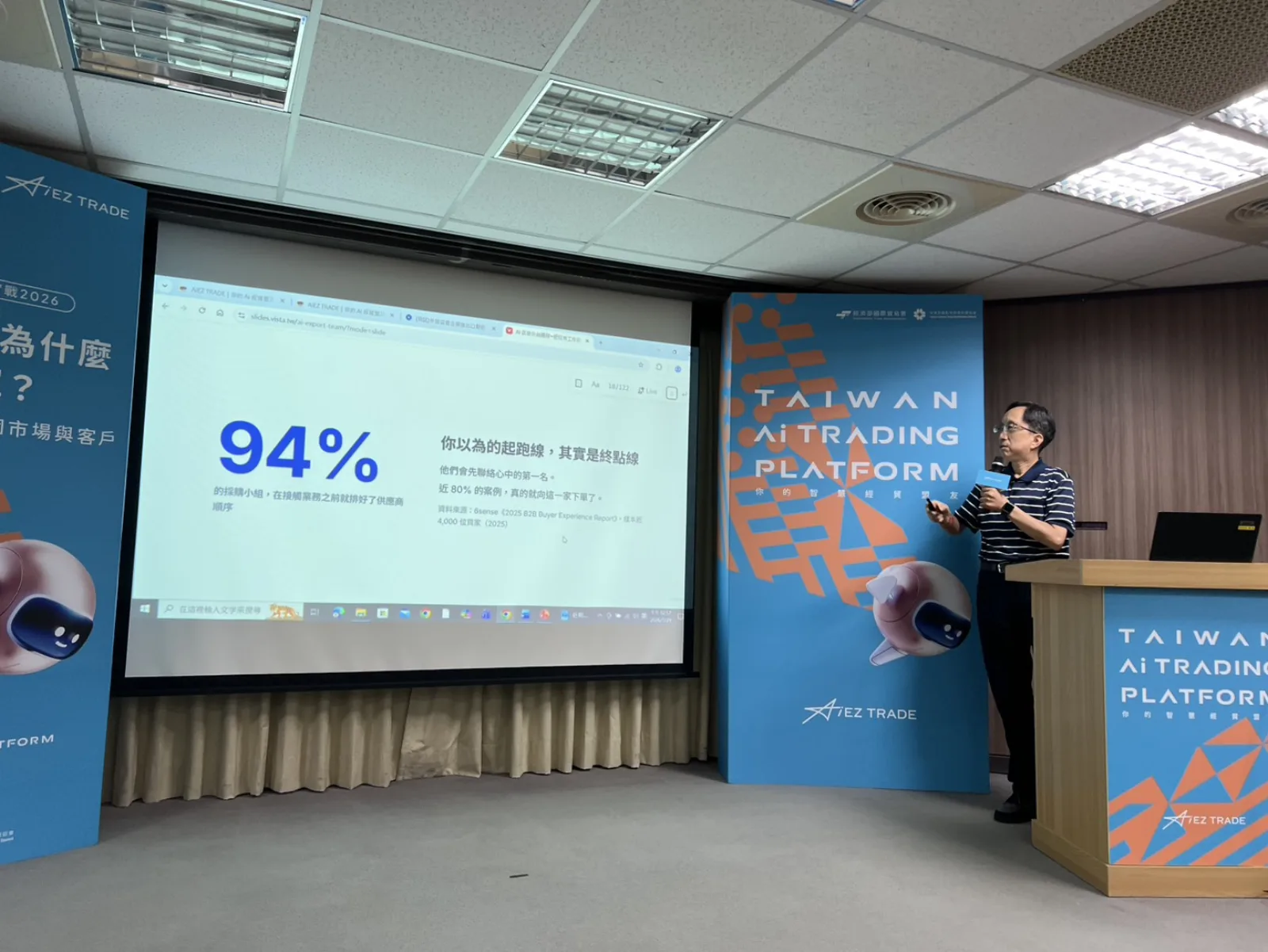
▲ Thanks to Mr. Giga (opens in a new tab) for taking the photo
When preparing for this lecture, I have been thinking about a question: If Taiwanese exporters can only remember one thing, what should it be?
Later, I condensed it into one sentence: What you think is the starting line is actually the finishing line.
By the time you receive the inquiry letter, the competition may have ended.
Well, let’s look at a number first.
6sense surveyed nearly 4,000 B2B buyers in the “2025 B2B Buyer Experience Report” and found that 94% of the purchasing team had already arranged the order of suppliers in their minds before contacting any business. They will contact the first one in their mind first, and in nearly 80% of cases, they actually place an order with this company.
In other words, when that inquiry letter arrives in your mailbox, you think the opportunity has come, but you may just be the third pick to accompany the bid.
There are several figures in the same report that I think are more worthy of note by export traders:
- 95% of sales come from buyers’ pocket lists on day one, compared with 85% the year before, and barriers are tightening rapidly
- 97% of buyers have had past contact with at least one company on the list, and they are not doing business with strangers
- 68% of buyers already know the sales staff of the final winning bidder.
When we put these numbers together, the answer is clear: the key is not how beautifully you write back, but whether you are in the buyer’s field of vision at the stage when he is doing his homework.
And now, the way buyers do their homework has changed. The same survey shows that 94% of B2B buyers use large language models in the purchasing process, using an average of seven sources of information, with generative AI ranking first. If AI cannot read or understand your product information, you will not appear on that list.
The problem is, your team simply doesn’t have time to do these things
At this point, I guess the reaction of most friends who are engaged in export business is probably: I understand these principles, but where do I get the time?
Well, that’s a totally reasonable reaction.
The seventh edition of Salesforce’s State of Sales (opens in a new tab) surveyed 4,050 sales professionals in 22 countries and found that only 40% of business people’s time is actually spent selling. Where did the remaining 60% go? Administrative tasks such as manually entering data accounted for 24%, preparation and planning accounted for 16%, and developing customers accounted for 12%.
In the same survey, 47% of business people said that cold development is the worst part of the job, another 47% said that the team has no time to do development at all, and 42% said that they are overwhelmed by the number of tools, with the team using an average of eight tools.
Cold Outreach/Cold Lead Generation is the process of proactively initiating contact to create business opportunities with people who have no previous interactions with you, do not know you, or are completely unfamiliar with your brand, but who fit your ideal customer profile (ICP). Common forms include cold calling and cold email.
So, the real situation is: everyone knows that they need to manage customers in advance, but unfortunately no one has the time.
Taiwan’s opportunities are hidden in a very embarrassing number
OK, let us look at the situation in Taiwan.
In the first half of 2026, Taiwan’s exports reached US$416.6 billion, an annual increase of 47.1%, and positive growth for 32 consecutive months. This is a record high, it’s really not simple!
But at the same time, the “Survey on the Current Situation of AI Application in Small and Medium-sized Enterprises in 2025” commissioned by ITRI by the Small and Medium-sized Enterprises Administration of the Ministry of Economic Affairs showed that the AI introduction rate of small and medium-sized enterprises was only 7.4%.
Well, what’s more interesting is the question “Why not import?” Most people think that the answer will be too high costs or lack of talent. In fact, the biggest reason is “no clear application requirements”, accounting for 63.9%, far exceeding the 26.8% who do not understand the technology, the 25.5% who are high costs, and the 21.3% who are short of talent.
Share
In other words, what holds most small and medium-sized enterprises back is not money or technology, but the lack of understanding of what AI can be used for?
This is exactly the problem I want to solve in this lecture. Rather than talking about trends, let’s take a look at the daily routine of export business and tell you, frame by frame, where AI can be inserted?
Think of AI as a group of assistants with a division of labor, rather than a universal tool
Before talking about the five situations, I want to clarify one thing first, because it is related to how you use it?
Recently, the term AI Agent (opens in a new tab) has become very popular. Strictly speaking, Agent refers to a system that can plan its own steps, call tools, and complete an entire task. But for the vast majority of foreign sales teams, the first step really doesn’t require such a complicated structure.
You can first understand it in a more pragmatic way: think of AI as a group of assistants with their own expertise. Your job is to break down the task and hand it over to the right one.
For example, one assistant is responsible for studying information and comparing the market; one assistant is responsible for screening lists and scoring; one assistant is responsible for studying specifications and extracting requirements; and the other assistant is responsible for organizing post-meeting notes and writing follow-up letters. Each assistant is good at it, but they are not smart enough to replace you. However, each can compress a certain period of dead time from hours to minutes.
When all these single points run smoothly and are strung together into an automated process, only then can the power of Agent be truly unleashed! If you reverse the order, or do it the other way around, you will usually get stuck halfway.
Below are the five situations I helped you break down in the lecture.
Scenario 1: Choose a market, don’t decide the next battlefield based on impressions
The traditional approach is to decide the direction based on impressions and word-of-mouth from peers. Manually check customs statistics and compare country by country. It takes a long time to check just one market! This is because the information is scattered on different websites and in different formats. Once the tariff changes, all the previous homework must be repeated. Most people make a decision after evaluating two or three markets.
After adding AI, you can first use the public database to pull out the candidate markets at once, let AI organize it into the same comparable table, and include tariffs, shipping distances and growth rates into the evaluation. When the situation changes, run again and there will be a new sequence in a few minutes. Assessing ten to twenty markets at a time and then converging becomes easily accessible.
The time gap is very specific: It would have taken at least half a day to a day to do the basic homework of a market. Adding up the three markets, it would take two or three working days! But if we switch to AI assistance, the preliminary sorting of the ten markets after the data is ready will only take one hour, and manual review and adding own restrictions will only take about half a day at most.
There are four steps in the operation. Let me help you sort it out: first obtain the export potential data of your HS product code in various countries from public databases such as International Trade Center (opens in a new tab) (ITC), then use AI to organize it into a comparable table, then add your own constraints (production capacity, certification, language ability, existing channels), and finally converge into two or three main markets.
HS Code (HS Code, Uniform Commodity Classification Code) is a 6-digit global standardized code developed by the World Customs Organization (WCO). It is used to classify imported and exported goods, calculate tariffs and collect trade data. The first 2 digits represent “major category/chapter”, the 3rd and 4th digits represent “section”, and the 5th and 6th digits represent “head”. Taiwan extends to the CCC Code of 11 yards.
Here is a thought, please remember: ranking is not the answer, it is the starting point for discussion.
Scenario 2: Looking for buyers, the point is not to find, but to screen.
I think this is the one with the highest leverage among the five situations, because it determines the direction of all your subsequent efforts.
Most businesses have a list on hand, which may come from exhibition business cards, B2B platform downloads or trade union directories. The traditional method is to Google one by one starting from the first one, find contact us on the official website, and send it to the info@ mailbox. About ten to fifteen companies can be processed in a day.
The problem is that doing this will cost you just as much time as a good client as a bad client.
In my opinion, a better sequence is to first define what kind of company is worth your time? Go back and analyze the customers you have dealt with in the past three years and find out their common characteristics. This is the profile of your ideal customer. Turn the outline into a checkable checklist, and then let the AI score and sort each company on the list according to this checklist, and only process the top 20% in the end.
I used a funnel to illustrate in the lecture: the original list of 500 companies, excluding those with inconsistent product categories and large scale gaps, left 280 companies; after sorting according to the fit score, the top 20% were selected, leaving 56 companies; among them, about 40 companies could find specific counterpart windows. These forty companies are where you should really spend your efforts.
The workload of the same day has changed from ten to fifteen companies to fifty to one hundred companies. The list of 500 companies originally took five to seven weeks to complete, but now the scoring and sorting takes about two to three hours.
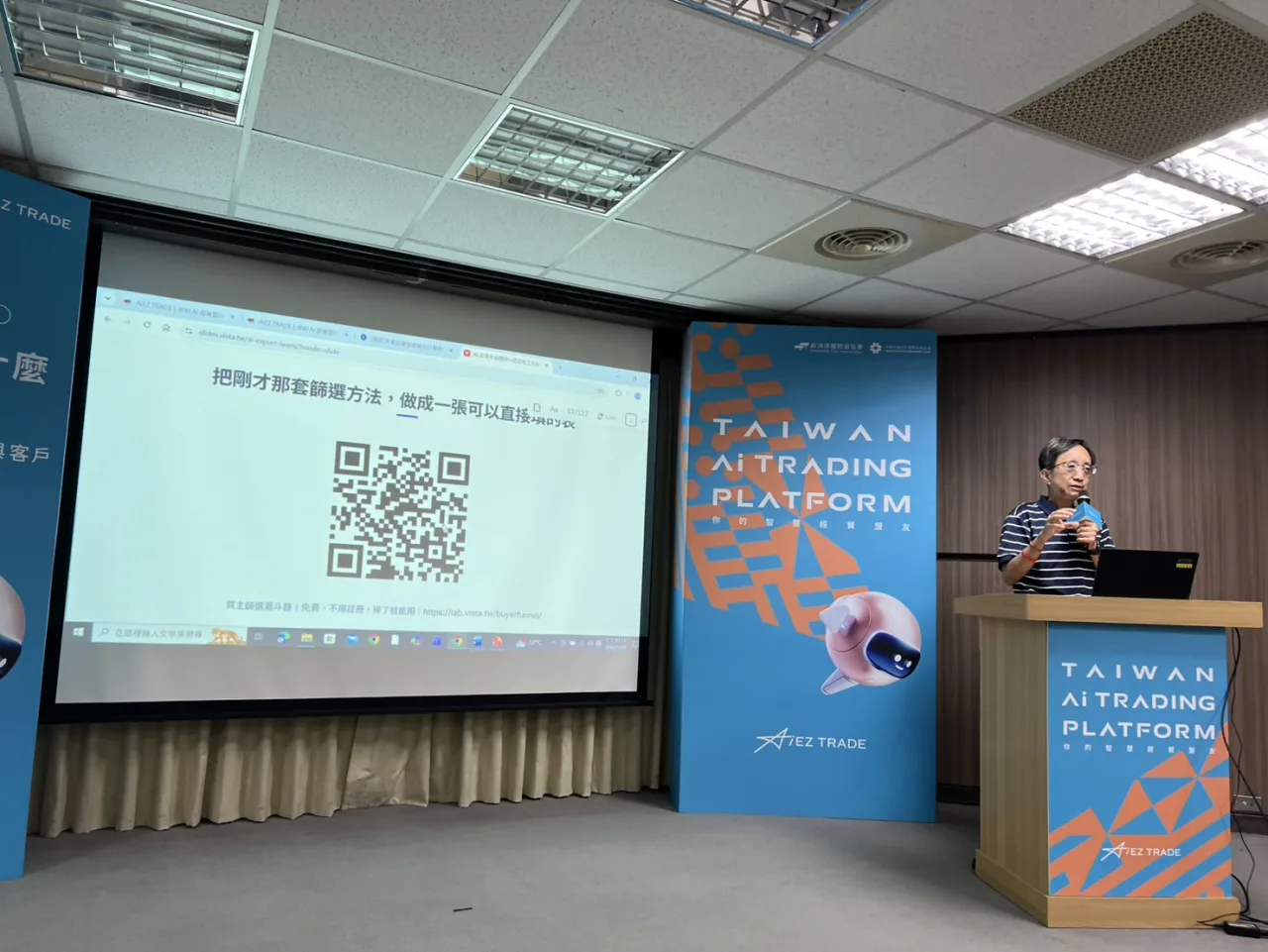
▲ Thanks to Teacher Giga for taking the photo
I also made this screening method into a tool that can be filled in directly at the scene. It is free and does not require registration. It can be used as long as you scan it: Buyer Screening Funnel (opens in a new tab).
As for how to write the prompt word, the key to the version I gave in the lecture is the last sentence:
Please do not guess the contact name or email address. Only answer based on the information I provided. If the information is not in the information, just say no.
It’s much more useful to have an AI admit that it doesn’t know than to have it hard-code an answer. Yes, I recommend you add this sentence to every prompt.
Scenario 3: Development letter, personalization does not equal “Dear First Name”
Let me give you a cruel number first. Belkins counted 7.53 million cold development letters in 2025, and the actual response rate was 0.45%. In other words, it will take 222 emails to get one person to reply to you.
However, there are some differences worth noting in the same information: the response rate for small companies with less than ten people was 0.72%, and only 0.22% for large companies; the response rate for founders or bosses was 0.57%, and only 0.42% for C-level executives. This tells us that if we choose the wrong target, it will be useless no matter how well the content is written.
I know you want to ask: How can you improve your chances? The answer is truly personal.
Many people think that personalization means filling in the “Dear [First Name]” variables correctly. No. Real personalization should be something like this: I know you attended the Cologne exhibition last month, I know you are recently looking for suppliers that comply with new regulations, and I know your product line lacks this piece…
To be honest, this information is all in public information. In the past, the problem was that there was no time to check, but now AI can help you sort it out in a few minutes. By the way, there is another thing that is most easily underestimated by exporters: multiple languages. Forrester’s actual measurement of the introduction of AI translation shows that internal translation processing time is reduced by 90%, the three-year return on investment is 345%, the cost is recovered in less than six months, and the proportion of employees’ working hours spent on translation is reduced from 10% to 1%. When you can write in the other person’s native language, the difference in response rate is not a small difference.
Scenario 4: Inquiries and quotations, turning speed into your competitive advantage
This scenario has the quickest results because it can be used today and does not require any pre-work.
The Harvard Business Review audited 2,241 companies in 2011 and found that companies that responded within an hour were seven times more likely to receive a qualified opportunity. The average response time at the time was 42 hours, and 23% of companies never responded. This study is fifteen years old. Don’t take the numbers as current conditions, but the truth it reveals remains the same: speed itself is differentiation.
In terms of export practice, we can divide it into four steps: first organize the product specifications into a structured form (this is a one-time investment and the basis for all subsequent automation), then use AI to summarize the requirements, turn the long specifications into an itemized list, and then let AI do a preliminary comparison and mark three categories of “conformity, non-conformity, and manual confirmation required”, and finally have humans review the exceptions and final figures.
Yes, you can’t skip the last step. Giving the quotation work entirely to AI without human review is one of the most dangerous practices I have ever seen.
The reason is simple, because the competitiveness of the quotation is never just the price. When you can give a professional reply before the other party receives other offers, you have won the psychological position. The role of AI here is not to help you calculate prices, but to help you compress understanding demand from hours to minutes.
Scenario 5: Exhibition, the outcome is decided two months before the exhibition
In the past year (2025), the China Foreign Trade Association held 144 domestic and overseas sales promotion activities, contacted 63,000 buyers, 25 international professional exhibitions, and 1,737 procurement meetings, and secured US$6.37 billion in business opportunities. Frankly speaking, the opportunity is there, the question is how do most people use it?
What I have observed is that there is no preparation before the exhibition, business cards are distributed during the exhibition, and the business cards are put in the drawer to get moldy after the exhibition.
A better rhythm is this:
Obtain the exhibitor list two months before the exhibition, use AI to screen out target buyers, and send letters in advance to make appointments for meetings. During the exhibition, you can focus on the meeting and record the key points on the spot with your voice, without having to sort them out. Within 48 hours after the exhibition, let AI organize the messy notes into structured summaries, send out personalized follow-up letters that night, and then classify them into different follow-up rhythms according to popularity.
There have been large-scale verifications internationally. Clarion Events (opens in a new tab) AI-matched meeting invitations achieved a response rate of 85%, resulting in 2,371 confirmed meetings from 7,809 invitations, an average of ten per person.
The most critical point in the prompt words for follow-up letters after the exhibition is the version I gave at the lecture: requiring the AI to specifically mention a certain detail in the conversation in the letter, so that the other party will immediately remember who you are. Granted, this is a watershed moment in whether or not this letter will be remembered.
Three mistakes I have seen most people make
- Think AI will automatically know which market is good? Oh, sorry to disappoint you, it won’t. You need to obtain objective data first, because AI is responsible for sorting and comparing.
- Use AI to mass generate lists. The result is just more to-do items. The correct way to use it is to use it to filter and sort, focusing precious time and firepower on the top 20% of potential customers.
- Quotes are left entirely to AI. Please remember: before sending a quotation, it must be reviewed by your company’s supervisor or a designated person.
Your 30 Day Action List
In this talk, I put together a 30-day action list for you. However, you don’t have to do them all, just pick three of them and execute them!
- This week: Find a recent RFQ specification and use AI to summarize the requirements list. It takes five minutes to verify whether it works.
- This week: Add “If it’s not in the information, just say it’s not there” to each of your prompts. This sentence alone is enough to block out most of the misinformation.
- Within two weeks: Go back and list the common characteristics of customers who have closed transactions in the past three years. This is important because these are the profiles of your ideal customers.
- Within three weeks: Organize product specifications into a structured form, these are the basis for all automation.
- Within a month: Take out the exhibitor list of the next exhibition you plan to attend, and first screen out 30 targets. Preparation before the exhibition is the real key to victory or defeat.
Back to the question
Why can other people get orders for the same product?
My answer is: Because at the stage when the buyer is doing his homework, others are already in his field of vision, and you are still waiting for that inquiry letter.
You may have known for a long time that the ratio of domestic sales to export sales of Taiwan’s small and medium-sized enterprises is about 9 to 1. In 2024, the total sales of small and medium-sized enterprises will exceed 31.1 trillion yuan, of which domestic sales will be 27.9 trillion yuan and exports will be only 3.2 trillion yuan. This disparity in ratio, I think, is where the biggest opportunity lies.
It is true that the threshold for export sales is being lowered by AI. Market research, list screening and multi-language communication that used to require a whole team can now be run by just one person and a few right tools.
The only difference is, have you started?
Let’s do our best together.
Sincerely, Vista
🚀 If you want to set up this entire workflow, from personal style files, inspiration collection, in-depth research to content production, I will take you step by step in the AI Content Production System Workshop. This method is not only applicable to content production. The logic behind it is actually very similar to the five export scenarios discussed today.
👉 Learn now about the AI content production system workshop
Next step
Bring this topic to your team
Vista Cheng speaks and runs workshops on AI workflows, writing and content systems for companies, schools and public agencies.