In the age of AI, should you follow the trend and transfer knowledge, or delve deeper into originality? A survival guide for content creators
Recently, when you open Facebook or Instagram, you will see a bunch of accounts doing the same thing: translating a foreign celebrity’s TED talk into Chinese summaries, turning a best-selling book that does not have a Chinese version into a package of ten pictures and text, and reorganizing the opinions of an English channel on YouTube into a professional-looking short article. The traffic of these contents is usually not bad, and responses such as “It’s so useful!” and “Collect it!” often appear in the comment area.
To be honest, I not only read these contents occasionally, but I even did similar things a few months ago. After all, people’s time is limited. Why not have someone help you condense a 300-page English book into a summary that can be read in ten minutes?
But recently, more and more friends have asked me privately: “Teacher Vista, I have seen that many people can quickly accumulate fans by transferring content. Should I do the same?”, “I spent several days writing an original article, but the traffic is not as good as others spending two hours to translate a foreign video. Is this normal?”
These questions make me think it’s time to talk about handling knowledge.
This is not to criticize anyone, but I feel that today, when AI tools are so powerful, the threshold for handling this matter has been lowered to an unprecedented level, and the opportunities and risks it brings are completely different from before. If you are running a personal brand, or you are considering using content to build your professional image, then the things discussed in this article are very relevant to you.
First define clearly: what is handling knowledge?
Before continuing, I would like to clearly define the concept of handling knowledge, because it actually has many levels.
The most basic transfer is direct translation. It’s like translating an English interview into Chinese verbatim, or translating a Japanese report intact, without adding any of your own opinions or comments. This approach was still somewhat technical before the popularity of AI translation tools, but now? You can throw a video into any AI tool and get a translation of good quality in five minutes.
The second level is arrangement and processing. You collect information from multiple sources, reclassify it, format it, and make it into a structured article. This requires more effort than direct translation, because you at least need to judge what information is worth putting in and how to organize it so that it is easy for readers to understand?
The third level is paraphrase plus comment. On the basis of conveying other people’s opinions, you add your own opinions, experiences and analysis. This is no longer a pure transfer, but closer to secondary creation.
What I will discuss later will mainly focus on the first two levels, that is, the practice of moving other people’s things over and adding at least a minimum of your own things.
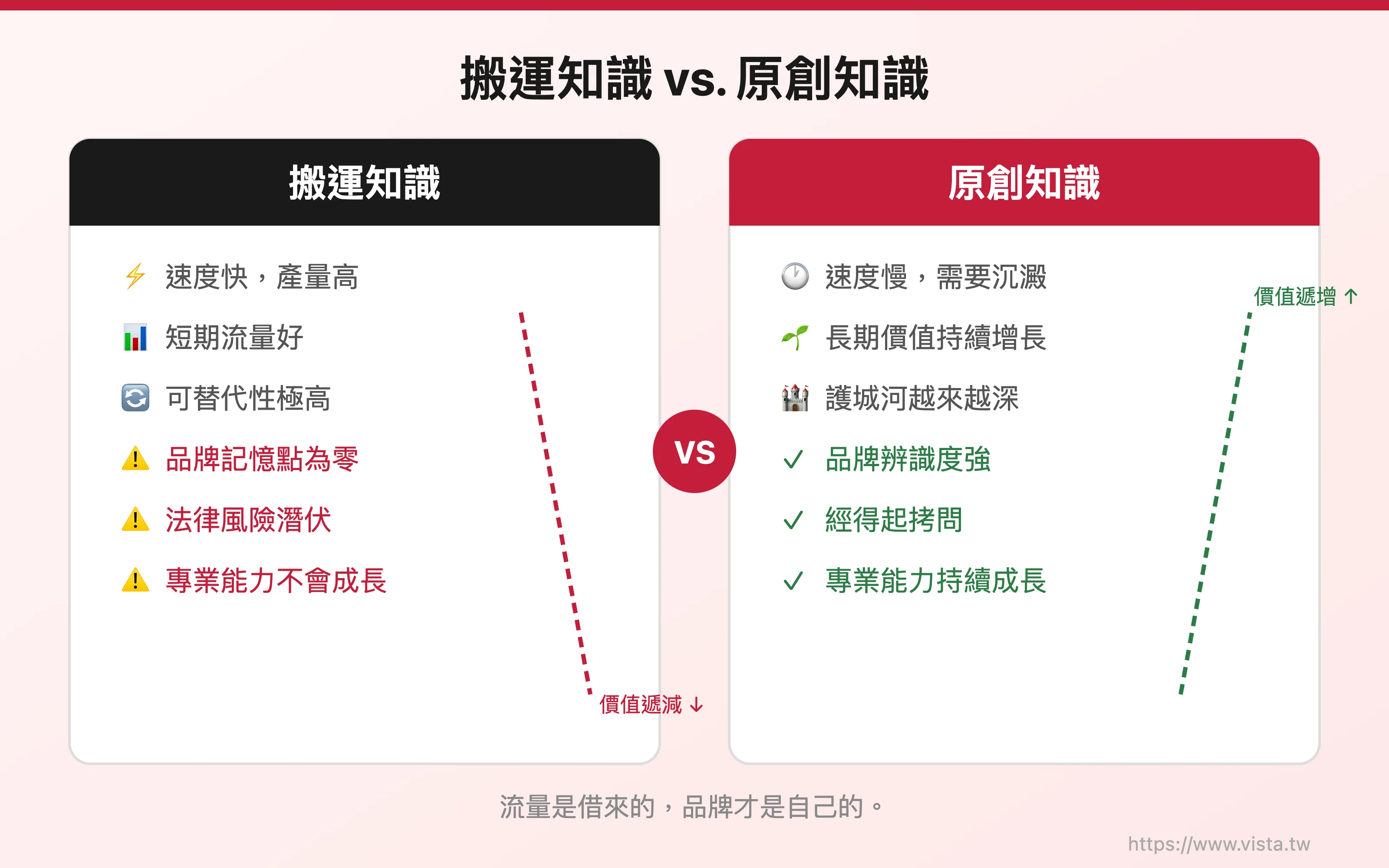 ▲ Transferred knowledge vs. original knowledge: The two are completely different in nature, threshold and long-term value
The advantages of moving are real: fast, ruthless, and high flow
I have to be fair and say that moving is popular because it does have benefits.
First, it’s fast. An original in-depth article would take at least an hour or two to write by myself. If it involves a lot of research and thinking, it may even take several days of preparation. But moving a foreign interview? If you are proficient in AI tools, you can complete everything from translation to typesetting to publishing in half an hour.
Second, the topic selection is guaranteed. What you move is usually popular content that has been verified abroad - a certain TED talk has been viewed millions of times, a certain book has been on the New York Times bestseller list. These contents are popular because they are inherently attractive. If you move them to the Chinese world, you are standing on the shoulders of giants and leveraging their strength.
Third, it is of real value to readers. Not everyone is familiar with English, Japanese or other foreign languages. By translating these contents, you have indeed provided a service to readers who cannot read the original text directly. I don’t deny this.
Fourth, the entry barrier is low. You don’t need to be an expert in a certain field, nor do you need to have ten years of practical experience, or even have strong writing skills. As long as you know how to use AI tools and basic layout, you can start to produce content that looks good.
These benefits add up to making moving a road that seems very tempting. Especially for those who have just started to operate self-media and are in urgent need of accumulating fans and traffic, porting is almost the highest CP value approach.
But things are not that simple.
The paradox of the AI era: when transportation becomes easier, transportation becomes less valuable
This is a key logic that I think many people have not thought clearly.
Before AI, moving had a certain value because translation and collation themselves required language skills and time costs. But AI has lowered this threshold to almost zero.
You can use AI to translate a 10,000-word article in ten minutes. You can use AI to convert a one-hour YouTube video into a verbatim transcript and then translate it into Chinese. You can use AI to organize the key points of ten books into a lazy package.
Sounds great, right? But here’s the thing: everyone can do it.
When everyone can do in ten minutes what you spend two hours doing, what is your competitive advantage? The answer is obvious, naturally no.
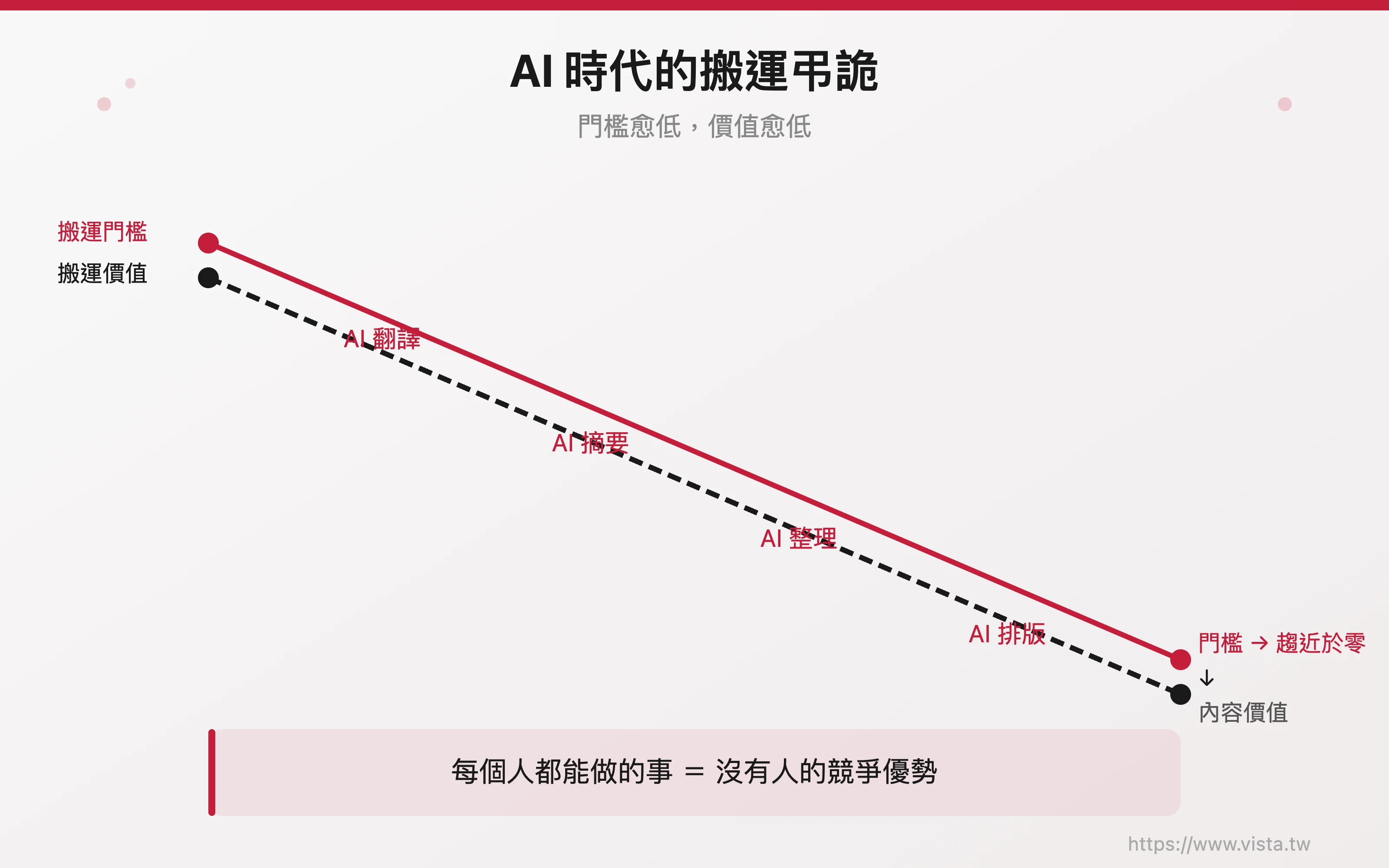 ▲ The paradox of porting in the AI era: the threshold drops to close to zero, and the scarcity and value of ported content also collapses
What’s even more bizarre is that readers are beginning to realize this as well. When they know that this article is probably an AI translation with a little typesetting, their trust and importance in this type of content will begin to decline. You can observe, is the interaction rate of those porting accounts on social platforms slowly declining? Is the depth of the message getting shallower? Is your willingness to share decreasing?
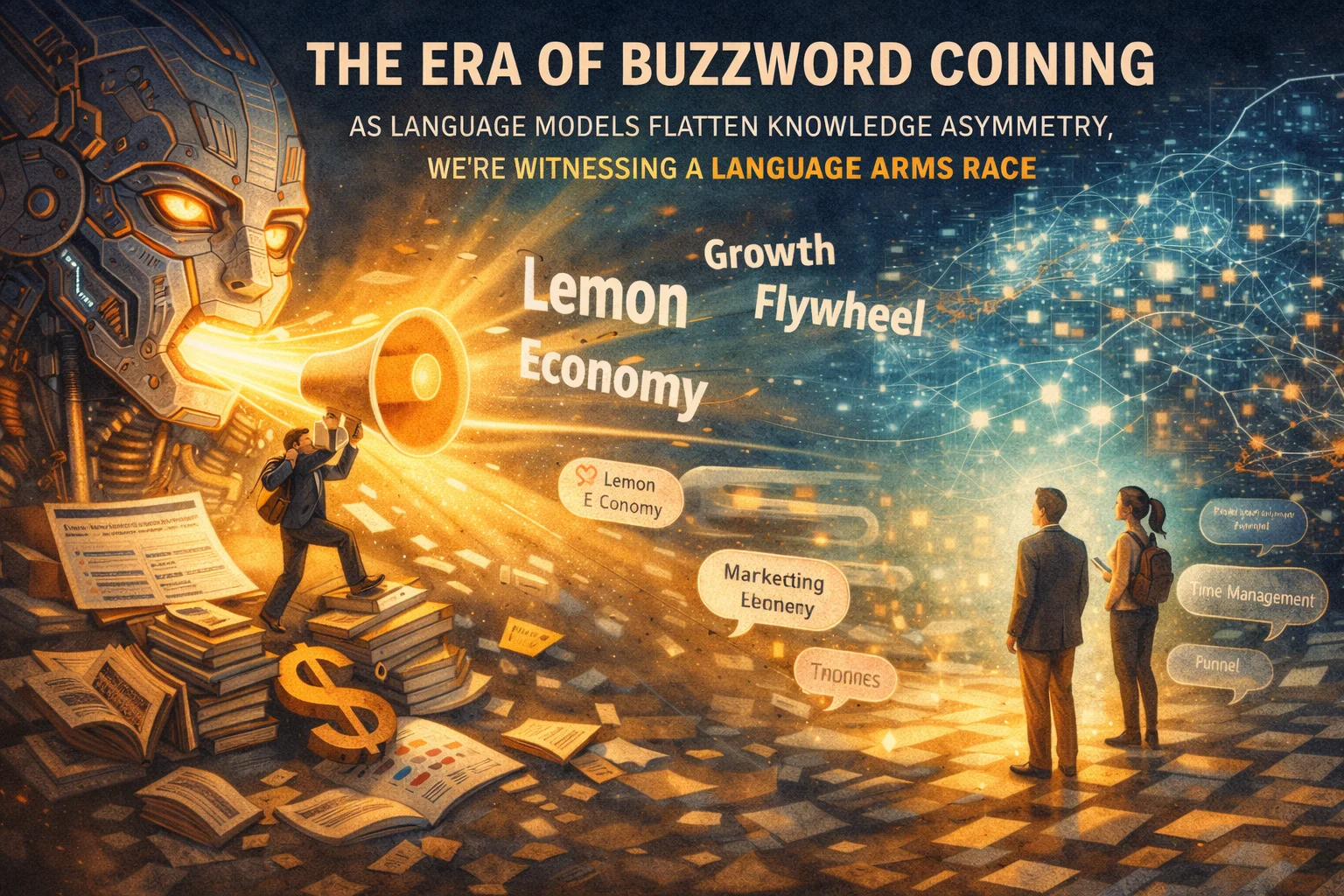
This is almost an irreversible trend: **AI makes it easier and easier to obtain information, and the value of the information itself becomes lower and lower. ** What is truly valuable is the judgment, interpretation and application of information.而这些,恰恰是搬运做不到的事。
Should you be nervous when you see others moving?
If you are a person who is serious about creating original content, and you see others getting better traffic numbers than you through porting, you will inevitably feel a little unbalanced.
My answer is: In the short term, you may feel a little frustrated; but in the long term, you don’t need to be nervous at all.
The reason is simple. Portable content and original content essentially compete on different tracks.
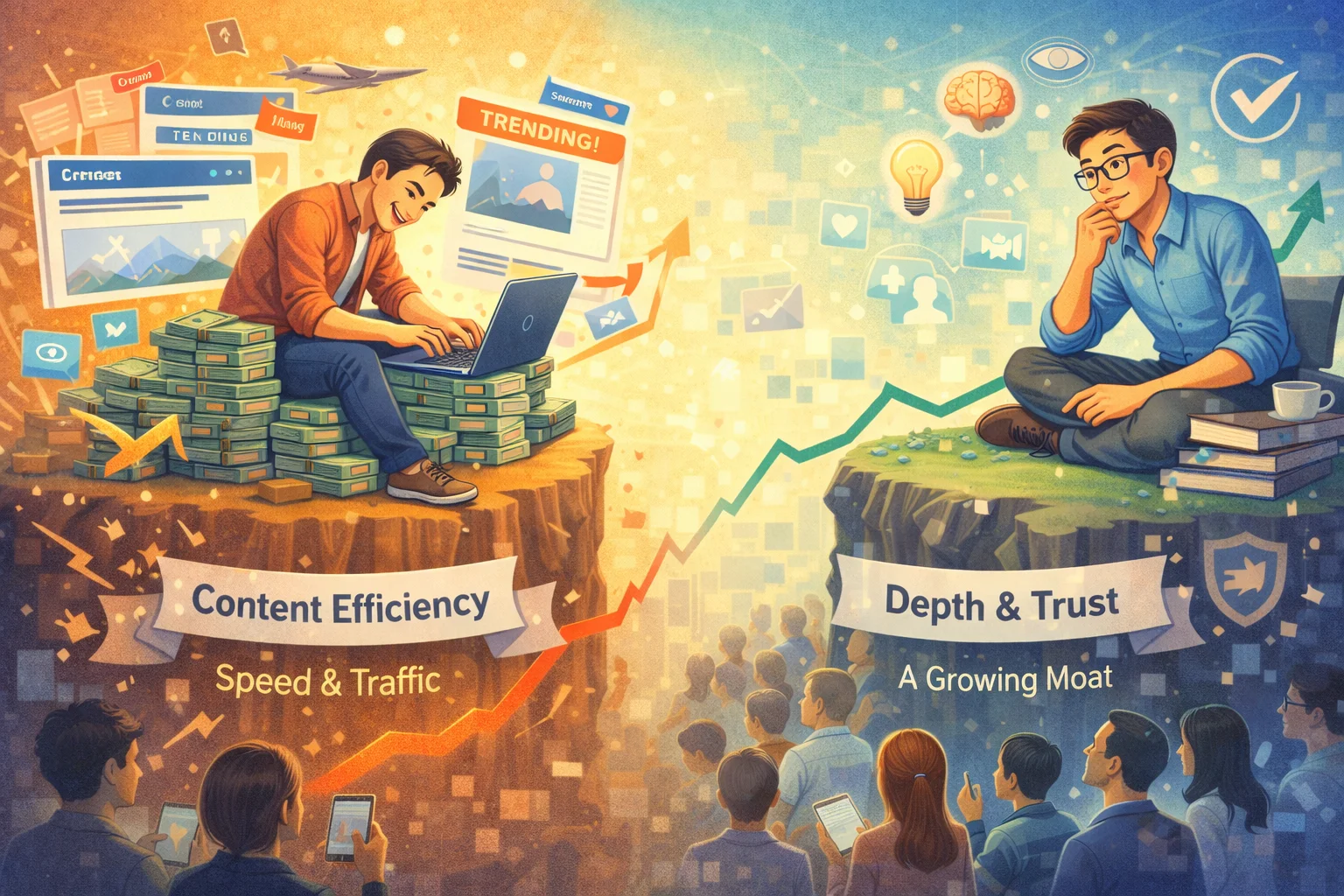
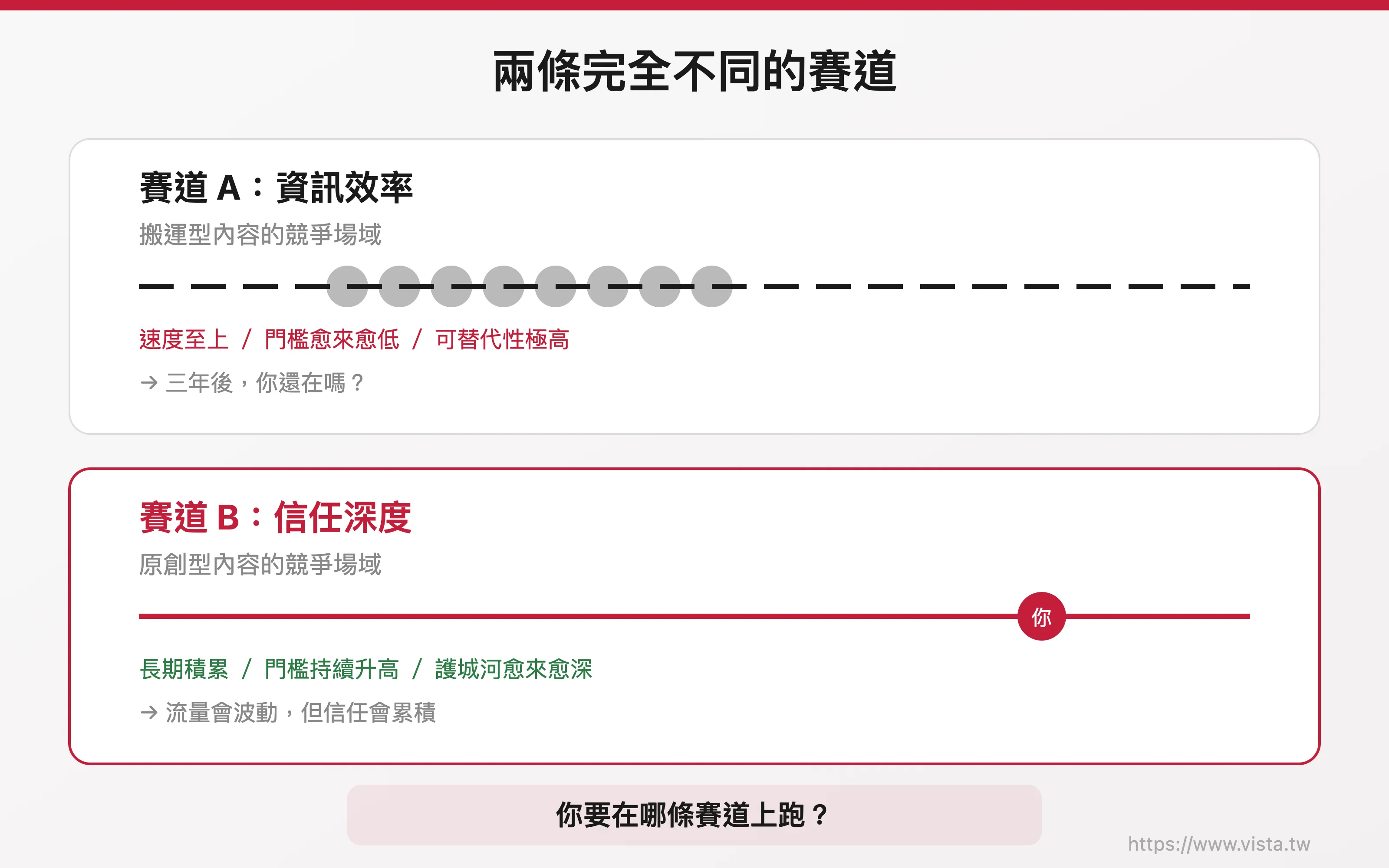 ▲ Two completely different tracks: handling and information efficiency, originality and depth of trust.
Portable content follows the track of information efficiency - whoever moves the latest and hottest foreign information the fastest will win. The characteristics of this track are that speed is paramount, the threshold is getting lower and lower, and the fungibility is getting higher and higher.
Original content follows the track of depth of trust. In other words, whoever can use his or her real experience and thinking to help readers solve real problems will win. The characteristics of this track are that it requires long-term accumulation, the threshold continues to rise, and the moat becomes deeper and deeper.
Which track you want to run on depends on your goals.
If your goal is just to accumulate traffic and earn advertising revenue, then moving is indeed a shortcut. But if your goal is to build a personal brand, become a trusted voice in a certain field, and be able to rely on professional knowledge to serve as a consultant or teacher, then porting will not only not help you, but will also hurt you in the long run.
Why does it hurt? Because when your readers and potential customers start to get to know you better, they will find that your content lacks original ideas and unique experiences. And in the AI age, a lack of uniqueness equals a lack of raison d’être.
Don’t be anxious just because someone else got good numbers from the move. You should focus on your own track and ask yourself: Have I accumulated a little more knowledge from real experience today?
How should we view the transferred content in the future?
I’m not saying that moving is completely out of the question. What I want to say is: **Transportation should be a means, not an end. **
What’s the meaning?
If you regard porting as a way of understanding the world—when you see a good foreign article, translate it, digest it, and then reinterpret it in your own language and experience—that’s totally fine. In fact, this is a normal process of learning.
But if you regard transfer as the main strategy of managing your personal brand, such as translating and publishing three articles every day, relying on quantity to win, and positioning yourself as an information organizer…then you need to be very careful. Because the shelf life of this positioning in the AI era is very short.
When facing portability content in the future, I suggest thinking at three levels:
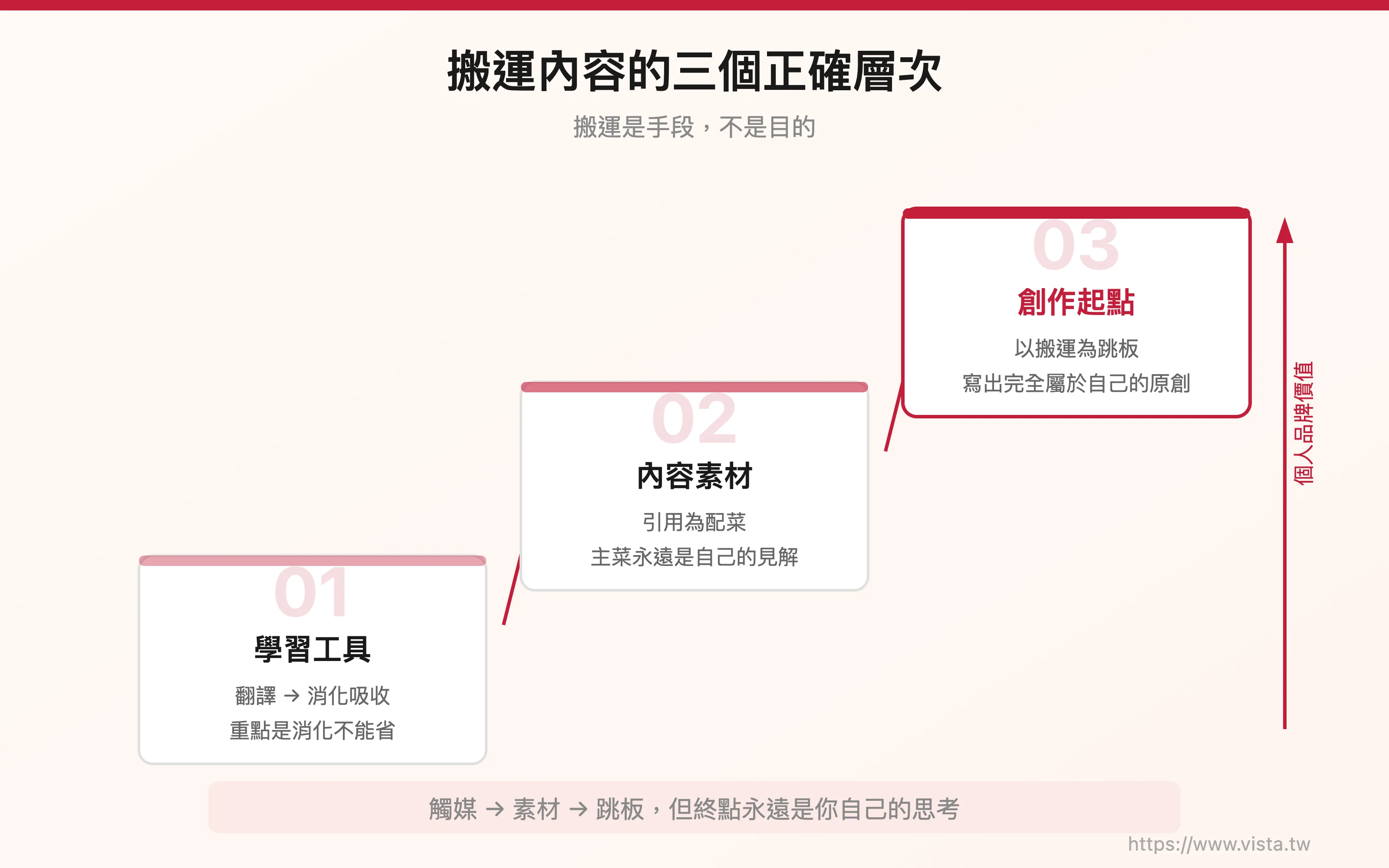 ▲ Three correct levels for moving content: from learning tools, content materials to the starting point of creation
**The first level is to use handling as a learning tool. ** The good foreign content you see is translated for your own learning and digestion, which is completely positive. The key point is that the digestion step cannot be omitted, which means that you are not just translating, but you have to think about whether this point of view is applicable in the context of Taiwan, and whether you have similar experiences that you can echo or refute.
**The second level is to treat transportation as the material of content. ** You can cite foreign cases and opinions, but they should be the side dishes in your article, not the main course. The main course should always be your own thoughts and opinions.
**The third level is to regard transportation as the starting point of creation. **A foreign article inspired you with an idea? Great, but don’t stop at translating and organizing, use this as a springboard to write something entirely your own. Let that foreign article be a catalyst for your thinking, not the end of your output.
Transportation should be a means, not an end. Let other people’s opinions be the catalyst for your thinking, not the end of your output.
💡 **Want AI to help you build your own digital base instead of working for others? **
I opened a Vibe Coding Practical Workshop to take you from scratch to use AI to create your first sales page in 3 hours. There is no need to learn programming, just come with your expertise and ideas.
Five response strategies: In an era when portability is prevalent, what should original creators do?
Okay, after talking about the pros, cons and positioning of moving, let me share five coping strategies that I practice.
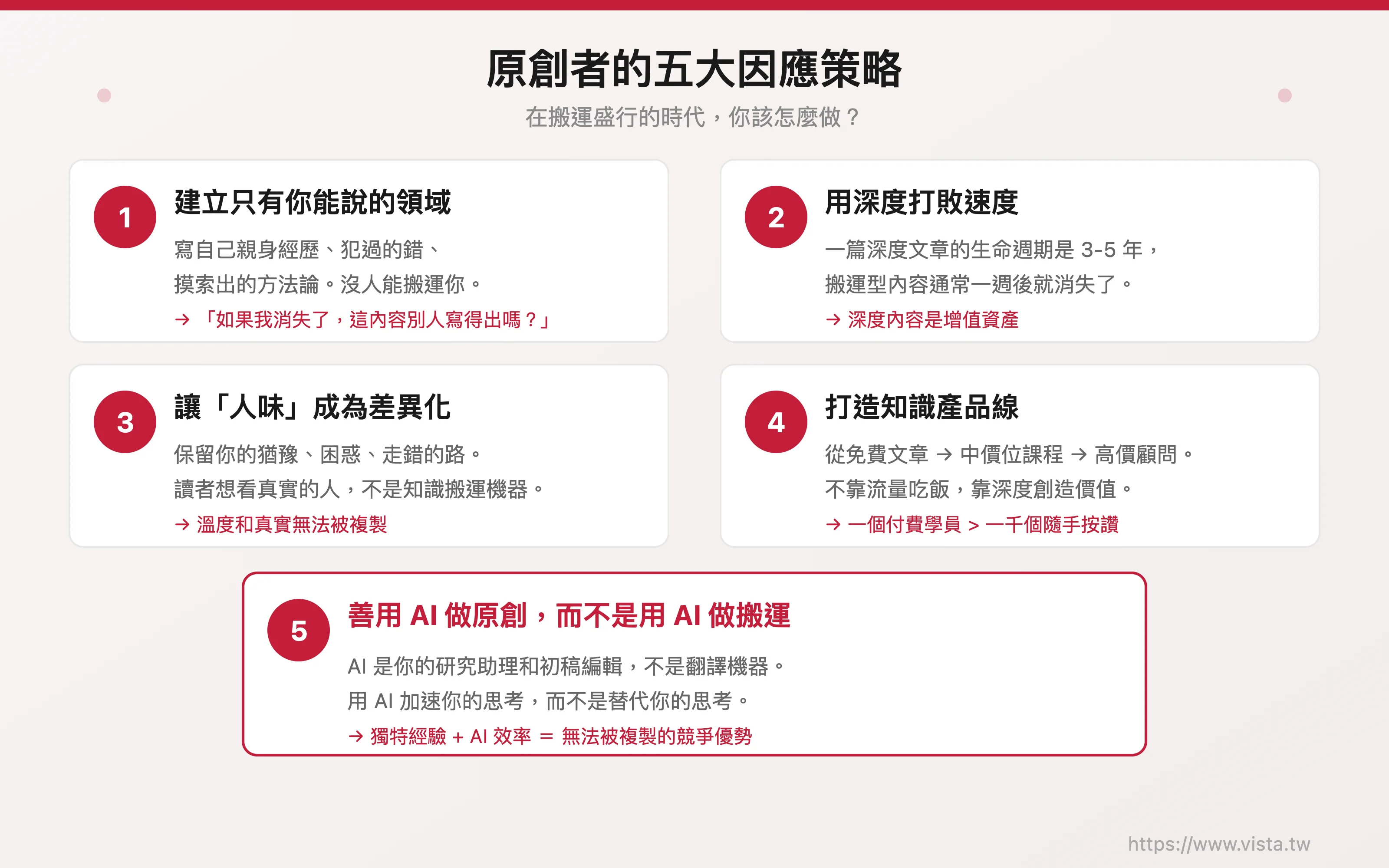 ▲ Five major strategies for original creators: from establishing unique content areas to making good use of AI to accelerate original creation
Strategy 1: Establish content areas that only you can speak about
The biggest weakness of a mover is that the things he moves can also be moved by others. But if you write about your own personal experiences, the mistakes you have made, and the methodologies you have figured out, then no one can help you.
Thinking back to when I was running the “Content Hacker website, the most popular articles were never those lazy articles about the top ten marketing trends, but those practical sharings about the pitfalls I stepped into in a certain project and how I climbed out in the end. Because those stories are unique and readers won’t see them anywhere else.
You have to ask yourself a question: “If I disappear, can this content be written by others?” If the answer is yes, then you need to inject more things that only you have.
Strategy 2: Defeat speed with depth
The movers compete for speed, so don’t compete with them on speed. What you have to fight for is depth.
An in-depth original article may take you three days or even a week to write. But the life cycle of this article can be three years, five years, or even longer. What about portable content? Usually after a week no one is watching.
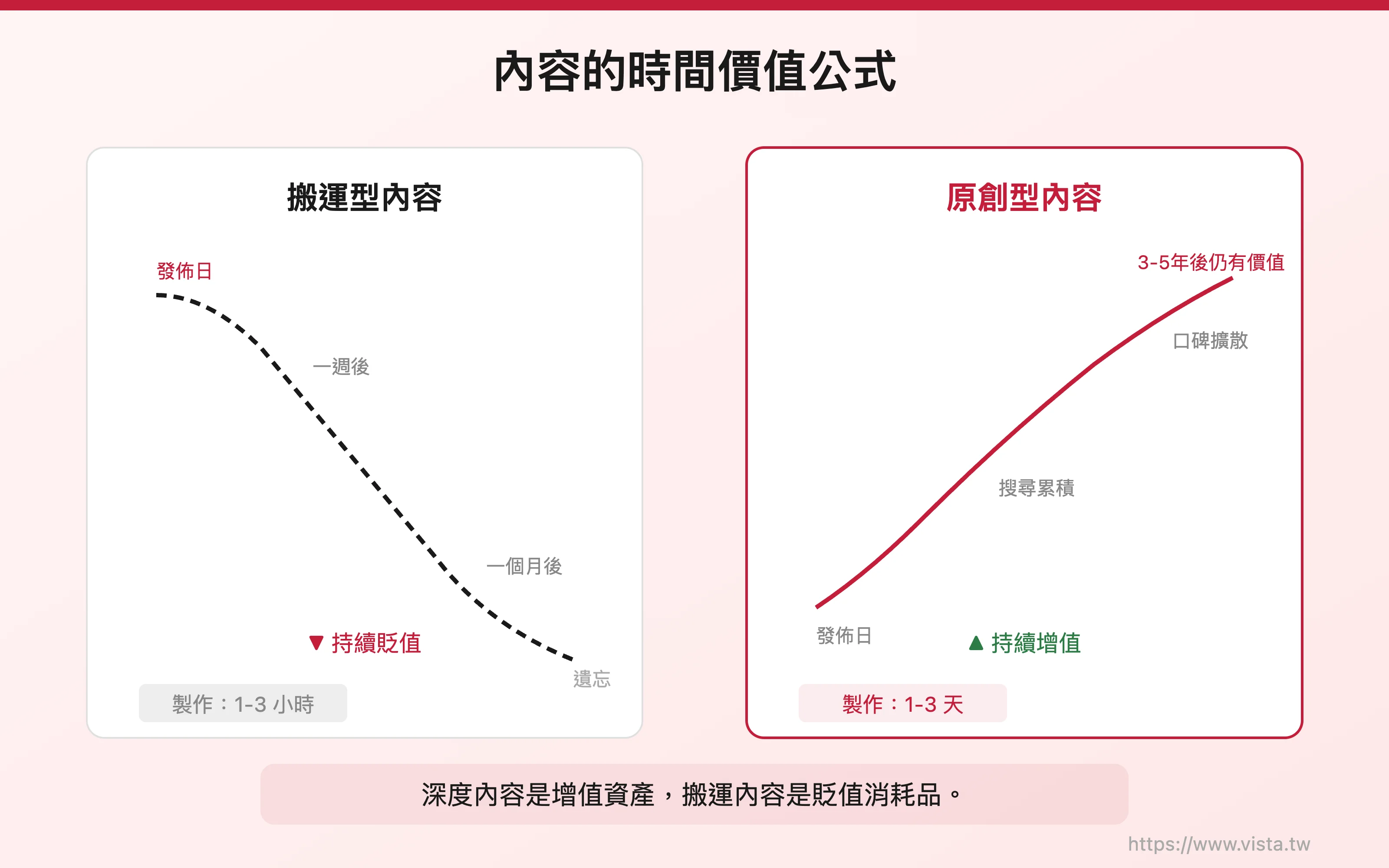 ▲ The time value formula of content: Deep Original is an asset that will increase in value, and moved content is a consumable that will depreciate.
My own experience is that some in-depth articles I wrote five years ago are still being found, read, and shared on search engines. And those portable posts that follow current events? To be honest, even I forgot what I wrote?
In-depth content is an asset that will increase in value, and moving content is a consumable that will depreciate. This account is very clear when viewed over a long period of time.
This is also a point I have repeatedly emphasized in Blog Operation Guide: Good content takes time to ferment, but once fermentation is successful, its compound interest effect is amazing.
Strategy 3: Let your human touch be the biggest differentiator
AI can move, translate, and organize, but what can AI not do? It is a personal perspective with warmth, a real experience with stories, and an emotional expression.
When I write articles, I will deliberately retain some “imperfect” parts - my hesitations, my confusions, and the wrong paths I have taken. These things may not seem “professional” enough, but they are precisely the parts that readers can resonate with most. Because readers are also human beings, what they want to see is not a flawless knowledge transfer machine, but how a real person thinks and responds when faced with problems.
Your humanity, your warmth, your authenticity…these are the things that AI and carriers can never replicate.
Strategy 4: Create a knowledge product line rather than an information flow
Porters usually operate information flows. They constantly produce new content and rely on traffic and algorithms to make a living. The problem with this model is that you are always chasing the next piece of content, and once you stop, the traffic will stop.
A healthier approach is to build a knowledge product line. Your content is not just a social post, but a systematic knowledge system. That is, from free article traffic, to mid-priced online courses or physical workshops, to high-priced consulting services or accompanying coaches. There is a logical relationship between each level, and readers can choose which level to delve into according to their own needs.
The advantage of this model is that you don’t need to chase traffic every day, because your value does not lie in the latest information, but in the deepest insights. A student who is willing to pay to learn from you is much more valuable than a thousand passers-by who just like you. This is also the core concept of turn teaching into long-term assets.
Strategy 5: Make good use of AI for original creation rather than using AI for portability
This last point may be the most important.
Many people regard AI as an accelerator for transportation. They use AI to translate faster, organize more, and produce more frequently. But honestly, this is actually using a powerful tool where it has the lowest value.
What AI should really be used for is to help you create better original content. For example: use AI to help you analyze a large amount of research data and find out viewpoints that you may have overlooked; use AI to help you polish the structure and logic of articles to express your opinions more clearly; use AI to help you do preliminary market research and audience analysis to help your content reach your target readers more accurately.
When I write articles, AI plays a role more like a research assistant and first draft editor than a translation machine. I use AI to speed up my thinking, not to replace it. This is also the concept I shared in this article Vibe Coding - AI is your superpower multiplier, not your substitute.
When using AI for transportation, you are competing with everyone who also knows how to use AI. In the end, the only competition is who is faster. When you use AI to create original products, your competitive advantage is your unique experience and insights plus the efficiency blessing of AI. This combination cannot be copied by others.
A true story: the transformation from mover to original creator
I know a friend who is very active in the self-media circle, so I won’t mention his name here.
When he first started building his personal brand, he took the porting route. Two or three foreign business articles are translated every day and sent out with beautiful pictures. The effect was very good, with over 10,000 fans within three months.
But he told me that by the sixth month, he began to feel a deep sense of emptiness. Once he was invited to share at an event, and someone in the audience asked him: “What do you think of this trend?” He was stunned because he had translated so many articles, but those opinions were other people’s. He found that he was busy transferring knowledge and had not actually formed his own opinions.
What made him even more anxious was that he noticed that more and more accounts were starting to do exactly the same thing as him, but with faster speed and more beautiful layout. His traffic slowly began to decline, and he had to translate more and faster to maintain his old numbers. He said that during that time, he felt like a translation machine, racing against time every day, but his heart became increasingly empty.
Later, he made a decision: gradually reduce the proportion of porting and start writing his own stuff. At the beginning, the traffic did drop a lot because his original content was not mature enough and his writing skills also needed time to hone. But after he persisted for more than half a year, an interesting thing happened. Readers began to leave messages saying: “I especially like the articles you wrote yourself, they are much more flavorful than the ones you translated!”
More importantly, companies began to come to him to give speeches. Well, why? Because after reading his original content, the human resources directors of those companies felt that this person really understood this field and not just translated many articles.
He told me: “The transformation process was very painful, but looking back, it was the best decision I ever made.”
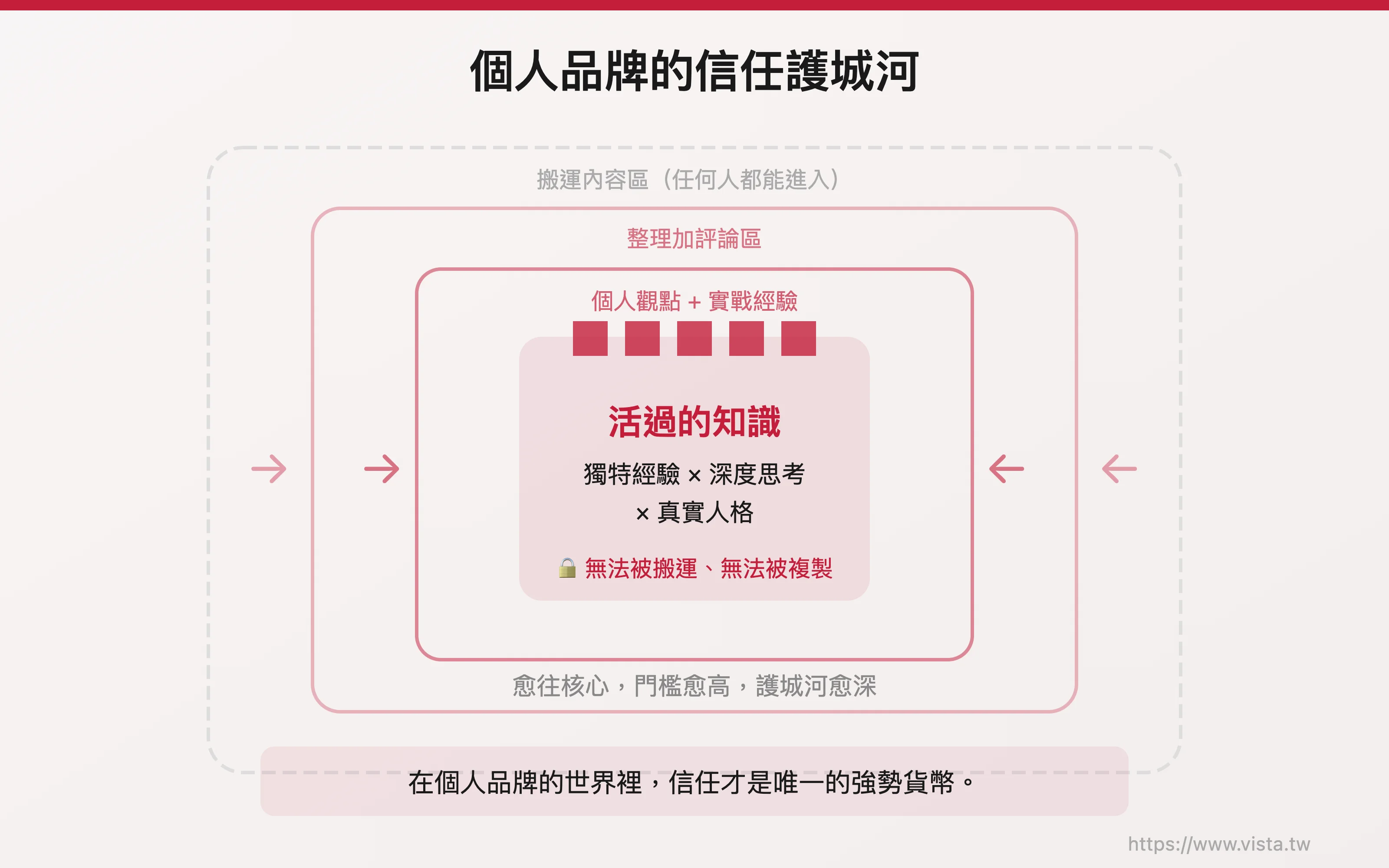 ▲ The trust moat of personal brand: The trust established by original content is a long-term asset that cannot be copied by movers.
Write to you who are hesitating
If you are now standing at the crossroads of moving or originality, I would like to say a few words of sincerity to you.
Moving is not a sin. If you just want to run a sharing account to help readers who are not familiar with foreign languages access to good content, porting can be a legitimate service, provided that you respect the rights and interests of the original author, indicate the source, and do not regard other people’s opinions as your own.
But if your goal is to build a long-term personal brand, to become a trusted expert in a certain field, and to support yourself based on your expertise - then I would say that porting cannot be your main strategy. At most, it should be a small part of your content mix, and that percentage should gradually decrease as you grow.
My own experience is that I have done a lot of organizing and summarizing content before. But as time goes by, I feel more and more clearly: Those things that really help me build my brand are my own things, such as the trends I observed in corporate consulting cases, the real problems I encountered in the teaching field, and the mistakes I made in the entrepreneurial process. These things are not glorious but real, imperfect but warm, and this is precisely what readers and customers care about most.
There is a saying that I have always kept in mind: “Only through your own experience can you withstand torture.”
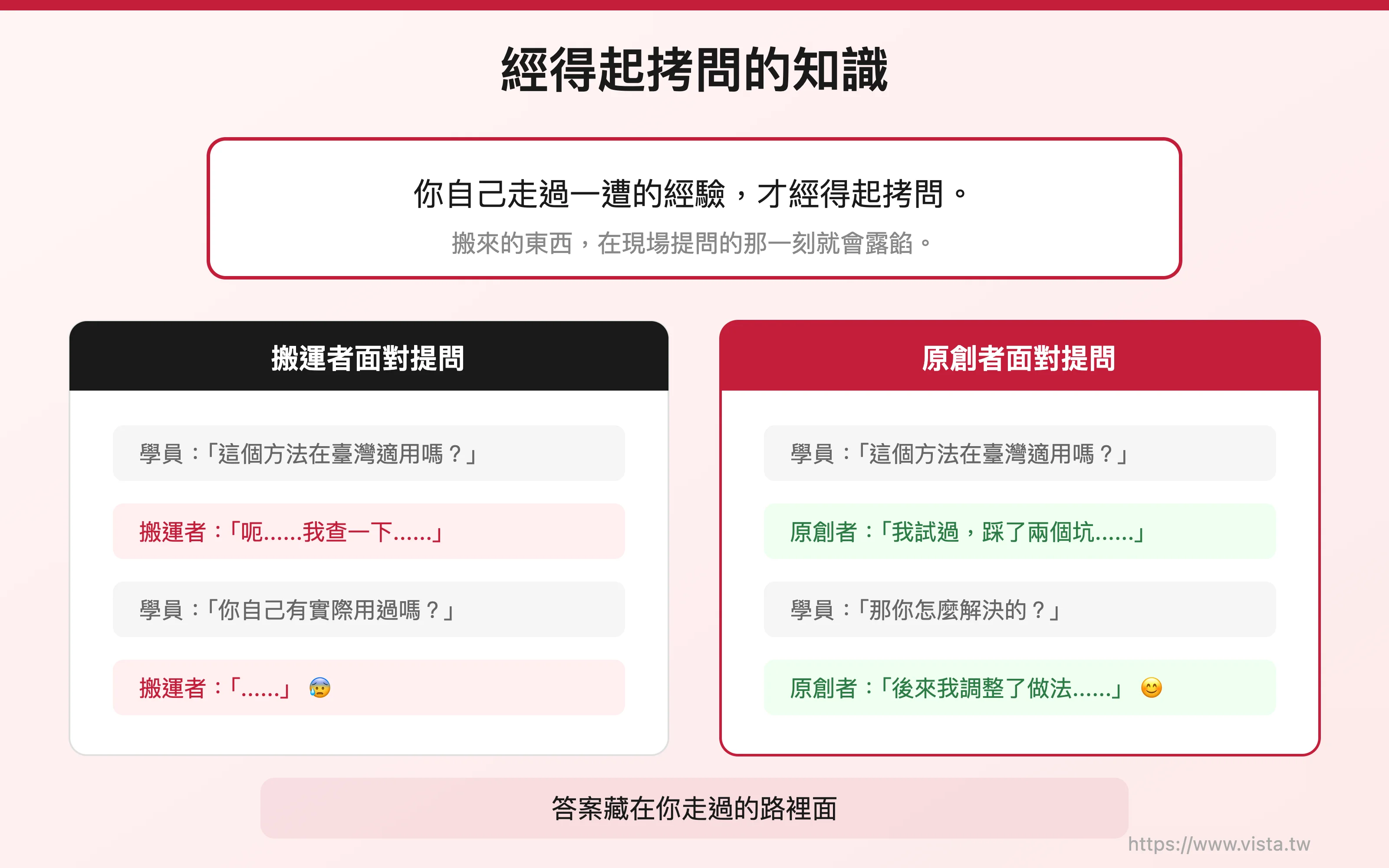 ▲Knowledge that can withstand torture: The knowledge you bring in makes you panic, but the knowledge you live out gives you confidence.
One day, you stand face to face in front of a student or client, and he asks you a pointed question. If your knowledge is imported, you may panic; but if your knowledge is lived, you will have confidence, because you know the answer to the question is hidden in the path you have traveled.
Slow is fast, deep is far
In this era where everything is about speed, it seems silly to choose to slow down and dig deep.
It takes you three days to write one article, but others can use thirty minutes to move three articles. It takes you one year to accumulate a hundred readers who truly agree with you, but it takes others three months to acquire 10,000 followers. In the short term, it looks like he’s winning.
But what if you stretch the timeline to three, five, or ten years?
Is the account that moved 10,000 followers still there three years later? Do his readers remember him? Are there any companies that want to cooperate with him because they trust his expertise?
And you? If you are willing to spend three years writing a batch of truly in-depth content, establish a group of readers who truly trust you, and develop a methodology that only you have. Your brand is not built on traffic, but on trust. Know that traffic will fluctuate, but trust can accumulate.
Traffic will fluctuate, but trust can accumulate.
I have been a reporter and chased hot news, so I naturally know what traffic is all about. But looking back now, what really brought me to where I am today was never the passing clouds, but the things that I really took the time to think about, practice and accumulate.
 ▲ Slow is fast, deep is far: In the era of pursuing speed, deep cultivation is the smartest strategy.
So, if you ask me: In the AI era, everyone is moving, what should I do? My answer is simple, let them move and you can do the digging.
Your time should be spent accumulating things that cannot be moved.