Content Hacking Lecture (CHL1) Participation Experience: Delivering the Values Behind the Product
[ ](https://blogger.googleusercontent.com/img/b/R29vZ2xl/AVvXsEjdLNE4u7WhWEmNr6SyNK1j1l9o3YgGBVQ2wVM6EeeMYkgrFNIzV4WUXyPdhNRrVMWGp1ySE-pJOHrWIW2rZSohCTM__dQ jmqhQs4aYdV9rZ4E8yR60Jrdx06YaE5guLniBHuZ55qE8yOxw/s1600/%25E5%2585%25A7%25E5%2 5AE%25B9%25E9%25A7%25AD%25E5%25AE%25A2%25E8%25AC%259B%25E5%25BA%25A7%25231.jpg)
[This article](https://medium.com/@yachuh/%E5%85%A7%E5%AE%B9%E9%A7%AD%E5%AE%A2%E8%AC%9B%E5%BA%A7-1-%E5%8F%83%E5%8A%A0%E5% BF%83%E5%BE%97-21b7d772ac30) The author is Xie Yazhu. He has spent his career (actually only two and a half years ago) in start-up companies, pursuing rapid growth and success in a rapidly changing environment. Perhaps because he grew up in the south and has a natural tendency to reciprocate good things, he is hopelessly passionate about brand marketing. He even founded his own company with his friends at the age of 24, but it ended after one year of operation. Now I plan to return to the workplace with the nutrients of entrepreneurship and continue to create influence in different ways! Thank you for your permission to publish. I would like to express my gratitude.
Since Sean Ellis first proposed the term “Growth hack”, the concept of “Growth Hacking” has quickly become popular all over the world. Soon a variety of books, lectures, courses, and even job openings emerged. Suddenly, all marketers in Taiwan (or rather around the world) follow “Growth Hacker” as their guideline, and all talk about “AARRR”.
Some people criticize growth hacking as just new wine in old bottles, while others say growth hacking can end the traditional “spray and pray” marketing method. However, the most indispensable thing in the marketing world is the wave of new terms. The reason why “growth hacking” can be widely discussed and studied by the public can prove to some extent that the growth mindset and hacker spirit it emphasizes are indeed one of the mindsets that all marketers today must embed in everything they do.
So when Vista decided to join forces with Fabius to hold the “Content Hacker Lecture”, I was also curious about how to embed a growth hacker mindset in an era where content is the dominant content, and maximize the benefits of content. The following are some thoughts from participating in this lecture:
Content Hacking vs. Growth Hacking
At the beginning, Vista introduced everyone to the term “content hacking” and explained its differences with growth hacking and traditional content marketing.
My own understanding is that compared to traditional content marketing, what remains unchanged is that the significance of content marketing is not to directly sell products (tell customers how good and good my products are), but to acquire consumers with the same belief through selling the “values” behind the products.
This also reminds me of the famous “Golden Circle Theory” by the famous TED speaker Simon Sinek, which also emphasizes that great brands sell “WHY” rather than “WHAT”.
When content marketing further evolved into “Content Hacker”, it became more growth-oriented (the pursuit of twice the result with half the effort, giving priority to exponential growth strategies), returning to audience-oriented precise content marketing, and supplemented by data throughout all decisions.
Compared with growth hacking, which pursues explosive growth of key indicators through various low-cost methods, content hacking focuses more on creating sustainable, shareable (even viral) content.
If the growth hacker’s true north is growth, then the content hacker’s true north is sharable content.
[ ](https://blogger.googleusercontent.com/img/b/R29vZ2xl/AVvXsEgczhriEFTyWBQw0yRq0X065qx1QrXemLQ3iTq1r4Ao5Xy8SBV9W4Up Ugpm-HUvXQ9QMFhdduqwJnaEGKcK3igj3ZAYYFqDJvsH3FryHMTdi5xm54igyS_SwhHtYVuVKIkhURa6wx_s6Cm7/s1600/a+content+hacker.png)
source: Coschedule Blog
](https://blogger.googleusercontent.com/img/b/R29vZ2xl/AVvXsEgczhriEFTyWBQw0yRq0X065qx1QrXemLQ3iTq1r4Ao5Xy8SBV9W4Up Ugpm-HUvXQ9QMFhdduqwJnaEGKcK3igj3ZAYYFqDJvsH3FryHMTdi5xm54igyS_SwhHtYVuVKIkhURa6wx_s6Cm7/s1600/a+content+hacker.png)
source: Coschedule Blog
At first glance, customer-centered, data-thinking, and growth-oriented concepts seem to be the inevitable direction of today’s marketing, but it is often easier said than done. Vista also specifically cited James, co-founder of TPG Investment Group. Jim Coulter) just published [Five major investment trends in 2018](https://www.bloomberg.com/news/articles/2017-11-08/here-are-five-of-jim-coulter- s-big-investment-themes-for-2018) as an example, leading us to think about how to layout content on these future trends, including trends such as: consumers shift from purchasing goods to purchasing experience, seat belt economy (in response to the emergence of new technologies), localization and other trends. This once again emphasizes the ability of marketers to grasp changes in consumers and the market at all times and to plan ahead.
When it comes to content hacking, we often see foreign countries and other countries paying attention to this issue, and there are also many successful cases worth learning from. However, there is currently no relevant discussion focusing on this topic in China. This is the main reason why Vista decided to establish the “[Content Research Institute] (https://www.facebook.com/content.taiwan/)” society and co-operate with Fabius “[Content Hacker Website] (https://www.contenthacker.today/)”.
Content Hacking Trends 2018
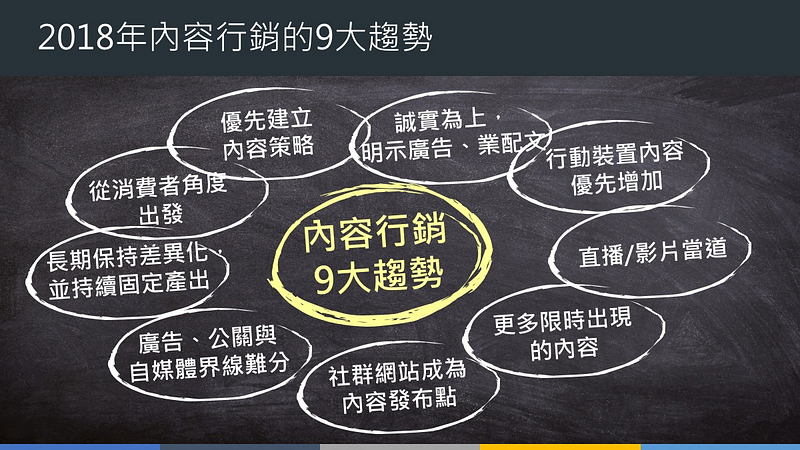 Source: Content hacker website
The lecture continued with Fabius, who has served in the fields of public relations and advertising for many years, introducing nine major content marketing trends in 2018. The most important of these is of course “prioritize establishing a content strategy”.
Layout content strategy
In fact, a good content marketing strategy remains the same, and it needs to closely focus on the target, audience and strategy. I have previously taken the SEO course offered by Moz on Udemy (https://www.udemy.com/whiteboard-seo/). The key points emphasized in the course coincide with what the two shared. They also follow the following steps:
- Determine marketing goals based on corporate goals.
- Select the target audience and find out their preferences and problems to be solved.
- Define how the company’s product features/differentiation (unique value) satisfy the above target audience.
- Set the theme cluster according to the selected product positioning (the product may consist of several features and keywords).
- Develop a content strategy (production, distribution, testing and verification, content revision) around selected keywords.
Among them, finding differentiation will be the key for a company to stand out. Fabius specifically cited Cargo Shipping Industry Maersk Line as an example, and also emphasized the thinking of “easy and easy”, leading everyone to think about how to package the hidden messages behind companies and products into lightweight and close-to-people content.
Strategy is the main thing, content is the supplement.
Fabius also specifically mentioned that the future will be an era where “strategy is the mainstay and content is the supplement.” Although producing high-quality content is still an iron rule, how to “achieve the purpose of quickly distributing content through the correct channels” is more important.
In the past, media was divided into owned media (owned media), paid media (paid media), and earned media (earned media) based on different attributes. However, the boundaries between these three are gradually disappearing. Returning to the readers themselves, consumer touch points are cross-attribute, cross-channel, and cross-platform, and high-quality content can be used repeatedly across different channels. In addition, consumers are becoming more and more sensitive to “advertising” type content. It does not mean that consumers refuse to receive messages with strong advertising flavor, but they do not like the feeling of being deceived. Therefore, “honesty comes first and explicit advertising/industry supporting documents” is also a trend that must be paid attention to. Fortunately, high-quality, explicit advertising content is not only more acceptable to the public, but can even cause viral publicity effects. For example, the well-known blogger-[Pikachung’s spoof industry matching series] (https://www.contenthacker.today/2017/11/pikachung-contentmarketing.html) is a successful case.
Take control of content and meet the needs of various departments
In addition to being consumer-oriented, content hackers will also face a problem from within the company. For example, the business department cares about closing deals, the marketing department wants to convey product features and promotional messages, and the public relations department values the company’s external image. How to integrate the needs and expectations of various departments for content will be a major challenge for content hackers/content departments.
Self-improvement techniques of content hackers
The condensed three hours are only enough to kick off the “content hacking”. Therefore, Vista, known as the “mobile library”, has also teamed up with Fabius to recommend 10 books that are helpful for content hacking. From thinking establishment, strategic layout to content production, and even improving design skills (good visual presentation is also a part of the content!), related reference books can satisfy:
- Content Power Company: Use good content to create big business
- The power of content: don’t sell products! Use “content marketing” to let customers come to you!
- The harder it is to sell, the harder it is to tell a story!
Those who want to obtain the complete book list and related introductions can request it here fill in the form. (The must-read books selected by Vista, who has read countless books, are particularly reassuring and encouraging!)
In addition to recommending good books, of course you can also pay attention to the latest content marketing trends through the following marketing media:
In fact, today’s content far exceeded my expectations. I thought it was just a basic understanding of trends. I didn’t expect that Vista and Fabius, worthy of being senior marketers, selflessly shared many methods and application cases for grasping trends. I not only benefited a lot from this lecture, but I also look forward to receiving it. There will be a series of reading sessions and [Content Hacking Lecture Series] (https://www.accupass.com/event/1711210815391364882950), and I look forward to seeing more discussions and applications of content hacking!
[ ](https://blogger.googleusercontent.com/img/b/R29vZ2xl/AVvXsEgIsieEqIWjjNbMbL6XN-S_1uRgQELrSSsutkZyy LOZJ28zR4dvqy_9pHJZU5jC-kGtjQrQAnVVDpP-DxmQKWTONuDUjdL3ZG3yPAJYzCRiPaL7CFCS_a5ckf9RG2RL01iFtZ9WDtyqGT To/s1600/2017%25E5%25B9%25B411%25E6%259C%2588%25E5%2585%25A7%25E5%25AE%25B9%25E9%25A7%25AD%25E5%25AE% 25A2%25E8%25AC%259B%25E5%25BA%25A7%25E6%25B4%25BB%25E5%258B%2595%25E5%2589%25AA%25E5%25BD%25B1-1.jpg)
The first “Content Hacking Lecture” concluded successfully!
Want to plan your 2018 content calendar? Welcome to register for Content Hacking Lecture!
Time: December 6, 2017 (Wednesday) 19:00 - 21:30 Fees: Early bird tickets are NT$600 (already sold), general tickets are NT$800 (register through the [Event Pass website] (https://www.accupass.com/event/1711210815391364882950))
About Content Hacking Sites
This site focuses on content strategy, marketing and operations and other related issues. Welcome to contribute articles or discuss cooperation matters. The two founders (Vista and Fabius) have both worked in well-known media and technology companies. They have many years of practical experience in digital marketing and media operations, and are good at content marketing planning and related course teaching.
★ Featured image source: StockSnap
Further reading
- “Read slowly and understand in seconds: Vista’s digital copywriting analysis time”: Vista new book publishing and event information announcement
- Content marketing strategies you have to pay attention to─it is better to sell products than ideas
- Former “Health” magazine editor-in-chief Huang Huiru talks about the writing method of long articles
📖 深入探索相關主題