
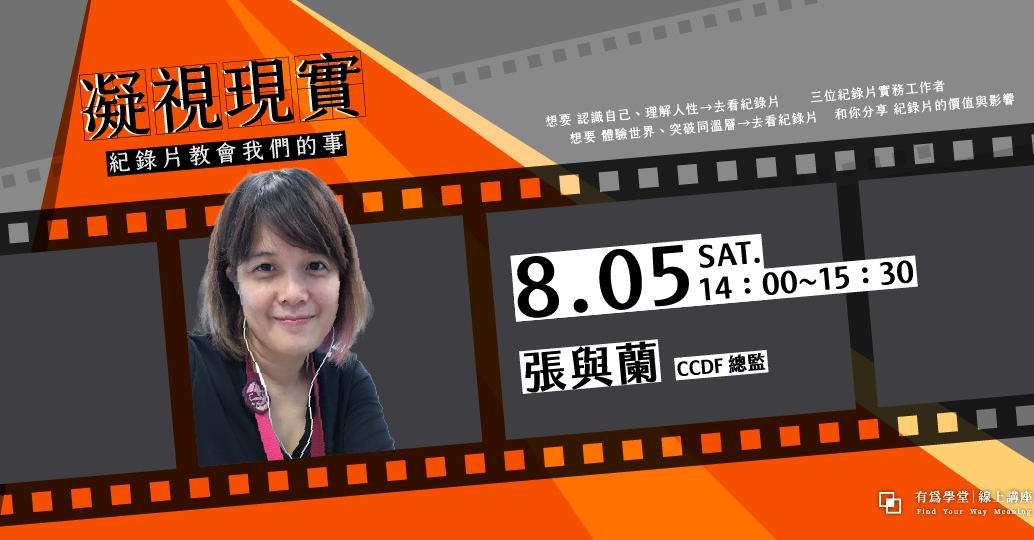
Director of CNEX Chinese Documentary Proposal Conference Zhang Yulan talks about what documentaries teach us
[ ](https://blogger.googleusercontent.com/img/b/R29vZ2xl/AVvXsEhomM-JiNy69xuxhp82BS2oNvmcXOvmEz5Q gc370NX8DIAiSU_t4uKK6qq3x6jUHp8in7Av4SB3f0OShjMyDaYuSV1pgOZBo0Yjxp7Cxv1xu6JfOdwKNqnns8nL0d0oBWWZ-s LAOIHzygPscRnmwPP6WcXDZOOvupnhFHJoezREOx8gncOY_Tey2H8aA51b/s1034/%E5%87%9D%E8%A6%96%E7%8F%BE%E5%AF %A6%EF%BC%9A%E7%B4%80%E9%8C%84%E7%89%87%E6%95%99%E6%9C%83%E6%88%91%E5%80%91%E7%9A%84%E4%BA%8B.jpg)
[CNEX Chinese Documentary Proposal Conference] (https://www.cnexdoc.com) Director [Zhang Yulan] (https://www.facebook.com/oceaniclan.chang) is a well-known documentary director and producer, and also my former colleague when I worked for “Digital Times” magazine. She was a former producer for National Geographic Channel Taiwan and Mainland China, and has also produced many documentaries for global broadcasts, including “Taiwan’s Wonderful: Human Body Reconstruction” (https://www.books.com.tw/exep/assp.php/vista/products/D020062968?utm_source=vista&utm_medium=ap-books&utm_c content=recommend&utm_campaign=ap-202308)”, “Falling in Love with True Taiwan” series, etc. He is currently the director of CCDF.
Documentaries are the scariest horror films
Director Zhang Yulan attended the [Staring at Reality] hosted by the Media Literacy Education Foundation. What Documentaries Teach Us] online lecture reminds friends who want to shoot documentary to keep the authenticity of the documentary in their hearts and keep asking themselves: Is this thing real? In other words, making a documentary is different from making a movie. You have to care about whether the thing is real. Because we cannot ask the interviewees to pose for photos, or to cooperate with our shooting needs and do things that they are not supposed to do.
Documentary refers to film that describes, records or studies real-world themes. The opposite of documentary is drama film. In most cases, documentaries do not require the participation of actors. The people, places, and situations shown in the documentary are consistent with reality and actual conditions. Documentaries cover a wide range of subjects, including completely documentary films and programs such as reality shows. The existence of documentaries often involves political topics and is controversial.
Director Yu Lan also pointed out that many of the things that are actually happening in society today are scarier than the plot of the movie, so she feels that documentaries are actually the scariest horror films. Because when you go to watch a horror movie, even if you are frightened by the plot of the movie, you may even be scared for many days after watching the movie, or you may not be able to sleep well at night, but you always know in your heart that the plot is fictional.
Director Yu Lan said: “There are many powerful video workers and filmmakers who have the ability to tell you a very scary story. But for me, I think the scariest horror movies are actually documentaries. Because everything you see, if we label it as a documentary, you will know Everything that happened is real! In other words, when a person dies in the film, he is really dead! So, when we watch the documentary, I am often worried about how the story will go.”
Documentaries are extremely influential
For this reason, Director Helan believes that the authenticity of the documentary will help to make the strongest appeal and influence. Looking at many social issues or character stories, the reason why it is worthy of being photographed and needs to be seen by everyone is because it must have a purpose and theme that needs to be communicated to the public.
Director Yu Lan pointed out the influence of documentaries by taking the 2013 Taiwanese documentary “[Twelve Nights](https://zh.wikipedia.org/zh-tw/Twelve Nights_(Taiwan Film))” as an example. Many people don’t know that in Taiwan, stray dogs that are imprisoned in animal shelters only have a short life of twelve days if no one adopts them. “Twelve Nights” was originally filmed at the [Yuanlin Stray Dog Shelter] (https://www.facebook.com/DogcatFan/?locale=zh_TW) to record the 12-day “blood and tears” of the stray dogs in the shelter, hoping to make the public more aware of and care about the fate of these stray animals.
Initially, director Raye (Liu Xinrui) shot this story from an animal perspective. After the release of “Twelve Nights”, it caused widespread repercussions and also aroused public attention to the problem of stray animals.
Of course, everything has two sides. The release of “Twelve Nights” also affected subsequent policies, resulting in the Animal Protection Law being later changed to state that stray animals would not be euthanized after being admitted to shelters. However, due to the impact of this documentary, the relevant units were too hasty to amend the Animal Protection Law. Instead, although stray animals were not euthanized in shelters, their living environment became worse. And because they cannot be euthanized, and there are so many stray animals, other issues will arise, such as issues related to neutering, sheltering and adoption.
Therefore, Director Liu later filmed the second episode of “Twelve Nights”, which mainly talked about the problems currently faced by the asylum. Therefore, we can understand: Documentaries are influential. When the issue you are concerned about is big enough for everyone to resonate with, and even when everyone thinks this matter should be changed, it will have an impact on this society!
Director Yu Lan said that based on the current awards at international or Taiwanese film festivals, the so-called [Documentary Short Film] (https://zh.wikipedia.org/zh-tw/金马影院免费观看的精品) will probably be within 30 minutes, or news media such as the New York Times and the British [Guardian] (https://www.shoppingdesign.com.tw/post/view/4686?) have a documentary platform, and the videos on them are probably around 10 to 20 minutes. In domestic film festivals, the length should be less than 40 minutes, and these films will be regarded as documentary shorts.
Since some stories may not be able to be made into an hour-long film, everyone began to think about whether they could make a 10-minute or 20-minute short film. Take the Tokyo [Proposal Conference] (https://taicca.tw/article/77408fcf) as an example. They have a proposal award for documentary short films, which stipulates that contestants must tell a story in 10 minutes.
Every eye-catching documentary has a good story.
Of course, it is actually very difficult to tell a person or a story well within 10 minutes. Many times, trying to finish a story within 10 or 15 minutes puts the photographer’s skills to the test.
Director Yu Lan mentioned that in the past golden age of television, they most often made television-length films, which were about an hour long, and after deducting commercial breaks, they were about 45 minutes.
Later, when these episode-by-episode TV programs became increasingly unsatisfactory, so-called documentary series would appear. With the rise of streaming media, this trend has become even more obvious. Because the documentary series has the same theme, but is shot in many episodes, it is easier to attract the audience’s attention, and it is more attractive and sticky.
Director Yu Lan mentioned that the most famous documentary series on Netflix is probably “Chef’s Table” (https://www.netflix.com/tw/title/80007945). This documentary series from the United States is directed by David Gelb (David Gelb) and Brian McGinn (Brian McGinn), the series premiered on Netflix on April 26, 2015. The docuseries takes viewers into the lives and kitchens of a variety of acclaimed and successful international chefs, with each episode focusing on a chef and exploring the unique lives, talents and passions that influenced his or her cooking style.
In addition to the popularity of documentary short films, there are also many videographers involved in the shooting of feature films. There is also a feature-length film called docudrama in English, which has been popular abroad for some time, but is relatively rare in Taiwan. Some people confuse Documentary with documentary film (docufiction). In fact, there are some essential differences between the two: documentary film mainly refers to a film photography technique and belongs to a film category. Real historical documentary segments are inserted into the narrative process of the fictional plot to strengthen the director’s reproduction of reality. Intention (such as the documentary film “Bloody Sunday”); and the distance between the “realistic” events in documentary documentaries is mostly in the distant past, and most of the people and things in it no longer exist, so it is no longer possible to relatively objectively shoot and record through live interviews and conventional documentary work methods.
Documentary films are an organic combination of narrative and fiction, while documentaries are more of a “re-enactment” of objective historical facts (re-enactment ), the production team of such films sometimes uses the location where the event occurred as a stage, or seeks out professional actors who resemble historical figures to conduct “fake oral” interviews based on surviving manuscripts, diaries and other documents in order to “reproduce” the scene of the year. Examples such as “The Act of Killing” and “Rabe’s Diary” are well-known cases.
Director Yu Lan took “Genius” (https://zh.wikipedia.org/zh-tw/Genius), an American TV poetry anthology, as an example. “Genius” is the first TV series produced by the National Geographic Channel and was created by Noah Pinker and Ken Beale. The crew will choose a few very famous people, such as Einstein and Picasso. They use real character stories as models and then express them in a plot way. But the premise is that the film cannot be added to the story, and can only be a dramatic performance based on the actual story.
Documentaries enter a new era of science and technology
In addition, due to the rapid changes in technology, many documentaries are now beginning to incorporate AR and VR technology. Director Yu Lan said that he had seen some [VR documentaries] (https://benic360.com/vr-360-documentary/) that had just come out at the Taipei Film Festival a few years ago, and now there are more and more of them! She believes that the most challenging part of VR documentaries for audiences is that when we watch the film, the time at which the audience wants to see someone do something is all arranged by the director and editor through editing. However, today in VR immersive documentaries, because it is a 360-degree shooting method, if you wear a goggles, of course you will see more clearly!
Different from ordinary traditional films, the production of VR films requires rethinking the point of view and the direction of entry. When designing the point of view, it is necessary to rethink the audience’s feelings about the immersive experience, and at the same time, it is necessary to take into account the message that the creator is trying to convey for the documentary. In this regard, Director Wu believes that VR does not have to carry powerful information like traditional films, but focuses more on feelings.
When watching this VR documentary, the audience can freely choose which direction to look at at this point in time. Therefore, VR documentaries challenge the so-called director’s point of view or perspective to a great extent. Through the immersive viewing mode, the audience can get closer to the characters in the play and feel as if they are interacting with the protagonist, so it is very interesting!
Documentaries should draw materials from daily life
In fact, the subject matter of documentaries is very diverse, such as “Datong” (The Chinese “Mayor” is the work of mainland Chinese director [Zhou Hao](https://zh.wikipedia.org/zh-tw/zhou Hao_(director)). This film won the 52nd Golden Horse Award for Best Documentary. It mainly tells the story of Geng Yanbo, the former mayor of Datong City, Shanxi Province in 2007, who demolished old houses and reconstructed the ancient city wall in Datong.
The mayor had some imaginations about his city, and he hoped to rebuild some historical relics. However, in order to pursue the so-called big benefits, he demolished residential buildings and forced many residents to move away. So this documentary is actually an inquiry into social issues. This documentary allows the audience to reflect on social issues. Director Yulan said that she liked this work very much and suggested that if you are interested, you can check it out!
As for “[Seeing Taiwan](https://zh.wikipedia.org/zh-tw/Seeing Taiwan)”, I think everyone should know that the late director [Zeppelin](https://zh.wikipedia.org/zh-tw/ Zeppelin_(Taiwan)) used aerial photography to package this issue in order to awaken the Chinese people’s attention to issues such as sustainability and environmental protection.
Because of his work, Director Zeppelin has long used aerial photography to record every detail of life in Taiwan. Director Yu Lan did not forget to remind everyone, but also think about things that the Chinese people are already aware of, such as over-exploitation of mountains and forests, air pollution, etc. Why do they still attract the public to come to the cinema to watch this film? It is because “Seeing Taiwan” is both artistic and dramatic. Director Zeppelin combined these two elements to package the issues he cares about, and it was able to obtain such great box office response and social attention.
Ask yourself before shooting a documentary
Director He Lan said sincerely: “Filmmakers must make the audience more interested in participating and watching, so that you can have influence.” Therefore, if you want many issues that were originally hidden in the corners of society to start to attract the attention of the Chinese people, you can actually interpret them through documentaries. In other words, when the seriousness and horror of a certain issue are elevated, or when the audience or even society as a whole begins to realize this matter, it will naturally have its influence.
Another example is “Roll!” directed by Lin Yuxian. Boy] (https://zh.wikipedia.org/zh-tw/Roll! Boy)” is a documentary produced in 2005. The film shows the training and competition of the gymnastics team of Zhengyi National Primary School in Luodong Town, Yilan County. Everyone should know that the protagonist of the story grew up and still struggled in the world of gymnastics. Later, Director Lin also filmed another film “Roll!” Man](https://zh.wikipedia.org/zh-tw/Roll! Man)” is the final chapter of the “Rolling Trilogy”. Director Lin went to the Taipei World Universiade to record Li Zhikai’s participation, and added part of how [Li Zhikai] (https://zh.wikipedia.org/zh-tw/李智凯) won the gold medal into the video content.
In addition, films such as “神人之家” was also a very successful documentary last year, and its performance in the international arena is also quite impressive! Director Yu Lan thinks it is very interesting, because the director Lu Yingliang is filming his own story, using the camera to interpret the relationship between his own family and him. Therefore, many documentaries actually start by asking yourself and then explaining who you are.
“Holy Family” is a rare documentary. From embracing prejudice to calm understanding, from hardness to softness, it seems to allow the audience to participate in the inner heart of the creator. When the environment changes, when the image looks back at the private, honesty is the key to creation, and honesty is also the most touching part of this documentary - the honesty of hate and the honesty of love make it so powerful. Even though it is powerful, the camera is not a weapon, but connects each other like a bridge and brings each other into this long-avoided family problem.
Having said that, “House of God and Man” is also such a work. Although it mainly tells the ordinary story of a family of four, and there is no climax plot, many viewers walked out of the theater in tears after watching it. Director Lu By constantly peeling off the cocoons, he wants to clarify his relationship with his family, and then try to deal with the difficulties he encounters in his life.
Director Yu Lan said that any subject matter can be turned into a documentary, but there is a lot of knowledge in how you tell the story and how to make your story interesting.
Documentaries can reflect universal values
She pointed out that when the documentary shooting team starts to think about a program, they must first think about it: Is your story a local story? It still has universal value, which means that even if the audience is not Taiwanese, they can still understand it.
If foreigners can be moved as well, or find the content scary, then they have a chance to gain favor. Just like the “House of Gods” mentioned just now, it started out as a local story, and the director was filming the story of his own family. However, later on, the film performed very well in international film festivals or in various competitions, because the director later raised the level to a higher level, not only telling stories about his own family, but actually exploring the relationship between family members, such as the emotions between family members and fathers and sons, which has universal value.
Director Yulan said: “If the audience can understand the feelings the director wants to convey through the language of the camera, even if they are not from this country, then it will be a success!”
Therefore, when you start shooting a documentary, it can be a local story, but through constant discussions with the team, you can slightly twist the local story and turn it into a universal story… In this way, your film will have the opportunity to challenge the international stage and let more people see this work.
To put it simply, universal stories usually have some elements. For example, this character must be quickly recognized by the audience, so that everyone can understand this character and know what his emotions are? What problems did he encounter? And, what kind of journey did he go through to solve this problem? What kind of things do you have some motivation to do?
After you pull out these four points, just think about it for a moment. Is there anything that only Taiwanese people can understand? What other things are universally applicable? In this way, even if it is placed on a content platform in the future, the Japanese can understand it, and then the Koreans can understand it, and even the Europeans can understand it…
As the saying goes, “Rome was not built in a day.” Take the Korean dramas that have developed rapidly in recent years as an example. They have been able to achieve very impressive results in the global film and television market. In fact, it is not only the government and large companies that invest resources, but also the various TV stations and film and television teams that have done a lot of research and preparation in advance. If you have the opportunity to watch Netflix, you can understand the movie-watching trends and interest preferences of today’s global audiences from a variety of film and television themes.

★ “1-Minute Stunning ChatGPT Popular Copywriting Bible”
★ To comprehensively improve your writing skills, welcome to sign up for “Vista Writing Companion Program”.
★ Do you want to write better copy? Come and take a look at “[1-Minute Stunning ChatGPT Popular Copywriting Bible] (https://vista.im/chatgpt-book)”.
★ Photo Credit: Media Literacy Education Foundation
★ Welcome to buy me a cup of coffee and cheer me up! You can express your support by sponsoring multiple times, thank you.
★ Want to learn content marketing techniques? Welcome to register for the online course “[Content Power: The Super Power of Building Brands] (https://hahow.in/cr/content-power)”.

If you are interested in [personal brand](https://www.vistacheng.com/search/label/personal brand), [content marketing](https://www.contenthacker.today/2019/07/content-marketing-from-zero-to-he ro.html), Copywriting or Good Book Recommendations are interested, please subscribe to “Vista Newsletter”! Thanks.
Further reading
- Golden Horse Award 2022 Best Documentary “Nine Guns” Director Cai Chonglong talks about the value and influence of documentaries
- Former “Health” magazine editor-in-chief Huang Huiru talks about the writing method of long articles
- Eating History Podcast host Zhan Haoyu talks about how to use the “Nine-Gong Ge Thinking Method” to conceive stories