Tutorial on how to use the GEO medical checker: Test whether your name will appear in the AI’s answers

When was the last time you carefully scrolled through ten search results?
More and more people no longer look for answers this way. They ask directly to ChatGPT, Perplexity, or look at the AI summary at the top of Google search results: Who should I contact about this? Who can be trusted in this field? At that moment, whether your name is included in the AI’s answer almost determines whether you exist in the eyes of the other person.
This thing has a name, it’s called GEO (Generative Engine Optimization). It is different from the SEO we are familiar with: SEO optimizes search rankings, while GEO optimizes “whether AI is willing to treat you as a quoteable answer.” Having your content ranked on the first page of Google does not mean that AI abstracts will mention you; conversely, people who do not have much content but have a clear enough structure and specific facts will be more likely to be cited by AI.
The question is: How do you know whether your current GEO status is good or bad?
To answer this question, I built a free tool in my AI lab: GEO Physical Examiner (opens in a new tab). This article will walk you through how to use it and what to do next after getting the results of the physical examination.
What is GEO physical examination device?
Let me start with three things that will concern you.
First, it is completely free, no need to register or leave an email, just open it and use it. Second, all checked information is only stored in your own browser (localStorage) and will not be uploaded anywhere. You can rest assured to answer honestly. Third, the entire physical examination process takes about ten minutes. After completion, you will get a GEO visibility score from 0 to 100, three holes that should be filled first, and a rewritten coaching prompt that can be directly posted to ChatGPT or Claude.
The physical examination is divided into three PARTs, corresponding to the three levels of GEO: your current search appearance, your content and physical constitution, and your territory structure.
STEP 1: First go to Google to search for your own name
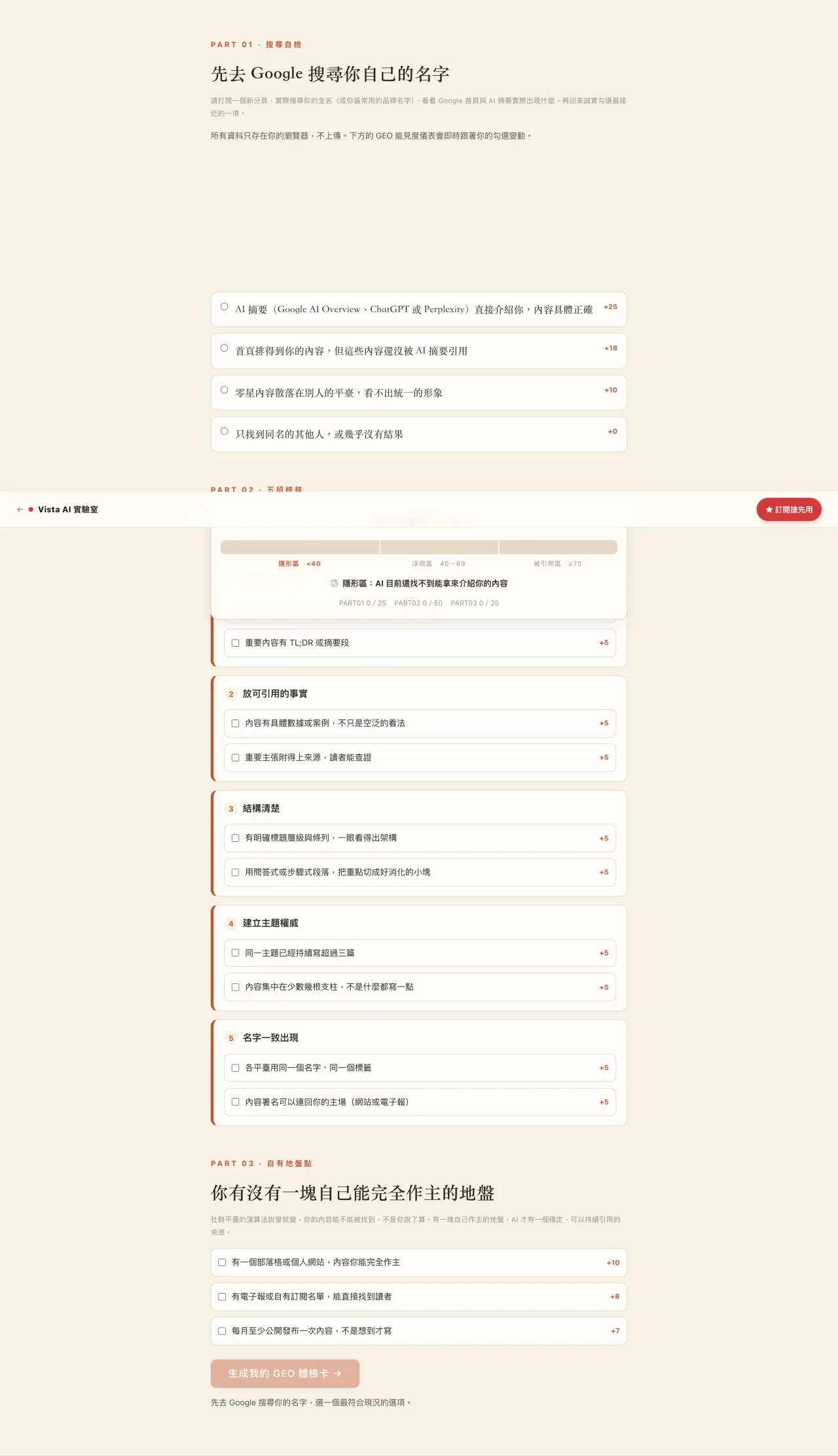
The first level is not to answer in the tool, but to actually open Google and search for your name. It is recommended to search in an incognito window to prevent personalized results from beautifying your current situation.
After searching, honestly choose the closest one:
- AI summary directly introduces you: in the AI summary above the search results, there is your name and professional description
- Your content is ranked on the homepage, but it has not been included in the AI summary.
- There are sporadic content scattered on other people’s platforms
- Only other people with the same name found, or almost no results
This question is worth 25 points and is the starting point for the entire physical examination. Many people will be shocked when they do this action for the first time: it turns out that how they look online is so different from what they imagined. And this is exactly the value of a physical examination. You have to know the current situation first before you know what to make up for.
By the way, when I searched for “Who is Zheng Weiquan”, the AI summary would introduce me as “columnist, corporate lecturer and AI application coach”. This is not luck, it is the result of more than ten years of continuous output of content. If your label has been in business for long enough, even AI will issue business cards for you.
STEP 2: Make AI willing to quote your five-stroke check
The second level is the content and physical examination, with a total of ten check boxes, accounting for 50 points. These five tips are compiled from my long-term writing and observation of AI citation behavior:
- Give the conclusion first: Start the article with the key points, or include a TL;DR summary paragraph. AI, like busy readers, likes to see the answer first.
- Put quotable facts: The content has specific data or cases, and important claims can be accompanied by sources. Adjectives don’t get quoted, facts do.
- Clear structure: There are clear heading levels and columns, and there are question-and-answer or step-by-step paragraphs. The clearer the structure, the easier it is for the AI to extract.
- Establish topic authority: Continuously write more than three articles on the same topic, with the content focused on a few pillars. The AI needs to recognize you as “the person who answers this question.”
- Names appear consistently: Use the same name and tag on each platform, and the content signature can be returned to your home page.
Each item is a specific behavior that can be checked or not checked, so there is no need to guess or freely confirm. During the ticking process, the visibility meter at the top of the page will change instantly, and you will directly see how the score moves with each additional move.
STEP 3: Take stock of your own land
The last level is worth 25 points and only asks three things: do you have a blog or personal website, do you have a newsletter or your own subscription list, and do you regularly publish content publicly at least once a month.
Behind these three questions is the belief I have been talking about for many years: social platforms are rented territory, and only the official website and list are your own home. For GEO, this matter is even more critical, because the sources cited by AI are mostly self-owned website content that has long-term stable existence and complete structure, rather than social posts that will be washed away by the algorithm.
Understand your score: three intervals
After completing the three levels, press “Generate my GEO physical examination card” and you will fall into one of three ranges:
- Invisible zone (below 40 points): Neither AI nor search engines can tell who you are yet. Don’t be discouraged, this means that every additional move is a significant improvement.
- Emerging area (40 to 69 points): You have content that has been seen, but has not yet been referenced by the AI. This stage is the most worthwhile investment, as it is only a few steps away from being cited.
- Cited area (70 points or above): When others ask about the field of AI, they have already had the opportunity to mention you directly. The next focus is on maintaining and deepening.
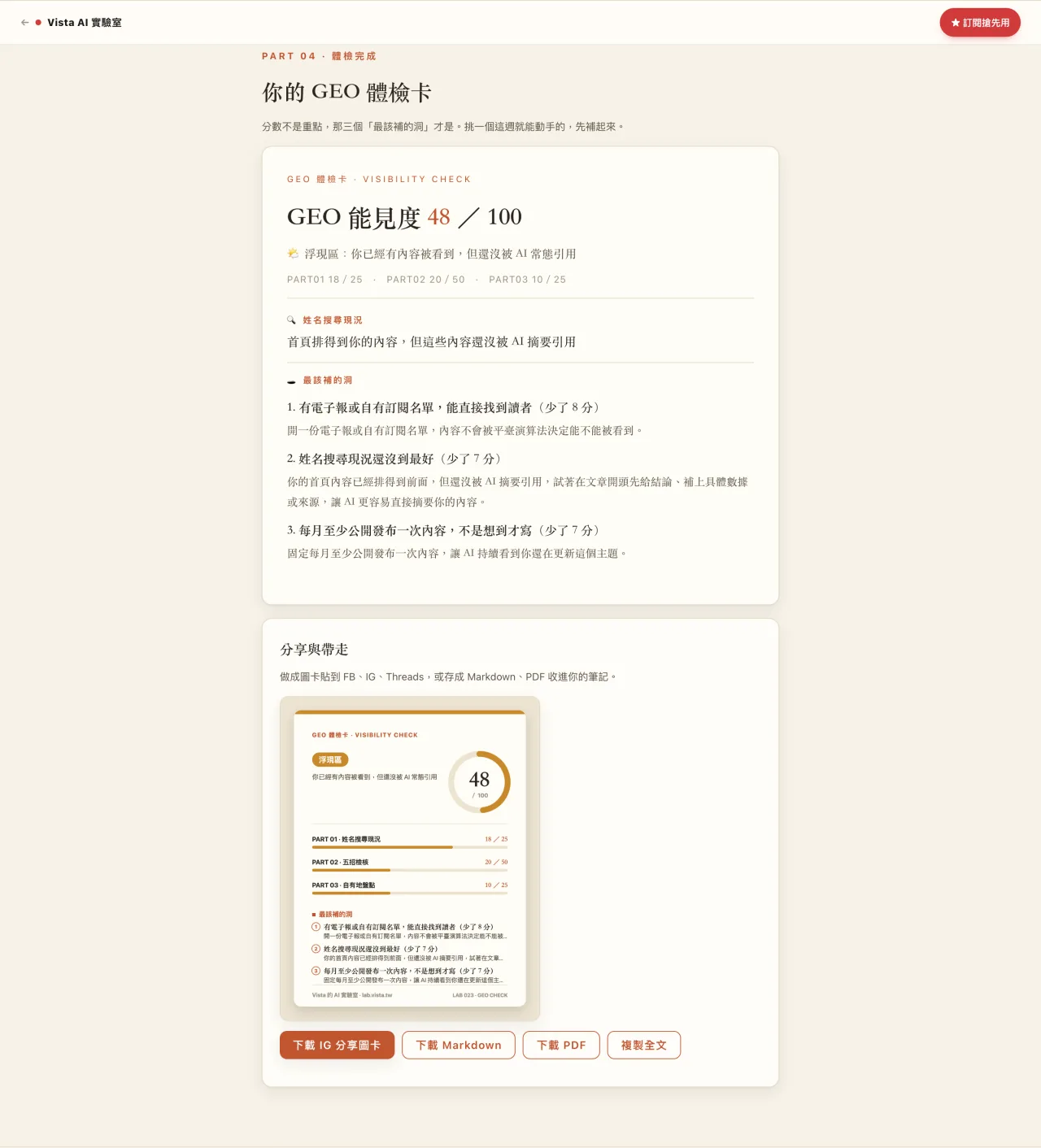
The most valuable thing on the physical examination card is not the score, but the “holes that need to be filled most”: the tool will sort the items you didn’t check in order of points lost, pick out the top three, and attach specific suggestions to each one. My suggestion is to pick one that you can start this week and make up for it first.
After getting the physical examination card: let AI be your rewriting coach
In the last section of the physical examination, the tool will generate a customized AI-rewritten coaching prompt based on your actual check status.
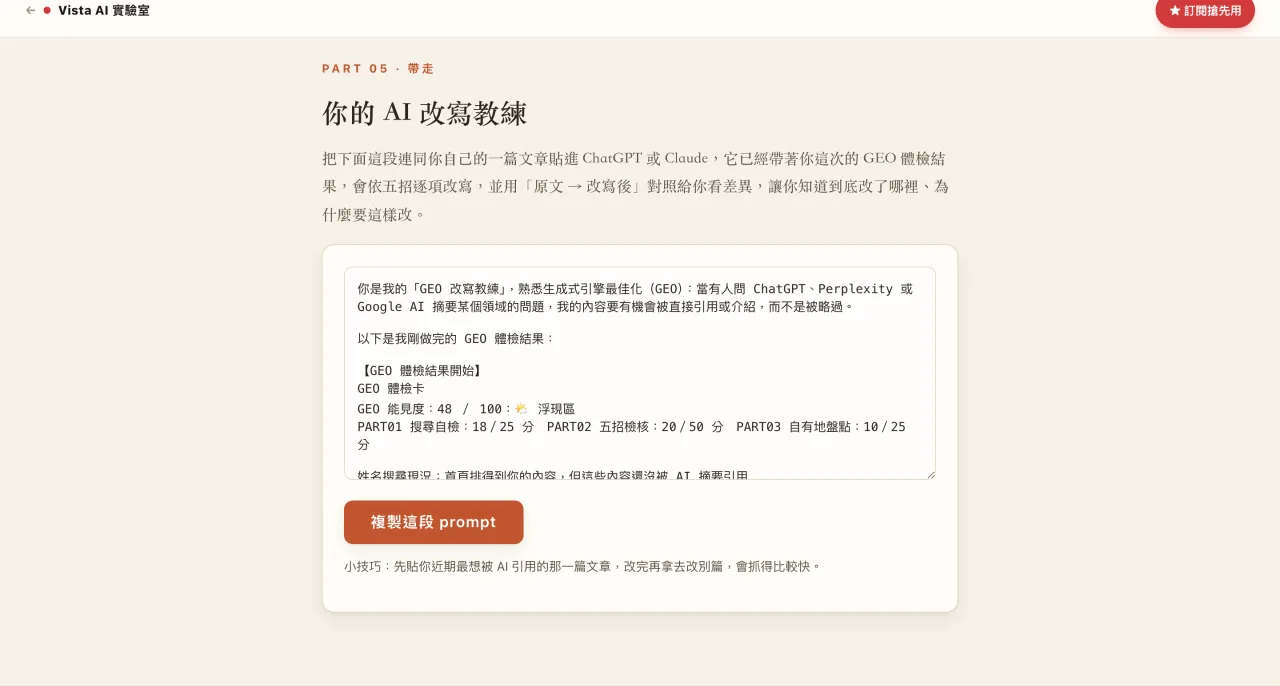
Usage is very simple: copy this prompt, paste it into ChatGPT or Claude, and attach an article of your own. AI will help you rewrite it one by one according to the five tips, and list the modification comparisons, allowing you to see the difference between the “original writing method” and the “writing method that the AI is willing to quote”. After changing two or three articles, you will internalize this writing method, and then you will naturally adopt a GEO-friendly structure when writing.
Physical examination results can also be downloaded as IG sharing cards, Markdown or PDF. If you are willing to post the picture card to the community after finishing it, please tag me. I would like to see everyone’s score distribution.
This is just one of 25 tools
The GEO Health Checker is Tool #23 of Vista’s AI Lab (opens in a new tab). There are currently 25 interactive tools developed by me in the laboratory. From positioning convergence, point of view, story generation to writing discipline system, they are all designed to “learn while practicing and produce on the spot”.
Some of these tools are subscriber-only. For example, two new tools were completed at the same time as the GEO physical examination tool this time: the “Content Pillar Planner” helps you converge three to four long-term content themes from three questions, and fills the question bank for each pillar; the “90-day Label Plan Generator” will arrange milestone dates and fifteen tasks based on the start date you set. Each time you come back, check the box to track the progress, and let AI follow you through the 90 days based on four real indicators. Both tools are currently limited to members and will be made public later.
If you want to use every new tool as soon as possible, the method is simple: Subscribe to the Vista AI Inspiration Supply Station (opens in a new tab). The subscriber-exclusive community will release the pass code for the month every month. Enter it once. You don’t need to enter it again for 35 days on the same device. All member-limited tools are directly unlocked. Your subscription also directly supports my continued development of these free and paid tools, so that the lab can always grow new things.
If you are still waiting to see, you are welcome to start using the free tools first, or subscribe to my e-newsletter (opens in a new tab). I will send new tools and new methods to your mailbox as soon as possible every week.
Only by being seen first can you have a chance to be remembered; only by being quoted by AI can you have a chance of being found. Take ten minutes now to check your GEO visibility (opens in a new tab).
Next step
Bring this topic to your team
Vista Cheng speaks and runs workshops on AI workflows, writing and content systems for companies, schools and public agencies.