Huang Huiru talks about writing methods: raise a pond and have concise short articles at your fingertips
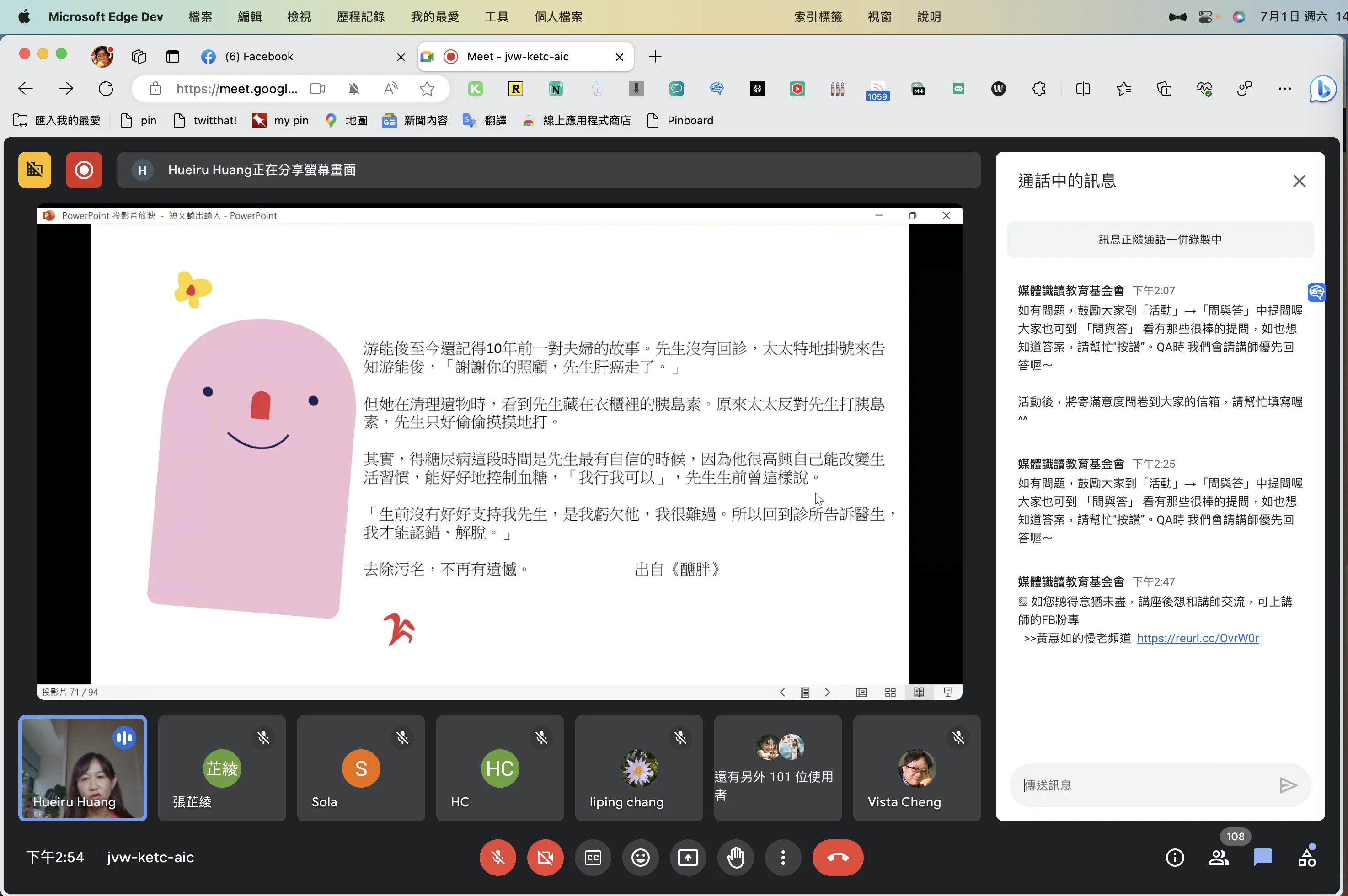
I still remember that on July 1, 2023, the former “Health” magazine editor-in-chief Huang Huiru should Media Literacy Education Foundation invited us to hold a wonderful online lecture titled “How to Write Concise Essays”.
Ms. Huang Huiru has been famous for a long time and has also won Asian Journalism Excellence Award and other domestic and foreign journalism awards recognition, it can be said that he is a senior media person and best-selling author, and now he is also a great yoga teacher.
To outsiders, her work seems to be inseparable from content production. From writing columns, writing books, recording podcast programs to operating fan pages, they are all closely related to content. She even believes that the course series prepared for each yoga teaching - including how to understand yoga and how to share it with students, is also part of the content.
When you look at a tree and feel its tranquility, you become tranquil too. Through this tree, you feel that you are one with all things. This is love, and this is the beauty of life. —— Huang Huiru
Editor-in-Chief Huang mentioned that if you think about how to input and output content from the beginning, it will be easy to fall into the bottleneck of what information to find and what topics to write about.
Many media people have the problem of procrastination. She found that even if her colleagues around her are very senior, everyone still feels anxious every time they have to hand in a column and don’t know what to write. Therefore, many friends will fall into deadline panic every time they have to submit a manuscript.
The writer should build a fish pond
She claims that she rarely encounters such problems, and she is not like some journalist friends who seem to be in great pain when they have to submit a manuscript. Editor-in-chief Huang gave an example. Her column in “天下 magazine is submitted every two weeks, but she will submit it in the first week of every month. She laughed and said that she never started looking for topics before the deadline because she usually had a pond with fish (writing subject matter).
The “pond” mentioned by editor-in-chief Huang Huiru is actually her inspiration database. That is to say, I usually actively collect various information, and then rely on a lot of reading and thinking to constantly think about the materials at hand. Is it possible to become an interesting topic?
The key to growing your pond is to keep reading. Whenever she sees a topic that she thinks is good, Editor-in-Chief Huang will start to organize and conceive, and even start to think about what kind of situation or bottleneck this topic will encounter in Taiwan? Is it possible to derive other phenomena or issues?
In other words, Editor-in-Chief Huang’s secret to successfully running a writing pond is to have his own coordinates. She will accumulate in her own coordinates for a long time, and will not collect or read information randomly, but will always read according to her own direction and coordinates. Only through conscious collection and accumulation can you raise one huge fish after another in your pond.
As for how to set the coordinates? Chief Editor Huang believes that the first step is to figure out who your readers are? Whether she’s writing a column or hosting a podcast, she’s speaking to the same people, serving the same people. Editor-in-chief Huang suggests that the more clearly you think about your service objects or target audience, the better! In other words, the more clear and specific you can describe it, the better, because then you will be able to better understand and empathize with the other person’s feelings and needs.
The second coordinate is to think carefully about the context of things. If the time and space scene of the incident were moved to Taiwan, what interesting effects would occur, or what would be the meaning behind it?
Many people go online to do homework when they need to write. Everyone knows the importance of input, but a lot of reading alone is not enough! Because a lot of foreign information or research surveys may not be “universally applicable”, the situation we encounter in Taiwan may be different. Therefore, Editor-in-Chief Huang recommends that all media people or content creators should first think from this aspect and think carefully about the impact this event or issue will have on Taiwan, or what specific indicators it means?
The third coordinate is Why now. Many people rush into writing without thinking carefully before. Why should readers read what you write now? If everyone starts writing in a hurry, it is often difficult to write an impressive and wonderful chapter. So, as pen wielders, we all need to answer the question, “Why now?”
A lot of reading is important. In this era of information explosion, everyone may be involved in all kinds of things, but what information is it that readers should know now?
Editor-in-Chief Huang gave an example. In the medical and health fields, there may be different information occupying the news page every day. Sometimes it is urticaria, sometimes it is lung cancer, or the new coronavirus epidemic in recent years, etc…
Although some topics seem to be important and the traffic performance is not bad, if your interpretation is only one-sided, it will not be easy to grasp the needs and preferences of the public. Therefore, Editor-in-Chief Huang recommends that everyone learn to “read the air”, that is, to resonate with this society - even if you want to attract traffic, you must start from your coordinates.
“Reading the air” is not just about observing words and colors, but cultivating the comprehensive ability to observe the environment and atmosphere, put forward and communicate suggestions for improvement, and implement them. —— Chu Shiying
Media people or content creators must understand your readers’ views on this incident, or how the general public in Taiwan views this issue? In other words, you have to approach it from a different angle and write your own unique point of view. Only when you resonate with this society will that thing be suitable to be written.
Writers must understand the readers’ profile and needs
Of course, for media people or content creators, everyone must try to serve a broad audience, that is, to produce content according to the needs of the target audience. If you think this topic is important (such as the reform of the medical environment, the promotion of health policies, etc.) and needs to be known to everyone, then you should write it so that they want to read it!
For media professionals or content creators, these topics are undoubtedly challenges for you. You must write it to the extent that readers can read it. Otherwise, if an article has only a few hundred clicks, its contribution to the media or the company itself will be a drop in the bucket. It doesn’t matter if the traffic is low, you may have wasted an important problem because your company will probably not or dare not deal with this kind of problem in the short term.
If you think this issue should be something everyone must pay attention to, you have an obligation to make it interesting and exciting, so that this target audience must watch it!
Moreover, you have to try to prove that they are not only interested in the incident, but also know the whole story and the ins and outs of the incident.
Of course, it is not easy to discern what readers really want to see. For example, before smartphones came out, probably no one knew that we needed smartphones? Even though our lives are now inseparable from smartphones, what other functions would be better? Editor-in-chief Huang said with a smile that if some media or technology companies held some focus groups now, the consumer public might not be able to figure it out!
 ▲ Huang Huiru’s best-selling book “Sugar Fat”, an in-depth discussion of the relationship between diet and health
Editor-in-chief Huang mentioned that when she was working in the media, she would use the focus group interview method from time to time, that is, to invite some readers to conduct focus group interviews. Not just making insinuations, but directly asking them what topics they want to see? Why don’t you continue reading magazines? It is conceivable that many readers will be very polite, and some people will say that they are too busy and have no time to read it.
In fact, many people have subscribed to magazines before, and often find that after each issue of the magazine is delivered, it is put aside without being opened at all. Then, over time, they lose interest and no longer renew their subscription. The reason is very simple, it’s because you didn’t watch it! But everyone knows very well that not having time to watch it is actually a false issue: the reason why you don’t watch it is just because it is not well written and exciting enough. In other words, it doesn’t meet the readers’ needs.
Editor-in-Chief Huang reminds everyone that even if readers have clear pain points and needs, the solution often does not necessarily lie with competitors. For example, modern people are busy at work and often need to relieve stress. In the past, many media liked to write about stress relief topics. However, if readers want to express their stress, they don’t necessarily need to read the report you wrote. She might go to a yoga class after work, or invite a few friends to a boxing ring or do aerobics, which can also achieve her goal.
The solution we want to find is not necessarily another content, but to understand the needs of readers. In other words, many problems in this world are not black and white or have only one answer. There may be many ways to solve people’s problems. Therefore, Editor-in-Chief Huang suggests that in addition to a lot of reading and typing, you should also use a growth mindset to look at everything in the world and try to adopt other input methods, such as “open your ears and chat” that few people have experienced.
Editor-in-Chief Huang cited a practical case. When chatting with a friend, someone mentioned that people cannot sleep well after middle age. After hearing this, ordinary people may think that this is indeed a common phenomenon, but friends care about each other and warm up, and this matter will be over. However, she will think about it, is age really a factor affecting uneven sleep? Therefore, Editor-in-Chief Huang collected some relevant information afterwards and started writing it into an article.
In other words, when everyone is chatting, you can also try to examine the causes behind many problems by peeling off the cocoons to see if there are any interesting discoveries or insights into new needs?
Write with a sense of problem
A novelist once pointed out that he is the one who turns his belly button to show others, but Li Ang believes that things with upward and downward belly buttons are more charming and taboo. Those taboo places were just enough for her to throw into the pot and cook into a pot of witchcraft that would challenge authority.
For Editor-in-Chief Huang, she also believes that disclosing information is not about showing others your navel, nor is it for traffic, or to hope that others will take the time to read more articles you write. But you believe that the information that is helpful to you can also help others. In other words, your readers will also grow as you grow… Therefore, Editor-in-Chief Huang not only encourages everyone to open their ears to chat and think, she also suggests that if media people have the opportunity to participate in some press conferences, seminars, or academic activities, they can go there with an awareness of the issues. On the way to the meeting location, you can think about it first. What are the possible problems?
Problem awareness means to first ask yourself “why”? Why is this question important? We need to have a clear problem premise, source, foundation point, or starting point, and set the main issues we want to explore and solve. Only then can subsequent questions stick to this starting point and extend downward to develop related issues. Only with good problem awareness can we find the right questions and make subsequent questions focused and effective. ——Hong Zhenyu
Editor-in-chief Huang said that whether you just mentioned opening your ears to listen to what others say, or practicing your own life experience, in fact these things are not that simple and require a long-term habituation process, that is, you must try to make it one of your living habits. This means that you have to get used to doing it for a long time and let it become a natural part of your life. As far as reading is concerned, instead of asking yourself when to input, what is more important is that there should be a fixed period of time in your life for input and output.

💡 Want to quickly turn your good ideas into a website or digital product? You don’t need to learn to write programs. As long as you can describe your needs, AI can help you realize them. Teacher Vista’s Vibe Coding practical workshop will take you from scratch to create your own digital works using natural language. Whether you’re a writer, content creator, or want to build a showcase for your expertise, this class can help you take that crucial first step.
Therefore, if you want to write a wonderful chapter, you must not just rush to the sea and catch a fish on the eve of the deadline. Just think, isn’t that very hard work? If we have the habit of input and output, that is, if we continue to raise fish in our writing pond, we can sit back and relax and ensure that there are huge fish on the table at any time.
Editor-in-Chief Huang pointed out that ensuring there are enough fish is only the first step. We also need to catch the fish and cook it. Therefore, there should be several pots cooking on your stovetop, for example, some pots are cooking miso soup, and some pots are cooking steamed fish soup…
A pot is a storage container. Only by placing the right pot can you cook a table of delicious dishes! That is to say, you must think clearly about where to store the information. This is actually a very important thing.
It’s not enough to just save information and materials in “My Favorites” or a notebook. Editor-in-Chief Huang suggests that it’s best to categorize and manage them according to what you need now (such as the subject of the next book, ideas for writing columns, inspiration for social posts, etc.). You can make good use of digital note-taking tools such as Anytype or Notion to build your own knowledge management system.
Therefore, regarding the topic of “content input”, Editor-in-Chief Huang suggests that everyone should have their own management and storage methods. In this way, you don’t have to worry about information explosion or out-of-focus issues.
My approach is: develop the habit of conscious input under your own coordinates. —— Huang Huiru
►►► Continue reading: Former “Health” magazine editor-in-chief Huang Huiru talks about the writing method of long articles