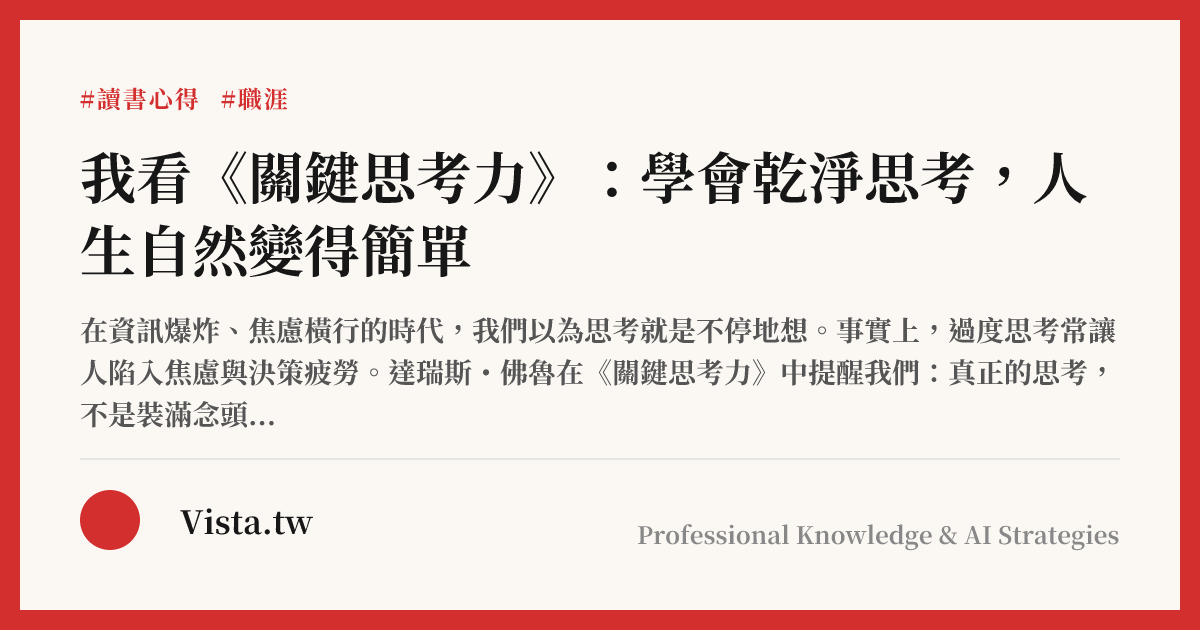
I read "Key Thinking Power": Learn to think cleanly, and life will naturally become simpler
We think that thinking can solve all problems, but sometimes we think too much and become more and more confused. Every day when I wake up, various push notifications and notifications are flooding in on my phone, and my thoughts are buzzing like a machine that never shuts down. We only focus on anxiety and worry, but rarely stop to ask ourselves: “Is it really useful to worry about these worries?”
The reason why this book “Think Straight” (Think Straight) deeply touched me is that it does not teach us to think more, but rather asks us to think less.
1. Too much information makes people even more lost.
When you wake up every day, your brain immediately enters battle mode. Mobile phone notifications, unread emails, and social updates…it seems like the whole world is competing for your attention. You think you’re thinking, but you’re actually just being forced to deal with a never-ending stream of messages.
“Key Thinking Power” This seemingly light and short book made me realize that the dilemma of modern people is not that they don’t think, but that they think too much. The author [Darius Foroux] (https://dariusforoux.com/) said: “Your brain should work for you, not against you.” This sentence seems simple, but it runs through our daily lives. Because many people are busy thinking every day but never really think.
Real thinking should bring order and clarity, not anxiety and confusion. This book reminds us: Don’t let your thoughts turn into noise, otherwise no matter how hard you try, it will just be in vain.
2. Learn to delete first before you can truly focus.
The author puts forward a very simple but profound principle: “Real thinking begins with deletion.”
Our lives are like a room full of clutter, seemingly rich but crowded. The same goes for thinking. When your mind is filled with assumptions, comparisons, and worries, you will naturally be unable to hold clear ideas.
In class, I once asked students to write down all the thoughts in their minds at the moment. In just two minutes, some students had already written densely on their paper. Then, I asked them: “What can you control?” As a result, most students were silent.
This isn’t anyone’s fault, but a common blind spot: we spend too much time trying to change things we can’t change. The core training of “Key Thinking Skills” is to help you clear your mind and restore purity to your thinking.
You know, deletion is not an escape, but a kind of wisdom. As the designer said: “Good design is not more, but less; the best is to have just enough.”
3. Not thinking about it is actually a higher level of thinking.
Darius challenges our thinking habits: “Smart people know when to think and when not to think.”
This may sound counterintuitive, but it is extremely critical.
Many times, we fall into recurring anxiety—not because the problem is too difficult, but because we can’t stop.
Neuroscience research points out that when people are idle, the brain’s “Default Mode Network” (Default Mode Network, DMN) will automatically integrate information and stimulate creativity. After all, that’s why inspiration often comes when you’re taking a shower, taking a walk, or riding the subway.
Thinking should not be a tense muscle, but a rhythm of breathing.
So, I began to deliberately arrange this kind of non-thinking period: for example, the 15 minutes when I drink coffee every morning, I don’t look at my phone, I don’t think about action plans, I just observe with my heart. This time seemed wasted, but unexpectedly it allowed me to clarify my direction faster.
Not thinking about it is not laziness or escaping, but giving the brain a breathing space.
4. Thinking too much is better than thinking about the right things
One of the concepts that struck me most in the book is: “Thinking is not about finding more answers, but about deleting unimportant questions.”
We tend to spend a lot of energy on issues we shouldn’t be thinking about. Worry about what others think, worry about what the future will bring, and dwell on a mistake that cannot be changed. These are not thoughts, but the rotation of emotions.
In corporate training, I often remind supervisors: “It’s not that you don’t have time, you just waste your attention.”
A truly efficient professional will usually not deal with ten things at once, but can clearly know which one is worth dealing with? And “Key Thinking Skills” teaches exactly this kind of discrimination. Guide us on how to identify the 1% that are truly worth thinking about among a large amount of information.
This reminds me of the words of management guru Peter Drucker: “Efficiency is doing things right; effectiveness is doing the right things.” The same goes for thinking. People who think a lot when they have nothing to do may be just busy; but people who can think about the right things are truly sober.
5. Focusing on one thing is the best weapon against chaos
Darius told us: “If you want to succeed, focus on one thing.” This sentence may seem old-fashioned, but it is especially precious in this era of multiple distractions.
Because focus is an improvement in self-efficacy. When you decide to do just one thing, you are also saying to yourself, “I am willing to give up other possibilities.”
For example, I once tried to write three projects at the same time, but each one fell by the wayside. Until one day, I forced myself to do only one thing a day. Not only did my efficiency double, my anxiety also disappeared. Only then did I understand that concentration does not restrict freedom, but creates order.
“Key Thinking Skills” allowed me to redefine success: not having more, but knowing better what I want.
In this changing world, focus is a gentle force.
6. From clearing your mind to regaining control of your life
The author finally reminds us that we may not be able to control the external world, but you can decide how to face it.
This sentence reminds me of the confusion of many students: they desire to control everything, but forget to control their own thoughts first. If you have similar troubles, maybe you can have a small ritual every morning:
- Write down the most important thing today.
- Write down three distracting thoughts.
- Ask yourself: “Who do I want to be today?”
Through this three-minute exercise, you can almost help anchor your life. It allows us to no longer be pushed by the outside world, but to actively choose the direction of thinking. Having said that, this is the deepest inspiration of “Key Thinking Power”: clearing your mind is not to become quiet, but to become powerful.
7. Clean thinking is a kind of life aesthetics
“Key Thinking Skills” is not like a heavy philosophy book, nor is it an ordinary inspirational book. You can read this book in half an hour. It is more like a mirror, enough to reflect the messiness of our thoughts.
After reading this book, I have a different understanding of thinking. It turns out that thinking is also a kind of practice. When you learn to let your thoughts work for you instead of against you, you will find that life becomes simpler and more comfortable. It is an inner peace, a freedom from being distracted by noise.
So, please try to ask yourself one sentence in the dead of night: “Is this idea worth thinking about now?” If the answer is no, let it go. Because true wisdom begins with letting go.
Further reading
- Grow influence in relationships: Learn the secret of building loyal fans from “Reader” Zheng Junde
- I watched “DEALS Trading Power”: Understand the underlying logic of the business world and learn to use economic thinking to design a winner’s trading structure
- I watched “Learning to Think Innovatively from Steve Jobs”: When Innovation Becomes a Lifestyle
📖 深入探索相關主題