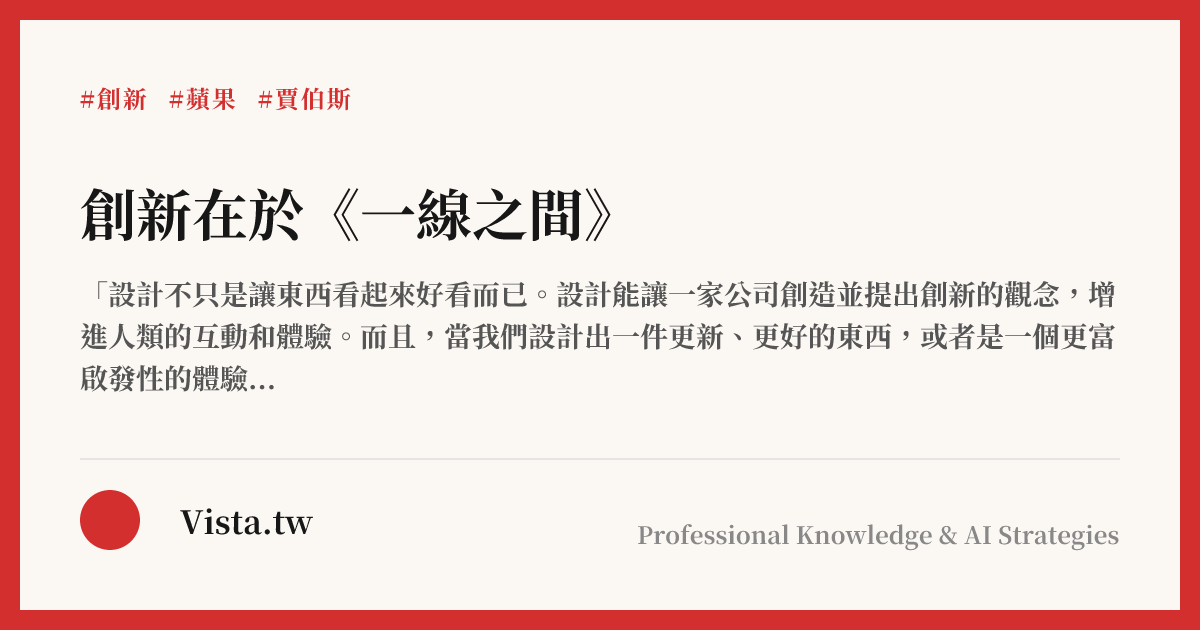
Innovation lies in "Between the Lines"
[ ](https://blogger.googleusercontent.com/img/b/R29vZ2xl/AVvXsEjMApJAXcsPapahwFbAjh_g00YvZ3uZiY4A6C_2R3nlh0WD-kR 5AeH9f3oTb7n1Dz19WXJ1Wp72BnRFjgXN1WDyCn9ePWc6N4BGmEaBt6nfrGY_GrORYIJr02ZjQgG3lfaxICR5eSnvsBo/s1600/IMG_0678.jpg)
“Design is more than just making things look good. Design allows a company to create and propose innovative ideas that enhance human interactions and experiences. And when we design a newer, better thing, or a more inspiring experience, the design itself becomes a symbol that creates a brand.” (“between the lines” - Preface)
Just listen to the causal relationship between “design”, “innovation” and “brand” mentioned above (it seems that you can only listen to it). Only with “cases” can “knowledge” be produced. Nowadays, there are more and more knowledge based on “hindsight”. Human progress is originally a process of innovation (it started with the invention of fire, oh! No, fire was secretly brought to the world by some god), but the “innovation” mentioned now is just a “myth” to urge the growth of “enterprises”?
A company may happen to find a workable “business profit model”, but where does the profit come from? It is also produced through people’s “consumption”. Through marketing methods, the illusion of “good products” can be created to induce people to consume. When people recognize the false image of a company boasting good products and no longer buy it, and the company has a revenue shortage, they start with operating costs, such as “cutting corners on products” (of course there will be costdowns every year), “layoffs and salary reductions (reducing personnel expenses)”, etc.
Most companies always think that “design” is about making things cheap and good-looking. However, Hartmut Esslinger emphasized: “‘Design’ is not just about making things look good.” It also requires designers to have the ambition to control the operation of the company and understand the relationship between the company, money and power. Not only can they avoid being sacrificed, but they can have the opportunity to use their creativity to achieve the common goals of corporate partners. Only in this way can they become true professionals. Also Hartmut The “fourth front” strategy proposed by Esslinger is actually similar to [Christian](https://wiki.mbalib.com/zh-tw/%E5%85%8B%E8%8E%B1%E9%A1%BF%C2%B7%E5%85%8B%E9%87%8C%E6%96% AF%E5%9D%A6%E6%A3%AE) The answer to “The Dilemma of Innovation” requires a sense of urgency within the enterprise to reserve innovation momentum. As long as the words “design” and “innovation” are mentioned, everyone will definitely mention “Apple”, but without “Jobs” there would be no “Apple” today, and “Jobs” is “dictator”. What’s amazing is that this “dictator” has a lot of “Sense” (texture, perception) and “Vision” (vision). Through a series of immediate “Intuition” (intuition) decisions, he established the current Apple. (Sometimes I suspect that at the end of the last century, God sent Steve Jobs to set fire to the world. What about this century? Kindle Fire?)
[ ](https://blogger.googleusercontent.com/img/b/R29vZ2xl/AVvXsEhBVQCEFX7M_HGIWd3H26H6OpkFxNDP92xYzsJ1iC5H784Wh j7I6YJ3jttfHu4rKERpSDy6gevEytja4ZvDs0arDQWCclr4xNYOo9QN3v_PuOhWEzJG1tdTl5hMpjqrSxv6r5Eme2BtVLs/s1600/111.JPG)
Apple’s unique “smartsourcing” model integrates and upgrades outsourcing resources to maximize the effect. This is the most worth reading part of this book. Without Hon Hai’s logistical support, it would be difficult for Apple to meet the world’s demand for product quality and quantity. In Hartmut Esslinger’s speech briefing in 2010, Apple’s concept of cooperation with suppliers was also vaguely revealed.
Hartmut Esslinger Lecture Materials (2010)
Taipei crisis.2 show 5.26.2010 from frog
Hartmut Esslinger was the first to participate in the product identity (PI) setting of Apple’s design style language “Snow White” (Apple II, 1984):
-
Apple computers will be small, clean and white.
-
All graphics and fonts must look clean and orderly.
-
The final appearance will be created using state-of-the-art factory floor tools to create a smart, high-tech look.
-
All product designs will adhere to the environmental protection rules of “no paint, low cost” and handle ABS plastic and all other materials carefully.
From points 3 and 4, you can understand the purity of Apple’s use of only materials in product appearance, such as crystal-clear GE plastic, unibody aluminum, and now the special tempered glass on the front and rear CORNING of iPhone 4. Through Hon Hai’s manufacturing technology innovation (processing technology), it has surpassed many products at that time. What many companies are doing now is trying very hard to imitate Apple’s products. However, due to the highest guiding principles of “low cost” and “lower cost”, the imitated products are only “superficially” similar, but they are very cheap, so people don’t choose them. Therefore, when a company spends a lot of effort and resources on “low cost”, does it still have time to do “innovation”? This is also what Hartmut Esslinger wants to tell us through “Between the Lines”.