Low-risk slash-for-freedom: From the lessons of blood and tears of quitting and starting a business to the practical wisdom of smart trial and error
A lecture that made me re-examine the courage to start a business
Last night, I sat in front of the screen and listened to Coach Huang Yaojun share his entrepreneurial story. To be honest, as someone who has been in the content industry for more than fifteen years, I can probably describe the countless lectures and courses I have attended. But this public welfare lecture made me stop what I was doing for several moments and listen carefully.
Not because he told any earth-shattering business theories, but because every story he told was filled with real warmth. That kind of temperature grows from the ashes of failure, not copied from textbooks.
The best learning comes not from the show-off of winners, but from the honesty of losers.
In this lecture, Yaojun spread himself out, from being retired from the army in his twenties and enthusiastically borrowing money to start a business after watching “Rich Dad Poor Dad”, to running a coffee shop that closed down after three months, and then to riding on the Facebook traffic bonus with his girlfriend to make a lot of money and then falling off - these stories may sound absurd, but they are extremely true.
The reason why I feel particularly touched is that over the years, in the process of teaching, consulting, and writing, I have met too many friends who have entrepreneurial dreams. The light in their eyes was exactly the same as Yaojun described himself when he was young. I always want to remind them of something, but I can’t bear to put out the fire. Yaojun’s lecture told me a lot of things I have always wanted to say.
The romance and cruelty of naked entrepreneurship
When Huang Yaojun mentioned the story of his first business venture, I couldn’t help but laugh. A group of young people watched “Rich Dad Poor Dad” and felt that the whole world was waiting for them to conquer, so they borrowed 100,000 yuan from relatives and friends to buy a failed Western restaurant and turn it into a coffee shop.
Then, it collapsed after three months.
 ▲ Starting a business naked may seem romantic, but the market won’t give you a chance just because you work hard.
This number reminds me of a past event. I once invested in a coffee shop. However, the biggest enemy of entrepreneurship is not your competitors, but your understanding of reality.
Many people think that starting a business is about having a dream, then daring and working hard is enough! But the reality is very cruel. The market will not give you a chance just because you work hard.
What impressed me even more was that Yaojun didn’t learn his lesson after the first failure. He said that he was the kind of person who would not shed tears until he saw the coffin. He continued to borrow money and start businesses, and eventually accumulated a debt of 300,000 yuan. For him at the time, that was an astronomical figure.
When I was listening to this paragraph, what came to mind were the many students and consultation subjects I have met over the years. Some people deposited all their savings, some maxed out their credit cards, and some borrowed money from family members and had a tense relationship. It’s not that they are unsmart, but they are confused by the myth of entrepreneurship. There are too many books and courses on the market telling you to be brave and pursue your dreams, but few people honestly tell you: What is the price of pursuing your dreams? Can you really afford it? **
If you have been attracted by the dream of starting a business, you may wish to read my previous article A Cruel Watershed in the AI Era to understand the changes in the real environment before making a decision.
The sweetness and pitfalls of traffic bonus
Huang Yaojun’s second entrepreneurial story sounds more interesting. While he was working to pay off his debts, he used his off-duty time to help his girlfriend run an online tarot divination business. They took advantage of the Facebook chatbot’s traffic bonus and designed a series of psychological test games related to tarot cards. As a result, their traffic exploded, and they once set a record of earning 300,000 yuan a month.
This story touches me particularly because I myself have gone through a similar journey. Having been in the content industry for so many years, I know very well what traffic dividends are. It’s like a sudden east wind that makes your boat fly all of a sudden. But if your foundation is not solid enough, you will fall hard when the east wind stops.
The most fatal thing is that their career is built on Facebook’s traffic dividends. When Facebook began to tighten the proliferation of chatbots, their traffic plummeted. I just received 300,000 yuan last month, and it may immediately drop to zero next month.
This experience reminded me of a concept I often emphasize: **Your career cannot rely solely on the gift of a platform. **Whether it’s Facebook’s algorithm, YouTube’s recommendation mechanism, or the traffic distribution of any social platform, these are beyond your control. The real moat is the trust relationship between you and your customers, and the position of your brand in people’s hearts. Regarding this concept, I have a more in-depth discussion in this article Refuse to be Digital Sharecropper.
Yaojun ran this business for two years and finally put it away. Two entrepreneurial failures made him realize one thing deeply:
Instead of pursuing the probability of success, it is better to control the damage of failure.
I think this sentence is priceless.
Low risk slash: a smarter choice
After listening to the stories of failed entrepreneurship, Yaojun started to get into today’s topic: how to start building his own slash business in a low-risk way without leaving his job.
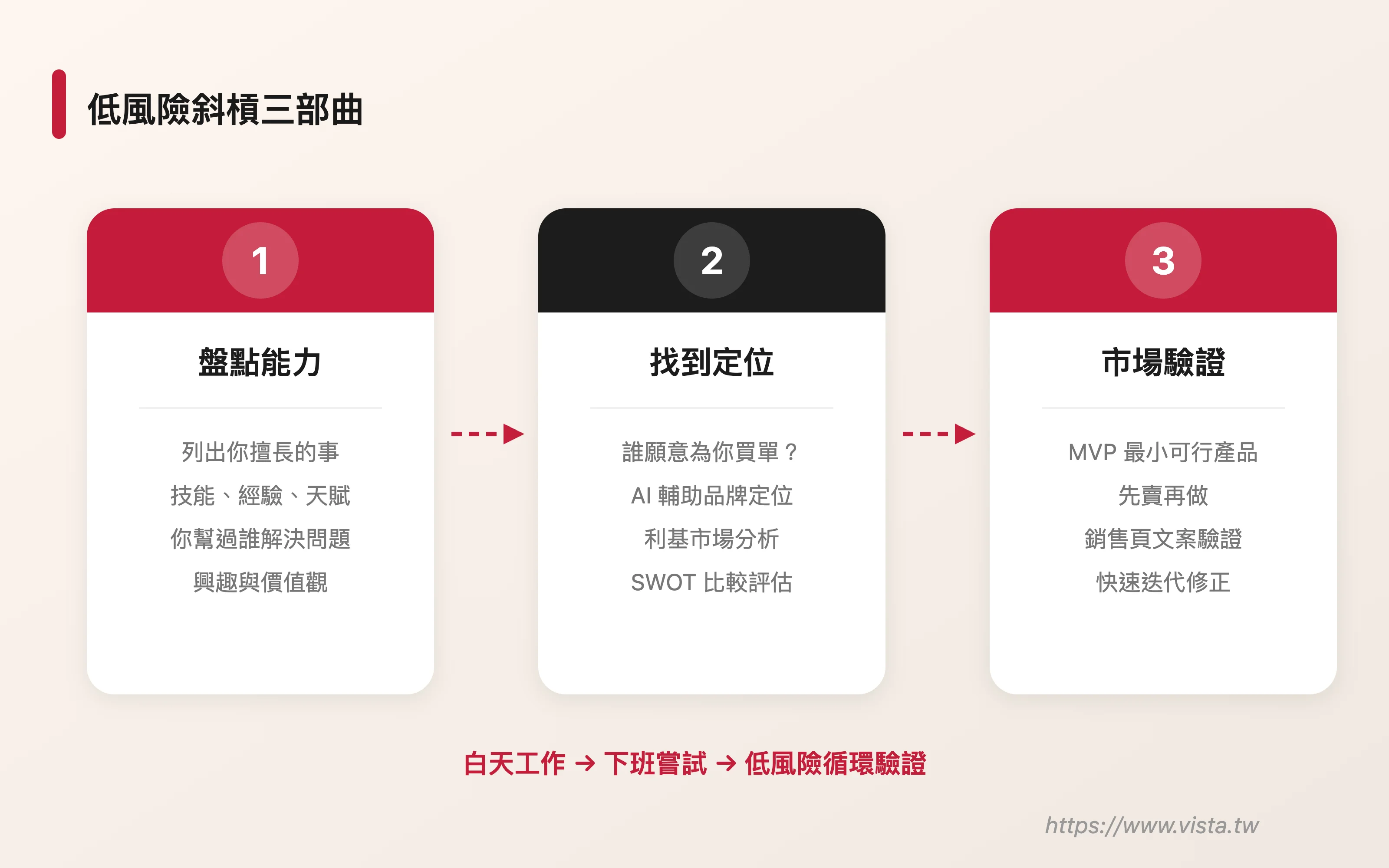 ▲ Low-risk slash trilogy: inventory capabilities, finding positioning, and market verification
He proposed three action steps:
- Inventory your abilities: List all the things you are good at, the problems you have helped others solve, your skills and experience.
- Find your positioning: Use AI tools to analyze which customer groups your capabilities are suitable for serving, and who will be willing to pay for your capabilities.
- Market Validation: Use the Minimum Viable Product (MVP) method to sell things first, see the market’s response, and then decide whether to invest more resources.
These three steps sound simple, but the logic behind them is actually very deep. I myself follow a similar line of thinking when running writing companionship programs and various courses. It’s just that Yaojun made it more straightforward and down-to-earth.
The wisdom of selling first and then building
What I particularly appreciate is his core concept - Sell first and then build.
 ▲ Sell first and then build, verify market demand at the lowest cost
Many people’s intuition is: I will make the product first, make it perfect, and then sell it. But the problem is that the market may not pay for what you spent three months or even half a year making. At this time you not only waste time, but also waste a lot of energy and money.
Yaojun’s suggestion is: write the sales page first, describe your service or product clearly, and then put it on the market to see if anyone is willing to pay. If someone pays for it, go ahead and do it; if no one pays for it, change the direction and continue testing.
What’s the worst that could happen? Someone paid money and you can’t do it, then refund the money to him. But at least you know where the market demand is.
I completely agree with this concept. In fact, I myself often use a similar strategy when launching new courses or services. For example, when I recently launched Vibe Coding Practical Workshop, I first sent out a registration page to see the market’s reaction. If the number of applicants reaches the threshold, I will start the class; if not, I will adjust the direction. The advantage of this is that you will never work behind closed doors, and every step you take is in dialogue with the market.
Slash accelerator in the AI era
The most eye-catching part of this lecture was Yaojun’s demonstration of how to use AI tools to accelerate the establishment process of the entire slash business.
 ▲ AI tools significantly shorten the distance from ideas to actions
Yaojun demonstrated several steps using Gemini:
- First, he threw the results of his ability inventory to AI and asked AI to help him analyze suitable brand positioning. AI gave ten positioning suggestions, divided into three dimensions, and even recommended the strongest combination.
- Then, after he selects a positioning, he asks AI to help him analyze potential customer groups. AI lists ten possible customer types, from over-the-top information hoarders to brick-and-mortar bosses in transition, each with a specific description.
- Then, he further asked AI to help him find niche markets that are more willing to pay and do a SWOT analysis.
- Finally, he asked AI to help him write sales page-long copy that complied with the AICA framework.
For the concept of AICA copywriting structure, you can refer to this video:
The whole process takes less than thirty minutes, from “What abilities do I have” to “Who can I sell to”, and then to the sales copy written.
As someone who has studied AI applications for a long time, I must say that Yaojun’s demonstration is very convincing. Not because of how perfect the things written by AI are, but because it greatly shortens the distance from idea to action.
In the past, if someone wanted to start a slash business, they might need to spend weeks researching the market, writing copy, and designing sales pages. Now, with the help of AI, this preliminary work can be completed in a few hours to complete the first draft. This is not to say that AI can replace your judgment and experience, but it can help you eliminate the “fear of blank pages” and give you a foundation from which to start modification and optimization. If you are interested in how AI changes work patterns, I also recommend you to read what I wrote Stop Chasing Tools! Build your “unbeatable system” in the AI era.
During the lecture, Yaojun also demonstrated a very practical technique: throwing the AI-generated sales copy into NotebookLM and letting it automatically generate presentation pictures. These images can be interspersed between the text on your sales page to make the entire page look more professional and attractive.
Tools are not the point, the point is what problem you use the tool to solve.
The process demonstrated by Yaojun, the tool itself is free or low-cost, but the problem it solves is of huge value - it helps you test whether your business idea is feasible in the shortest time and at the lowest cost.
In the world of martial arts, only speed is unbreakable
A concept that Huang Yaojun emphasized repeatedly in the lecture is small quantity production and accelerated circulation. The same is true for his own practice: In 2025, he tried a variety of different courses and services, from twelve-week annual plans, AI learning courses, marketing graphic teaching, to sales funnel courses. Some sell well, while others are not bought by anyone. No one bought it, so he just rubbed his nose and didn’t take it off the shelves, just left it there. If the sales are good, he will invest more.
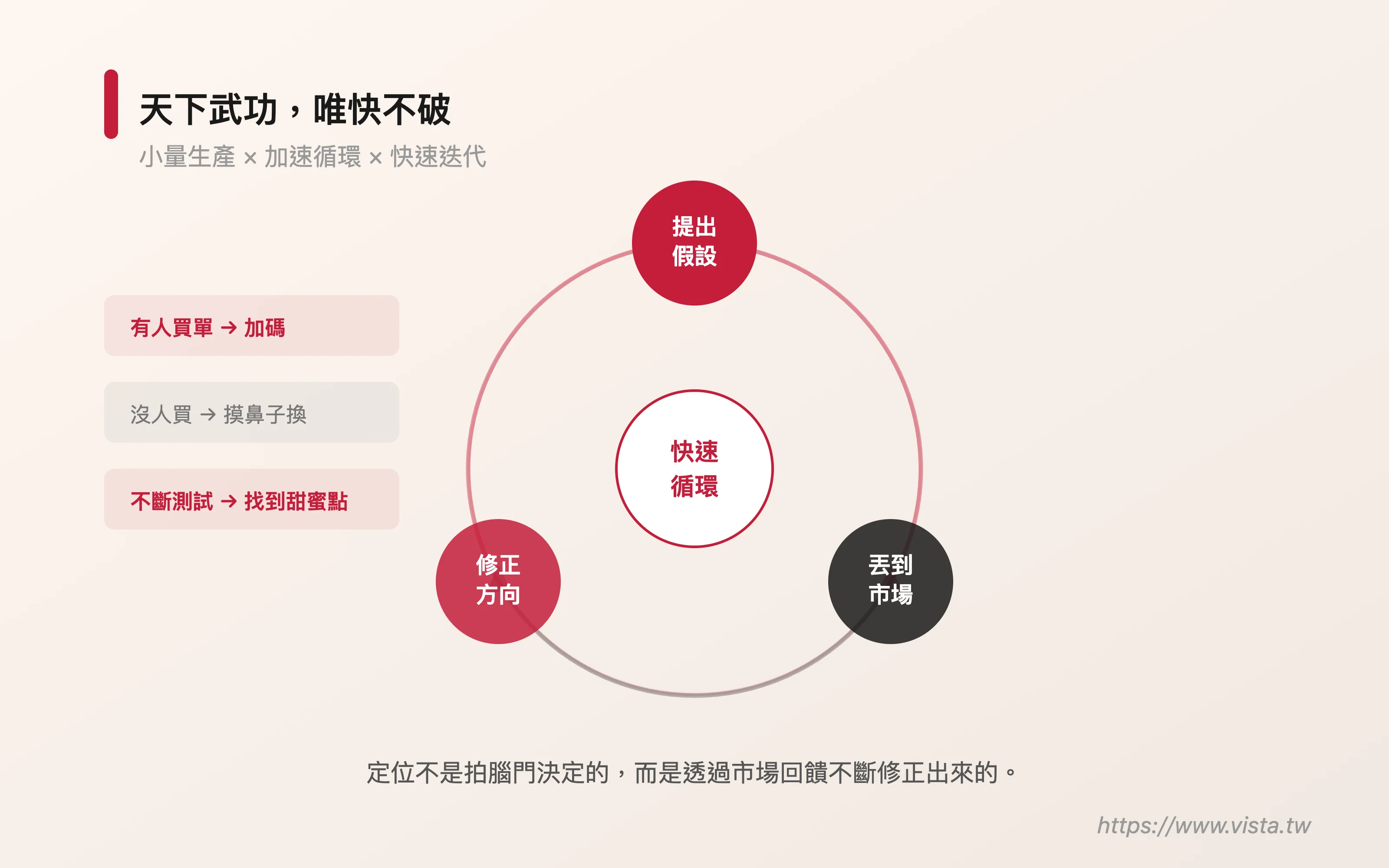 ▲ Quickly test and iterate quickly to find the market sweet spot at the lowest cost
This mentality of rapid testing and rapid iteration is actually very similar to the agile methodology (Agile) in software development. You don’t need to think everything through at the beginning, you just need to have a hypothesis and then verify it as quickly as possible.
This is also true of my own experience. Over the years, I’ve tried a variety of content products and services. Some are big hits, some are unknown. But every time I try, I learn more about the market, my audience, and my own strengths.
The only failure is to make something no one wants. But if no one wants what you make at the lowest cost and in the shortest time, it’s not actually a failure—it’s just the result of an experiment.
The real failure is when you spend half a year and burn a million dollars to create something that no one wants. Therefore, the core of minimizing risk is not not taking risks, but taking risks at a price you can afford. **
If you are also thinking about how to reposition your own value in the AI era, you can watch this video, which may give you some inspiration:
The distance from knowing to doing it
At the end of the lecture, Yaojun mentioned a problem faced by many people: knowing the method but not being able to do it.
I am all too familiar with this pain point. In my writing companionship program, the most common situation is that students tell me: “Teacher, I know I need to write, but I just can’t write it.” Or: “Teacher, I know I need to start a businessPersonal brand, but I just can’t update it daily or weekly.”
Yaojun’s solution is to lead partners forward through the twelve-week plan system and community. He does not rely on willpower or motivation, but on the power of the system and community.
This coincides with my own philosophy. I’ve always believed that writing (or any creation, building any career) can’t come from inspiration and willpower alone. You need a system to help you break down big goals into small steps; you need a community to help you when you want to give up.
The community I run on the Skool Communities platform is based on the same philosophy. When you go alone, it’s easy to get lost and give up easily. But when you have a group of fellow travelers, even if you walk slowly, you won’t stop.
My reflection: Instead of impulsively resigning, it is better to treat the boss as an angel investor
Huang Yaojun said something in the lecture, which I think is very exciting:
Instead of impulsively resigning, it is better to treat the boss as an angel investor.
What this means: Your day job provides a steady income and psychological security, just like an angel investor provides capital. You can use this sense of security as a backstop to low-risk business ideas during your off-duty hours.
Although I am currently working as a consultant, lecturer or columnist as my main job, my journey along the way also started as a part-time job. In the early days, I worked during the day and wrote articles, ran blogs, or took on cases at night. Wait until your part-time income stably exceeds your full-time income before you consider switching to full-time.
This kind of gradual transformation is far safer than quitting your job to start a business overnight. You have time to trial and error, space to learn, and room to adjust direction. Most importantly, you won’t make bad decisions because of financial pressure.
Under financial pressure, many people will start to do some short-sighted things: lowering prices to sell, taking on projects they don’t like, and compromising their quality standards. These actions may keep you alive in the short term, but in the long term, they can damage your brand and reputation. This is also the core concept I discussed in The hardest thing to sell in 2026 is not the product, but “you”.
In turn, if you have the backing of a regular job income, you can run your slash business more comfortably. You can stick to your own pricing, you can choose the customers you like, and you can spend time polishing your products and services.
This is not a sign of cowardice, but a sign of wisdom.
Written at the end: For you who are hesitating
If you are considering whether to start your own slash business, I would like to tell you a few things from my own experience:
**First of all, don’t wait until you are ready to start. ** Because you’ll never feel like you’re ready. One of the most wasteful things in the world is to have all the ability and experience but do nothing because you are afraid of failure.
**Second, make good use of AI tools to accelerate your start. ** This is not laziness, this is smart. AI can help you inventory your capabilities, find your position, write copy, and generate pictures. It can’t make decisions for you, but it can help you shorten the process from zero to one to one-tenth of the original time.
In the past two or three years, I have taught AI application courses at some universities, and have also done academic research on AI-generated content. I think that rather than saying that AI is here to steal our jobs, it is better to think of it as an amplifier to help us amplify our capabilities. As Yaojun demonstrated, one person plus several AI tools can accomplish things that previously required a team. If you are interested in Vibe Coding’s marketing applications, you are also welcome to refer to my previous sharing.
**Third, find your community. ** It doesn’t matter if it’s Yaojun’s Kua Kua community, my Skool community, or any learning circle you feel is suitable.一个人走得快,一群人走得远。 On the road to your slash career, you need not only methods and tools, but also the support and encouragement of your peers.
**Finally, seek something first, then something good. **
Don’t pursue the perfect sales page, make a usable one first.不要等到有一万个粉丝才开始卖东西,先找到第一个愿意付钱的客户。 Don’t wait until all the conditions are met to act, start with the resources you have at hand.
What moved me most about this lecture was not how novel Yaojun’s methodology was, but the pragmatism and sincerity he extracted from his own failures. He will not tell you “As long as you believe in your dreams, you will succeed.” He will tell you “First make sure you can afford failure, and then pursue your dreams!”
In this era, there is no shortage of people who can teach you how to succeed. What is lacking is the people who can teach you how to face failure intelligently.
Thanks to Coach Yaojun for sharing this, and also to Strategic Thinking Business School for providing such a public welfare lecture platform, so that more people can have the opportunity to hear these real and precious experience sharings.
If you are also interested in a slash career, you might as well start today, open a notepad and write down a list of your abilities. Then open your commonly used AI tool and ask it a question: “Based on what you know about me, who do you think my abilities can help solve what problem?”
Maybe the answer will surprise you. Maybe that answer is the starting point of your slash career.
Let’s encourage everyone.
Further reading
- A cruel watershed in the AI era: Why has the income of 95% of freelance workers been cut in half, while the income of 5% has doubled?
- “You can be more than an office worker”: Action guide for slash youth to start the era of resumption of work
- Refuse to be a digital tenant: Why do you need to use Vibe Coding to build a digital headquarters in 2026?
- Lecturer’s Digital Asset Management Technique: Use AI to turn teaching experience into a compounding system
External Resources: