King without a moat: OpenAI’s competitive dilemma and how we should respond to changes in AI
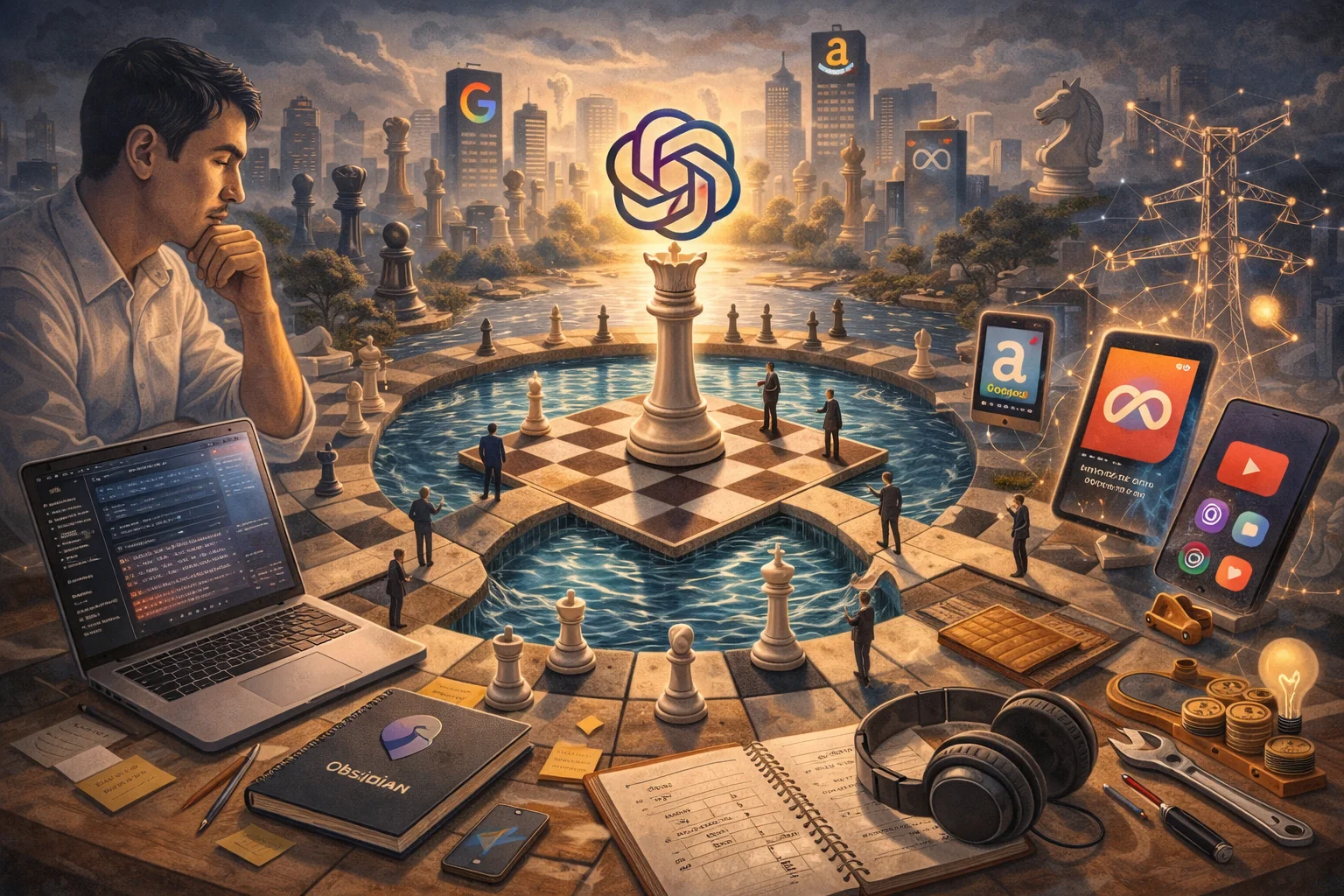
Last week I read Benedict Evans’s <How will OpenAI compete?>, I marked it three times in Obsidian. Not because the article is difficult, but because he uses extremely calm writing to dismantle a fact that most people dare not face up to: **OpenAI may be the most well-known company in this wave of AI, but it currently has no real competitive advantage. **
Evans raised four fundamental strategic issues: OpenAI has no unique technology, no network effects, no product-market fit (Product-Market Fit), and its product roadmap is not even determined by the product team – it is the breakthroughs in the research room that determine what to do next.
In his words, the product owner opens the mailbox in the morning and finds something new in the lab, and the task is to turn it into a button.
This reminds me of one thing: **When technology itself cannot form a moat, the real battlefield shifts to experience and distribution. **
“A mile wide and an inch deep” warning
In the article, Evans cited a set of sobering data: ChatGPT has 800 to 900 million users, but 80% of users will send less than 1,000 messages in 2025—an average of less than three conversations per day. Only 5% of users pay. Most American teenagers use ChatGPT a few times a week or less.
This is what he calls “a mile wide but an inch deep.”
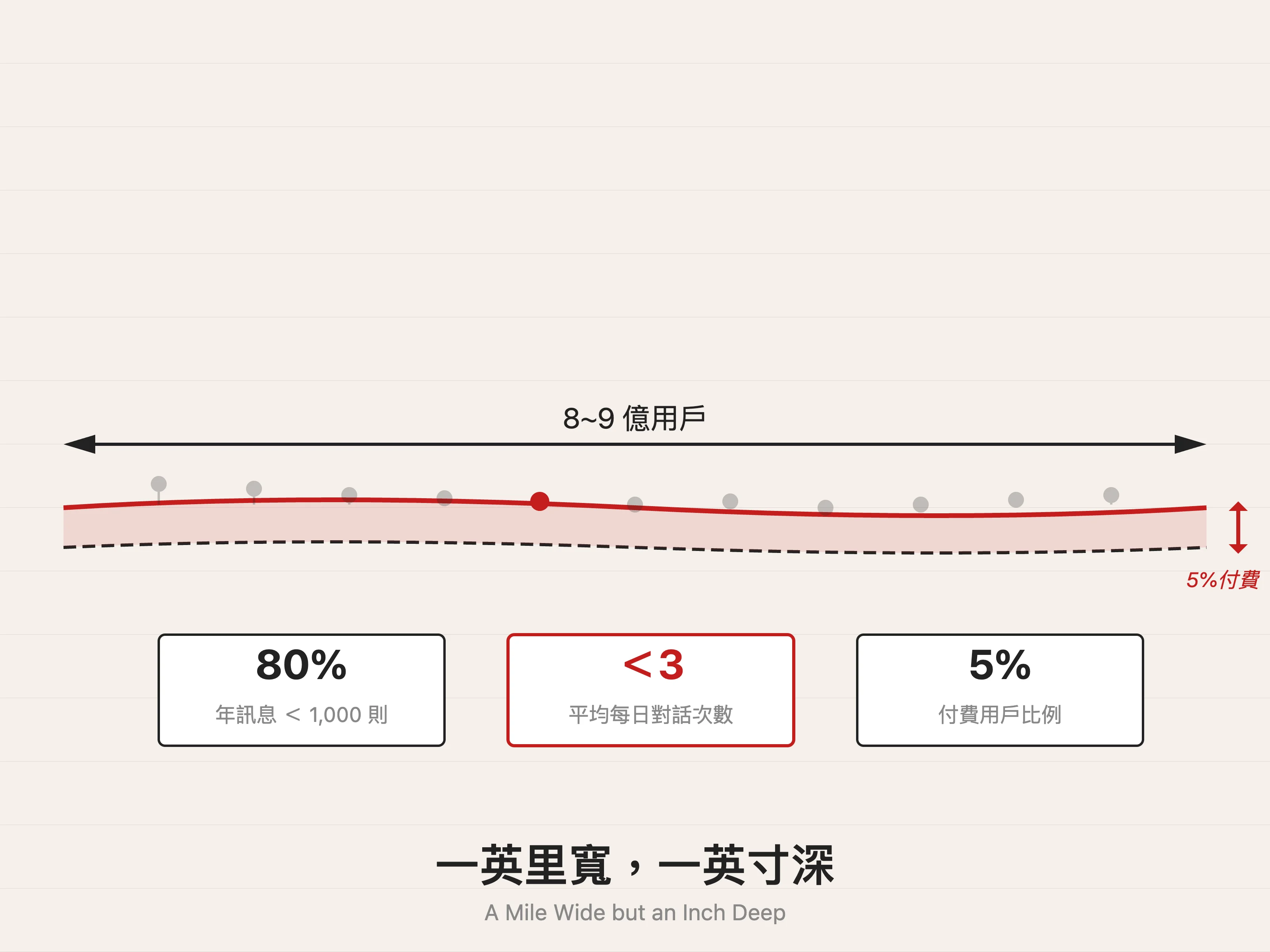 ▲ A mile wide and an inch deep: ChatGPT’s breadth of users is not proportional to its depth of use
After reading this, what came to my mind was not the dilemma of OpenAI, but the scene I encountered repeatedly at corporate training sites: trainees are curious about AI tools, but after returning to work, most of them still don’t know what to do with it.
The capability ceiling of tools is already very high, but the imagination of users is often out of reach.
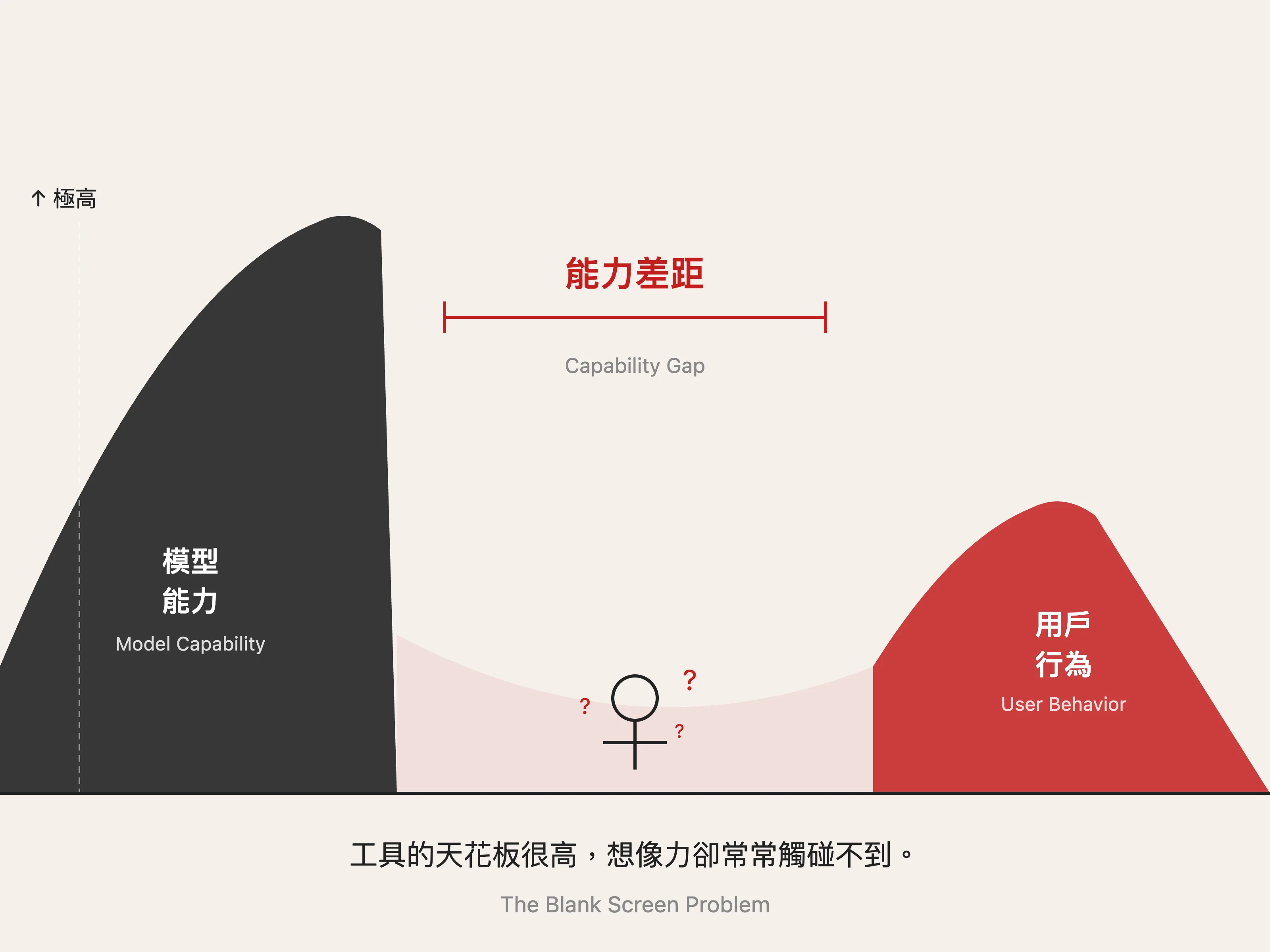 ▲ The ceiling of tools is very high, but the imagination of users often cannot reach it.
OpenAI itself refers to this problem as the “capability gap” - meaning there is a huge gap between what a large language model can do and what people actually do with it. Evans ruthlessly points out that this is a euphemism for “you haven’t found product-market fit yet.”
Is ChatGPT the next Netscape?
Evans made an impressive analogy: **ChatGPT may be to AI what Netscape is to the Internet. **
Speaking of Netscape, many young friends may be unfamiliar with it. Netscape was the first browser to introduce the Internet to the public, but was eventually defeated by Microsoft using its distribution advantage (tying IE to Windows). More importantly, the browser itself ultimately did not become the core field of value capture—it was services like Google, Amazon, or Facebook built on top of the browser that really created value.
ChatGPT is now facing the same structural problem: a chatbot is just an input box and an output box. How do you make differentiation?
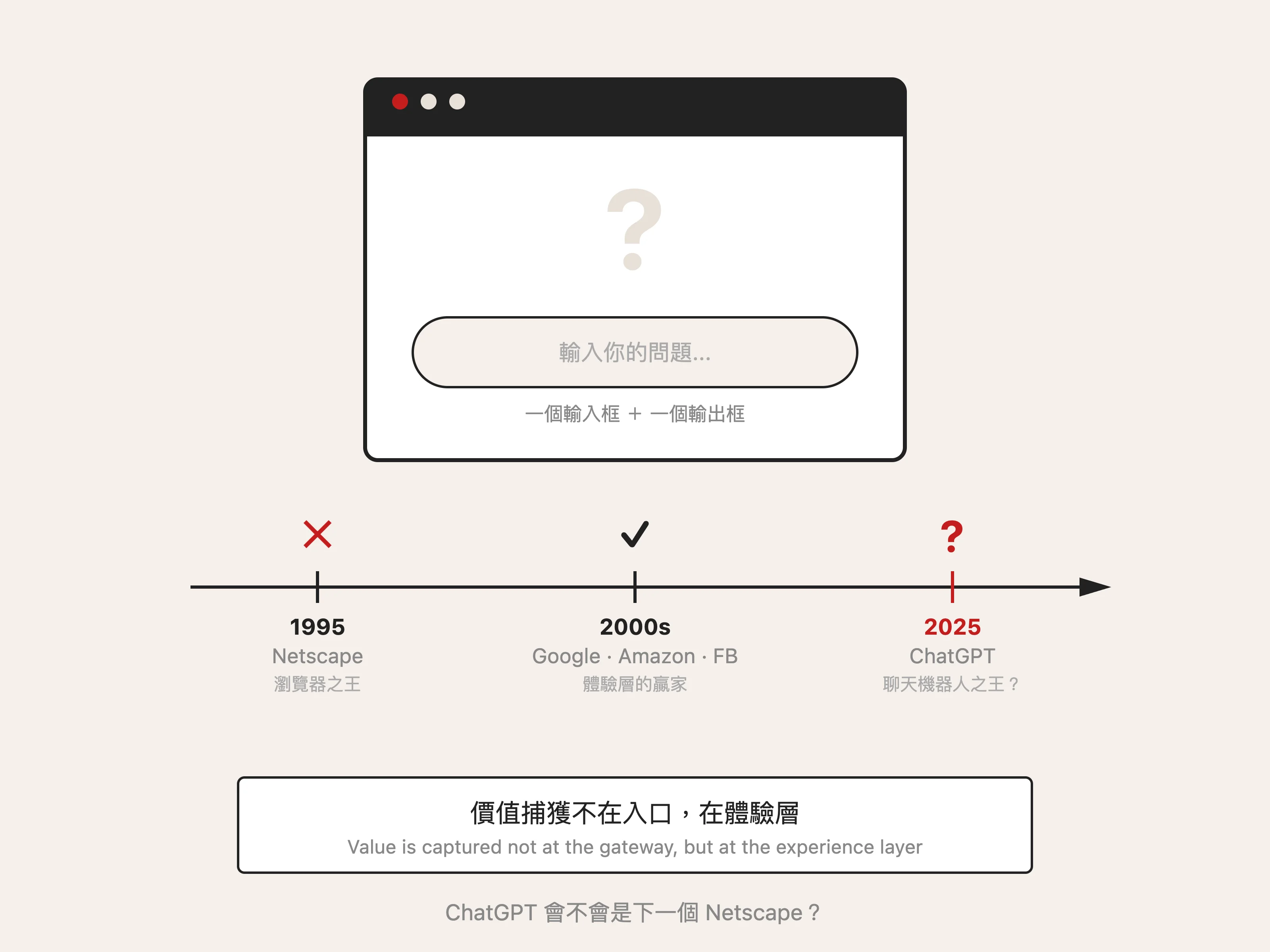 ▲ Value capture is not at the entrance, but at the experience level
Google has a search engine and Android distribution advantage, and Gemini is quickly grabbing the market. Meta has the traffic of social platforms, and the data of Meta AI is also growing. While Anthropic’s Claude often ranks among the best in benchmarks, it has almost no consumer awareness (I have a different view on this point, think about Claude Code’s recent development).
In the world of AI, being the earliest does not mean winning in the end. Those who can transform technology into irreplaceable experiences are the ultimate winners.
”Power” is the real keyword
Evans makes a wonderful conceptual clarification later in the article. He said that the technology circle often talks about the terms “platform”, “ecosystem” and “network effect”, but the real core concept is actually “power”.
He quoted medieval history professor Roger Lovatt’s definition:
Power is the ability for people to do things they don’t want to do.
Microsoft has this power - you have to use Windows because all the software is on it. Apple has that power - developers have to be on the App Store because the users are there. Amazon has that power – sellers have to compete on the Marketplace because that’s where the buyer’s attention is.
Does OpenAI have it? As of now, not yet. You wrote an email using ChatGPT, but if you switch to Claude or Gemini tomorrow, the experience will not be much different. Having said that, if there is no lock-in effect, there is no power. **
The implications of this for all AI practitioners, educators, or consultants are huge: If even OpenAI is still looking for its own moat, then each of us must seriously think about it—what exactly is our own moat? **
Sam Atman’s self-fulfilling prophecy
Evans has an interesting description of Sam Altman’s strategy: Altman was trying to create a “self-fulfilling prophecy.” He goes around announcing astronomical capital spending commitments—140 billion, a trillion, building a gigawatt of computing power every week—in an effort to force OpenAI into a table where only a handful of players can sit.
Evans admitted that Altman’s willpower was indeed strong, but also asked a pointed question: **Even if you sit at that table, it’s just a ticket, not a ticket to victory. **
Just like TSMC is the monopoly of chip foundry, but it has almost no say in the software, services, and application levels above the chip. No one will say “I use TSMC’s App”. In the same way, even if OpenAI has a place at the basic model level, if it cannot establish an irreplaceable position in the upper-layer experience and services, it may end up being just an expensive infrastructure provider.
To me, what is this article really saying?
After reading Evans’ analysis, my feeling was not pessimism, but a sense of sobriety after being reminded.
In the past two years, the general public’s understanding of the AI industry is that “large language models are getting stronger and stronger”, “AGI is coming”, and “hurry up and get on this train”. But Evans reminds us: **Technological progress itself does not equal commercial success, let alone lasting competitive advantage. **
For someone like me whose core career is AI education and content creation, the core message of this article can be condensed into one sentence:
Don’t bet on any one tool or platform, but bet on your ability to understand problems, design experiences and create value.
Mentality and action strategies in facing the changes in AI in 2026-2027
Based on Evans’ analytical framework and combined with my experience in the fields of corporate consulting, teaching, and writing over the past fifteen years, I would like to propose the following directions for thinking about the changes in AI in the next one to two years:
Strategy 1: Establish tool-independent core capabilities
If even OpenAI could be supplanted by the distribution advantage of Google or Meta, then any expertise built on a single tool is vulnerable. The real moat is not “I am good at using ChatGPT”, but “I am good at breaking down problems, designing prompt strategies, and integrating multiple AI tools to solve challenges in specific fields.”
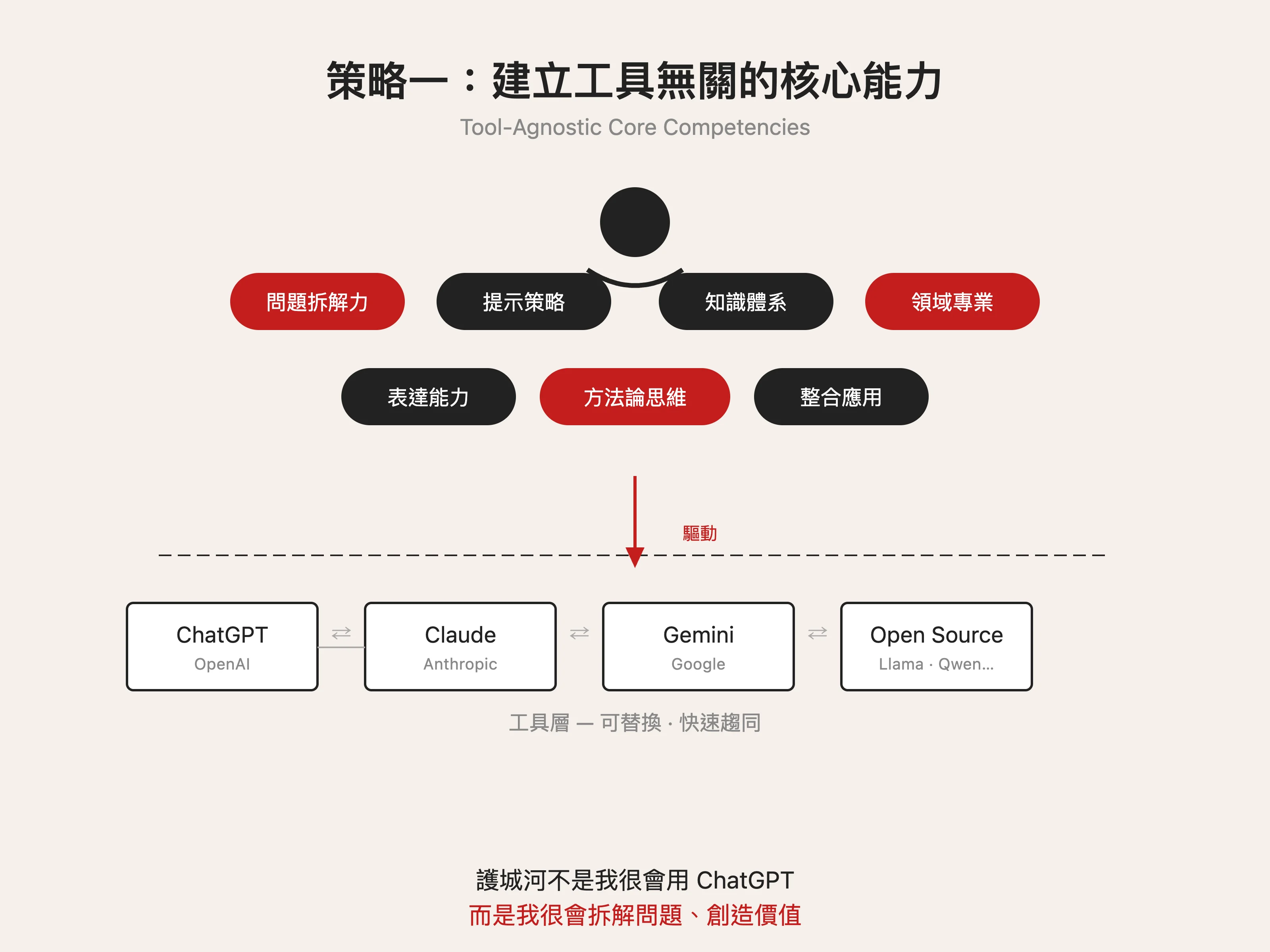 ▲ The real moat is not to be proficient in a single tool, but to master the cross-tool methodology
This is exactly what I have continued to emphasize in my past academic research and workplace applications: cultivating methodological thinking rather than tool operation skills. If you are still thinking about how to build this capability, you might as well start with this article When AI-feeling articles are flying everywhere: you are not not writing well enough, but you are too easily replaced.
Strategy 2: Evolve from user to experience designer
Evans points out that value capture from AI will occur at new levels of experience on top of the underlying models that have yet to be invented. This means: **The biggest opportunity lies not in using existing AI tools, but in using AI tools to create entirely new services, products and experiences. **
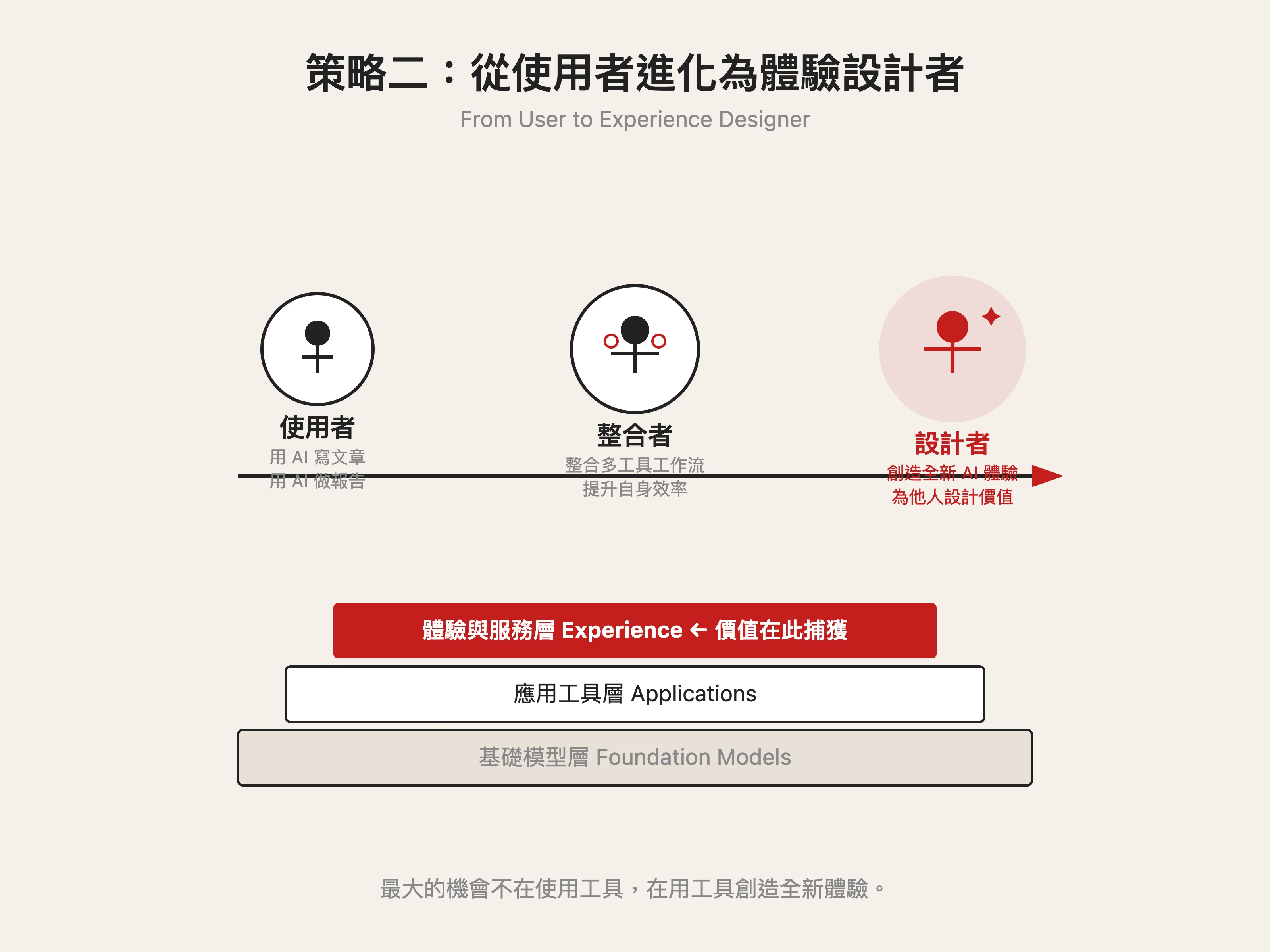 ▲ The biggest opportunity is not in using tools, but in using tools to create new experiences
For content creators, this means not just using AI to write articles, but thinking about: How can AI change the way readers interact with content? For business consultants, it is not just about teaching customers to use AI, but also helping customers redesign workflows with AI as the core.
▲ The biggest opportunity is not in using tools, but in using tools to create new experiences
For content creators, this means not just using AI to write articles, but thinking about: How can AI change the way readers interact with content? For business consultants, it is not just about teaching customers to use AI, but also helping customers redesign workflows with AI as the core.
**Want to upgrade from AI user to experience designer? ** In Vibe Coding Practical Workshop, I will take you to use natural language to drive AI and turn ideas into runnable digital products from scratch. No engineering background is required, just your expertise and a problem you want to solve. This is not just about learning a tool, but learning the ability to turn your experience into a system and your insights into products - exactly what this article calls “irreplaceability”. Hosted by Freeman Academy, places are limited, Register now →

Strategy Three: Deeply cultivate data and knowledge assets in vertical fields
Evans mentioned that proprietary data may become a key differentiator in future AI competition. For example, the underlying model has no idea what’s going on inside SAP, nor does it have the millions of spreadsheets at investment banks.
Proprietary data refers to exclusive data provided within the company or by third-party organizations, covering unique insights such as the company’s financial analysis and industry reports. Proprietary data is valuable because of its uniqueness and often informs higher-quality decisions.
What this enlightens us is: **Systematically accumulating, organizing and structuring knowledge assets in one’s own professional field is the key to establishing long-term competitiveness. ** This is why I continue to operate the Notion knowledge management system and the Anytype and Obsidian note libraries - these are not just notes, but my proprietary data sets.
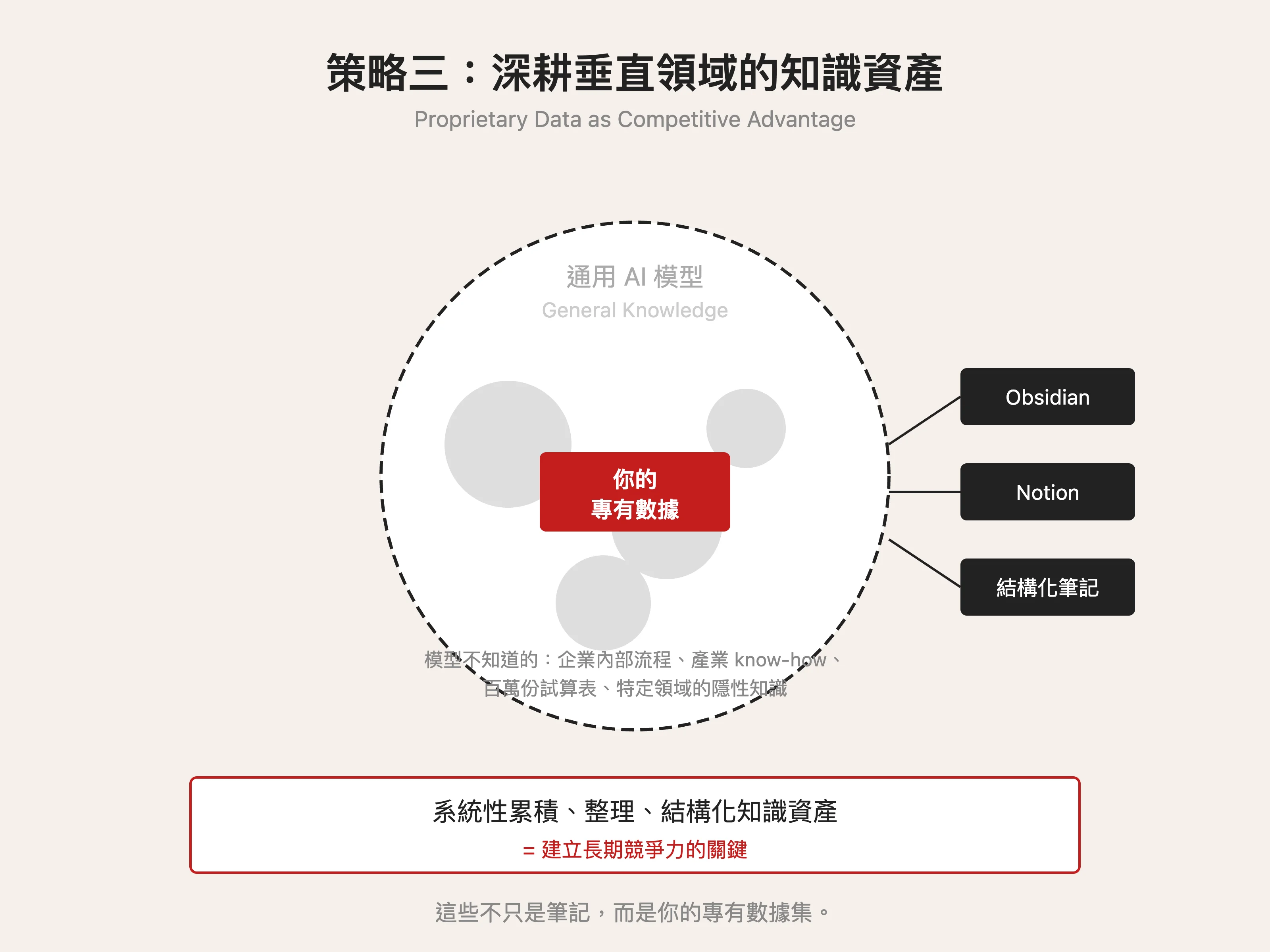 ▲ Systematically accumulated knowledge assets are a moat that cannot be easily replaced by AI.
Regarding how to manage knowledge assets in a systematic way, you can refer to what I wrote before Is PARA really the key to information management in the AI era? and Turn-teaching-into-long-term-assets-with-ai.
Strategy 4: Embrace the diversified layout in the era of oligarchy competition
Evans suggested that the future of AI infrastructure could become an oligopoly, like aerospace manufacturing or semiconductor manufacturing. But at the application level, competition will be extremely diverse.
This means: **Don’t put all your eggs in one basket. ** At the same time, be familiar with ChatGPT, Claude, Gemini, and open source models, understand their respective advantages and limitations, and choose the most suitable tool according to different scenarios. This is the philosophy I continue to practice from the Vista Writing Companion Program, Content Hacking, to Freeman Academy.
Strategy 5: Seize the educational business opportunities of the “blank canvas problem”
Both Evans and OpenAI admit there is a “capability gap” - a model can do a lot of things, but most people don’t know what to call it. This “blank screen problem” is the greatest opportunity for educators and consultants.
Helping people go from “not knowing what they can do” to “knowing how to do it”, from “occasionally curious” to “daily dependence” - this is the real value of AI education. It’s not about teaching tool operation, but about thinking transformation.
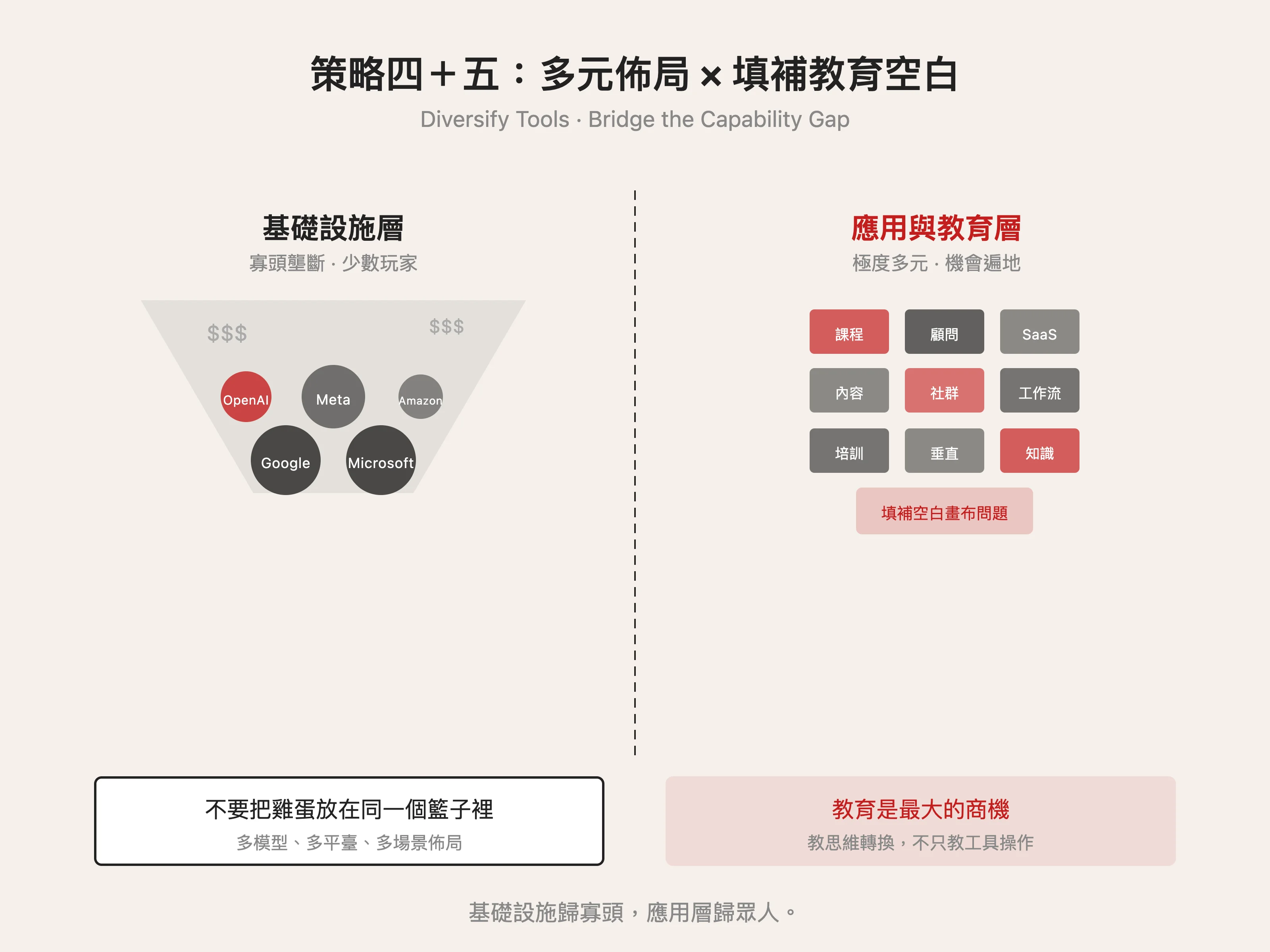 ▲ Diversified layout and filling the gaps in education are the most robust survival strategies in the AI era
If you are interested in this direction, it is recommended to read Don’t wait for engineers! Vibe Coding allows your ideas to run today, and Refuse to be a digital tenant: In 2026, why do you need to use Vibe Coding to build a digital headquarters?
Strategy 6: Stay constructively paranoid
Evans quoted Andy Grove’s famous saying: “Only the paranoid survive.” Intel There used to be network effects, but then they disappeared; there used to be technological leadership, but then they were lost.
In the world of AI, this anxiety about being replaced at any time is actually healthy. But paranoia does not equal panic. **Constructive paranoia means: continuous learning, continuous experimentation, and continuous adjustment of strategies, but not driven by fear, but by curiosity. **
Find your own certainty in uncertainty
 ▲ Find your own certainty in uncertainty
Benedict Evans’s article is ostensibly an analysis of OpenAI’s competitive situation, but to me, it is actually a mirror that reflects the core issues that every AI practitioner must face: **When tools are rapidly converging, and when technology is no longer a moat, where is your irreplaceability? **
The answer lies not in any large language model, nor in any platform, but in the depth of your understanding of the problem, your knowledge system, your ability to express yourself, the way you connect with people, and your ability to create unique value for a specific group.
From 2026 to 2027, the AI industry will undergo dramatic consolidation and reorganization. Some companies will disappear, and some new giants will be born, but no matter how the landscape changes, those who can stay awake in the chaos and find their own certainty in the uncertainty will be the ultimate winner.
This is not a prediction, but a choice you and I will face.
Extended reading:
- When AI-feeling articles are flying everywhere: It’s not that you don’t write well enough, but that you are too easily replaced
- Stop waiting for engineers! Vibe Coding lets your ideas run today
- Five key points for small and medium-sized enterprises to introduce AI: Don’t use AI for the sake of AI, pragmatic application is the way to go
- Refuse to be a digital tenant: Why do you need to use Vibe Coding to build a digital headquarters in 2026?
- Claude Code is not just a tool for engineers: five practical uses that amaze knowledge workers
- When AI replaces Google: Is your website ready to be cited? A practical review of AEO
External Resources:
- How will OpenAI compete? — Benedict Evans
- Benedict Evans’ blog
- Sam Altman — Wikipedia
- Andy Grove — Wikipedia
- Freeman Academy