It’s not that you can’t choose a positioning, you just can’t let it go: a lesson I learned in the Positioning Convergence Workshop

In today’s Positioning Convergence Workshop (opens in a new tab), Teacher Susie asked everyone to fill in a form “What do you do?” To be honest, if I had to write it, I would probably get stuck.
Why is this? Because I write, published twenty-one books (opens in a new tab); I teach and lead workshops on copywriting, media public relations, personal branding and AI content production; I also use Vibe Coding and run several websites and products by myself; in addition, I also work as a content consultant (opens in a new tab). Each item is valid individually, but taken together it is difficult to explain clearly in one sentence. I’m the kind of standard person who “does a little bit of everything”, and such a person is actually not naturally distracted, but just hasn’t assembled the skills yet. Therefore, when I listened to it for three hours again, not as a spectator organizer, but as a participant, I felt particularly touched.
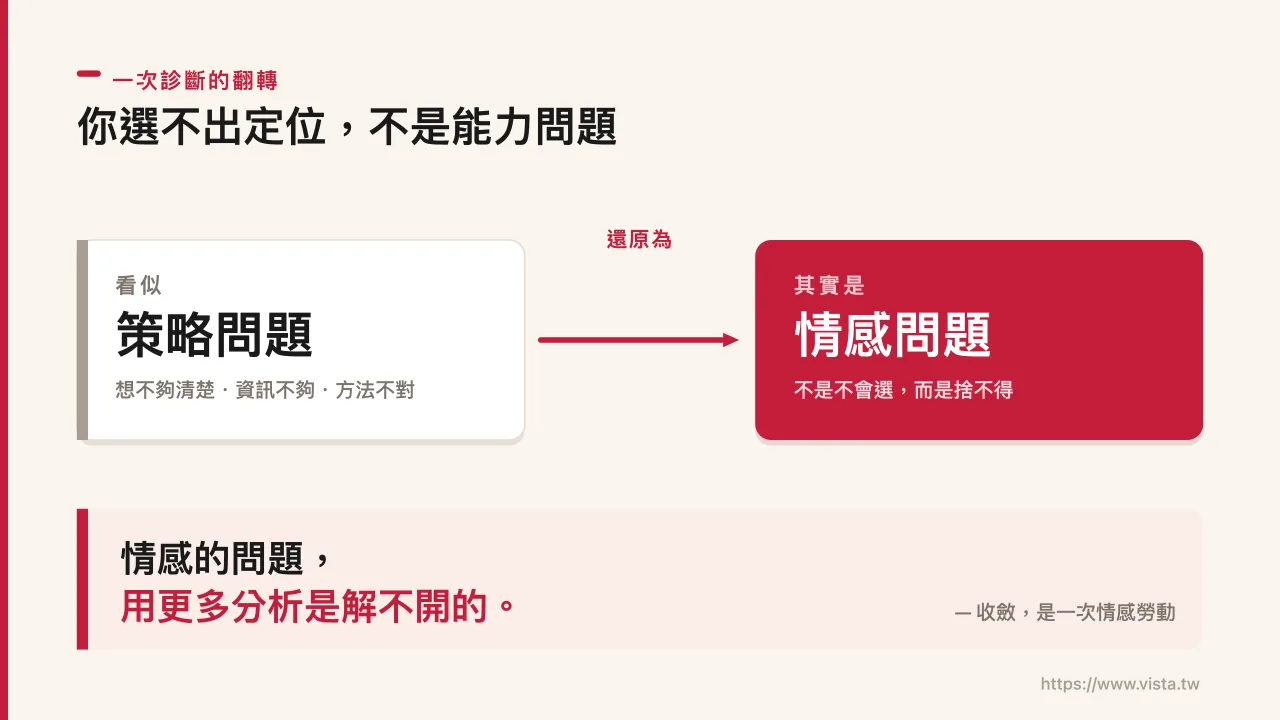
To be honest, what really hit me was not a certain technique, but a sentence that redefined the problem: If you can’t choose your position, it’s not a matter of ability, but probably an emotional issue. Because it’s not that you don’t know how to choose, it’s that you can’t bear it.
Reluctant, there are three very specific reasons
In the past, people might have thought that the reason why a person was slow to converge on his positioning was because he didn’t think clearly enough, didn’t have enough information, or had the wrong method. When teacher Susie came, she completely overturned this assumption. She said that she accompanied people through this step one after another, and there were only three reasons for getting stuck, and none of them was “I don’t know what to choose.”
First, every aspect is the true self. That’s something you spent years growing, and letting it go feels like you’re denying those years. Second, I am afraid that no one will see me. What you are afraid of is not the wrong choice, but the skills you have worked so hard to develop. After you choose this one, no one will know about it. Third, leave a way out. Keep them all for now, just in case this doesn’t work and there are others. It seems to be playing a safe card, but in fact no one dares to really invest.
I was shocked when I heard it, because these three points touched my heart. I have been reluctant to condense myself into one sentence, not because I can’t think of it, but because I can’t let go of every identity. The reason why this diagnosis is powerful is that it reduces a seemingly strategic problem to an emotional problem. The emotional problem cannot be solved with more analysis.
The antidote is a change of thought: thickness, not noise
The solution provided by teacher Susie is not a smarter formula for choosing, but a change of thought: the things you discard will not disappear, they will become the thickness of the one you selected, not noise. You are not deleting yourself, you are deciding which one will appear first.
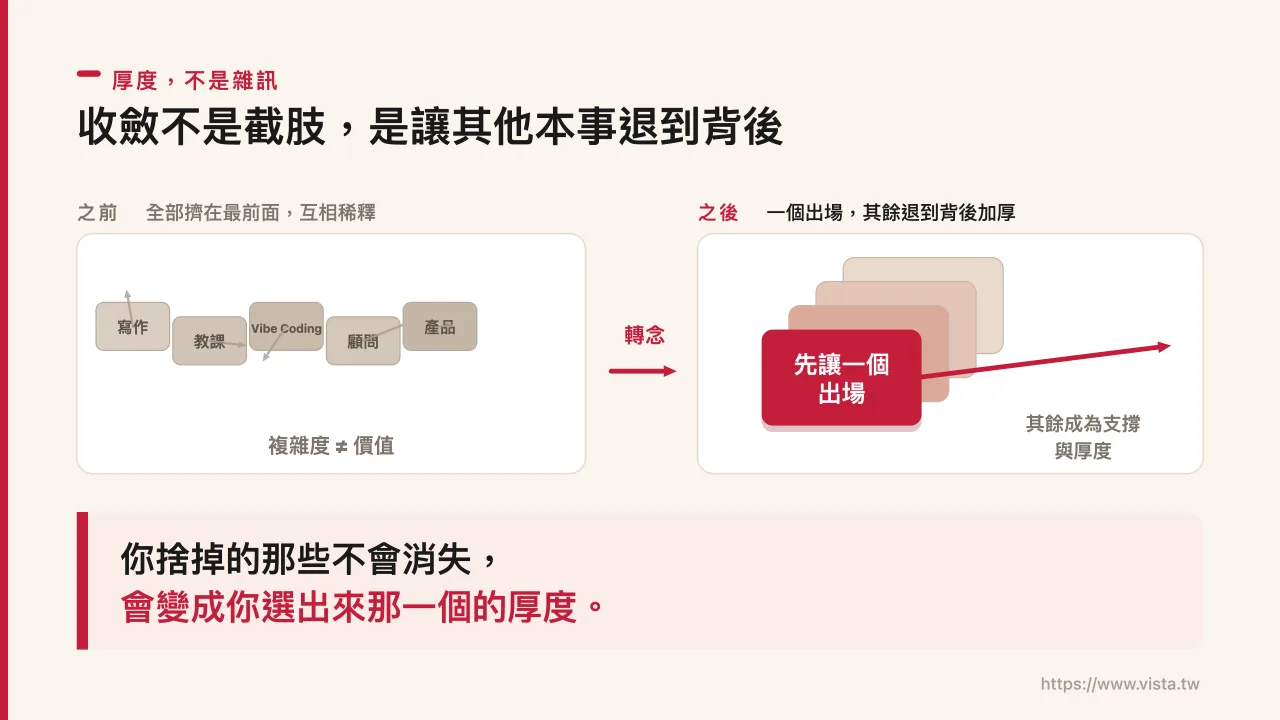
At that moment, I truly understood the word “thickness”: convergence is not amputation, but letting those abilities retreat behind the position to support it and thicken it, rather than diluting each other at the front.
This concept is especially important for freelance workers or people who run personal brands. I have repeatedly said one thing in my articles this year: convergence is more difficult than expansion, complexity does not equal value. I always knew it was right, but I could never find a way to restrain myself. What Teacher Susie’s workshop makes up for is that “willingness”: she doesn’t teach you but is more analytical, she accompanies you through the emotion of “equanimity”. She has a saying that is very impressive: “So you have to give up. My heart still hurts, but you have to keep the one that lasts the most.” A teacher said personally, “I still feel pain.” This is more honest than any words. Convergence is never a logical exercise but an emotional labor.
The biggest problem for people who know how to feel is that they can’t explain clearly.
Later in the workshop, Teacher Susie talked about a structure she called the “five-layer content engine”: seeing, desire, translation, method and catching. I resonate most with the third level of “translation”.
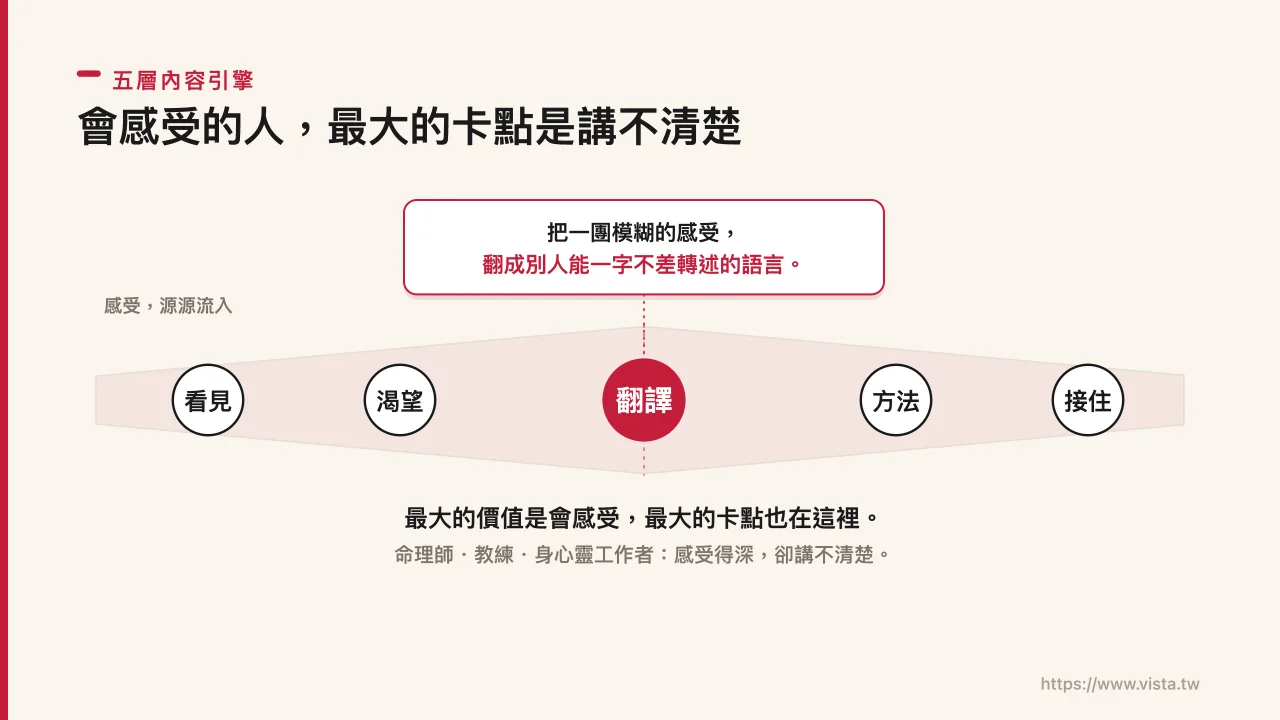
She said that the greatest value of people like numerologists, coaches, or mind-body workers is that they can feel, and the biggest sticking point is exactly here: they feel deeply, but they can’t explain clearly. Translation is to translate a vague feeling into a language that is concrete, picturesque, and can be described verbatim by others.
This matter is particularly touching to me because it is actually the core of writing. I have taught writing for these years, and I have seen too many good content die because I want to put everything in it. The ability to translate, in the final analysis, is the willingness to give up ninety-nine other ways of saying things that are correct but not so accurate in order to make someone understand. This comes back to the same thing: convergence. Positioning is the convergence of “who are you”, and translation is the convergence of “how do you say it”. They are the same skill, used in two places.
After walking out, do three things first
Teacher Susie divided the closing actions into three specific time points, which I think are worth your reference: within seven days, post the sentence positioning (opens in a new tab) you have converged into a post; within fourteen days, find three people to talk about your main product and record their expressions; within thirty days, hold the first paid event, even if it is only one person.
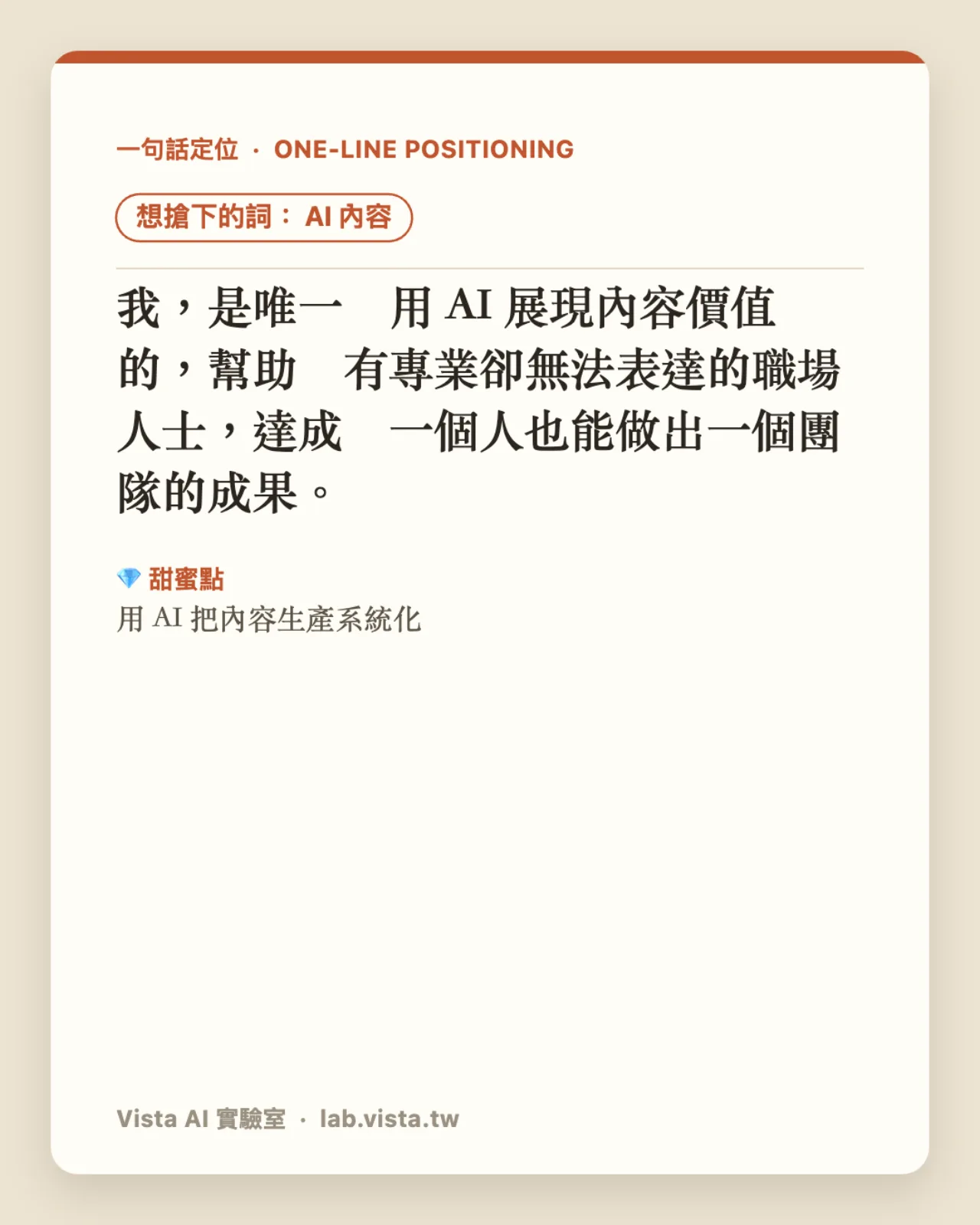
If you also want someone to accompany you and put all your skills into one sentence, Susie’s Positioning Convergence Workshop (opens in a new tab) is just for this purpose. Before you start, you can also use the Positioning Convergence Device (opens in a new tab) I made to run it yourself and spread out the mess in your mind.
##Finally
If you are also the kind of person who “knows everything, but can’t choose one for yourself”, I will give you the most precious sentence from this workshop: other things will not disappear, they will become the thickness of the one you choose.
Thank you, Teacher Susie, for leading everyone to rethink positioning. To be honest, I didn’t learn any new skills from it, but this workshop made me face myself frankly: It’s not that I can’t choose a position, I just can’t let it go. And admitting this is the first step to restrain yourself.
Next step
Bring this topic to your team
Vista Cheng speaks and runs workshops on AI workflows, writing and content systems for companies, schools and public agencies.