Presentation is not only a technology, but also a practice of communication: what it feels like to participate in the release of Fu Ge's new book "Technology of Presentation"
This afternoon, I walked into the National Taiwan University Conference Center, which was packed with 350 people. There was a special tension in the air, not the formality of a business seminar, but the excitement of a group of people who wanted to witness something happening together. Today is the tenth book “Presentation Technology” book launch event.
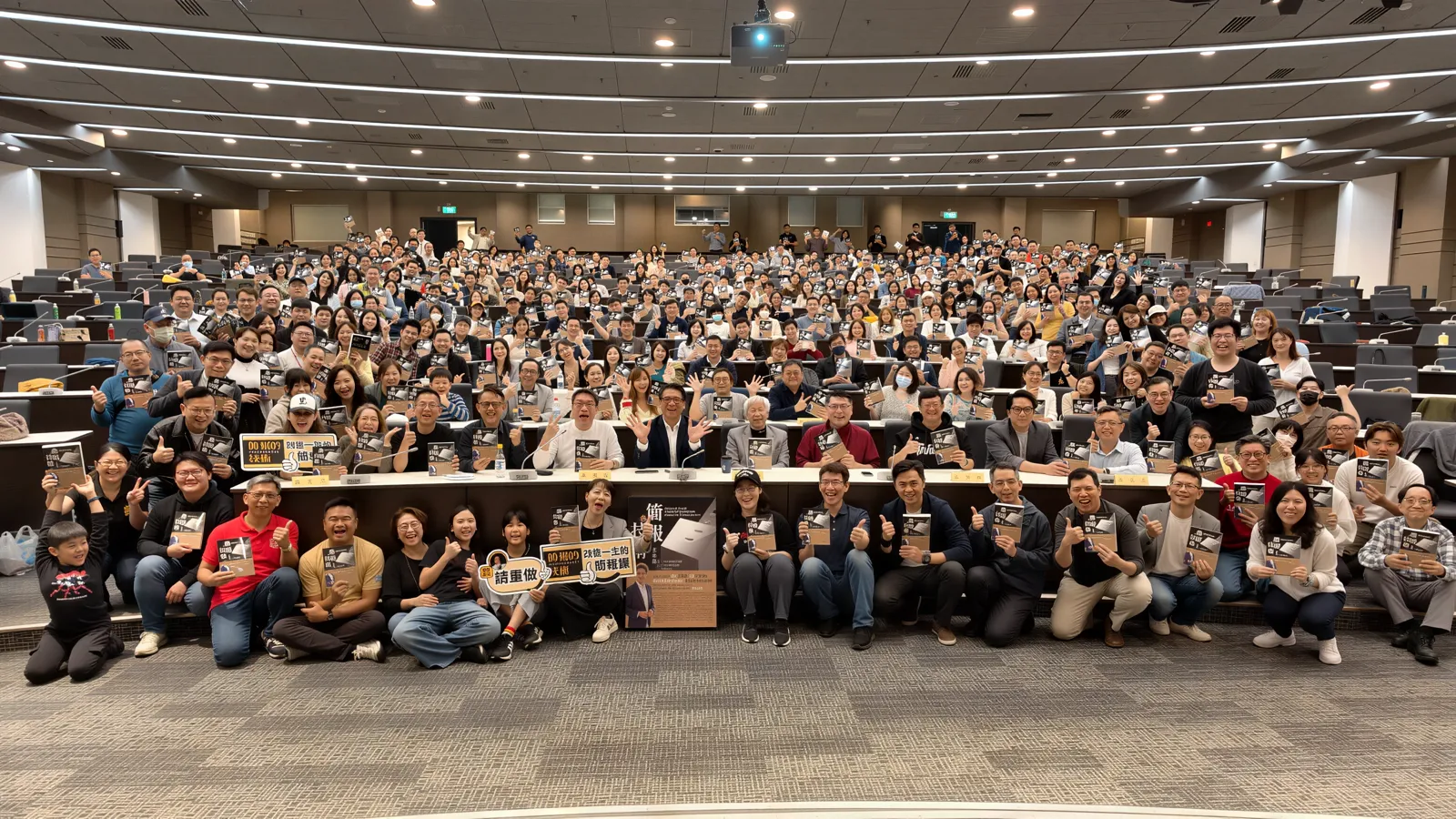 ▲Three hundred and fifty people gathered together, each holding “The Technology of Briefing”
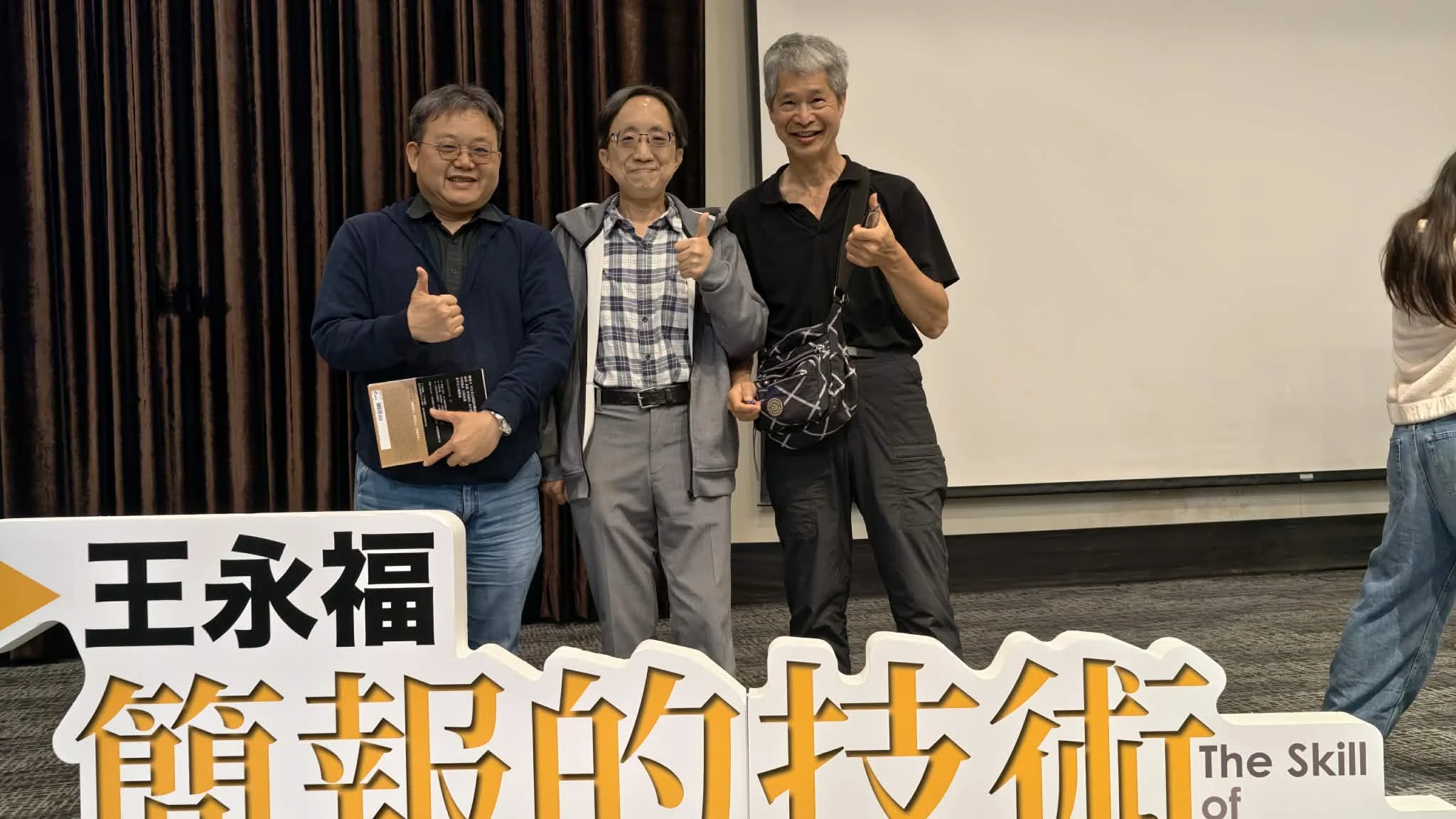 ▲ Taking photos with friends at the event
I have worked in the field of media and content communication for more than ten years and have attended countless book launches. But this scene made me think about a question from beginning to end: Why can a book that teaches people how to make presentations make more than 300 people willing to go out on a Saturday afternoon, and many of them flew back from Kaohsiung, Hualien and even the United States?
The answer is not in the thickness of the book, nor in the number of techniques. The answer lies in the fact that Brother Fu spent twenty years turning “briefing” from a workplace skill into an attitude towards life.
A new book launch is the best presentation demonstration
The very structure of the day’s events is worthy of study. Brother Fu did not follow the routine of a normal book launch—no lengthy guest speeches and no standard chapter introductions. Instead, it’s a well-designed immersive experience.
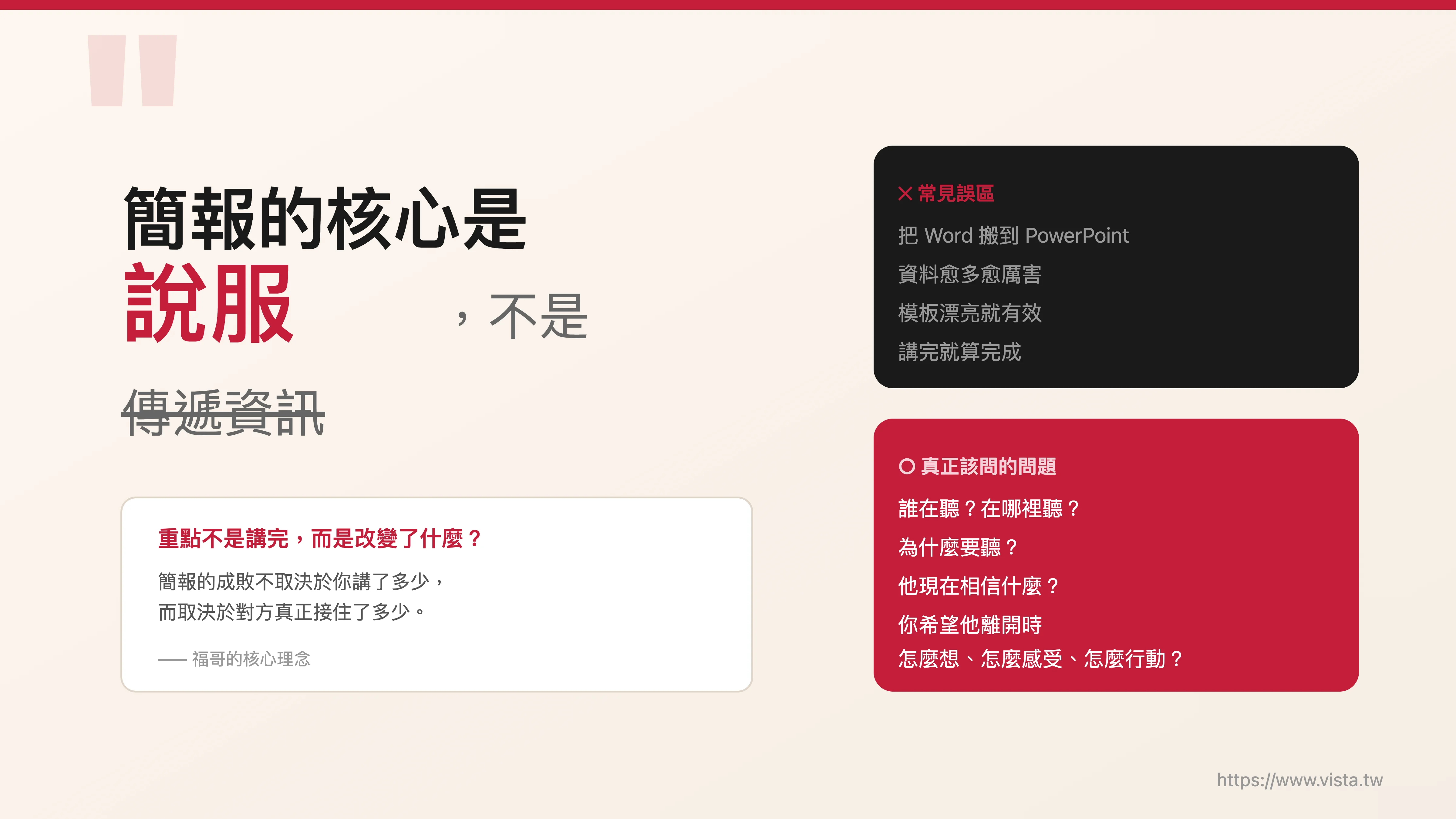 ▲ The focus of the briefing is not to finish the speech, but what has changed
At the beginning of the event, the host shared his personal experience. She used to be a member of the public relations department of a listed company. After taking Brother Fu’s class, she boldly abandoned the company’s public version of the briefing and restructured the content. After the event, a dean of the engineering school of a well-known university came to the stage and told him: “Your briefing made me really get to know your company for the first time.” This story was not just a warm-up, it directly pointed out the core proposition of the entire event - the focus of the briefing is not to finish the presentation, but to change what has been done.
The point of the briefing is not what was said, but what changed.
Then, President He Feipeng, founder of City State Publishing Group, took the stage and used two keywords to position the book: “witness the birth of a classic” and “witness the birth of a master of presentations.” President He mentioned that twelve years ago he published Fu Ge’s “Techniques for Getting on Stage”, twelve years later this book has been completely transformed. The fact that Fu Ge wrote an English paper on briefing techniques and published them in international journals and was widely cited shows one thing: good practical knowledge can withstand academic testing.
Starting from Nowhere: Brother Fu’s Twenty Years of Cultivation
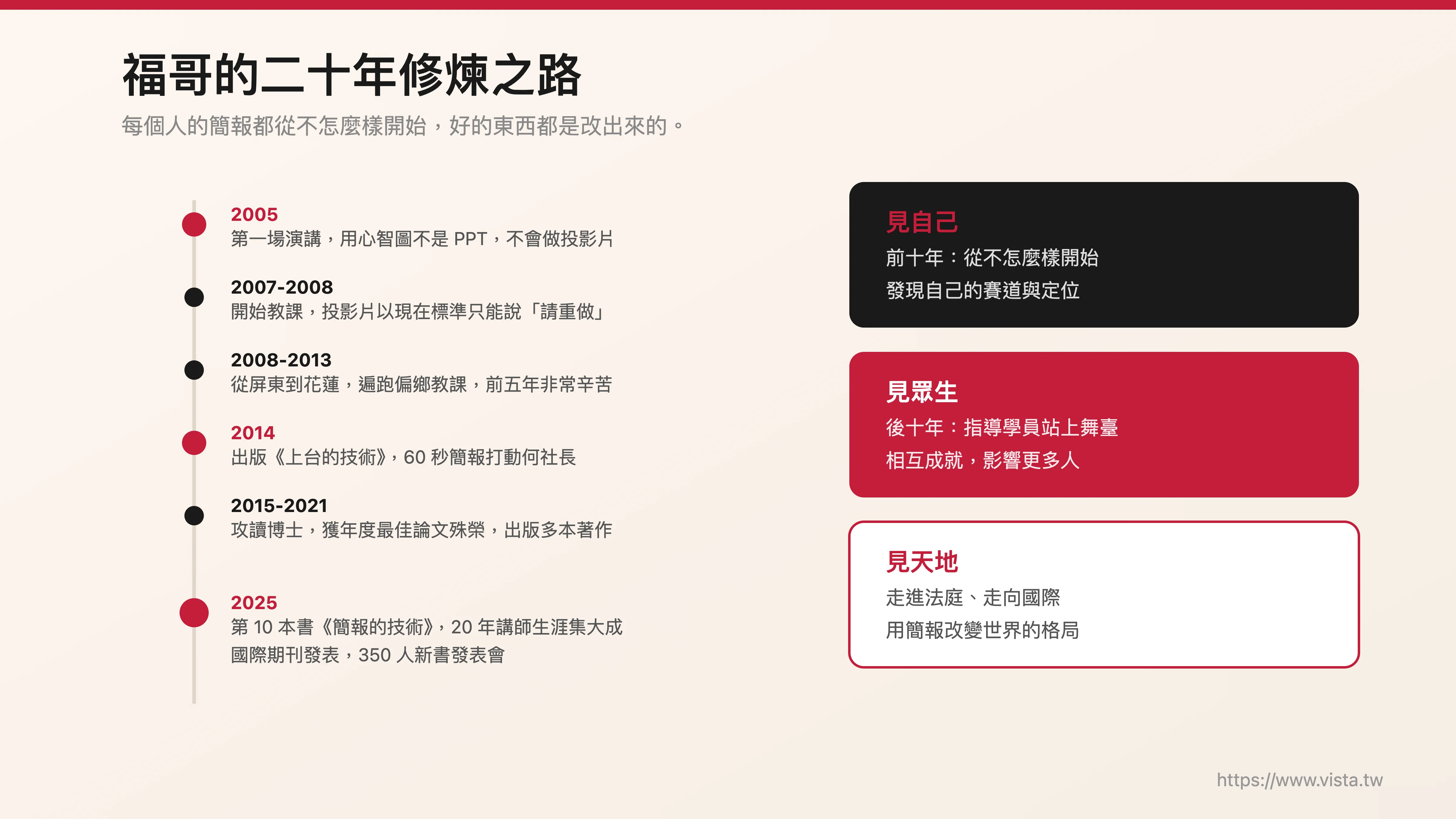 ▲ From the first speech to an international journal, Brother Fu spent twenty years blazing his own path
The most touching part of the entire press conference was that Brother Fu unabashedly showed his true journey over the past twenty years.
He showed the slide of his first speech in 2005 - it was not PowerPoint, but a new word picture, because at that time he did not know how to make slides. Later, he showed the briefings from his early teaching days in 2007 and 2008, and then said only three words using his current standards: “Please redo it.” The whole audience laughed, but after the laughter, there was a profound understanding - everyone’s briefings started from scratch, and this was never a talent, but a technology that can be learned, copied, and imitated.
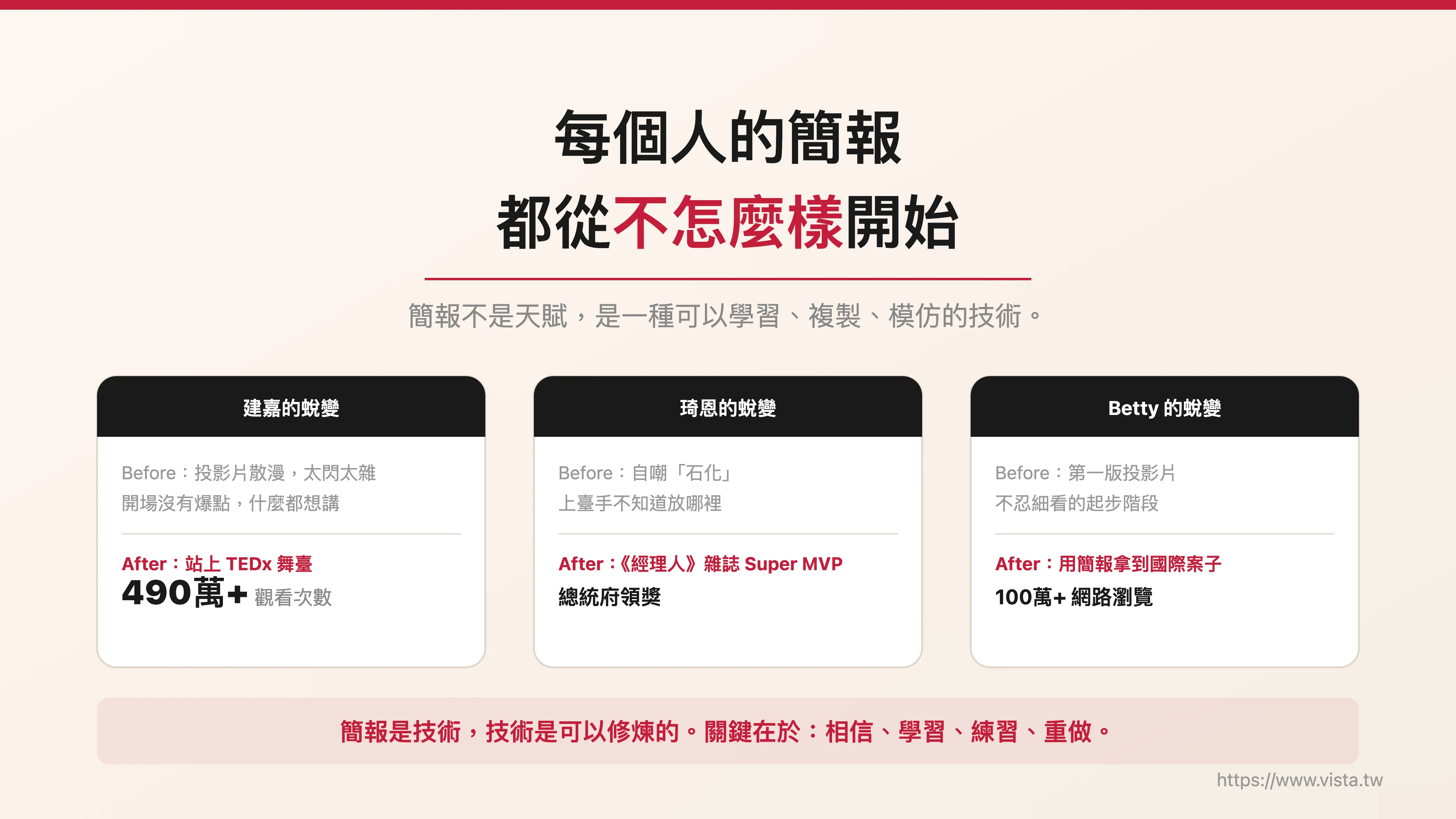 ▲Everyone’s briefing starts with something bad
Brother Fu took everyone through his first five years: from Pingtung to Yuli, from Yuli to Hualien, and took the train around half of Taiwan to teach. Sometimes there are cases, sometimes there are not. He went to school to teach club students how to practice presentation skills, and went to remote primary schools to take classes. He picked up everything and slowly found his way. Those days, in his own words, were “very, very hard.”
If you work really hard, really hard, some things will slowly change.
But Brother Fu also said something that impressed me deeply: “You work really hard, really hard, and some things will slowly change.” His mother saw his first newspaper report on the hospital bed. What behind that photo was not just the growth story of a lecturer, but the moment when a person was finally seen after continuing to invest in the stupidest way.
Xie Wenxian and He Feipeng: Your honor is not a coincidence, you are ready
Another passage in the event that made me think deeply was when Brother Fu talked about two important noble people in his life: Xie Wenxian (Brother Xian) and President He Feipeng.
Brother Xian shared a little-known story at the scene. In 2014, after he went to see Fu Ge take a class, he made a major decision: “I will never teach the presentation class again. I can teach him everything.” He gave up the briefing track to Fu Ge and specialized in speeches. As a result, both of them succeeded. Brother Xian said: “I am not his noble person at all. Instead, I feel that he has helped me in the past ten years - helping me clarify the track and helping me find better methods in business.”
This passage reminds me of a concept in communication: co-construction. Really good interpersonal relationships are not about one-way help, but about each other redefining their roles and directions during interaction. The relationship between Brother Fu and Brother Xian is the best example - it is not who achieves who, but the two people in their respective fields become clearer because of each other’s existence.
President He brought out another important revelation. Twelve years ago, Brother Fu introduced himself to him with a 60-second briefing. President He still remembers that briefing. Brother Fu played the video on stage, and you can see a young lecturer conveying his value proposition in the most precise way within one minute. Brother Fu said: “If there is a briefing you submitted twelve years ago, and your nobles will still remember it twelve years later, that should be pretty awesome, right?”
A briefing is not a one-time performance, but a communication act that can continue to have an impact.
Well, that’s the power of a brief – it’s not a one-time performance, but an act of communication that has ongoing impact.
Briefing Coaching Time: From Passive Learning to Active Diagnosis
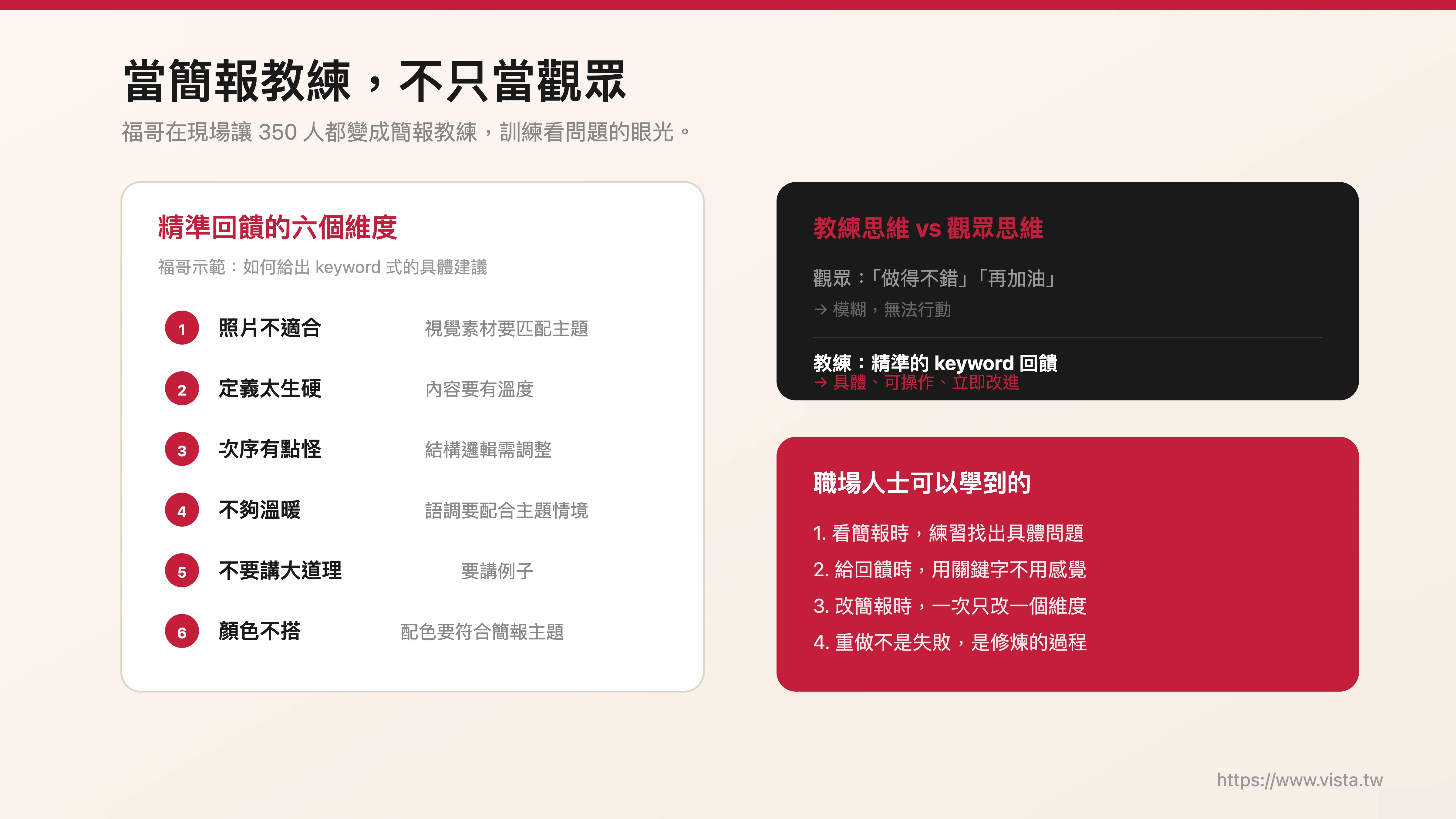 ▲ Brother Fu asked all 350 people in the audience to serve as briefing coaches
Brother Fu did a very smart thing at the scene - he did not just give lectures, but let all 350 people in the audience act as briefing coaches.
He took out real slides of past students and asked everyone to discuss in groups and give diagnostic opinions. From “the photo doesn’t fit” and “the definition is too rigid” to “the colors don’t match” and “the order is a bit weird”, every feedback is specific and actionable. He demonstrates how to give precise keyword feedback instead of vague “good job” or “keep up the good work.”
Really good teaching is not about telling you the answers, but about training your perspective on problems.
This session also reminded me of one thing: Really good teaching is not about telling you the answers, but about training your perspective on problems. Fu Ge is not just teaching briefing skills, he is cultivating everyone’s ability to become a briefing coach - one who can see where the problems in a briefing are and then give specific suggestions for improvement.
He also showed the before-and-after comparison of the presentation works of many students: Gong Jianjia From the first version of the scattered slides to the TEDx stage, it has accumulated more than 4.9 million views; Liyuan Technology’s Chen Weizhu (Betty) went from the unimpressive first version to now using B2B Briefing won an international case; Chen Qien went from mocking himself as “petrified” to winning the 2020 100MVP Manager Super award from Manager magazine MVP and went to the Presidential Palace to receive the award. Every case says the same thing: briefing is not a talent, it’s a skill, and skill can be practiced.
🎯 Want to further improve your presentation skills? If you are interested in the topic of “AI-assisted presentations”, welcome to join my [Vibe Coding Practical Workshop] (https://www.vista.tw/workshop/vibe-coding). In the workshop, you will learn how to use AI tools to quickly create interactive presentations, build a personal brand website, and even develop your own AI presentation system. No programming background is required, just bring your laptop and get started.
 ▲Vibe Coding Practical Workshop: Use AI to create your digital works
In the AI era, you are still the one on stage
 ▲ No matter how powerful the AI is, the person standing on the stage will always be you
During Fu Ge’s speech, he spent some time talking about the relationship between AI and briefings. This is also the part that I pay most attention to. He first showed the results of using NotebookLM to generate a slideshow from the entire book’s manuscript - AI automatically organized the core concepts and even generated case photos by itself. Then he tried ChatGPT, and the AI promised that it could help him create a Steve Jobs-level briefing. When he opened it, it was laughable. This demonstration is both humorous and profound because it highlights a key fact: AI can be a great auxiliary tool, but it cannot yet replace human judgment and sense of presence.
Brother Fu then made a very powerful comparison. He showed photos of Jen-Hsun Huang, Elon Musk, the bosses of Google and Meta giving presentations on stage, and then said: “These four companies are currently the top companies in AI. They have the most powerful AI, but they are still on stage.”
You are the one on stage. No matter how many tools or AI assistance you use, you are the one who finally takes the stage.
For me, this quote particularly resonates. I am currently developing an AI briefing system. The core concept is to position AI as a “coach” rather than a “stand-in”. The preface written by Brother Fu in the book points out the key: “The person who takes the stage is you. No matter how many tools or AI assistance you use, the person who takes the stage in the end is you.”
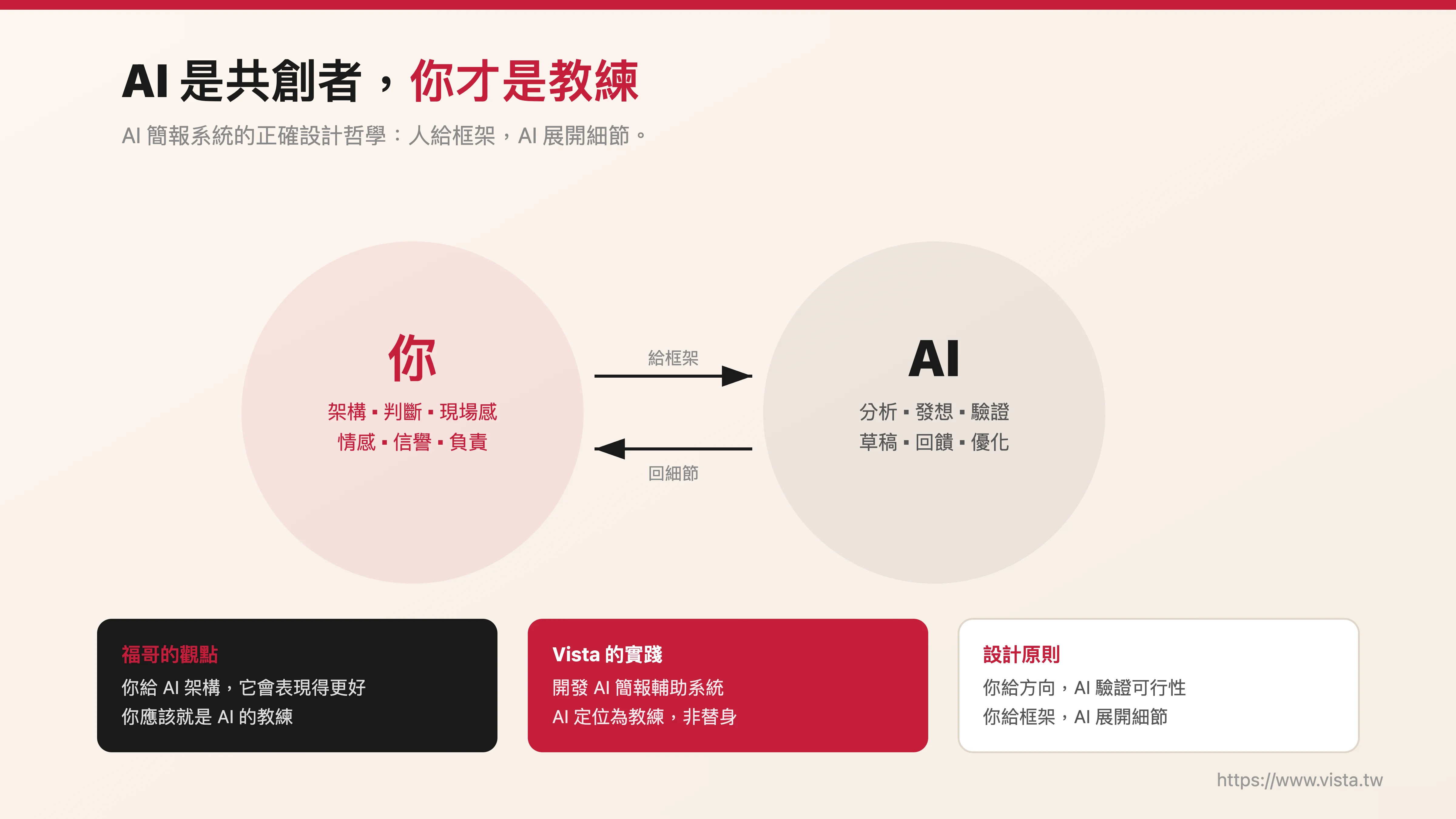 ▲The most powerful role of AI is not the creator, but the co-creator
From my practical experience, the most valuable application of AI in the field of presentations is not to automatically generate slides, but to provide structural support at every stage before, during and after presentations. Fu Ge also demonstrated this concept at the scene: you can use AI to analyze the characteristics of the audience, discuss the flow of the story, design the opening and ending, and even throw the speech recording to AI for performance analysis. But the premise of all this is that you first have a clear structure and judgment.
As Fu Ge said: “If you can give AI structure, it will perform better. Otherwise it will be very divergent. So you should be the coach of AI.” This view is completely consistent with my design philosophy when developing the AI briefing system - the most powerful role of AI is not the creator, but the co-creator. You give it a framework, and it helps you unfold the details; you give it a direction, and it helps you verify feasibility.
Reunderstanding briefings from a communication perspective
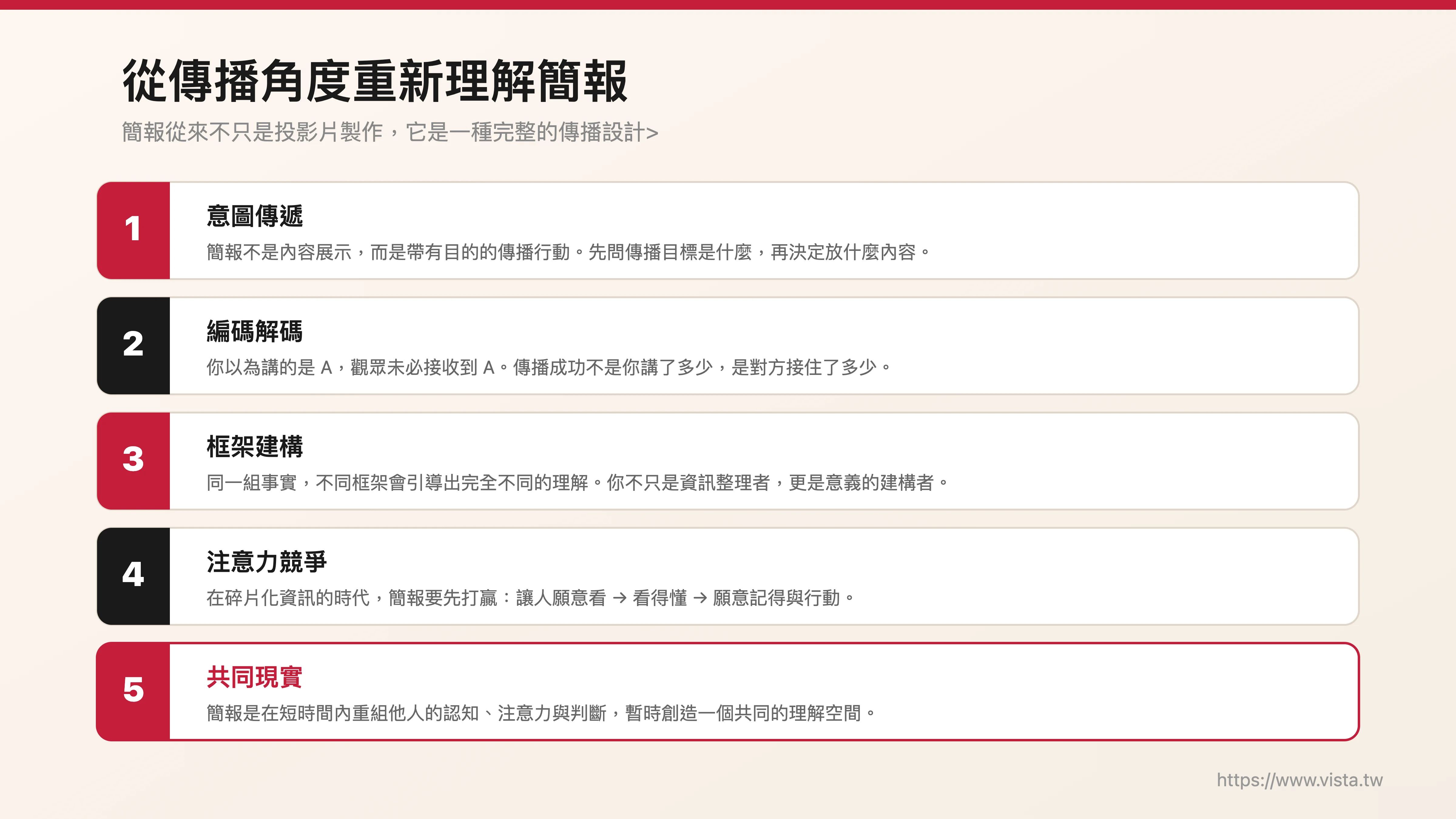 ▲ Briefing has never just been about slide production, it is a complete communication design
As a person who has studied content communication for a long time, Fu Ge’s speech once again confirmed for me a point of view: a briefing has never just been a slide production, it is a complete communication design.
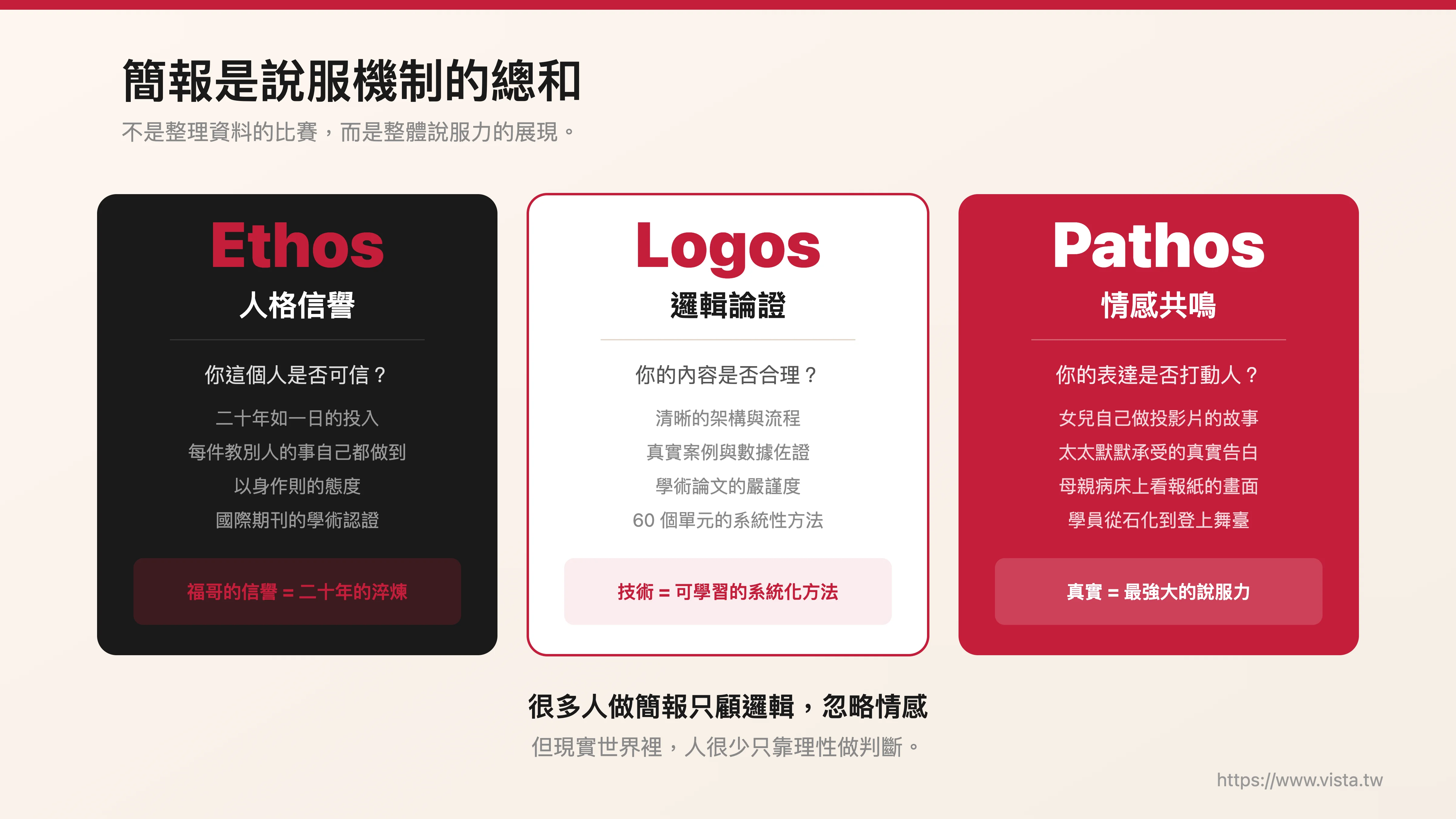 ▲ Briefing is the sum total of persuasion mechanisms
From a communication perspective, the briefing involves the process of encoding and decoding. You think you are talking about A, but the audience may not receive A. This is why Fu Ge spends a lot of time in the book talking about audience analysis and structure design - because the success or failure of a briefing does not depend on how much you say, but on how much the other party actually catches.
There is no doubt that a briefing is also a framework. How you order the material, what to talk about first and what to talk about later, what to emphasize and what to ignore, these decisions are not neutral. In fact, you are helping the audience build a framework for understanding the world. Brother Fu’s speech at the scene itself is the best demonstration - he does not introduce the content in the order of chapters in the book, but uses his twenty-year life story as the skeleton, giving every technique and concept an emotional focus.
What’s more, briefings are a competition for attention. In today’s era of short videos and fragmented information, the audience’s patience and retention time have become shorter. Fu Ge used interactive sessions, real cases, humorous jokes and emotional climaxes to constantly regain the attention of 350 people, and this lasted for nearly two hours. This is not achieved by stacking skills, but by a deep understanding of the rhythm of communication.
The success or failure of a presentation does not depend on how much you say, but on how much the other person actually catches.
Ultimately, the brief is about temporarily creating a shared reality. When Brother Fu stood on stage, he invited everyone present to enter a space of understanding he had built. In this space, we are not just listening to a person introduce his new book, we are experiencing a twenty-year cultivation journey, and then leaving with a new cognitive framework at the end.
That moment that made the whole place quiet
In the last ten minutes of the entire event, Brother Fu put aside all the techniques and structures and began to talk about the real reason why he wrote this book.
He said that the secret behind writing this book was that he hoped that when his daughter grows up, one day when she needs to make a presentation, she will have a complete reference book at hand. He mentioned that his daughter, Amber, recently made a slideshow because a goldfinch came to her door, and came over and said, “Dad, I’m giving you a briefing.”
He also mentioned his wife. In the process of preparing for this press conference, he said to his wife: “Don’t talk to me before March 22. I have no brain, no spirit, no energy, and I don’t want to discuss anything.” Then he said: “The person who endured all this is my wife.” His wife came on stage and only said a few words, but at that moment, the entire audience fell silent.
Well, that’s the deepest power of briefings. It’s not a technique, it’s not a slide design, it’s not an opening formula or a closing technique. It is a person standing on the stage, showing the truest part of himself, and then letting everyone present feel: this thing is true, this person is serious.
What can you start changing in your next briefing?
When I walked out of the venue, I was holding the heavy “Presentation Technology” - 438 pages, nearly 200,000 words, 60 units, each unit is written in extremely detail. Brother Fu spent nine pages and 4,460 words on the theme of “Post-it Notes” alone.
But what I took away from my heart were not just these words.
What I took away was what Brother Fu said on stage: “Everyone’s briefing starts from something bad.” And what he spent twenty years proving: good things can only be modified.
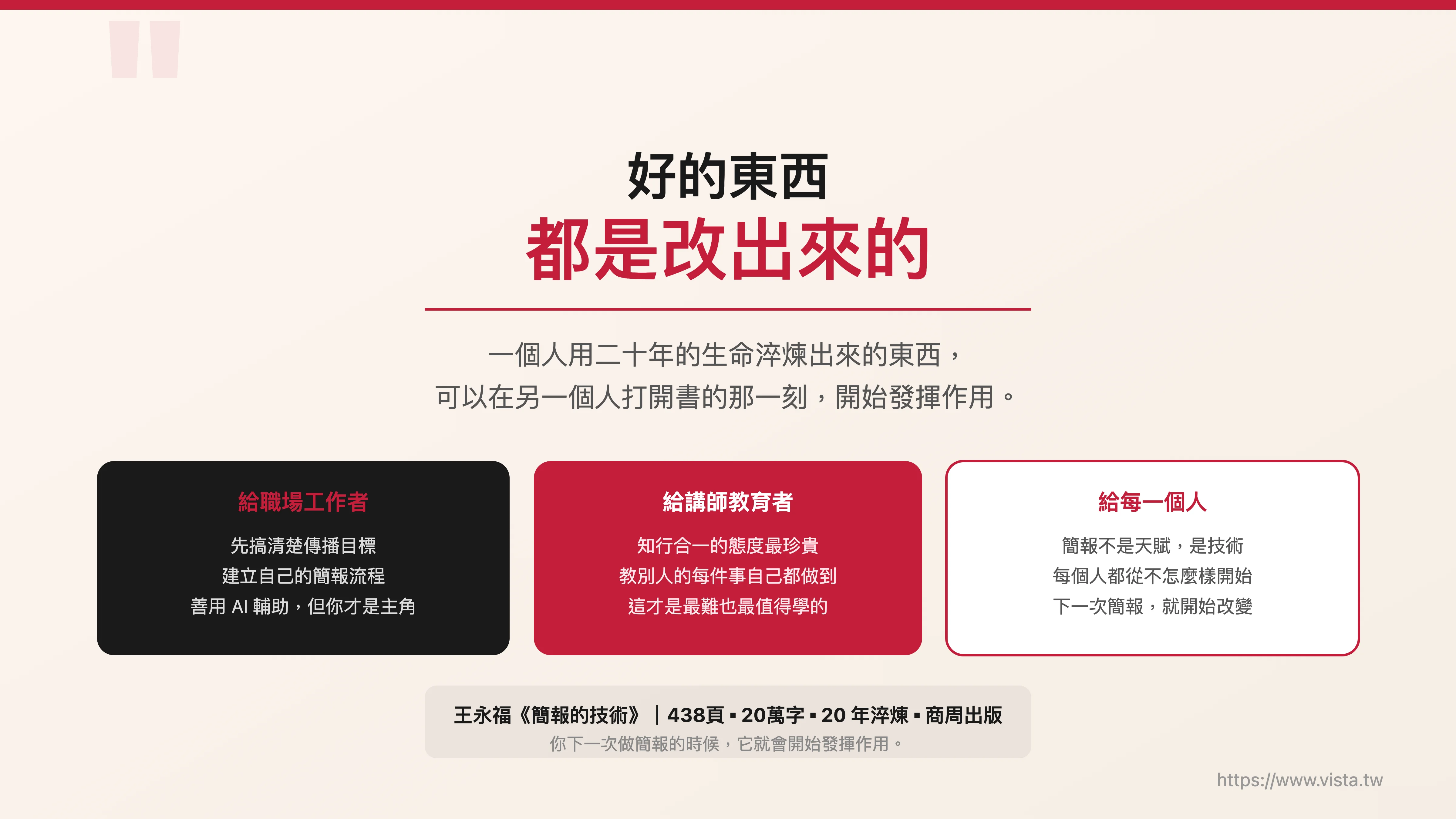 ▲ Good things are all modified
Good things are all modified.
If you are a working professional, I would recommend that you start with the structure of this book and build your own briefing process. Don’t rush to learn skills, first figure out what your communication goals are and what your audience needs. Then make good use of AI tools to assist in idea generation and verification, but always remember - you are the one on stage, and you are also the responsible person.
If you are a lecturer or educator like me, this book will give you not just presentation skills, but a model for leading by example. Everything Fu Ge teaches others, he does every day. This attitude of integrating knowledge and action is the most difficult and worth learning thing.
When I finished writing this review, it was already half past nine in the evening. The cover of the book on the table reflects the black and gold luster under the light, and the waistband of the book shines with the recommendations of one hundred and eight experts and celebrities.
I think of the last words that Brother Fu said: “I spent twenty years accumulating these two hundred thousand words. You don’t have to spend twenty years now. You only need to get this book. For the price of one book, you can get the experience I have accumulated in the past twenty years.”
Yes, this is probably the most romantic thing about writing a book - what one person spends twenty years of his life refining can start to work the moment another person opens the book.
When you finish reading this book, it will start to change something the next time you give a briefing…
Okay, it’s time for me to write my next book too.
Further reading
- 📖《Presentation Technology” - 438 pages of Fu Ge’s twenty years of experience.
- 📖《Techniques for getting on stage”——Fu Ge’s classic work twelve years ago
- 🎙️AI Briefing System——AI briefing auxiliary tool developed by Vista
- 🎓Vibe Coding Practical Workshop——Use AI to create your digital works