Professor Zheng Yujun from the School of Communication at National Chengchi University talks about the impact of AI on communication and humanistic society
[ ](https://blogger.googleusercontent.com/img/b/R29vZ2xl/AVvXsEiTmsMrNlMF2YRYIEkP6zKnUPxM_kXK0TcobIkhn4yD5qPMpOUE6hyXbQDFVuKHwxO-VUxysKCP2aWs85Uq pSh8QfxjNvmqRVDecJL1nX2TZu-IFxtcY-uK7ZzDDPAL9N_0HP1Z62Uohko8stWwIQ9US8Wd5 7gBmHqBmffz7N3mN04NgO8l2IAG31f_TEOs/s1134/%E9%84%AD%E5%AE%87%E5%90%9B.jpg)
The academic exchange workshop between [Shih Hsin University Doctoral Program in Communication] (https://www.facebook.com/PPCS.SHU) and [Innovative Communication and Data Intelligence Laboratory] (https://www.facebook.com/shucidi) invited [National Chengchi University School of Communication] (https://comm.nccu.edu.tw) [Zheng Yujun] (https://comm.nccu.edu.tw/PageSt affing/Detail?fid=11123&id=3684) Professor “[From AI to AIGC: The impact of AI on communication and humanistic society]” (https://www.facebook.com/PPCS.SHU/p osts/pfbid05u79ajGxAqKyRwcpBbPQYRQdr8eqMU41PXyGwMT58Di15Q6YcSfieWsB7dG5XeWjl?locale=zh_TW)” to share.
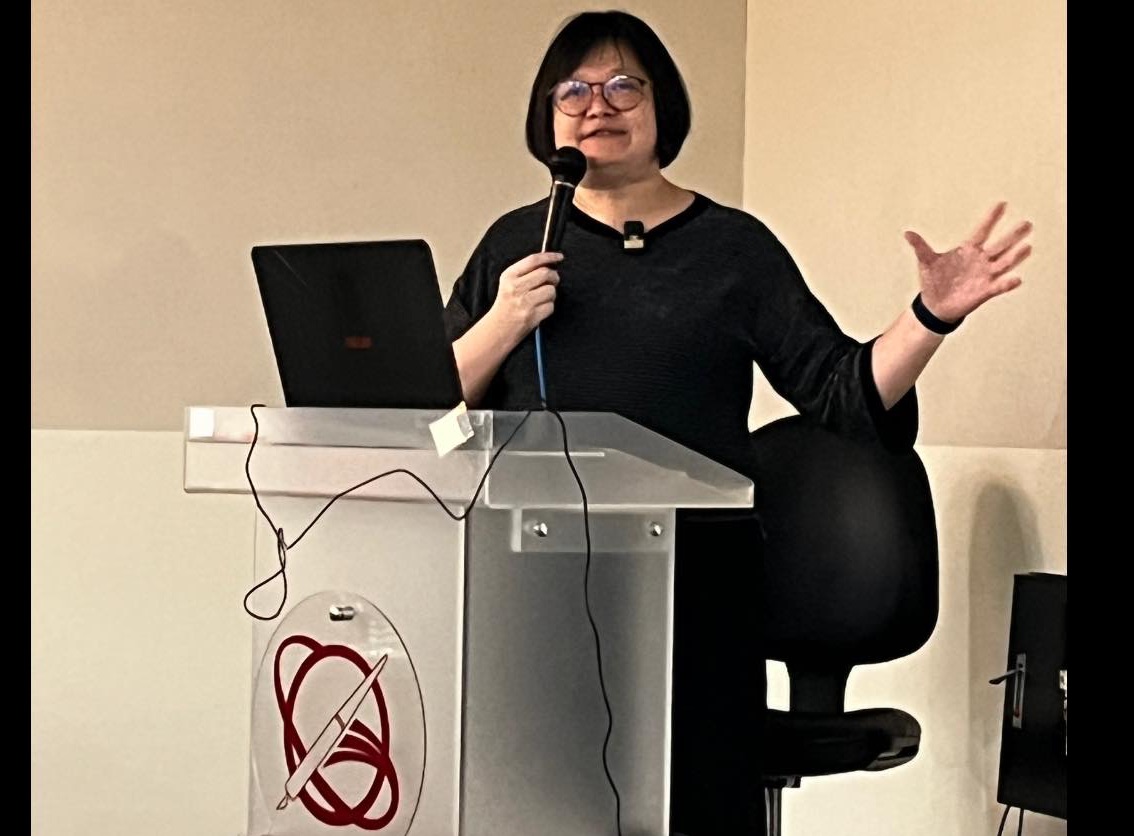
Professor Zheng Yujun is an interdisciplinary scholar. He studied at the Department of Zoology at National Taiwan University, and then completed his master’s and doctoral studies at the Institute of Journalism at National Chengchi University. In the early days, he also taught at the Department of Mass Communication of Xuanzang University, and later returned to his alma mater, National Chengchi University.
Professor Zheng smiled and told the guests: “We are working with AI is actually not as far away as everyone thinks. Although it is changing rapidly, it can actually be seen in our daily lives. And I have moved from the field of biotechnology to the humanities society, and now I have returned to some AI things, and I feel that I have returned to that kind of science and engineering thinking.”
Professor Zheng shared her feelings with the guests. She said: “As a student of the School of Communication, we need to think about the relationship between AI and communication? And from AI to AIGC, it may seem like a small step, but it may be a big change. Especially the impact of AI on communication and humanistic society, as well as the imagination of the future, it is worth thinking carefully about the various applications of AI and AIGC in teaching and research.”
Professor Zheng said that from a communication perspective, AI is not an issue that only emerged this year. Basically, AI has been around since the last century! It’s just that every era change it has gone through has had different technological progress and forms.
“In the [field of communication](https://medium.com/@rihssmost/学人说-AI has changed the communication ecology-application-challenges and future development-bc340485acd4), we will probably look at AI from three different angles: The first angle is to treat it as a tool, it may be A tool that helps us produce content. The second perspective is that it is a medium for receiving content (just like when we watch TV or Netflix now). The third perspective is that it is a partner, especially a collaborative partner. In fact, many scholars are discussing these three perspectives mentioned by Professor Zheng.
Looking at the development of AI today, she believes that three perspectives may coexist at the same time: “Especially after the advent of smartphones, we first used it as a tool. For example, in the production of news, everyone will see that it is used as a tool that can quickly help us produce some reports, especially now we see some more standard reports, such as the rise and fall of the stock market, football game results, etc. These contents can all be automatically generated through AI. For example, News in Australia Corp, which uses AI tools to produce these reports very quickly.”
Professor Zheng said: “Another tool that everyone uses every day, but may not feel it, actually has the power of AI behind it. We see all kinds of beautiful photos now, but they are not what they originally looked like. Everyone will retouch the pictures before uploading, so we often find that the person is very different from the photo… Having said that, this is also because everyone is now very accustomed to this kind of photo editing, and even edits photos into different styles such as comics, cartoons, or Japanese. I think everyone should have downloaded similar apps on their mobile phones, right? Basically, these software are also operated by the power of AI!
[ ](https://blogger.googleusercontent.com/img/b/R29vZ2xl/AVvXsEhjZlh2LNskyuDTTWBgu5etb52mYDJQVXsy10fIKnovd8y-wwxnRBXTLlDlCT1slxGlLm6xD-XK 4zpSROE-KGL9Pyq_zTpZv4jX-IR07QLPK3Ai7stg59zrp3TZ9C5OspNrAHoTNoutXWFsEAJ56ZfhlcwSw2mH6xA8felm91AiMWyluDFqlWLaWsXaGwtp/s4032/IMG_7361.HEIC)
In addition, when talking about AI as a medium, Professor Zheng cited Apple’s Siri as an example: “This kind of personal intelligent assistant has basically become familiar with your voice because it has interacted with you for a long time. If another person uses it today, it will basically not be able to grasp the pronunciation of the words. Because as far as voice input is concerned, it serves as a medium… When I use Siri as a communication channel today, many people are too lazy to type now. They usually use voice input, but sometimes there are some strange words and so on. ”
“Next, AI as a partner. Some movies mention that when modern people are often lonely, they will want to find a virtual lover… This sounds a bit like a plot in a movie, but today’s technology can already do it! In other words, AI can not only become your virtual lover, but also your work partner, interacting closely with you.”
ChatGPT came out around November last year, and there was a wave of AI craze at that time. But the real golden cross was actually in January and early February of this year. In other words, at that time, the search popularity of AI began to be higher than that of media.
Professor Zheng pointed out that this has a profound meaning: “That is, our demand for media in the past, whether you want to read content or use various media, can be transformed by AI today. Perhaps it cannot be said to be replaced. In other words, these original media have incorporated some AI into them to some extent.”
In other words, before the emergence of AIGC, AI had basically appeared in various media tools in daily life. But what changes have resulted from the advancement from AI to AIGC?
She reminded everyone: “From AI to AIGC, we all have to understand that this is a superposition relationship, not a replacement relationship. In other words, the original operations of AI are still there, but with AIGC on top, then when these two are added together, it will produce some additive effects. The AIGC we are mainly talking about today is in addition to the original AI In addition, the more important part is the generative content behind it. Of course, some people say that this is “Generative AI”. In fact, the scope in English is [Generative]. AI](https://www.preface.ai/blog/what-is-generative-ai/), also called GAI.”
[ ](https://blogger.googleusercontent.com/img/b/R29vZ2xl/AVvXsEjJFu5T42ded8VGo1eYcGjjRYAmg4MrJ2DOrEYXFDHtdMhahQSRxaZe721aJBLjJox_WtuugY4V KVVHxFF_FwtqA7ClIxn0YaaRF6NFrDz1HCWpGkKHXJSc9lVP989U4teOt8lqiHKOpv-rrVMg3IlraHVbMk_K0JqnhmBTMnF5RMGqaHTJm9Inj74XdlCm/s4032/IMG_7366.HEIC)
“In this context, AIGC, especially in the field of communication, will regard it as the third generation of content creation methods after professionally produced content (PGC) and user-generated content (UGC). PGC is the content produced by professionals in the early years. For example, TV news on TV stations is produced by a group of professional news personnel, while UGC initially emphasized that everyone can produce it, such as various contents on YouTube, which were most popular around 2010.”
](https://blogger.googleusercontent.com/img/b/R29vZ2xl/AVvXsEjJFu5T42ded8VGo1eYcGjjRYAmg4MrJ2DOrEYXFDHtdMhahQSRxaZe721aJBLjJox_WtuugY4V KVVHxFF_FwtqA7ClIxn0YaaRF6NFrDz1HCWpGkKHXJSc9lVP989U4teOt8lqiHKOpv-rrVMg3IlraHVbMk_K0JqnhmBTMnF5RMGqaHTJm9Inj74XdlCm/s4032/IMG_7366.HEIC)
“In this context, AIGC, especially in the field of communication, will regard it as the third generation of content creation methods after professionally produced content (PGC) and user-generated content (UGC). PGC is the content produced by professionals in the early years. For example, TV news on TV stations is produced by a group of professional news personnel, while UGC initially emphasized that everyone can produce it, such as various contents on YouTube, which were most popular around 2010.”
Professor Zheng also mentioned that UGC has begun to slowly move towards professionalization. For example, we have seen some Internet celebrities with high traffic, such as Zhiqi Qiqi and Adi English. They are not working alone, but there is also a team behind them. Therefore, compared with these videos shot by ordinary amateurs or classmates, it is basically difficult for your traffic to compete with their professional [Internet celebrities] (https://zh.wikipedia.org/zh-tw/Internet celebrities).
“So, when [UGC](https://zh.wikipedia.org/wiki/User-generated content) (user-supplied content) begins to become professionalized, it has now entered the next generation. We will think that the content creation model will become AIGC. For example, ordinary amateurs cannot compare with Zhiqi Qiqi, Adi or Tang Qiyang, they will all have one A professional team helps with lighting and script writing… However, in the era of AIGC Yuan, and can change a form of content creation.
For the field of communication, Professor Zheng believes that this is a new form of content creation, even a revolution. AIGC has many types of content production, and the most basic output is text. Taking ChatGPT as an example, with the help of natural language processing, text can be used to generate text, and then text can be used to produce images, videos, etc., such as the well-known Midjourney or DALL·E 3. Now, there is also AI that can produce music…”
Professor Zheng pointed out that whether you want to produce text, images or even construct some 3D virtual spaces, generative AI can be achieved through text as a communication medium. She mentioned that in the field of academic research, she has been doing data analysis for more than ten years, starting with machine learning.
She admitted that in the age of machine learning, the whole process was more difficult: “For example, I worked with [Chen Bailing] (https://scholar.google.com.tw/citations?user=TRZ_2FYAAAAJ&hl=zh-TW) from the Department of Journalism at National Chengchi University more than ten years ago. When doing [Internet text analysis of Typhoon Morakot] (https://ah.nccu.edu.tw/item?item_id=69831), I asked some people to label the categories of these texts, and then used machine learning to help label the thousand items we needed to label. Later, machine learning was used to help label 8,000 pieces of information. Of these 1,000 pieces of information, machine learning was able to classify 8,000 pieces of information, which sounded great! But the biggest difficulty encountered at that time was when [Typhoon Morakot](https://www.researchgate.net/profile/ Yuchung-Cheng/publication/354200915_goutongbuquedingxingtansuoshejiaomeitizaizainanshijianzhongdejiaose/links/612 b60a3c69a4e487964b881/goutongbuquedingxingtansuoshejiaomeitizaizainanshijianzhongdejiaose.pdf) finished, if you encounter another [disaster] next time (h ttp://newdoc.nccu.edu.tw/teapaper/04/357574.pdf), or when I need to reclassify, the past knowledge cannot be transferred. Therefore, when I encounter another event, I have to re-label it, which is very labor-intensive… Therefore, the biggest bottleneck encountered by machine learning at the time was that it could not learn if you did not label the data in advance. In other words, someone had to label it first, so it had to rely on a lot of labor. It gradually changed after the emergence of artificial neural networks and artificial neural networks. You can learn very well without using labels! After a period of development, we have what is called “generative AI” today.
Professor Zheng explained the basic concepts of large language models (LLM) through an official video of OpenAI in this lecture. She mentioned that the popularization of AI will actually have a considerable impact on the communication industry, and it can help a lot not only in news production, marketing and publicity, etc. For example, in the areas of automated news and automated summaries, AI moves very quickly, even including chart production.
Today, there is a wave of AI craze around the world, and various industries have launched various diversified applications. It is true that AI can do many things, even [precision marketing](https://zh.wikipedia.org/zh-tw/precision marketing) is no problem. Professor Zheng also specifically cited the previous cooperation between the hit singer [Sanny Chen] (https://zh.wikipedia.org/zh-tw/陈anny) and [Taiwan AI Labs] (https://ailabs.tw) (Taiwan AI Labs) as an example, and shared with everyone through the video the news event that [Sanny Chen] (https://www.storm.mg/lifestyle/4764572) released the first single sung by AI.
Listening carefully, you find that the AI has not only imitated Chen Shanni’s unique timbre, but also learned how to breathe! This single, co-produced by Chen Shanni and Taiwan Artificial Intelligence Laboratory (https://www.verse.com.tw/article/artificial-intelligence-taiwan), has deceived the ears of many professional musicians, demonstrating the capabilities of AI.
In the current hot discussion about the development of AI, creators are excited and worried at the same time. Shanni Chen hopes that through this song, she will encourage all those who care about artistic creation to think - if the era of AI is bound to come, what creators should care about may not be “whether we will be replaced”, but “what else can we do”.
Professor Zheng said: “From a positive perspective, AI chat robots can indeed meet the emotional needs of some people to a certain extent. But everyone knows that once you fall in love, you may naturally fall out of love… If [AI Lover] (https://www.youtube.com/watch?v=gouUZvlpEiw) makes you fall out of love, it may cause psychological trauma, or some people who are more psychologically fragile Weak people, what should we do in the future? I think we will all have to face this problem in the next era. However, it is of course impossible to ban the development of AI. Therefore, the development of AIGC will naturally have some negative impacts. In other words, when the technology reaches a certain level, I believe that this kind of AI chatbot will not be completely banned. It will keep pace with the times and become more and more customized.
Professor Zheng pointed out that in terms of the negative impacts of AI, the first one is ethical issues and prejudice, the other is the spread of false information, and the other is user privacy and data security. In addition, psychological safety and mental health are actually very important issues.
“Just like when I attended Li Yizhi teacher’s workshop before, he once demonstrated that by adding some prompt words to Midjourney, you can [produce very] Multiple images](https://tw.stock.yahoo.com/news/李伊志-With generative-ai-most people can express themselves-063300128.html) Later, he could use negative prompt words, which means I don’t want anything… So, he played an “A”. Girl in the bathroom”, generate a photo like the one on the left, and then the second time you click on the negative word “No future”, a photo like this will appear. I believe everyone will know at a glance that this picture is obviously racially biased, which means that when the girl has no future, a black child will be automatically drawn… So, I specifically asked Teacher Li to use this picture as an example. This seems to mean that the AI training materials we just talked about may also have such ethical bias. ”
In addition, Professor Zheng also mentioned that for the recognition of images and audio-visual content generated by AI, if you want to do [false information](https://www.mjib.gov.tw/EditPage/?PageID=adf9b60f-98af-4b65-b996-4f741 45a4cd0) and Fact Check, the biggest difficulty is related issues faced during the election season.
For example, in the upcoming 2024, elections may be held in many countries around the world. At a time when news events are hotly debated, such quickly generated pictures can easily be shared, and there will be more than one. Professor Zheng showed a photo that had been circulated on the Internet, which showed [Former US President Trump was arrested] (https://www.cna.com.tw/news/aopl/202303240321.aspx). But obviously this is an AI-generated photo and did not actually happen.
[ ](https://blogger.googleusercontent.com/img/b/R29vZ2xl/AVvXsEjJ8UvjR67L9XuTY6fjdZxuc0WEikVNKuFYpsWAKOxEjt3tTKTeXcODniyafOPuJKMdPfzl5995 KPsmNIDJloqx_Lfe-ti6oA65s6ogMlMlfIk2hLAIeZlplDUY3MQ7JNNtWRBsGh1-PbYA L3PQBBH3BH0FUB7n5IjzbfjO6keDY_ujwpOpf-eP-7v3tRqA/s4032/IMG_7369.HEIC)
“If something like this happens today, unless you check it very carefully, you will basically not be able to see its flaws. Therefore, it is undoubtedly a challenge for disinformation and fact-checking organizations. Especially [deepfake technology] (https://zh.wikipedia.org/zh-tw/deepfake technology), which has appeared probably last year! We have seen characters in some videos saying certain things, and then you may not be able to tell whether they are true or false.”
For example, someone forged the Ukrainian President [Zelensky](https://zh.wikipedia.org/zh-tw/Vladimir Zelensky) in the [Ukrainian-Russian War](https://zh.wikipedia.or g/zh-tw/Russia Invades Ukraine) speech, we can see that Zelensky’s face was changed, and there were even rumors that he announced his surrender… At the beginning, everyone found out that this was a fake video and immediately took it off the shelves. It was even alarmed that Zelensky himself immediately clarified.
Professor Zheng mentioned that if a war were to start today, even if he knew it was a fake video, if the person involved could not clarify it immediately, the fake information would continue to circulate on the Internet. Even if you remove videos from various content platforms, you still can’t catch them all! In other words, once this kind of thing has a copy, it is easy to copy and spread in large quantities.
“Especially during wars or elections, if the other party happens to be unable to clarify due to certain circumstances, the consequences will be serious. Therefore, I think generative AI will indeed be a very big problem on the issue of disinformation. It is undoubtedly a big challenge for news organizations around the world. War. From a personal perspective, in the face of the advent of the generative AI era, the faster we generate content in the future, the slower we will share information. Please don’t share it immediately as soon as you see it. We just need to slow down and see if any other credible organizations come forward to confirm this.”
Professor Zheng reminded everyone that if you see suspicious information in the future, it is recommended to find many credible organizations for verification. For example, if a well-known news organization has reported it to more than one, or even two or three, it will be safer for you to share the news.
“When AI generates content faster and faster, we have to do this. This may be the biggest threat to society currently seen in the AI era. Because as long as there is no label on the photo that is made by AI, you need to be particularly careful. Of course, there is also discussion in the market today about whether all pictures made by AI will be labeled in the future? But there is currently no conclusion, so we need to compare the accuracy of the information. It often takes a lot of time. When people see some specious information, they will unconsciously pass it on and share it. Therefore, when we teach media literacy, we will remind everyone that under such circumstances, we should not pass on various information too quickly, and you should wait until a credible news organization has done a fact check, or even confirmed the matter with the relevant organization.”
“The advent of AI will indeed have a great impact on our society. However, as ChatGPT begins to connect to the Internet, you can go to Wikipedia or many websites to check information in the future. It is possible that things will be corrected. But no one can guarantee that everything will be corrected. Another question is if people collaborate with AI, for example, if you collaborate with it to write a press release, who will be responsible if something goes wrong? For example, some AIGC software currently prohibits the generation of images of current politicians, which also avoids some possible disputes.” Professor Zheng reminded everyone that these issues may arise in the future and are worth thinking about.
Professor Zheng pointed out that with the advent of the AI era, we can no longer avoid the spread of a lot of false information. Therefore, how to find a trustworthy source of information is extremely important. In addition, for professional news organizations, how to verify facts is also very important.
[ ](https://blogger.googleusercontent.com/img/b/R29vZ2xl/AVvXsEgUQ5kwcAHYybvUQqkd8NDKB0qlm6SX2RMRuRBZzWTklwIyhUckzWtxG5-qUtq7FHZWlO2CFAR4 20rx2hBJGTqBjUApFuufQdSBwsn_hmZQKPWDgvvvI_-wwKaVNJ9iS_DyYfDTJO55jmAl ATWJfqq0qaCqf8FO8897xb8HMn9-DVvD_Vf8H-_3YinqcFHF/s4032/IMG_7371.HEIC)
Finally, Professor Zheng mentioned the impact of AI on education: “ChatGPT can be used as a teacher, learning companion or teaching assistant. It is particularly good at subjects that originally required time to memorize and recite. For example, if you ask it who is the emperor of the Ming Dynasty, it can actually answer it. Writing and programming are also its strengths. For example, some students are learning to write programs. For example, he originally studied R. If he wants to learn Python today, the logic is basically the same. At this time, he can directly ask ChatGPT to help him write the R language program into Python. However, I think the premise is that students still need to have some basic operational thinking and logical thinking. With this prerequisite knowledge, when you want to convert from R to Python, you can use ChatGPT to help translate or rewrite it.
Professor Zheng said that as long as you think clearly enough, even if your program structure is not very complete, ChatGPT can help you improve it more completely.
“I think one good thing is that in the past, some teachers may have been afraid that students would ask AI to help write answers to their homework. For example, if the teacher asked students to hand in homework to make a summary, the things they picked out might be very similar! Therefore, teachers must redesign teaching methods. For example, I once saw a teacher who asked his students not to ask AI to give you answers, but to let AI design questions to test students! So, we can think about it from another angle Take the test of teaching design and combine it with the knowledge system of AI. The advantage of AI knowledge system is that it has a wide range of information. The disadvantage is that it may lack information for certain knowledge areas, and its answers may be limited. Therefore, we must understand how to combine the teaching methods of human knowledge with the teaching methods of AI, and how do we learn to use its language? That is to learn the so-called prompt engineering.
Professor Zheng pointed out that there are currently some things that AI cannot do. For example, if you ask AI to write an essay, it will definitely write it, but the quality of the essay still needs to be judged by humans. Whether the data is correct also needs to be checked.
[ ](https://blogger.googleusercontent.com/img/b/R29vZ2xl/AVvXsEiN3StLY16dFjsAqb98e5eYSy64TiXtP6Y2R87ZKnQH6v2QDTAYxaOLl9Xr9DZlEASCMROIrpD4 ZI_XsslJGzekstcl5ohUoXb_L8OS_TRiVpBZNjJhVT24VmSzbd5XjZ01t0MFHoe6RibI 5ZeRUeTREiFyKXz46bZR1TBO3nt5tPHPn9GRC5wv_3QQr4ss/s4032/IMG_7373.HEIC)
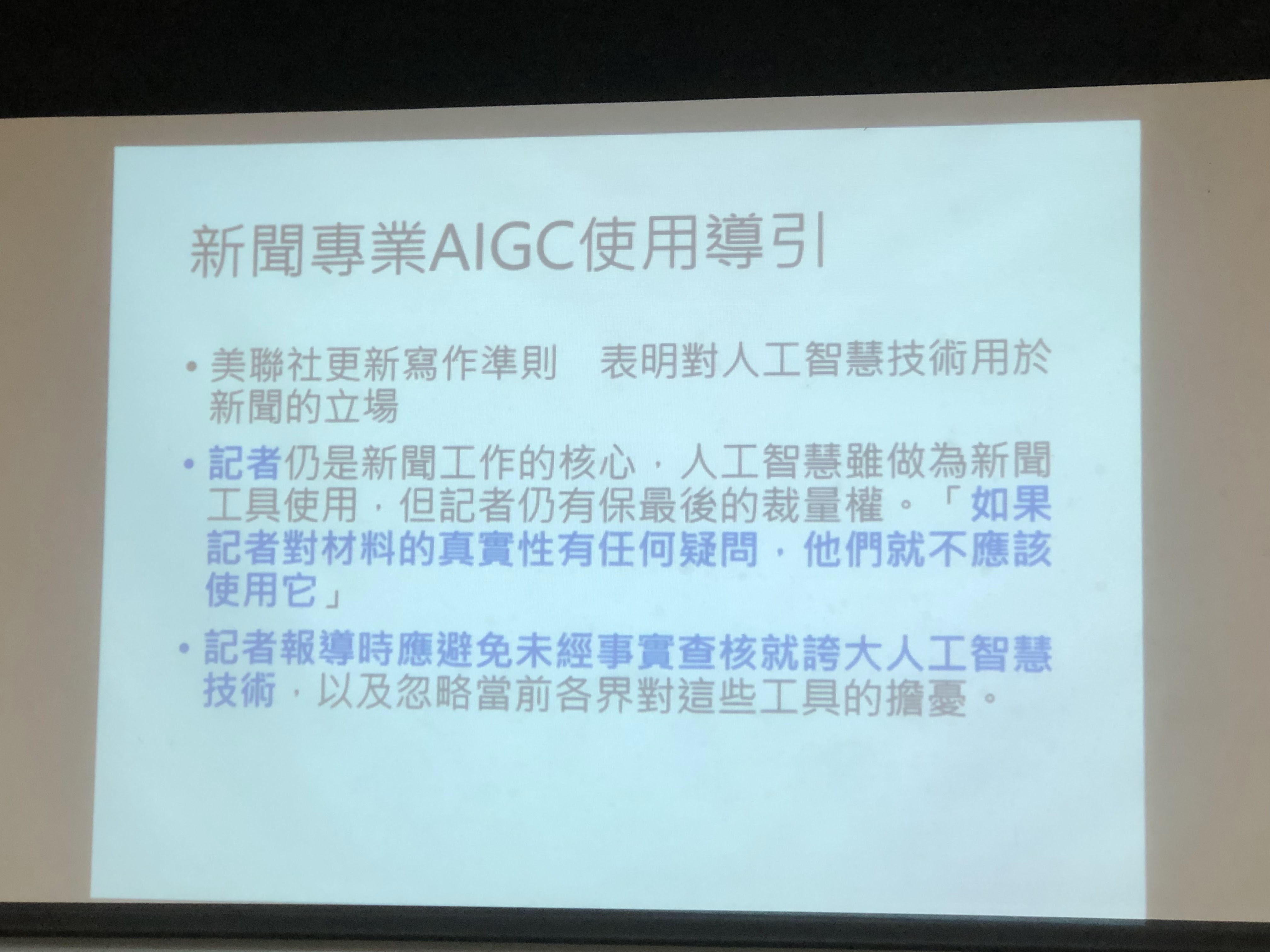
As an AI user, Professor Zheng suggested that everyone should have a concept of “taking responsibility” (https://www.managertoday.com.tw/articles/view/1932): “That is to say, whatever I use AI to do today, whether it is studying or working, if I make a mistake today, it will still be the same. Someone has to be responsible. For example, the Associated Press has clear guidelines for the use of AIGC. The attitude of all news work is that reporters are still the core of news work, so you can use AI as a tool, but reporters must retain the final discretion. This means that if you think it is problematic, then we should not use it.
She said earnestly: “In addition, we don’t need to over exaggerate AI technology, because AI is progressing very fast, and there are really not many people in the world who dare to say that they are AI experts. And because it is progressing really fast, please don’t over exaggerate it, and you must understand the hidden worries it may bring.” Professor Zheng divides the impact of AI on the humanities and society into three circles: “It can be viewed from the inside out, and many, many new research topics will emerge. For the inner circle, I think the emergence of AI is basically a new type of Cyborg(Cybernetic Organism). For example, the emergence of mobile phones is a cyborg phenomenon. But in the future, AI will not even have a small thing like a mobile phone attached to it. When this new cyborg appears, you will ask again: “What is the essence of AI?” and how will human cognition and thinking change because of it?
[ ](https://blogger.googleusercontent.com/img/b/R29vZ2xl/AVvXsEjnAhJ6Q1APNGbYkcqaCD5pcjYYfth3iQJmMRUurA_Z3prJm-kPdaH5hFeeUnbUHSO18X-dp_A0 EMMqrIjtqjbcjRgGd1_iPbvQ7dWOpxwXo8wy23h_LIfSkHcHkovtN8-KUc5AH-fA4w2cOtBeSMTaLmRW_CmdNKfmRmvfXW5LBbagCKlVUrwu_40QRDSC/s4032/IMG_7376.HEIC)
She mentioned that how people and AI work together may be a common problem in the field of communication. One is AI and communication, which can be divided into two types: purposeful and unconscious. Purposeful is like saying that I want to co-write an article with AI, and the unconscious part may also have many innovations, such as the possibility of integrating AI and VR, etc.
Professor Zheng put forward her macro views on the entire evolution process from AI to AIGC. Summarizing the sharing of this lecture, she believed that the emergence of AI will not only affect the overall interaction between technological civilization and the social environment in the future, but we may also see the emergence of some new ways of cooperation, and the impact and influence on the entire society will naturally be huge. At present, AI basically has no way to solve the problems of truth, goodness and beauty in human society. These are the parts for which we must seek truth from facts.
Regarding the content or art created by AI, is there any distortion and is it really beautiful? Professor Zheng feels that this part also requires people’s community consensus. However, AI will obviously touch on the aspects of reality and ethics in real society. In addition, in terms of governance, education and the entire system and regulations, including intellectual property rights and other issues, that is, the impact of AI on humanistic society requires us to have some new thinking and standards.


Further reading
📖 深入探索相關主題