Five key points for small and medium-sized enterprises to introduce AI: Don’t use AI for the sake of AI, pragmatic application is the way to go
🚀 This article was originally published in “Economic Daily
In an era when the AI wave is sweeping the world, many small and medium-sized enterprises are facing an embarrassing dilemma: on the one hand, the media, scholars, and experts continue to advocate that AI is the key to future competitiveness; on the other hand, blindly pursuing AI for the sake of AI often brings anxiety and waste of resources.
According to KPMG’s “Taiwan Industrial AI Application Trends and Outlook Report”, more than half of companies have begun planning or introducing AI, but only 12% have actually applied it to overall operations. What’s even more worrying is that 45% of companies regard talent shortage as their biggest challenge, and 42% complain that import costs are too high. This not only reflects the pain points of small and medium-sized enterprises in AI transformation, but also highlights that many business owners are worried about falling behind but don’t know where to start. As a result, they often invest in flashy tools that fail to produce actual value.
AI is not a panacea, it should be a tool to solve specific problems.
In fact, the challenges that small and medium-sized enterprises face in introducing AI include difficulties in data integration, unclear risk assessment, or conservative organizational culture. For small and medium-sized enterprises, making good use of AI technology to implement digital transformation can be said to be an important key to improving competitiveness.
Dutch Experience: AI Innovation Ecosystem in Small Steps
Take the Netherlands, which also has small and medium-sized enterprises as its economic main body, as an example. As a European innovation powerhouse, the Netherlands leads the EU average in AI adoption rate. The Netherlands has become Europe’s leader in AI, according to a survey by consultancy Consultancy.nl.
The Dutch government has proposed a vision of generative artificial intelligence, emphasizing cross-sector collaboration and the construction of an inclusive ecosystem. The country has been promoting the development of AI since 2019, connecting enterprises, academia and the government through the AI Alliance, providing free AI knowledge sharing platforms and innovation funds for small and medium-sized enterprises. Small and medium-sized enterprises in the country often start with a “small steps and fast” strategy, such as using SaaS-type AI tools to optimize supply chains or customer services, rather than building complex models from scratch. This not only lowers the threshold, but also allows small and medium-sized enterprises to see results quickly.
The secret for Dutch SMEs: Instead of building complex models from scratch, make good use of ready-made SaaS-based AI tools to see results quickly.
Dutch SMEs are also leading Europe in the development of AI automation, especially in the context of labor shortages, using AI to relieve manpower pressure; the government also provides tax incentives and subsidies to encourage SMEs to invest in research and development. This is something we can learn from.
The experience of the Netherlands shows that the introduction of AI must focus on differentiation, that is, adjusting strategies according to the size of the company and industry. For small and medium-sized enterprises in China’s manufacturing industry, this means using AI to improve efficiency, rather than pursuing advanced generative AI applications.
The Netherlands also attaches great importance to skills development and provides AI training through public-private partnerships to ensure that employees are not replaced but collaborate with AI. This approach is expected to solve the common problem of employee resistance in Taiwanese companies.
Swiss Experience: Balancing Technological Innovation and Ethics
Switzerland is another example. The country is famous for its precision manufacturing and financial industries and has a high proportion of small and medium-sized enterprises. Different from the market segmentation and focus of the Netherlands, Switzerland pays special attention to the balance between technological innovation and ethical norms in the development and governance of the AI field. Starting from 2025, we will actively promote the formulation and implementation of AI regulations, hoping to create a human-machine vision that takes into account humanity and technological innovation.
When it comes to the introduction of AI, Switzerland focuses on data protection and ethics, which is similar to the privacy regulatory challenges faced by Taiwanese companies. The country combines legal protection with technological innovation and advocates a people-oriented concept, which is worthy of reference for our country.
Chasing trends may not lead to success. The real key lies in prudent evaluation and pragmatic application.
Five key suggestions: Starting from pain points and moving towards smart transformation
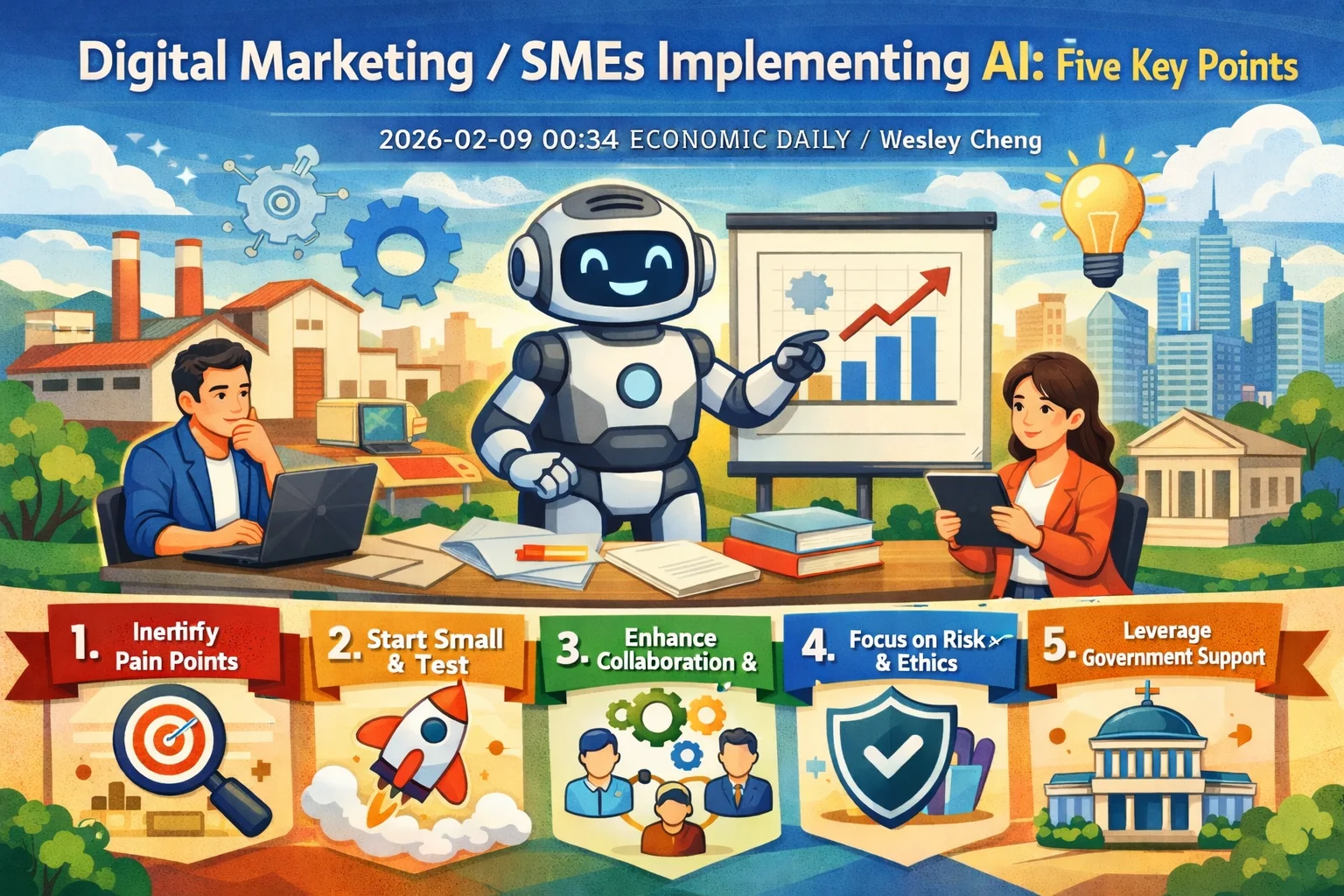
Drawing inspiration from the above-mentioned countries, my country’s small and medium-sized enterprises should avoid the trap of “AI for AI’s sake” and turn to pragmatic strategies. The following five key suggestions are provided for your reference:
1. Start from the pain points and formulate differentiated strategies
Don’t rush to follow suit just because everyone else is using AI. Let’s first take stock of where the company’s current biggest pain point is—is it poor customer service efficiency?库存管理混乱? Or is there a lack of precision in marketing placement? The best entry point for AI can be found by starting from the problems that really need to be solved.
2. Small-scale testing and gradual expansion
Rather than committing a large amount of resources all at once, start with a small proof-of-concept (POC). Select one department or product line as a pilot to verify that the AI tool can indeed bring benefits, and then gradually expand to other areas.
3. Strengthen cross-department collaboration and talent cultivation
AI onboarding isn’t just for IT departments. From decision-makers to front-line employees, everyone needs to have basic AI literacy. Through internal training and cross-department workshops, we can reduce the organization’s resistance to new technologies and truly integrate AI into daily operations.
4. Pay attention to risk management and ethics
When introducing AI, you must also pay attention to potential risks such as data privacy and algorithm bias. Only by establishing a clear data governance framework to ensure that the application of AI complies with regulations and corporate ethics can we enjoy efficiency improvements while maintaining corporate credibility.
5. Make good use of government and local resources
The Taiwan government has continued to promote AI-related policies and subsidy programs in recent years, and small and medium-sized enterprises may wish to pay more attention and take advantage of them. In addition, industry-university cooperation, joining industry alliances or participating in AI community exchanges are also effective channels for obtaining technical support and experience sharing.
Conclusion: AI is a problem-solving partner, not a source of anxiety
AI is not a source of anxiety, but a problem-solving partner. If our country’s small and medium-sized enterprises can learn from the innovation ecology of the Netherlands, the ethical balance and government support of Switzerland, and start from small steps, they will be able to avoid waste and move towards smart transformation.
AI is not a source of anxiety, but a problem-solving partner. Starting from small steps, we will be able to avoid waste and move towards smart transformation.
But please also remember that chasing trends may not lead to success. The real key lies in prudent evaluation and pragmatic application.
Extended reading:
- Lecturer’s Digital Asset Management Technique: Use AI to turn teaching experience into a compounding system
- Find your keywords: Use AI to hone the core elements of your personal brand
- When AI Meets Presentation: A Practical Guide to Rethink Your Workflow
External Resources:
- KPMG Taiwan Industrial AI Application Trends and Outlook Report
- Economic Daily original text
- Consultancy.nl
📖 深入探索相關主題