Sweden spends 100 million euros to buy back paper books: When digital advanced countries begin to reflect, what have we learned?
Today I saw a message on Threads, mentioning Sweden, announced a shocking policy shift: it will invest 100 million euros (approx. 16 billion yen) to abolish tablet computers and return paper textbooks to schools.
This news made me curious, so I checked online. It turns out that Sweden has allocated 60 million euros (about $65 million) as early as 2023 to reintroduce paper textbooks. By 2025, Sweden plans an additional €44 million (about $48 million). The goal is simple: ensure every student has a paper textbook for every subject.
Does more technology application mean better learning results? This is a question Sweden answered with real money.
Officials stress that Sweden is not abandoning technology but rather repositioning it as a tool rather than a preset option. Paper books will be given priority in basic learning, especially in reading comprehension.
It is true that Sweden remains one of the most technologically advanced countries in Europe. But its policy shift reflects a broader question that many countries are currently thinking about: Does more technology application mean better learning results?
This is not just a change of teaching materials, but a battle to defend values.
In my opinion, this is not only a replacement of educational equipment, but also a battle to defend the value of deep focus and fast information.
Sweden’s decision reminds me of an often-overlooked fact: technology is never neutral. Every tool implicitly shapes the way we think. When we hand tablets to our children, ostensibly giving them more resources, we may actually be handing over a ticket to a world of distraction.
Technology is never neutral. Every tool secretly shapes the way we think.
This coincides with the concept that I often emphasize to students in the class I teach AI Application at the university: the tool itself is not good or bad, the key lies in what mentality and strategy you use to use it?
We underestimated the tactile depth that paper brings
While digital devices are convenient, they are inherently leapfrog. Hyperlinks, push notifications, and sliding screens make the brain accustomed to fragmented reading, causing students to forget things quickly when processing long articles.
The Swedish Ministry of Education’s decision-making tells us that the sense of stability provided by paper textbooks, the spatial positioning when flipping through, and the brain-hand linkage when handwriting notes are cognitive processes that are difficult to replace with digital media.
According to Norwegian scholar Anne Mangen’s research, students who read paper books performed significantly better than students who used e-readers in ordering storylines and recalling details. This is because paper books provide a kind of tactile feedback - the thickness changes of turning pages, allowing readers to intuitively feel the reading progress, thereby strengthening memory.
The sense of stability provided by paper textbooks, the spatial positioning when flipping through, and the linkage of brain and hand when taking handwritten notes are cognitive processes that are difficult to replace with digital media.
This is not nostalgia, but scientific fact. As we pursue efficiency, are we sacrificing our ability to understand deeply?
The digital gap should not be filled by reading ability
In the past, we believed that “Everyone has a tablet” can shorten the gap between urban and rural areas, but real-life data shows that when children lose their in-depth understanding of text, digital tools become a distraction.
“Every student has a tablet” (formal name: Digital Learning Improvement Plan for Primary and Secondary Schools) is a four-year plan promoted by the Ministry of Education starting in 2022. It is expected to invest 20 billion yuan to achieve a goal of providing one tablet for each student in remote areas and according to the number of classes for students in non-remote areas, making tablets a teaching tool like a pencil case. This solution distributes devices including iPads, Chromebooks, Windows, etc., and is supplemented by a mobile device management system (MDM) to control student usage screens.
The former Swedish Minister of Education Lotta Edholm mentioned that “students need books”, which means that the essence of education should be to build a knowledge system rather than search for information. If even basic reading literacy is lost in the process of swiping on a mobile phone or tablet, the convenience brought by technology will become an illusion.
The essence of education should be to build a knowledge system, not to search for information.
This reminds me of something I often say when promoting content creation: It is becoming easier and easier to obtain information, but the ability to transform information into insights is becoming increasingly scarce. This ability of deep transformation is exactly what paper reading and handwritten notes are best at cultivating.
The bravery of science and technology is not to blindly pursue the new, but to know how to look back at the right time
Sweden does not completely deny digital education, but changes its positioning from core to auxiliary. This kind of courage to admit the side effects of excessive digitalization is worthy of our reflection.
In the pursuit of AI and smart classrooms, are we unknowingly sacrificing the space for children to think quietly and chew over knowledge?
The weight of books is often the weight of knowledge.
Sweden’s policy shift allows us to see that a truly advanced country does not blindly chase the latest technology, but has the ability to decisively lead the next generation back to that quiet, ink-scented desk when technology gets out of control.
This is consistent with what I wrote in “Digital Complications: Is Google Making Us Dumb?” ](/blog/digital-complications-is-google-making-us)》The point of view discussed in the recommended preface of this book is the same-technology has given us unprecedented convenience, but we have also unknowingly outsourced the ability of deep thinking to algorithms.
A truly advanced country does not blindly chase the latest technology, but has the ability to decisively lead the next generation back to that quiet desk when technology gets out of control.
Looking at Taiwan’s educational technology path from Sweden’s experience
Sweden’s story holds a mirror up to Taiwan. Our “Everyone has a tablet” policy has invested 20 billion yuan, which is a staggering budget. But the question is not how much money to invest, but whether we have thought simultaneously:When tablets enter the classroom, will the quality of reading literacy improve?
A few questions worth pondering:
- Does the tablet really shorten the gap between urban and rural areas? Or does it just give kids another device to play games on?
- Do teachers have sufficient training in digital teaching? No matter how good the tool is, if the user doesn’t know how to use it properly, the effect will be compromised.
- What are the metrics by which we measure effectiveness? Is every student having a tablet, or is there a significant improvement in students’ reading comprehension?
I don’t think Taiwan needs to copy Sweden’s approach, but it needs to learn from Sweden’s spirit—to conduct an honest review of the effects of policies instead of taking something done as a good one.
Conduct an honest review of the effectiveness of policies, rather than taking a good job as a good one.
Make good use of technology instead of being kidnapped by technology
At this point, you might think I’m going against technology. Quite the opposite.
As someone who works with AI tools every day, I deeply understand the tremendous value that technology brings. I use AI to assist research, use digital tools to manage knowledge, and use Vibe Coding to quickly create product prototypes. Technology is an integral part of my workflow.
But here’s the key:I’m using technology consciously, not being led by technology.
For adults, this kind of consciousness may be relatively easy to cultivate. But for developing children, their noreferrer”>The prefrontal cortex (the brain area responsible for self-control and concentration) is not fully developed, and it is almost an unreasonable expectation to ask them to stay focused in a digital environment full of temptations.
Technology should be a tool we use consciously, not a yoke that hijacks our attention.
 ▲ From paper knowledge to digital products, Vibe Coding helps you build that bridge with AI
🚀 Want to use AI to create your own digital products?
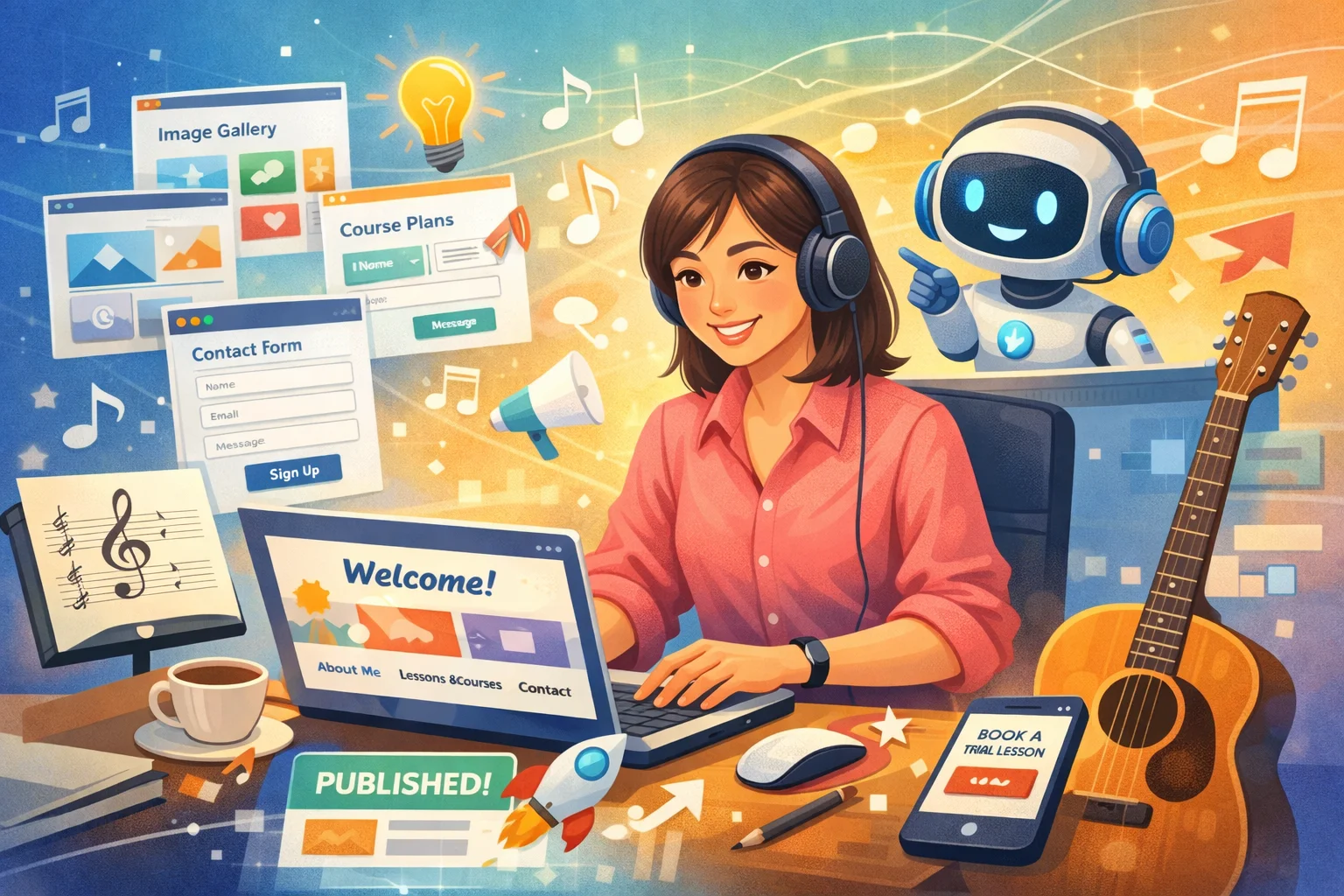
You don’t need to be able to write programs, you just need to be able to “speak” your ideas. In the Vibe Coding Practical Workshop, I will take you step by step to start from scratch and use AI to turn the ideas in your mind into truly operational websites and tools.
Whether you want to build a personal brand official website, develop an online course platform, or create an exclusive AI gadget - this class can help you take the first step.
Find the balance between technology and learning
The Swedish case reminds us that the core of education has never been the tools, but the learning itself.
Whether it is paper books, tablets, or AI teaching assistants, they are just carriers of service learning. What really matters is: have we helped the next generation develop the habit of in-depth reading, the ability to think independently, and the literacy to transform information into wisdom.
As I emphasized when talking about Unbeatable System in the AI Era: Tools will be iterated and platforms will disappear, but your thinking ability and knowledge system are assets that you can always take with you.
Tools will be iterated and platforms will disappear, but your thinking ability and knowledge system are assets you can always take with you.
Next time you see your child swiping away at their tablet, think about this Swedish decision. Then, hand him a book.
Extended reading:
- Stop chasing tools! Build your own “unbeatable system” in the AI era
- When AI not only helps you write, but also helps you research, format and publish: the content production line I created with Claude Code
- From lightning writing camps to brand resonance: How to build an influential reading community
- Refuse to be a digital tenant: Why do you need to use Vibe Coding to build a digital headquarters in 2026?
External Resources:
- Sweden is investing over 100 million to swap classroom tablets for traditional textbooks
- Ministry of Education’s “Digital Learning Improvement Plan for Primary and Secondary Schools”
- Lotta Edholm — Former Swedish Minister of Education
📖 深入探索相關主題