From network thinking to linear expression: The hardest part of writing is not putting pen to paper, but turning ideas into a path that readers can follow.
I have always felt that the most torturous part of writing is never not being able to write, but that you have so many ideas in your mind but don’t know where to start?
Well, I know that it is a very special kind of frustration: you clearly know that you have experience and opinions, and even the cases are in your mind, but as long as you open the file and watch the cursor flash, you will start to doubt your life - not that you don’t work hard enough, but how to turn these things into an article?
The dimensionality reduction journey of network thinking
Steven Arthur Pink is a Canadian-American experimental psychologist, cognitive scientist and popular science writer. Pinker’s words almost clearly explain the pain points many people have had with writing over the years:
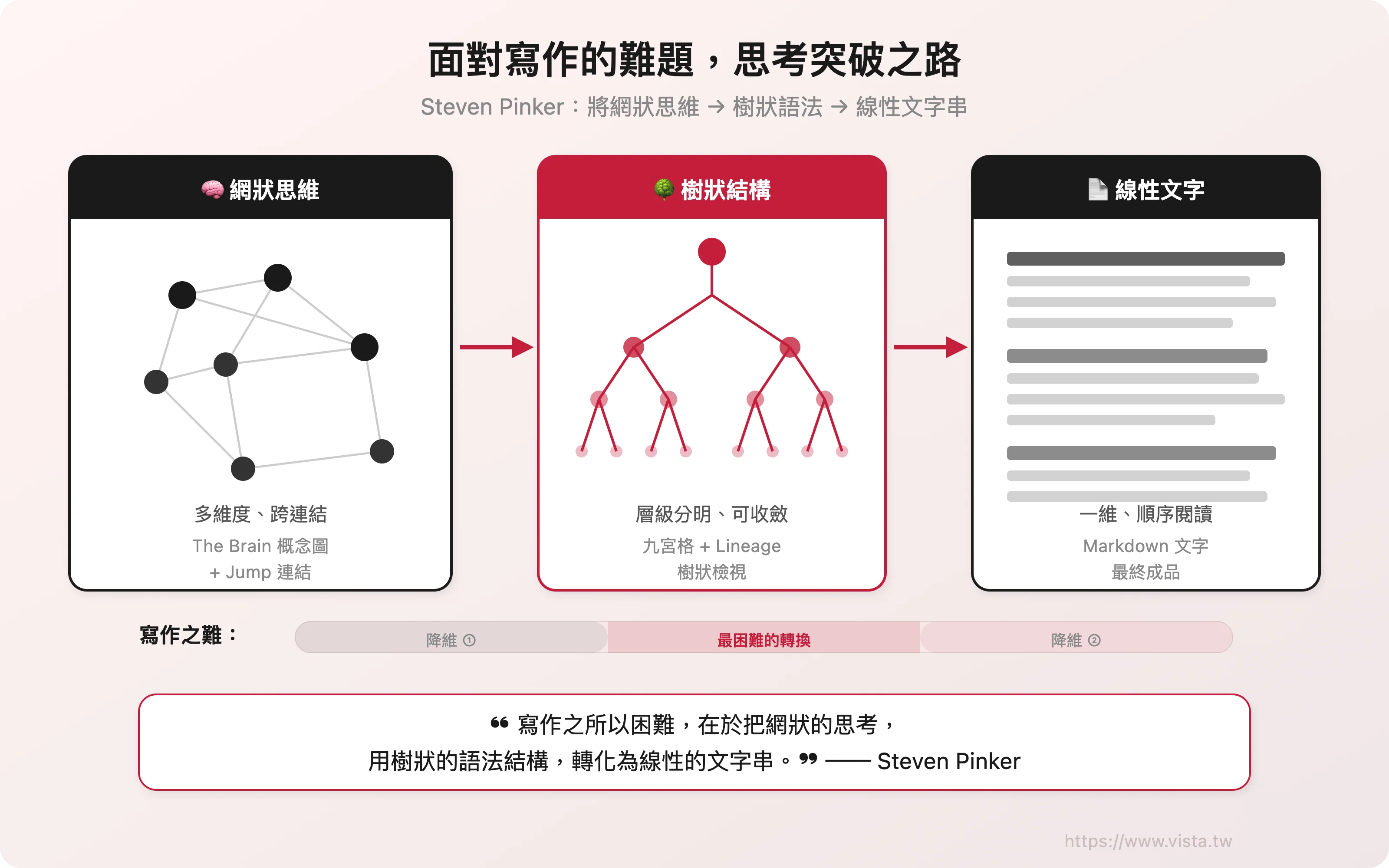
The reason why writing is difficult is that we have to convert network thinking into a tree-like grammatical structure and finally into a linear text string.
This transformation is essentially a dimensionality reduction. The ideas in your mind shine at the same time like a constellation, pulling and echoing each other; but the article you hand out must be laid out section by section like a road, so that readers can follow it, and feel smooth and comfortable when they reach the end!
However, here is the problem: our thinking is a network, but the reader’s reading is a line. If you forcefully throw the entire website to the readers, the readers will not appreciate your deep thinking. They will only think that you are showing off your skills, going around in circles, or talking about a lot of things without getting to the point. Therefore, many people are stuck in writing, not because of their ability, but because of the conversion process. To put it more bluntly, in fact, it’s not that everyone has no ideas, but that they lack the path to turn their ideas into readable ideas.
The more professional the person, the easier it is to get stuck.
For me, I have been engaged in content teaching, in-house training, consulting and writing work for so many years. The phenomenon I see most often is actually the same: the more professional a person is, the easier it is to get stuck in this place. It is easier for a beginner to write, because he only needs to worry about one or two points and can write along intuitively; but a really good person has too many points, too many relationships, too many exceptions and contexts in his mind at the same time. As soon as you start writing, you can’t help but want to add; as soon as you add, you can’t help but add more; in the end, the article is like a net with no edges, the whole net is stretched very wide, but there is no backbone. When readers walk in, it is like walking into a forest without signage. There are many trees and the surrounding light is beautiful, but it is easy to get lost while walking.
Therefore, what I want to talk to you about in this article is not “How to write better?”, but something more pragmatic: How do you turn the network thinking in your mind into a tree, and finally pave a path that readers can complete. Because this is the real way to breakthrough.
The charm and limitations of network thinking
Well, let’s start with “net”. Network thinking usually has two characteristics: first, it is cross-connected; second, it is established simultaneously. For example, when you think about “Does AI make writing easier or more difficult?” your mind will jump out at the same time: tools bring efficiency, but also bring homogeneity; content production capacity increases, but the cost of trust increases; writing is faster, but it does not mean writing is deeper; readers are more picky, and platforms prefer rhythm; your own role changes from author to curator, coach, and director.
Having said that, these points are not linear 1, 2, 3, but affect each other: efficiency and depth pull each other, speed and style conflict with each other, and tools and trust are a new set of tensions.
Honestly, that’s the beauty of network thinking: it’s closer to the real world. The real world is not linear, and people’s decisions are naturally not made according to the rules. For example, if you are an investor with a large amount of money, when you are looking at a case, you will not just look at one aspect: you will look at the people, the system, the resources, the timing, and the wind direction at the same time. The more professional you are, the denser the network will be and the more connections there will be.
However, readers are not looking at the entire web in your mind. Readers are here to be taken along by you. The reason is simple, because reading is a linear experience: he will start from the first paragraph and go down the second and third paragraphs. Even if he is smart, he still needs you to provide road signs; even if he is patient, he still wants you to save him effort. All this also explains why many articles written by experts are evaluated as “very informative, but difficult to read”: because the author directly outputs network thinking into text, without doing the most critical conversion in the middle, that is, turning the network into a tree.
Tree Structure: The Art of Convergence
As for the tree, what is it? The essence of the tree structure is not only clear hierarchical structure, but also has convergence properties. It’s not about making things less, it’s about layering things. You can still retain the richness, but you have to decide: which one is the backbone? Which ones are branches? What are leaves? Which leaves can not grow first? The web in your mind can be very luxurious, but the tree of the article must have a backbone, otherwise readers will not be able to grasp the focus.
When I am engaged in internal training in enterprises, I often use a very intuitive metaphor to explain to everyone: there are people speaking in the online conference room at the same time, and many voices are reasonable; the tree-image host converges the voices into an agenda, deciding to talk about A first, then B, and finally converges to conclusions and actions. The real difficulty is not having too few ideas, but when you have too many ideas, can you control the overall situation?
Writing is actually a kind of decision-making. You have to decide what to leave out, what to postpone, what to just hint at, or what to delve into?
I want to remind everyone that there is a reality that many people ignore: writing is actually a kind of decision-making. You have to decide what to leave out, what to postpone, what to just hint at, or what to delve into? The less you dare to give up, the easier it is for the article to become a bunch of noise; on the contrary, the more willing you are to make decisions, the easier it is for the article to be fresh and refined, and become a valuable work. Therefore, the maturity of writing often does not lie in how much you can stuff in, but in whether you dare to leave the most important thing behind?
From tree to line: the rhythm of laying out
However, the tree is not the end yet. The tree structure is only “writable”, and the lines are truly “readable”. After many people create a tree structure, the article is still difficult to read because they have only organized it but not laid it out. The so-called organization means putting things into the correct drawers; and layout means that when readers enter the house, they will not get lost and feel that they are being taken care of properly.
Linear text strings are most afraid of two things: one is jumping, and the other is looseness. A jumping article is like you were suddenly teleported while walking on the road: the previous paragraph was still talking about AI tools, and the next paragraph suddenly started talking about the education system. The author knows the link in your mind very well, but the reader does not have that network, so he will only think that you are skipping a needle. Have you ever seen an article with a loose structure, like you are walking on the road and seeing beautiful scenery, but you don’t know where you are going? I can read every paragraph, and it seems to be pretty good, but there is no sense of direction. In the end, readers don’t know what they will get after reading it.
Therefore, the key to laying out trees into lines is not just to arrange the paragraphs in order, but to design a psychological rhythm that suits the readers. Do you want him to know where he is as he reads each paragraph? For example: What did I just understand, what do I want to get into now, what will I get after waiting? This is not a routine, but a form of respect. A well-structured article is actually very much like an instructionally designed course: you wouldn’t let students not know where this class is going to take them in the 30th minute? You wouldn’t just throw out the conclusion suddenly in the last five minutes and ask him to swallow it.
Writing is not about pouring out all the knowledge in your mind, but about bringing the reader along.
I often say that writing is not about pouring out all the knowledge in your mind, but about bringing the readers along. Bringing it up means that you have to arrange a climbable slope for him. If the slope is too steep, he will not be able to climb; but if the slope is too flat, he will feel bored; only if the slope is just right, he will become addicted.
Four practical ways to transform your mind
So, what’s the real way to break through? Next, I would like to share some of my most commonly used and most effective ways to transform my mind.
Tip 1: Find your roots
The first thing I recommend is to ask yourself a very cruel question before writing:
If there is only one sentence left in this article, what is that sentence?
This sentence is not a title or a slogan, but the core insight you really want to deliver to your readers. Of course, you can think of it as the roots of a trunk. When you have tree roots, all your branches and leaves will automatically know where to grow?
The reason why many people’s articles feel scattered is because they think they are writing an article, but in fact they are writing a bunch of related ideas. Correlation is merely a network of connections, not a thematic convergence. So, you have to converge the net into a tree.
Tip 2: Replace knowledge with scenes
The second method is to change what you want to say into a scenario that readers will encounter. When I was engaged in consulting work, I was especially able to feel this difference: experts easily start from their own knowledge structure, as if opening an encyclopedia; but the reader’s needs start from his situation, and many times it is more like looking for an escape route. Therefore, if you write in an encyclopedia style, no matter how correct the content is, the reader may not buy it; on the other hand, if you write in an escape route style, even if you only talk about a short paragraph, he will feel that you saved him!
Well, let’s take a case that I often use: When we are also talking about the phenomenon of writing stuck, you can start from the theory and talk about how the brain processes information, language generation, and cognitive load. These are all correct. However, you can also start from a real scene: at 11 o’clock in the night, you turn on the computer and there are obviously a lot of things in your mind, but you can only write “I want to share with you today.” When readers see this sentence, they will first chuckle, then nod, and finally be willing to continue reading.
The reason is very simple, because you are not talking about theory at this time, you are talking about his current life. When the reader is willing to continue reading, you have the opportunity to take him to the theoretical section.
Tip 3: Deliberately arrange convergence points
The third approach is to deliberately arrange convergence points in the article. I know that many people don’t like to be told “to draw conclusions” because they think the world is very complicated and the conclusions are rough. But you don’t have to be rough, you just have to be restrained. Convergence is not about simplifying the process, but about managing complexity into something that readers can absorb. Therefore, you can quietly make a small convergence at the end of each paragraph: use one sentence to bring the meaning of the paragraph back to the main stem. This sentence is not a mechanical one like “so…”, but like when you are chatting with a friend, you gently remind him that “what we just talked about actually refers to this matter.” This small convergence will allow the reader to establish road signs in his mind, which can help him move more steadily.
Tip 4: Write action suggestions as conceivable next steps
The fourth approach is to write action suggestions as conceivable next steps. To be honest, as I get older, I no longer believe that writing down a list of ten suggestions can change people. The reason why people change is not because they see these golden sentences, but because they see pictures of what they can do. A truly effective action suggestion is when you ask the reader to rehearse it in their mind: What can I do when I turn on the computer tomorrow morning? What can I do first when I get stuck next time? How can I use a little trick to restart myself.
Just like when I was in Vibe Coding Practical Workshop recently, I took the students to practice together. Only by truly practicing can the rewards be real.
The most pragmatic action: outsource the network first
So, if you ask me: What is the most pragmatic action to turn the net into a line? I would say, you can start by “outsourcing the network first.” In other words, don’t force yourself to write the net directly as a line from the beginning. You can first spread out the net in the way you are accustomed to - such as using mind maps, sticky notes, voice, etc. to pour out your ideas, and use any method that allows you not to be tied to a linear line. Next, what you have to do is not to write an article immediately, but to act as a host: select the trunk and determine the level of the tree. Finally, you lay out the trees into paths and arrange the reader’s pace.
This process may sound like one more step, but it actually saves time. Because you save yourself the waste of circling around in a document, deleting and rewriting, and writing something and then feeling it’s not right. The real waste of time in writing is not that you are slow, but that you get lost. As long as you don’t get lost, your movements will naturally be fast.
In the AI era, “turning the Internet into a road” is more important
Having said that, I also want to bring this matter back to the larger trend: Why is it more important to “turn the Internet into a road” in this era of explosion of AI tools and excess content production capacity?
因为,AI 工具固然能让每个人都能顺利生成文字,但不是每个人都能够生成可读的路径。 AI can help you write sentences smoothly, complete paragraphs, and adjust your tone to a decent tone, but it is difficult for it to make real decisions for you: What is your main focus? Who are your readers? Where will your article take him? What do you have to give up to let him go? These are not questions of language but of strategy; not of grammar but of structure; not of tools but of the author’s judgment.
Well, this also explains why I have always believed: Writing skills in the AI era will not depreciate, but will be upgraded. In the past, you could write articles fluently, even if you had the ability, but now your fluentness is just passing the exam, which means you are at the starting line like everyone else. In the past, you could win as long as your layout was beautiful, but now you only get basic points for being beautiful. What can really widen the gap is whether you can design a path that allows readers to walk to the end and be willing to turn around and share after finishing the journey?
The idea is your asset, but the delivery is your work.
The core of this path is what I want to remind everyone: writing is not about printing the net, but translating the net into trees and then laying the trees into lines. This is a kind of consideration for readers and an exercise for yourself. Every time you make a switch, you’re training yourself to move from “having ideas” to “delivering value.” In other words, the idea is your asset, but the delivery is your work.
For you who are stuck
If you are stuck at this moment, I want to give you a very pragmatic consolation: it’s not that you can’t write, you just haven’t mastered the trick yet and can’t turn the net into a road. Your difficulty is probably not that you have no ideas, but that you lack a relay station for conversion.
So the next time you turn on your computer and the flashing cursor annoys you, don’t rush yourself into writing the perfect first paragraph. You can first allow yourself to spread the net and release all the connections in your mind. Then, take a deep breath and return to that cruel but valid question: If I could only leave one sentence, what would I leave behind? When you find that sentence, you find the roots; with the roots, you can grow the trunk; with the trunk, you can pave the way.
A breakthrough in writing is not about praying for inspiration to suddenly come to you, but when you are finally willing to make the most difficult transition.
A breakthrough in writing is not about praying for inspiration to suddenly come to you, but when you are finally willing to make the most difficult transition. The transformation that transforms network thinking into a linear path that readers can walk through.做得到的人,不只写得出文章,也写得出影响力。
And I believe that you will be the one who can do it. Because the web in your mind is inherently beautiful. You only have one last small step left: turn it into a road so that more people can walk in and see the world you see.
Extended reading:
- How to improve your writing skills? Please develop three abilities first
- When AI Becomes My Editor: How a creator used AI to revive content plans that had been shelved for years
- Make good use of mind maps to plan writing structure
- Content creation starts with thinking, observation and lots of practice
- Let AI become a thinking partner, not just a machine that produces answers
External Resources:
📖 深入探索相關主題