AI Board Method: A set of dialogue methods to make your thinking more clear
I recently discovered something very interesting and cruel: the longer you chat with an AI, the easier it is to have the illusion that “I seem to be thinking.”
Yes, it can return you quickly, smoothly and comprehensively; if you ask, it will give you three plans, five options and seven suggestions. As you nod, you feel that you are very efficient, and you can’t even help but think: Wow, have I taken a big step forward in this way?
But the moment you close the conversation window, you suddenly realize that your mind has not become clear.
You know very well that you are just pushed along by a series of beautiful answers, but you are not really forced to think by anyone. What is missing?
That’s right, it just lacks brainstorming and thinking collision.
The moments when we truly become lucid are rarely when we hear the right answer; more often when someone politely asks, “Are you sure?”
That sentence is like a needle that quickly pops your bubble of reasonableness. You are forced to look back and check: Do your assumptions hold true? Are the definitions consistent? Is it mixing two different things together? Is it just using a nice word to cover a hole that you didn’t think clearly?
That’s why I’ve recently started having a new conversation: Instead of treating AI as an advisor or helper, I’m bringing it to the table and making it a member of my board of directors.
A very embarrassing truth: Halfway through MVP, I admitted that I had not thought clearly.
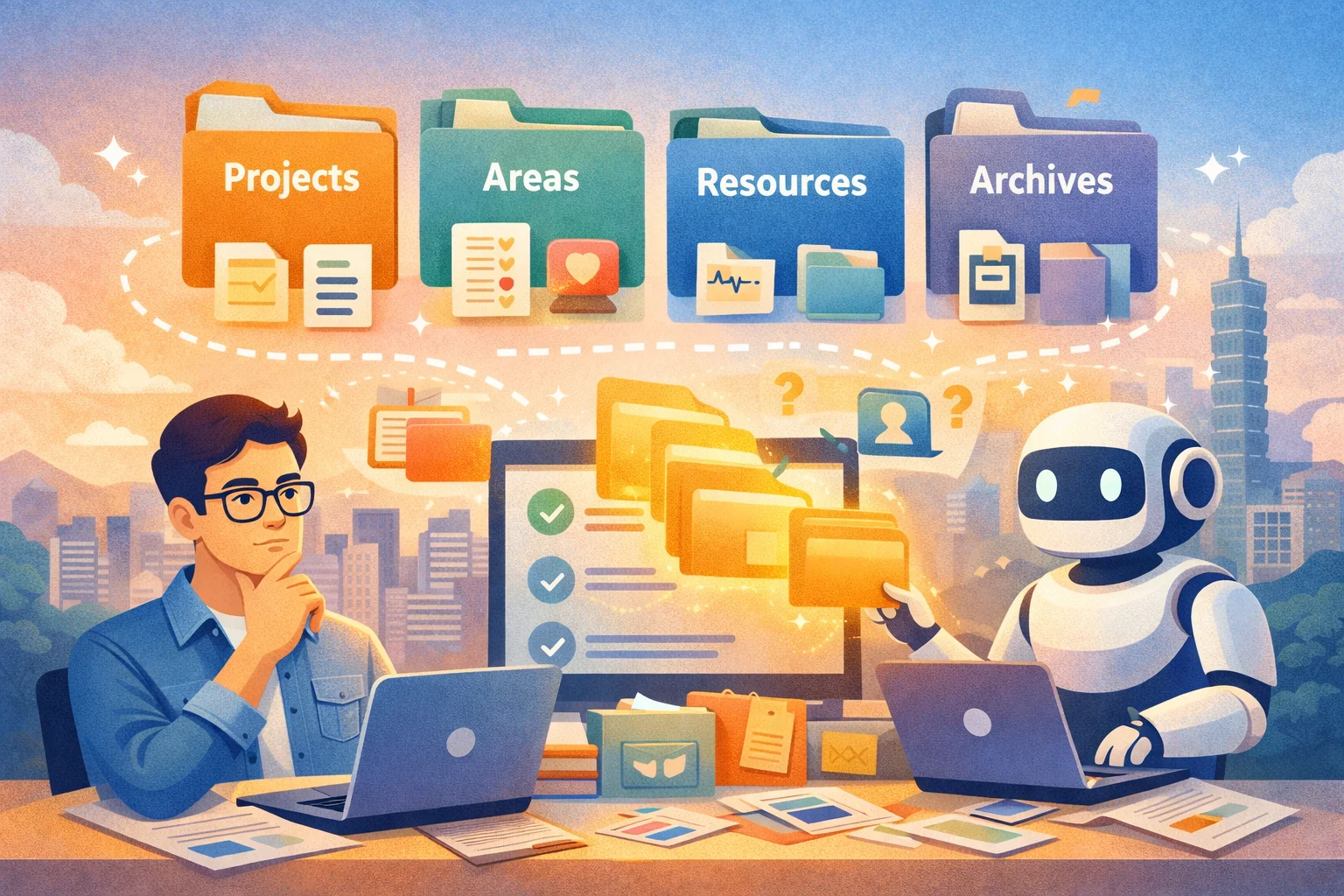
I’m currently using AI to collaborate on the development of a knowledge base system - you can think of it as my “Second Brain” prototype: integrating book reading, note management, project tracking and material archiving. I was originally very excited, thinking that with all the features added, I would be able to develop an MVP very quickly.
But halfway through, I encountered a very embarrassing but also very common problem: the system has more and more functions, but the architecture becomes increasingly blurry.
What is a project? What is material? What counts as output? What is the relationship between them?
I use this “collect → organize → output → archive” process tomorrow and every day, but when I try to translate it into a product architecture, I can’t tell clearly: is it differentiated by data type? Divided by workflow? Or distinguish by view? Or is it still based on authority and management logic?
What’s worse is that the less clear I am, the easier it is to fall into a dead end and develop a patchwork product: add a button where it’s not smooth, add a state where it’s not enough, and add a label where it’s confusing. It looks like it is solving a problem, but it is actually using functions to cover up conceptual emptiness.
So, the other day I decided to stop running away from this design debt. I told myself: If we don’t clarify the noun definitions and system logic today, it will be a waste no matter how many functions we do tomorrow.
Then, I did something I had rarely done before: I asked the AI not to act like one person, but to act like a group of people.
The idea is simple: stop treating AI as an encyclopedia, let it act as your opposition
The way most people use AI is as a faster search engine and a smarter encyclopedia. In other words: when I have any questions, you have to answer them right away.
But this kind of interaction naturally tends to slide into a smooth situation - so smooth that you think you understand, so smooth that you are not challenged, and so smooth that your blind spots are gently let go.
My approach this time is just the opposite: I hope it doesn’t go well, I hope it’s difficult, I hope it’s like the board members in those movies who don’t pretend to be pretentious and don’t even give you face.
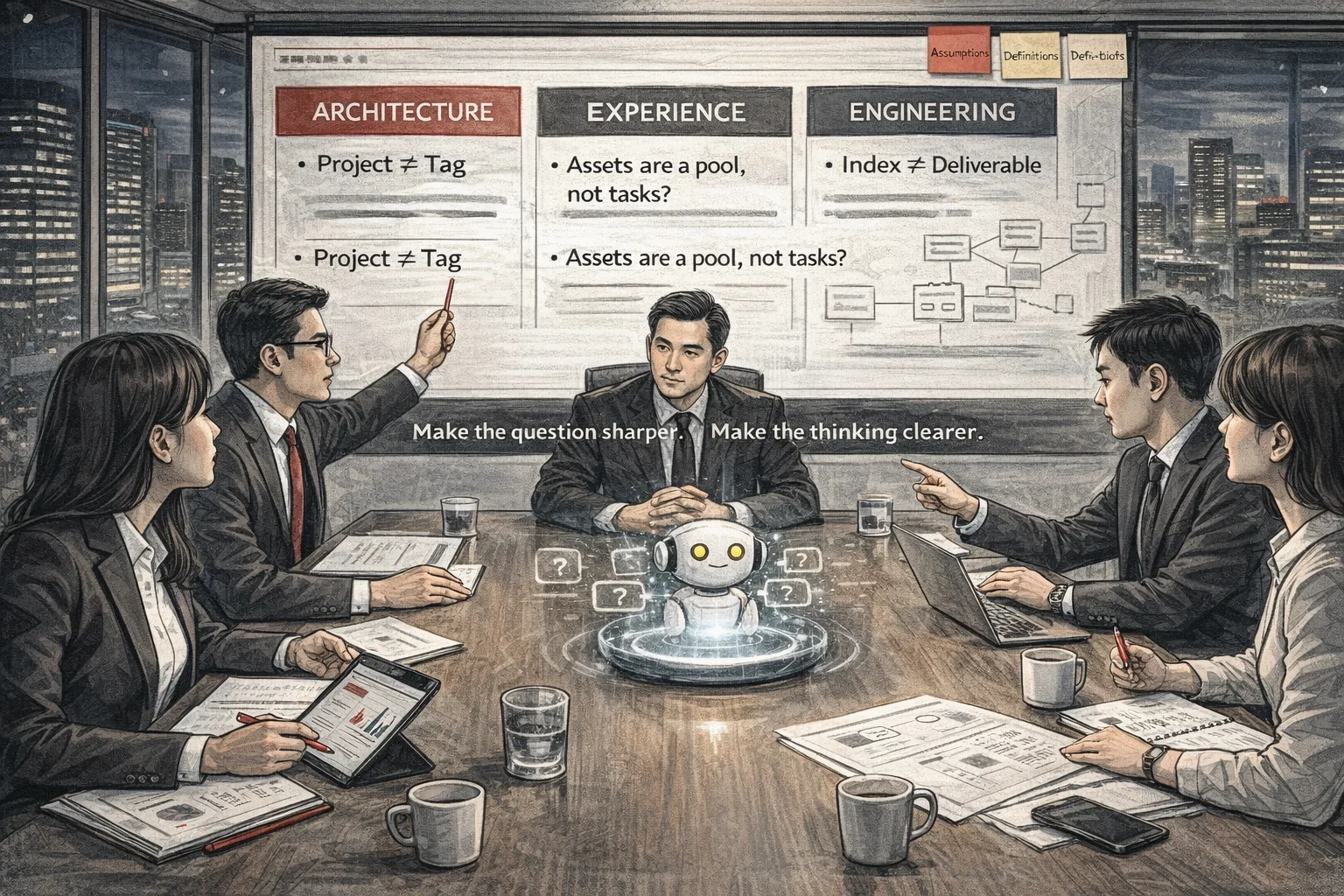
Therefore, I let it play three types of people at the same time: the architectural group, the experience group, and the technical group.
- Architecture School focuses on your boundaries and definitions
- Experiencers only ask you “Do you really know how to use it like this?”
- Technical School specializes in estimating “Will there be any risk if you do this?”
And what do you really want? In fact, it is not three suggestions, but three very different pressures.
When pressure comes, you can’t be vague, you can’t be lazy, and you can’t mutter to yourself, “Probably, almost.” You have to clear up all the fog in your head and explain everything clearly.
This is the most fascinating thing about the “AI Board of Directors Method”: it does not give you the answer, but pushes you into a state where you must think clearly.
How I was forced to wake up: Three key debates that made the architecture grow a skeleton
**The first question pursued by the board of directors is “What exactly is the project?” **
I originally thought that projects were just categories. Tags or folders would work anyway. As a result, the architect asked me the first sentence: “The project you are talking about is a data type or a view filter?” I answered “more like a view” because a piece of material may be referenced by multiple projects at the same time.
The experientialist immediately asked, “Then what’s the difference between it and ordinary labels? Why do you want to make it a separate project?”
Ugh, my head was instantly in knots. Because if it’s just a label, then I’m really just renaming something old.
The technical guy added another punch: “What about changing the name? Do you want to change the labels on all the files? Who will do the data migration?”
At this point in the board meeting, I finally admitted: projects are not labels. A project is a core object that needs to be managed by the system. It must be managed, renamed, counted, and referenced.
Therefore, I finally decided to use frontmatter’s exclusive project field (or project id) to implement it, making the project a system-level capability rather than text scattered on the document.
**The second thing that was demolished was the “material state” that I was originally very proud of. **
I want the design materials to have “processed/pending”. Well, that sounds pretty orderly, right?
But the experience school only asked coldly: “When will you look at the material, whether it has been processed or is to be processed?” I thought for a long time, and the answer turned out to be: almost never.
The architects added a judgment that I still find beautiful: “The value of materials only becomes meaningful when they are quoted and connected; therefore, the status should be left to output and progress.”
At that moment, I was awakened: materials are not task lists, materials are resource pools. You don’t ask the resource pool “Are you done?”
So I removed the status from materials and changed it to output and project progress. The entire system was instantly clean and reasonable.
**The third most critical thing is “Does the project master document count as an output?” **
Originally, I regarded it as a type of output. As a result, several members of the board of directors asked me: “If it is an output, how many outputs can a project have?” I said a lot. Then it asked: “Then what is the difference between it and other outputs? What is the necessity of its existence?”
I finally figured it out: the project master file is not a deliverable, it is actually an index. Its purpose is to give me a quick overview of the whole picture—goals, materials, progress, links, and next steps.
In other words, it is a map, not an outcome.
You see, these conclusions did not come from inspiration, but grew up bit by bit in the process of being questioned, refuted, and forced to explain clearly.
Here comes the key point: How can you apply the “AI Board of Directors Method” to your work and life?
If you are working on products, writing, course design, or making career decisions, or even planning a research topic for an academic paper—anything that requires clarification of ideas, you can use this method. Its real value is that it allows you to quickly accomplish three things:
**First, nail your “noun” tightly. **
A lot of confusion is not because you don’t work hard, but because you keep thinking in vague words. Projects, materials, outputs, strategy, positioning, and audience—they all contaminate each other as long as you don’t clearly define them.
**Second, dig out your “hypotheses” hard. **
You think you are discussing solutions, but in fact you are protecting assumptions. The task of the board of directors is to identify the hypothesis and ask you without reservation: What are the conditions for this hypothesis to be true? Where does it fail? Why do you believe it?
**Third, make your “choices”. **
Many people get stuck not because they don’t have options, but because they don’t want to make the choice. Those on the board are going to push you to take responsibility: Do you want consistency? Want intuition? Want speed? To be maintainable? Yes, you can’t have them all.
Action plan: 15 to 30 minutes per round for best results
You just need to follow these four steps:
1. Choose three characters first (no more than three)
Architectural school/Experiential school/Technical school are universal; you can also change to “Market school/Content school/Financial school” or “Academic school/Method school/Practical school”.
2. Throw out your questions and your current first draft ideas
The point is to have your version and don’t just throw out an empty question or the conversation will diverge.
3. Ask them to only ask questions and doubts, and don’t give conclusions yet
What you want is questioning, not comfort, and not full emotional value.
**4. Make a summary every three rounds: What is the consensus? What are the differences? What’s the next assumption to clarify? **
If you want, I even suggest you add a sentence at the end:
“Don’t cater to me, don’t comfort me, your job is to force me to speak clearly.”
This sentence will instantly freeze the atmosphere of the whole meeting and make you feel like a real gun.
Write at the end: You think you want answers, but actually what you want is to be forced to grow.
I believe more and more that the most powerful thing about AI is not to provide answers, but to force you to sort out your messy thoughts.
If you just treat it as a search engine, you will only get a bunch of complicated information; if you treat it as a member of the board of directors, you will have the opportunity to gain business wisdom and judgment.
Judgment is rarely something that develops in a comfortable state. It usually takes shape when you are pressed until you are speechless, questioned until you frown, or forced to rewrite the definition.
That being said, if you’re stuck on something today—whether it’s product, writing, career, or research—I’d like to invite you to do something simple that might change the quality of your thinking:
Give yourself 30 minutes today, bring AI to the table, and let it be your board. Instead of asking it what to do, let it ask you first: “What are you doing?”
You will be surprised to find that many things you think are difficult problems are actually just things you haven’t explained clearly. And when you finally speak clearly, the path will appear.
Further reading
- When AI Becomes My Editor: How a creator used AI to revive content plans that had been shelved for years
- Anytype + Claude: Create an AI-driven second brain to make your notes come alive
- When AI makes answers cheap, what’s really valuable is whether your questions are accurate enough
- Stop “reading hard”, AI is rewriting your reading efficiency and knowledge absorption method
- A cruel watershed in the AI era: Why has the income of 95% of freelance workers been cut in half, while the income of 5% has doubled?