Stop Using AI as a Q&A Machine: How a Five-Layer Content System Keeps a One-Person, Multi-Platform Operation Running

In the past six months, whether it is in-house training or one-on-one consultation, one of the questions I am most frequently asked is this:
Teacher, I pay hundreds of dollars every month and subscribe to both ChatGPT Plus and Claude Pro. Why am I still tired of producing content? Every time I change the platform, I have to rewrite it, and the things written by AI always read smoothly, and they don’t look like me at all.
People who ask this question are usually very serious. They thought of a good topic, opened the browser to check the information and compared the numbers, and two hours passed. Then they changed the prompt back and forth in the dialog box, and finally produced a long article. Then they turned around and thought about changing it into a Facebook post, an e-newsletter, and a short video script. They were already exhausted.
My opinion is that the problem is not that the AI is not strong enough, nor is it that you are not working hard enough. What’s really stuck is that you’re still just asking and answering questions, and haven’t built a stable content production line for yourself.
I have been writing for more than thirty years and published twenty-one books, ranging from print media and digital media to generative AI. The title has changed several times over the years, but one thing has never changed: typing and moving are physical tasks, and thinking and taste are the core values. A good content system will not replace your thinking. Its task is to give you time back so that you can concentrate on saying what only you can say.
In this article, I will lay out the five-layer architecture that I use every day, and also attach an exercise that you can do after reading it.
Starting from scratch every time, this is how the production capacity is exhausted.
The way many people use AI is a bit like walking into the same no-menu restaurant every day and saying to the chef: “Cook me a delicious dish.” Go in the next day and say it again. The chef will never remember what you liked to eat last time, so you have to tell the taste again every time.
Each input is an independent event, and each output requires you to recalibrate the tone and format. This kind of single-point usage will reduce your production capacity along the way:
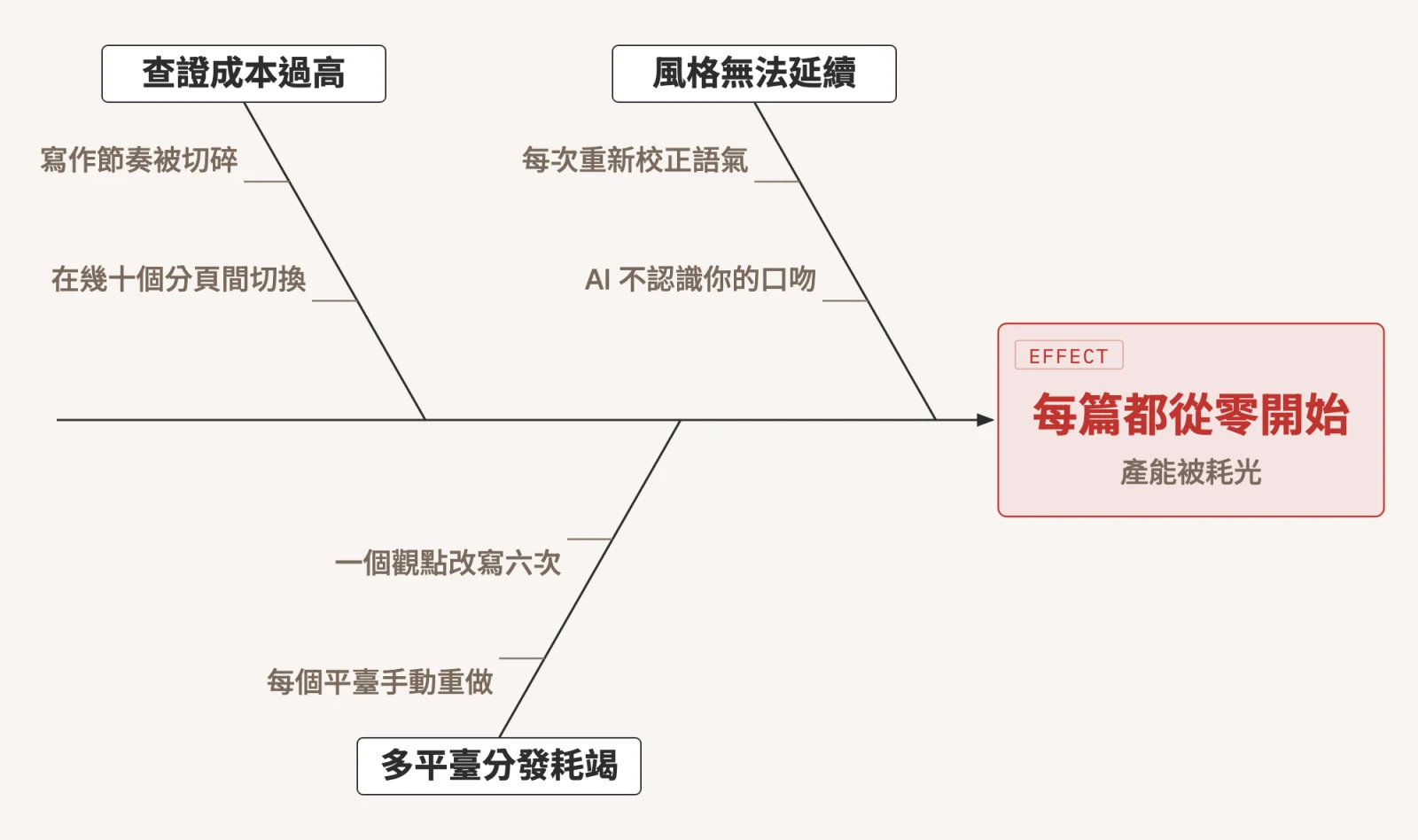
▲ The three causes are independent, and together they mean “every article starts from scratch.”
The first is that the style cannot be connected. AI does not recognize your past writing habits. What you write is objective and correct, but it is like reading an encyclopedia.
The second is that multi-platform distribution brings people down. The same point of view should be written as a long article with arguments when posted on a blog, it should have an opening that makes people stop when posted on Facebook, and it should be written like a letter to a friend when posted in an e-newsletter. There is never enough time to manually modify platform by platform.
The third is that verification takes too much effort. In order to confirm a number and find an example, cutting back and forth between dozens of pages, the rhythm of writing is chopped up in this way.
These three things don’t seem big on their own, but they happen every day. To solve it, you need to fix your know-how and turn it into a reusable pipeline, which is what engineers often call Pipeline.
Five-layer structure of content production: from one idea to six versions
A content system that can accumulate compound interest for you. I have broken it down into five layers:

▲ Five layers are connected from top to bottom. The finishing layer marked in red determines whether the final piece sounds like you.
Input layer: catch the inspiration first, don’t rush to write
Good content often comes from fleeting thoughts in life, and is rarely forced out of sitting in front of the computer. I am used to recording voice notes on my mobile phone. The job of the input layer is to automatically organize these scattered voices and notes into a structured material library. When it’s time to write, what you are facing is not a blank piece of paper, but a stack of materials that have been sorted into categories.
Research layer: Let AI run the first round of verification first
Anyone who makes a living by writing knows that running out of inspiration is easy to solve. What is really annoying is the trivial data retrieval hidden behind the article. The research layer hands over the first round of retrieval, aggregation and source checking to AI, for example using Claude Code to run a fixed research process. After I have found and sorted it out, I will judge which ones can be used and which ones need to be pursued again.
Liu Jing, a student in the previous session, said it very directly: After using Claude Code, the verification work that she had to do so hard in the past has become much faster and easier.
Production layer: first have the skeleton, then fill in the arguments
Don’t just say to the AI “Write an article about so-and-so for me.” The production layer must first prepare several sets of proven narrative structures, such as “hook, question, solution, action” or “story, reflection, tool”, so that the AI can fill in arguments on a solid skeleton. Once the skeleton is fixed, you don’t have to think about the structure from scratch for each article.
Finishing layer: hang up your style profile
This is the soul of the entire system. Many people ask me how to get rid of the AI flavor. The answer is not to write a longer prompt, but to first create a style file that belongs to you (the next paragraph will directly explain the method). Give AI the articles that best represent your tone and let it learn your word choice, sentence rhythm, and questioning habits.
I have tested it myself. If the AI runs a round first, and then I do a round of editing myself, the AI flavor of an article can be reduced from seven points to two or three points. Without the input layer and research layer, you will be slow; without the refinement layer, you will be so fast that there is no soul.
Distribution layer: one master draft, six versions
The most labor-saving state of content production is when the core content is produced only once and the platform version is automatically derived. After the refined master manuscript is released, the distribution layer will rewrite it into six formats according to the reading habits of readers on each platform:
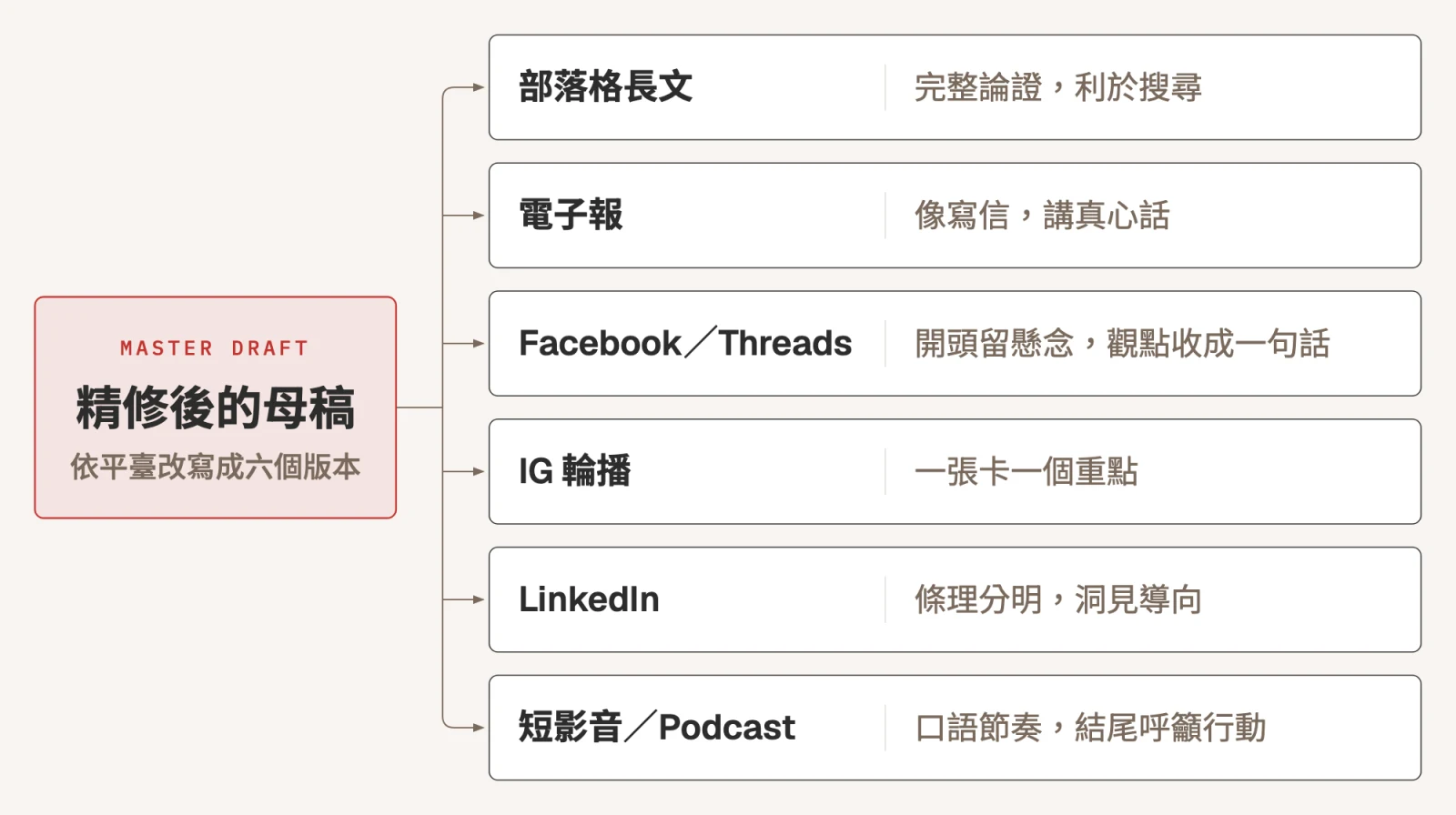
▲ There is only one root node, and the six versions all grow from the same master draft.
Each of the six versions has its own emphasis: the long blog post should have a complete argument and be easy to search; the e-newsletter should be like a letter and tell a few true words; Facebook and Threads should leave suspense at the beginning and condense the point of view into one sentence; IG carousel card should only talk about one key point; LinkedIn should be clear and organized; short videos and podcasts should use a spoken rhythm and end with a call to action.
In ten minutes: Extract your personal style profile
In the five-layer architecture, what I recommend you to do first today is to refine the style files of the refined layer. It does not require installing any software, just open Claude or ChatGPT.
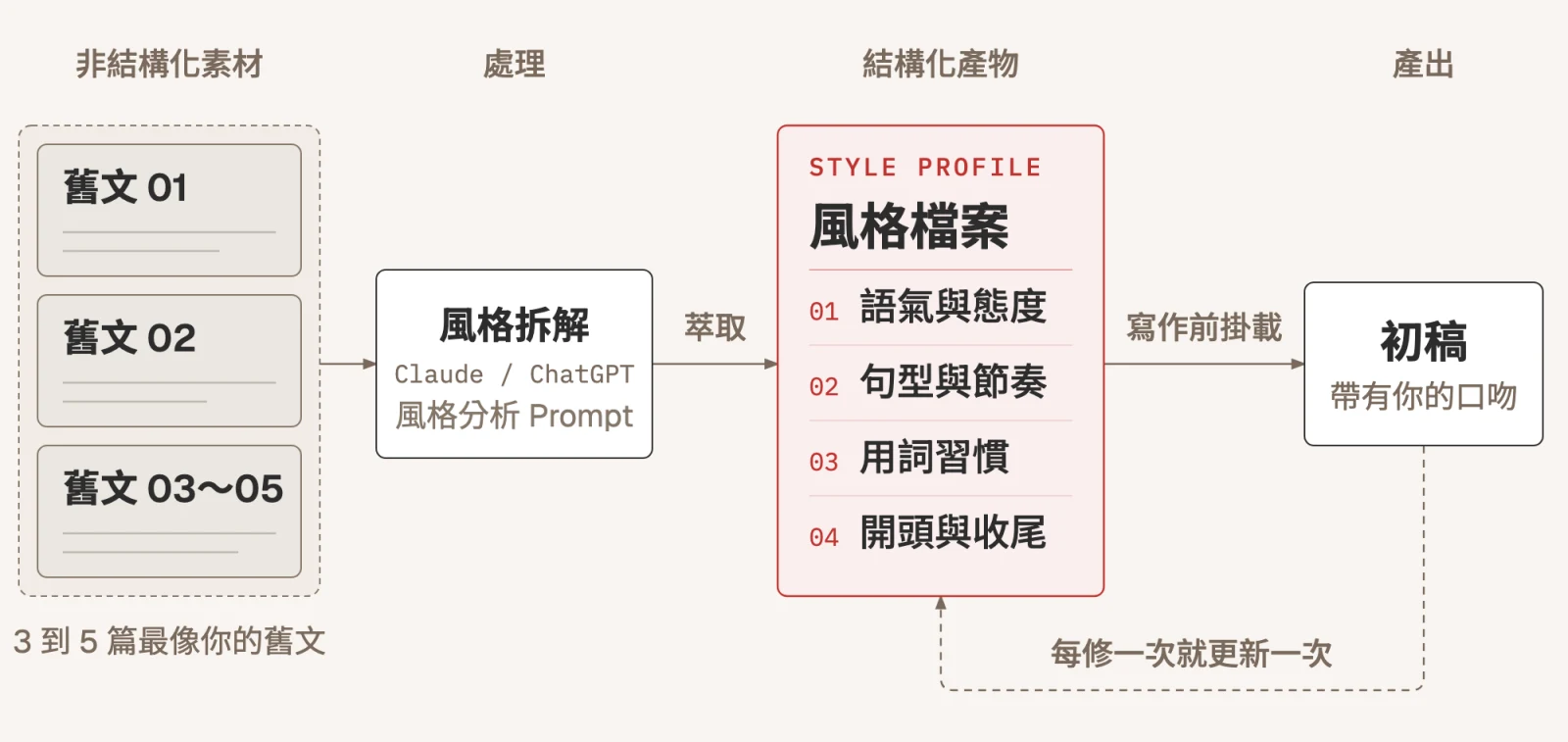
▲ Unstructured old articles go in, and structured style files come out; after that, every time you revise a draft, go back and update it.
The first step is to select three to five works from your past articles or social posts that you are most satisfied with and that most resemble your tone of voice.
The second step is to post the following prompt together with those articles to Claude or ChatGPT:
Below are a few original articles I have written in the past. Please use the perspective of a semantic and stylistic analysis expert to deeply analyze my writing style and compile a structured writing style guide (Style Guide), covering the following aspects:
- Tone and attitude: Gentle and friendly, professional and rigorous, sharp and direct, or is it persuasive?
- Sentence structure and rhythm: the ratio of long to short sentences, are questions, contrasts or parallelism commonly used?
- Word usage habits: commonly used connecting words, catchphrases, and preferred proper nouns.
- Narrative strategy: How do you usually break the topic at the beginning, how do you give examples, and how do you usually end?
Please output in a list, and finally attach a specific instruction that can be directly posted to the AI and let it imitate my writing.
After getting this style file, paste it in every time before asking AI to write something. Bengo Li, a student in the previous period, said that he threw in his old article, and ten minutes later the AI told him: You prefer a comparative structure, like specific numbers, and are used to asking the reader a question at the end. His actual words were: “It’s more accurate than what I said myself.”
From single point tool to automated workflow
Style files can solve the taste problem, but if you have to manually paste it once every time and manually change six platforms, you are still doing porting.
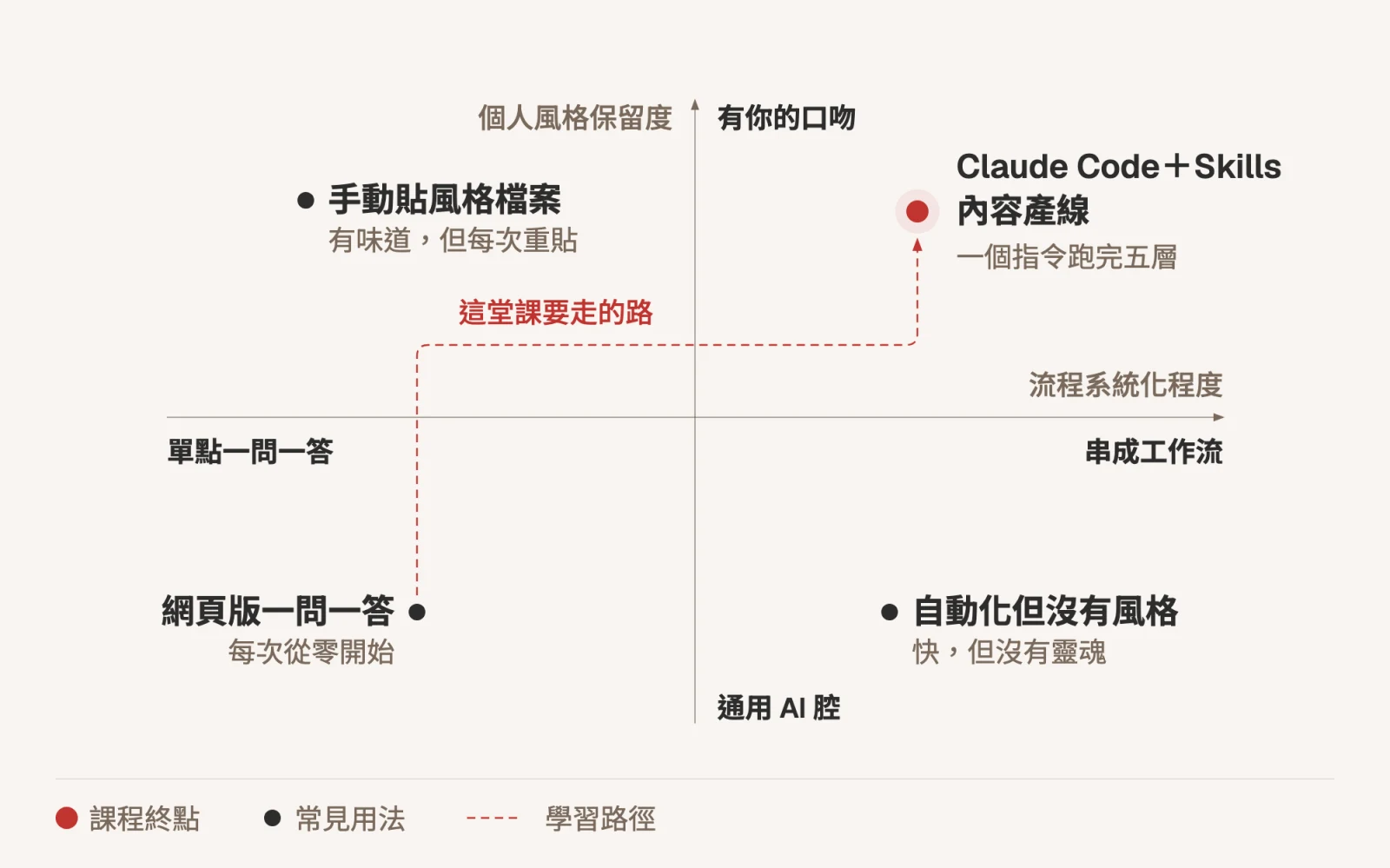
▲ Most people stop at the lower left corner; what you need to do in class is to go all the way to the upper right corner.
The next step is to leave the copy and paste of the web version and use Claude Code with the Skills workflow module to string the five-layer architecture into a real production line. As long as you issue a command, the system will complete the process in sequence: data retrieval, framework drafting, style refinement, and multi-platform rewriting. If you want to stop midway to confirm, you can.
Ma Shaoen, a student in the previous period, wrote a sentence after class, which I like very much: Skill is not just a Prompt, but a workflow module that can be activated by a trigger word. Another student, Rex Lin, gave a more life-like metaphor. He said that using Claude before was like ordering a la carte in a restaurant, but after adding Skills, it was like ordering a set menu.
This thing sounds very engineering, but in fact the threshold is not as high as you think. There were many text writers, brand consultants, and university professors in my class, all of whom had no background in programming. They all finished their first content production line in three hours.
November 14, Taipei, sixteen seats
If you are tired of chasing content every day and want to build a stable content production line for your personal brand or career, welcome to participate in the seventh issue of the “AI Content Production System Workshop”.
This is not a class where you sit and listen to theory. Please bring your laptop and do it on site, and take away a complete set of tools right after class.
AI Content Production System Workshop・Seventh Issue
- Date: November 14, 2026 (Saturday) 9:00 to 12:00
- Location: downtown Taipei, within walking distance of the MRT station (address will be notified after registration)
- Number of people: limited to 16 people
- Fee: NT$5,500, register before October 31st to enjoy the early bird price of NT$5,000
- After class: Join students’ exclusive LINE group to continue communicating and asking questions
The three hours are divided into three units. The first unit establishes the concept and completes the environment setting; the second unit goes from input to output, including research automation, narrative framework and style injection, and using MCP to connect your note-taking software; the third unit deals with refinement and distribution, implements one-click conversion of multiple formats, and also teaches you how to expand your own skills.
You will take away six things after class: five-layer architecture blueprint, six-format conversion template, personal style profile prompt, research automation process, MCP integration guide, and content scheduling template. Before class, you only need to prepare a Claude Pro account and two to three articles you have written in the past to build a style file.
No need to know how to program at all. Claude Code can be operated using Chinese natural language, and the class will take you through the setup from scratch.
Three hours would give you several hours a week. Leave the tedious handling to the system, and leave the thinking and creation to the readers who really care about you.
View the complete course syllabus and register for the seventh period
Further reading
- What really widens the gap in the AI era is never questions and answers, but the establishment of a content production system
- Inspiration never runs out, publishing effortlessly: Use free AI tools to build your content flywheel
Next step
Bring this topic to your team
Vista Cheng speaks and runs workshops on AI workflows, writing and content systems for companies, schools and public agencies.