Don’t just leave the problem to AI: From a live stock broadcast, understand the thinking of self-built systems

At the beginning of last night’s live broadcast, Teacher Giga told a story. Twenty years ago, he was studying for a PhD in engineering, doing computational finance, and used NVIDIA graphics cards to run parallel operations every day. He touched this thing earlier than almost everyone in the world and touched it with his hands every day, but he didn’t even buy a single share of the stock. The reason for not buying it was simple, and he easily explained it: at that time, he was just a scholar who enjoyed doing research and did not have enough investment knowledge.
When I heard this, I pressed the pause button in my mind. At first glance, this live broadcast sounds like it is talking about stock investment, how to use Claude Code or Codex to develop a Stock Investment Bulletin Board (opens in a new tab), and also to recruit students for the weekend practical class. To be honest, my understanding of stock investment is limited, and such topics usually do not interest me. What really made me listen to the whole story were the three judgments under the skin of investment. Each one is the same thing in collaboration with the content I am doing and the AI I am teaching.
Being exposed early does not mean that you can eat it.
That 400-fold story touches not on luck, but on cognition. He was technically ahead of everyone else, but he didn’t turn his technical insights into actions. There was an invisible layer stuck in the middle: Do you have the ability to judge the value of the thing in front of you?
To be honest, I’m too familiar with this kind of thing. I’ve seen too many people start using ChatGPT very early, use it for two years, and still stop at opening dialog boxes, asking questions, and getting answers. He uses the tool every day, but he doesn’t get any dividends at all. Because being exposed to a trend and being able to get something from the trend are two completely different abilities. The former relies on timing, the latter relies on cognition. Cognition will not grow on its own, it must be cultivated deliberately. I even wrote an article about this Poor perception is the real password of wealth, which talks about the same thing.
Make a tool yourself, the tool is never valuable
What impressed me the most in the whole session was Teacher Giga’s words: “The purpose of making a stock investment bulletin board is not only to help everyone collect information, but actually it is a tool to help everyone collect and organize their thinking.”
This sentence can almost overlap with what I have been saying: the value of the system is not to allow you to do more, but to allow you to spend time on irreplaceable things. A bulletin board that puts fundamentals, technicals, chips, and information all on the same page. On the surface, it saves you the effort of searching here and there. But its real function is to force you to answer a question that you usually avoid: What indicators do I care about? What is my central idea?
This is why customization is valuable. You can’t customize something that you don’t even know what you want. Therefore, the process of making tools is itself a forced introspection. This is why I have always insisted that content creators should have their own assembly line instead of starting a new conversation from scratch every time. I later organized this set of ideas into a complete dismantling of Content Production System. The tools may become obsolete, but the set of thoughts you have organized will not.
What you feed the AI determines what it responds to you
Teacher Giga divided the use of AI into two levels. This was the most resonant passage I heard last night. The first level is to directly ask the AI “if TSMC can buy it.” It may give you a conclusion based on its feeling or by obtaining information on the Internet that you don’t know the quality of. The second level is that you first organize the accurate, contextual, and correct information yourself and feed it together with the questions. This transition from asking AI to letting AI do it for you, I talked about in How professionals can make good use of AI Agent, which I think is the most critical watershed in the past few years.
He made a very simple judgment: “AI can’t help you decide. AI only gives you suggestions. You have to make your own decision. The person who gives you suggestions must have sufficient and correct information.” Another sentence: “The more accurate you give it, the better it will be able to give you the answer.”
These two sentences are similar to my own beliefs about collaboration with AI. In other words, leave the execution layer to AI and leave the judgment layer to yourself. To judge why this matter cannot be outsourced, I thought more clearly when I read Wanwei Steel’s “Humans Are More Dangerous than AI”. The key lies in every micro-decision you make. To be honest, the so-called ability to use AI does not mean that you can post fancy prompt words (opens in a new tab), but whether you have first controlled the quality of the data it sees. When the context window becomes more complex, it loses focus. This is true for investing, for writing (opens in a new tab), for research, and for anything else you want to do well with AI. After all, the information is captured, what next? What is truly valuable has always been the ability to read the context.
To be honest, I won’t open an account tomorrow after listening to this live broadcast, but the stock investment board developed by Teacher Giga is indeed very attractive. Come to think of it, a live broadcast on how to create a stock bulletin board taught me how to be a more conscious AI user and a more honest content creator.
If you are using AI every day, you can ask yourself a question tonight: Do you stop at level one and throw questions to it and wait for answers; or are you willing to put in the effort to go to level two and sort out the information first before speaking? The difference at this step may be who will make decisions for whom between you and the AI in the next few years?
As mentioned earlier, this set of thinking of “first sorting out accurate information, and then letting AI give suggestions” is equally valid for research and writing. If you want to really use it in academic research and paper writing, I have made the complete method into a practical workshop:
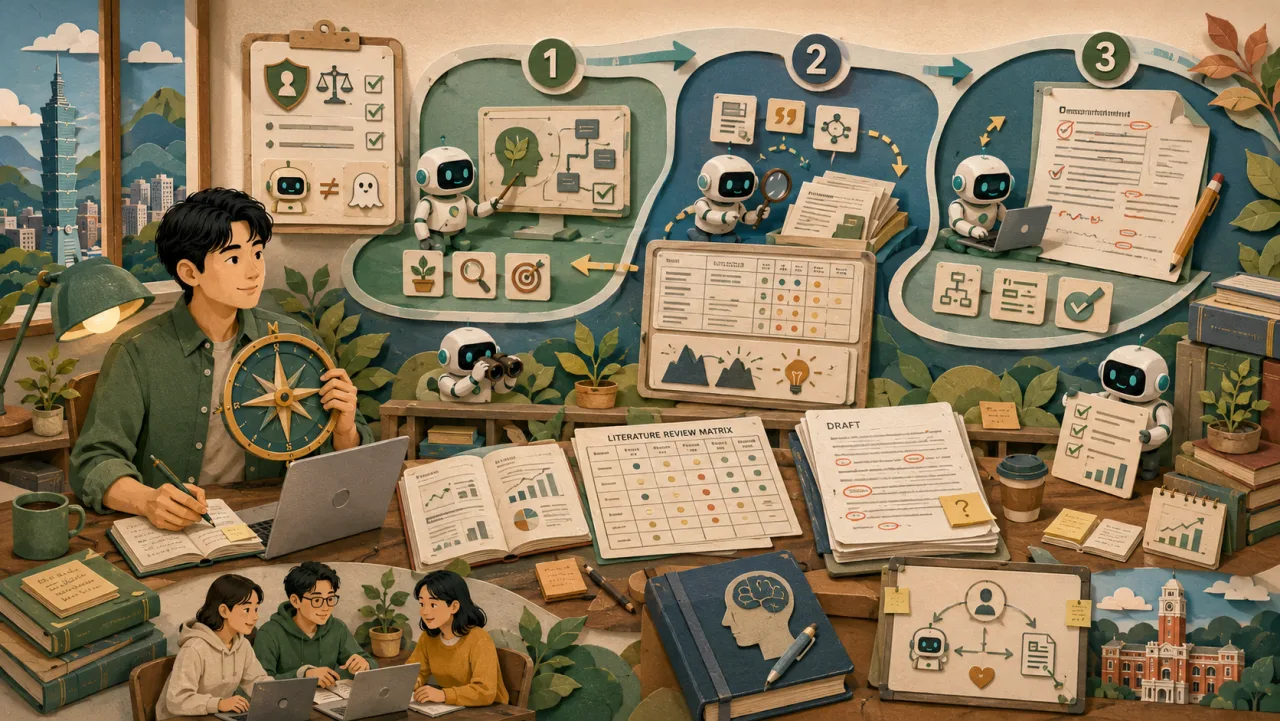
From literature digestion, research design to thesis paragraphs, we will take you step by step to upgrade AI from casual questions to a reliable collaborator in the research process. If you are interested, you are welcome to go to AI Empowered Academic Research and Writing Practical Workshop (opens in a new tab) to take a look at the course content.
Next step
Bring this topic to your team
Vista Cheng speaks and runs workshops on AI workflows, writing and content systems for companies, schools and public agencies.