AI assists, audio and video marketing is fast and economical: a three-stage path for small and medium-sized enterprises to reduce editing from five hours to thirty minutes

This article was originally published in “Economic Daily (opens in a new tab)”.
Today, as the battle for eyeballs becomes fierce, consumers’ attention has long been submerged in the endless torrent of short videos. According to the latest digital trends report, the average viewing completion rate of short videos far exceeds that of traditional graphics and text.
In the past, audiovisual marketing was a money pit with a high threshold. Equipment that costs tens of thousands of yuan, the salary of a professional editor, or expensive advertising outsourcing fees often discourage small and medium-sized business owners.
However, with the maturity of artificial intelligence automated editing and generation technology, this game rule has been completely subverted. The era of democratized editing has officially arrived, and Taiwan’s small and medium-sized enterprises can achieve real cost reduction and efficiency improvement without setting up huge budgets.
Three practical pain points for small and medium-sized enterprises
Before talking about the solution, let’s clarify the problem first. I have met many small and medium-sized business owners in the past few years, and they can hardly escape from these three areas where they are stuck in audio and video marketing.
**The first is the talent shortage. ** If you can’t find someone who can shoot and edit, you won’t be able to keep them even if you find them. Audio and video talents are a hot commodity in the market. Small and medium-sized enterprises cannot afford the salaries of big brands, so they often have to settle for the next best thing and let their marketing colleagues learn by doing. As a result, the marketing industry has been diluted and the quality of the films has not improved.
**The second is that the output speed is too slow. ** Content on social platforms is consumed at an alarming rate. The life cycle of a video may only be three days. However, the traditional process, from planning, shooting, editing to release, takes two weeks to complete. By the time you send it out, the topic will have already become cold.
**The third is the high cost of trial and error. ** Precisely because of slow output and high unit cost, business owners dare not experiment. When you spend 30,000 yuan on a film, you can only strive for stability and no mistakes, so the things you shoot are just average, and no one will watch them.
These three pain points are intertwined, and their common root is the same thing: The marginal cost of each film is too high.
AI reorganizes not a single link, but the entire production line
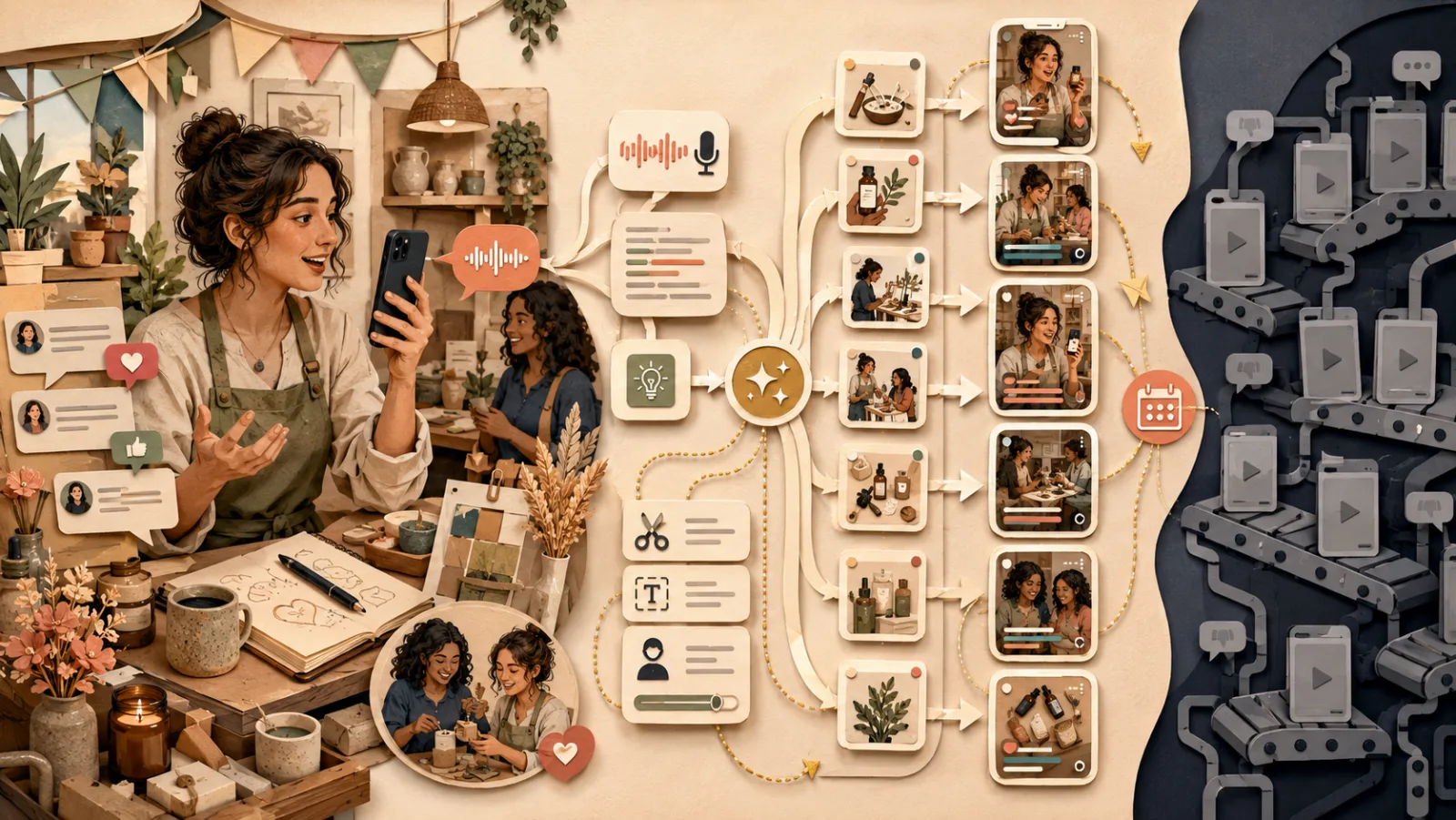
The emergence of AI technology has transformed complex technical barriers into simple instructions, compressing work that originally required a team to be completed by one person, a laptop or even a mobile phone.
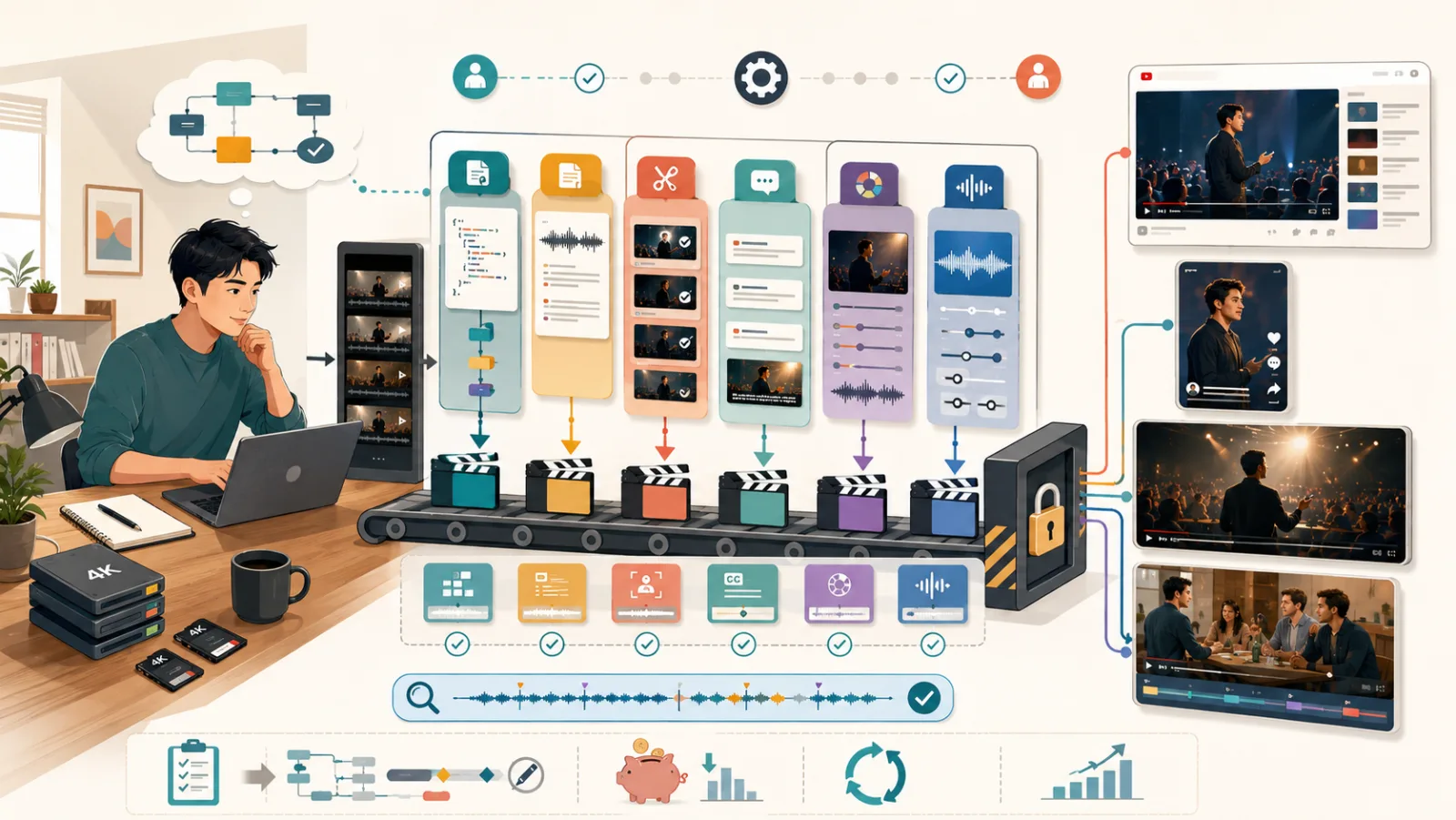
This change to film production is not the optimization of a single link, but the reorganization of the entire production line.
In the inspiration and script generation stage, through language models, marketers only need to input product advantages and target audiences, and they can generate several short video scripts of different styles in a few seconds. AI can even help optimize the beginning, automatically applying the most eye-catching golden three-second formula, and using amazing data or visual conflicts to capture consumers’ dwindling attention span.
The extremely fast automation of smart editing and post-production is the most significant place to reduce time costs. Today’s smart editing tools can convert speech to subtitles, generate accurate Chinese subtitles with one click, and automatically filter out redundant pronunciations.
At the same time, the system can also automatically add appropriate transitions and soundtracks according to the rhythm of the video. It can even automatically detect the climax highlights of a one-hour product briefing or live broadcast and cut it into several short videos suitable for social platforms.
I’ve actually run this line myself. In order to help promote a batch of courses, I wrote the entire video editing process into a system. From a pile of materials to eight promotional videos, it only took half a day. That experience made me confirm one thing: What is saved is not only time, but also the psychological cost of being willing to try. When the production of a video goes from 30,000 yuan to 300 yuan, you dare to test those ideas that seem a little crazy.
If everyone uses AI, will the videos look the same?
But now that everyone has access to new technology, will the videos all look the same?
This is indeed a concern for many business owners, and it’s a legitimate concern. When tools are available to everyone, the tools themselves are no longer a source of differentiation.
The key to reducing costs and increasing efficiency actually lies in human-machine collaboration. In other words, the labor-intensive work is handed over to technology, while humans focus on the layer that machines cannot fill.
When planning scripts, technology can help produce creative outlines and structures in batches, but humans must check and select the core concepts that fit the brand’s tone. During film editing, redundant words, automatic subtitles, and soundtrack are left to the system, while humans are responsible for the final aesthetic review and fine-tuning of key emotional resonance points.
I talked about it in another article, The threshold of audio and video has not disappeared, it has just moved. In the past, the threshold was technology, but now the threshold is judgment. You have to know what is good, know where to stop this sentence, and know which shot should be left for one second longer. These are things that AI currently cannot provide.
This is especially true for professional workers. The real threshold for short videos is not shooting, but knowledge translation: You must be able to translate the complex set of majors in your mind into something that can be finished within thirty seconds and that the other party can understand. AI can help with this, but it cannot replace you.
New technology can help cut editing time from five hours to 30 minutes. The four and a half hours saved should be used by business owners to conduct in-depth research on customer pain points, optimize product experience, or come up with more heart-warming stories.
This also echoes the point I have always emphasized: when content is so cheap that it approaches zero, the real breakthrough point for small and medium-sized enterprises is the human touch.
Three-stage implementation path: low-cost trial and error
If you want to take the first step, it is recommended to adopt a low-cost trial and error strategy. The following three stages can be followed in order.
Phase One: Tool Inventory and Personnel Training
Don’t rush to buy the most expensive professional software yet.
Start by using free or low-cost versions of mainstream editing tools on the market, and let your internal marketers spend one to two weeks to become familiar with the functions of automatically adding subtitles and converting long videos to short videos.
The goal of this stage is not to produce a finished product, but to establish a feel. If you have no clue at all, I have written down the few things that novices should practice in The first lesson of short video novices.
Phase 2: Establishing a one-hour audio and video factory
Set a goal: spend only one hour a week to produce three short videos.
Time is allocated like this:
- 15 minutes Use technology to discuss and generate three product scripts
- 15 minutes Use your mobile phone to quickly record material (this time you do not pursue perfect equipment, but emphasize realism)
- 30 minutes Import tool to complete editing, subtitles and soundtrack and export
The value of this process is not in the quality of a single film, but in the fact that it can run forever. One hour per week is an affordable investment for any small and medium-sized enterprise, and after three months, you will have thirty-six videos and a whole batch of real data.
The same logic can also be extended outwards. After I wrote the entire set of content production into a production line, one article can automatically become six kinds of output. Video is just one of the formats.
If you want to skip the stage of exploring on your own and directly set up the system at once, I held an “AI Content Production System Workshop” on August 30. In 3 hours, I used Claude Code to guide you in establishing a five-layer content production architecture, so that a piece of material can automatically produce six formats. Limited to 16 seats, early bird discount available until August 16th.
👉 Click here to view course details
The third stage: data-driven, rapid iteration
Don’t expect your first video to be a hit.
Take advantage of rapid output and test three different openings or entry points at once. Based on the completion rate and interaction data in the background, find the category with the highest clicks, and then use technology to copy the same style in batches.
This step is where the real leverage of the entire approach lies. When your marginal cost is low enough, you can afford failure; and only those who can afford failure have the opportunity to find the explosive formula.
(opens in a new tab)
Write at the end
The threshold for audio and video marketing has been lowered, but this does not mean that there are more opportunities, but it means that there are no excuses.
In the past, small and medium-sized enterprises could say that they had no budget, no manpower, and no equipment, so they could not produce audio and video. Now that these three reasons have been removed by technology, there is only one question left: Are you willing to set aside that hour every week?
Tools will continue to change, but the essence of making good use of video to capture consumers’ attention will not change. What is truly scarce is never editing skills, but your understanding of your customers and your ability to express that understanding well.
AI can help you edit the film quickly, but you still have to think clearly about what to say, who to say it to, and why it’s worth listening to.
If you want to find someone to accompany you to set up this process at once, welcome to the AI Content Production System Workshop on August 30.
See you in class.
Next step
Bring this topic to your team
Vista Cheng speaks and runs workshops on AI workflows, writing and content systems for companies, schools and public agencies.