Ten Life Insights from Alex Honnold: A Rock Climber’s Philosophy of Life
A few days ago, I watched an episode by “The Diary of a CEO” hosted by Steven Bartlett, the guest is the world’s greatest rock climber—— href=“/blog/climb-your-taipei-101”>Alex Honnold. The man who shocked the world with his ropeless free-solo climb of El Capitan in Yosemite in 2017 recently climbed Taipei 101 in a global live broadcast on Netflix.
Frankly speaking, I originally thought this would be an interview about extreme sports, but after watching it for a full hour and a half, I found that this is basically a master class on the philosophy of life. Alex Honnold uses the wisdom honed over his 30 years of rock climbing to answer the question that almost every modern person is struggling with: How to face fear? How to persist? How to move forward in uncertainty? How to truly live yourself?
As an educator who has long studied content strategy and AI applications, I saw so many insights in this conversation that can be applied to work, entrepreneurship, and life. Below, I will try to analyze Alex Honnold’s philosophy of life from my own perspective, and try to answer a core question: How does a rock climber’s life wisdom inspire those of us who climb in the urban jungle?
Insight 1: You think you are not taking risks, but in fact you are just taking risks that you did not choose.
At the beginning of the interview, Alex Honnold made a point that stunned me:
Everyone takes risks, the only difference is whether you choose the risks you take?
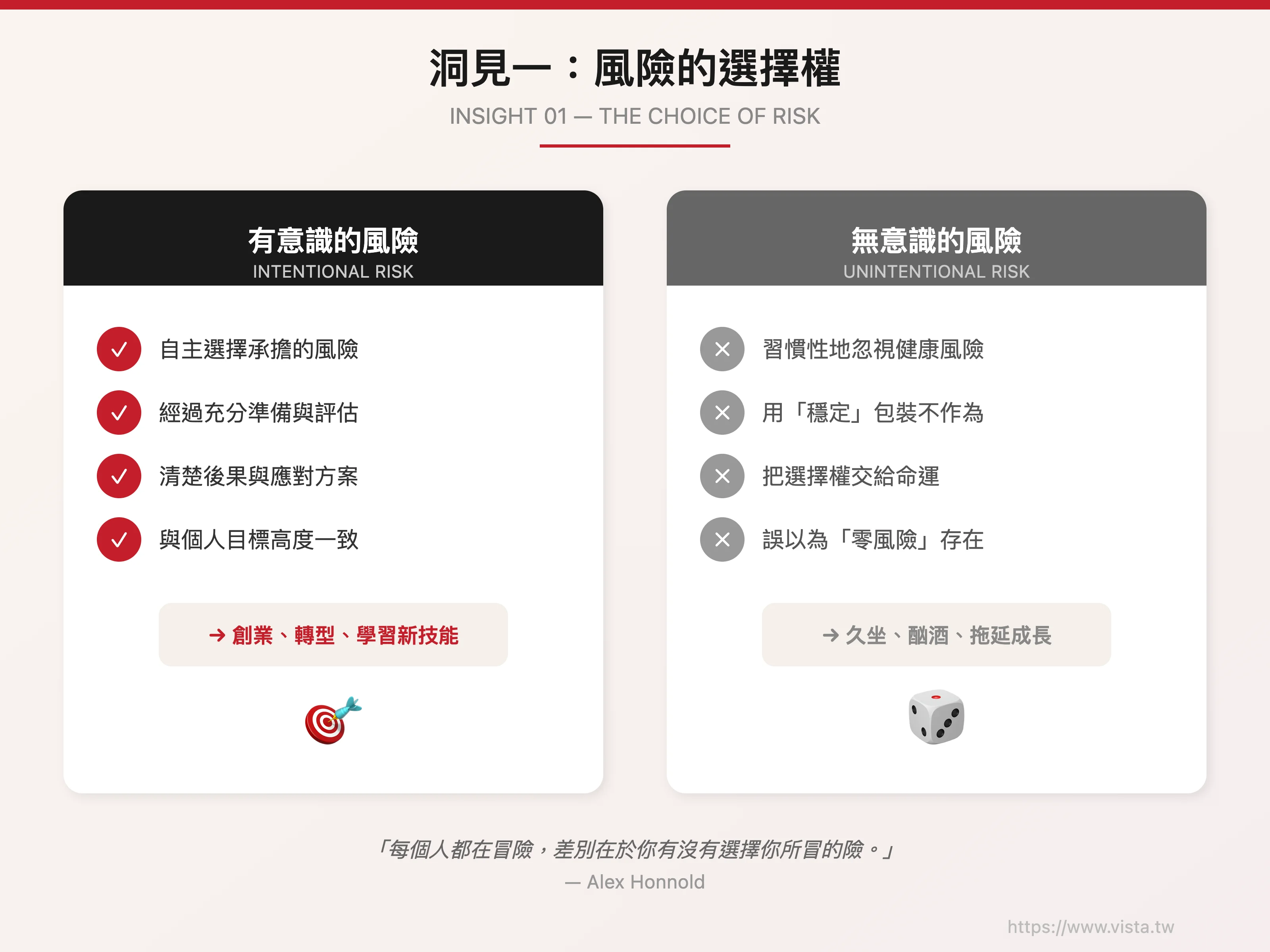 ▲ True risk management is not to avoid all risks, but to consciously choose the risks you are willing to take.
Those who go out drinking every weekend and drive home tipsy are taking a risk. People who sit on the couch and play video games all day without exercising are facing a higher risk of heart disease. Those who choose to do nothing are not truly risk-free! To put it bluntly, they just left the choice of risk to fate.
This passage reminds me that in my many years of experience as a business consultant, I have seen too many people package fear with stability. It’s not that they don’t want to start a business, transform, or try new content forms—they are afraid of failure, so they choose a lifestyle that seems safe but is actually full of hidden risks.
True risk management is not to avoid all risks, but to consciously choose the risks you are willing to take, and then go all out to prepare.
Seeing this makes me reflect on my career. From traditional media to content marketing, from corporate consultant to AI education, every transition is considered an adventure in the eyes of my family. But to me, not transitioning is the biggest risk – because the world won’t wait for you to be ready.
Insight 2: Fear is not an enemy that needs to be eliminated, but a partner that needs to be with you for a long time.
One of the passages in the interview that stood out to me was when Alex Honnold talked about the over-interpretation of brain scans.
In a scene in the 2018 documentary “Free Solo,” scientists scanned Alex Honnold’s brain and found that his amygdala reacted less favorably than the average person when faced with horrific images. Many people concluded from this: “He is naturally unafraid.”
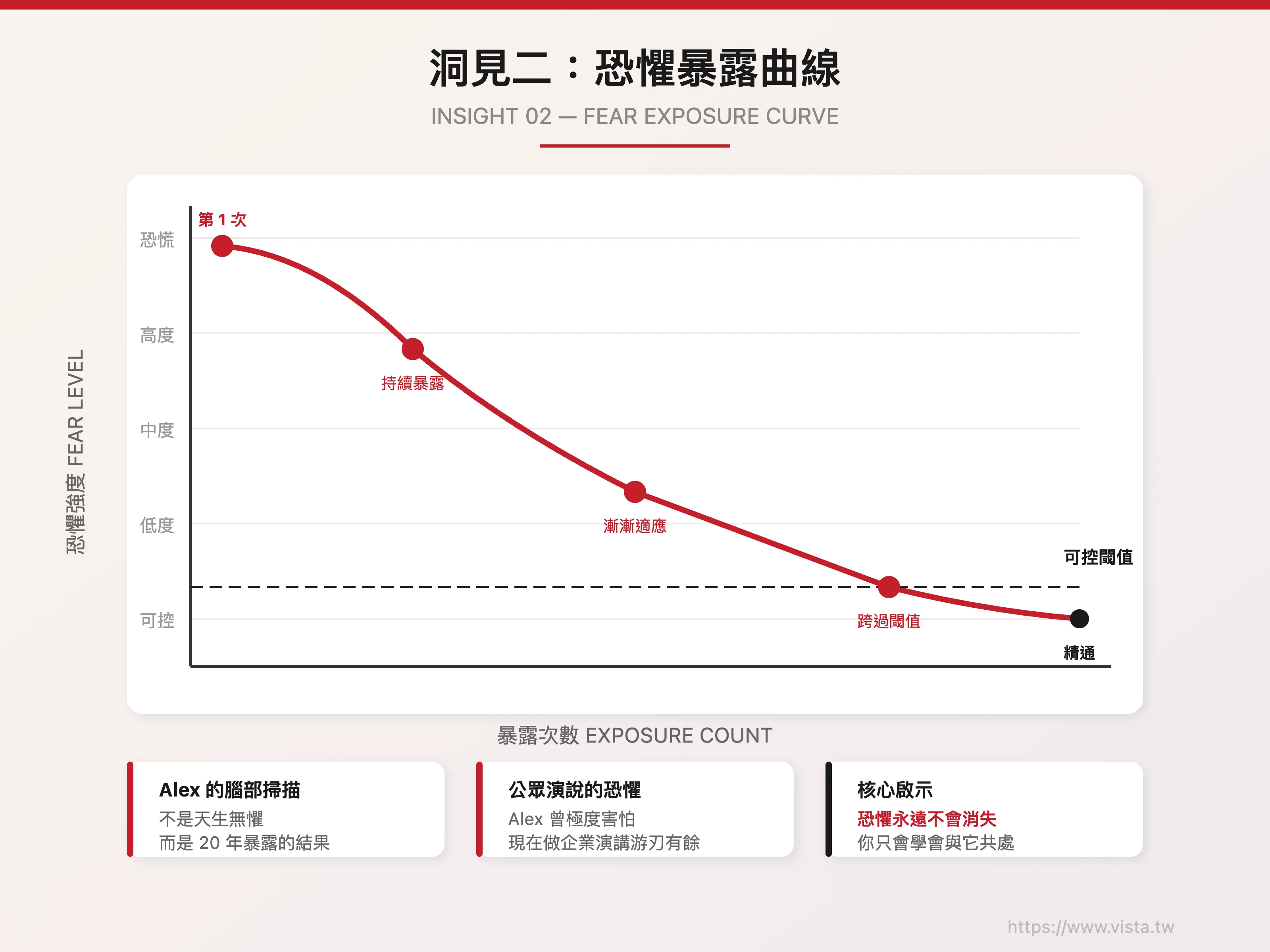 ▲ Fear doesn’t go away, you just learn to live with it
But Alex Honnold himself is extremely disgusted with this interpretation. He said:
I’m in a sealed metal tube, looking at black and white photos. I certainly don’t have a fear reaction – because I’m completely safe. But if you asked me to look at the same view from a 600-meter-high rock wall, I guarantee I would be scared.
He stresses that after 20 years of training to face his fears almost every day, his fear threshold naturally increased. It’s like a stand-up comedian looking at the stage without getting nervous, but for you and me it could be a nightmare.
The real revelation: He has an amygdala, and it’s functioning properly. He wasn’t born fearless, he just went through a long period of exposure therapy.
What does this mean to us? When it comes to career challenges, public speaking, or entrepreneurial decisions, many people wait until they are no longer afraid before taking action. But Alex Honnold tells us: That day will never come. Fear doesn’t go away, you just learn to live with it.
To be honest, I have been through a similar journey myself in my teaching career. The first time I stood in a lecture hall with hundreds of people, my palms were all sweaty. But 15 years and thousands of speeches later, instead of disappearing, the fear has turned into a controlled excitement.
Insight 3: Ten years under the iceberg - the price of mastery is invisible to others
The video of Alex Honnold free-soloing El Capitan looks as easy as him walking up there. What the audience sees is the climbing record of 3 hours and 56 minutes, but what they cannot see is:
- He climbed over 60 different routes in Yosemite
- He spent nearly 10 years preparing specifically for this rock face
- The documentary only filmed the last 2 years, and the first 8 years were not recorded at all.
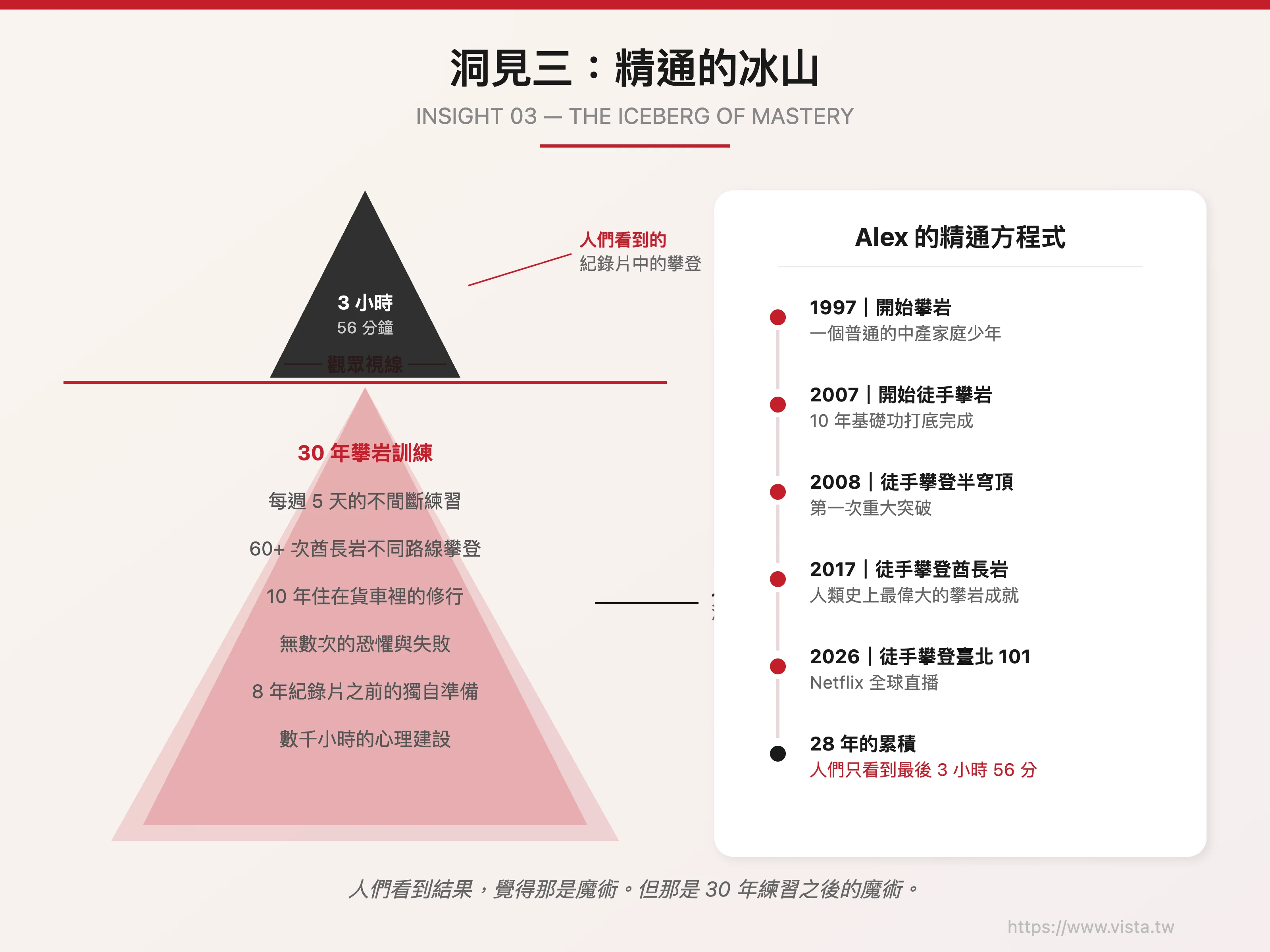 ▲ When people see the results, they think it’s magic. But that’s magic after 30 years of practice
People see the results and think it’s magic. But that’s magic after 30 years of practice.
Well, this reminds me of the world of content creation. Many people see a creator becoming famous overnight, but fail to see that behind the scenes he wrote 500 articles that no one read. Many people envy a certain AI lecturer whose lectures are packed with people, but they don’t know that he has spent 10 years honing his teaching skills before the AI wave.
In my own experience, I have written over 20 books, run multiple platforms, and accumulated over 15 years of experience as a consultant. But what the outside world often sees is just the latest successful speech or a popular article. God knows what’s underneath the iceberg is the real competitiveness.
Insight 4: Break down huge challenges into actionable pieces
Alex Honnold demonstrated a very pragmatic methodology when talking about the preparation process for climbing Taipei 101:
He first went to Taipei for on-site inspection in September 2025, using ropes to inspect each section. The appearance of the Taipei 101 building seems to be uniform, but the slope at the bottom, the bamboo-shaped bulge in the middle, and the balcony at the top, the climbing skills and difficulty of each part are completely different. He takes notes on his phone, paragraph by paragraph, just like we do when planning a project.
 ▲Don’t be intimidated by the end, be attracted by the starting point
This methodology is actually the work breakdown structure in project management. (Work Breakdown Structure, WBS).
In my teaching and consulting work, I constantly tell students: Don’t be intimidated by the end, be attracted by the starting point. For example, if a novice has to write an entire book, it may seem like an impossible task, but if it is broken down into 10 chapters, each chapter has 4 subsections, and each subsection is 2000 words, it suddenly becomes doable. In my opinion, any AI transformation project looks very complicated, but if it is broken down into four stages: cognitive establishment, tool introduction, process optimization and cultural change, each stage has clear milestones, it is no longer an impossible task.
I spent years looking at El Capitan and thinking it was impossible. I keep hoping that one day it will suddenly seem easy. But that day never came. Finally, I had to say: OK, then I will take it apart piece by piece and practice.
Insight 5: Don’t let perfect be the enemy of good enough
To put it bluntly, Alex Honnold’s mother is a typical Asian parent with high standards. She can speak seven or eight languages and play multiple instruments. Her mantra is roughly equivalent to “almost just not good enough.” Alex Honnold admits that this upbringing left a deep mark on him, but he deliberately chose the opposite philosophy as an adult:
Don’t let perfect be the enemy of good. It’s better to try than not try, and it’s much better to fail quickly and learn than to stand still and wait for the perfect moment.
 ▲ In an era of rapid change, good enough action is better than waiting for perfection.
This reminds me of what I often say to students in the AI era: “Complete first, then perfect.” Too many people are waiting for AI tools to get better, waiting for themselves to fully understand prompt engineering, and waiting for the market to become clearer - and then, inexplicably, they miss the entire window period.
In an era of rapid change, good enough action is better than waiting for perfection.
This is why I have always advocated using the RESET (Reflect, Edit, Set, Empower, Transform) methodology to promote the transformation of individuals and organizations - it does not require you to do it all in one step, but to continue iterating through reflection.
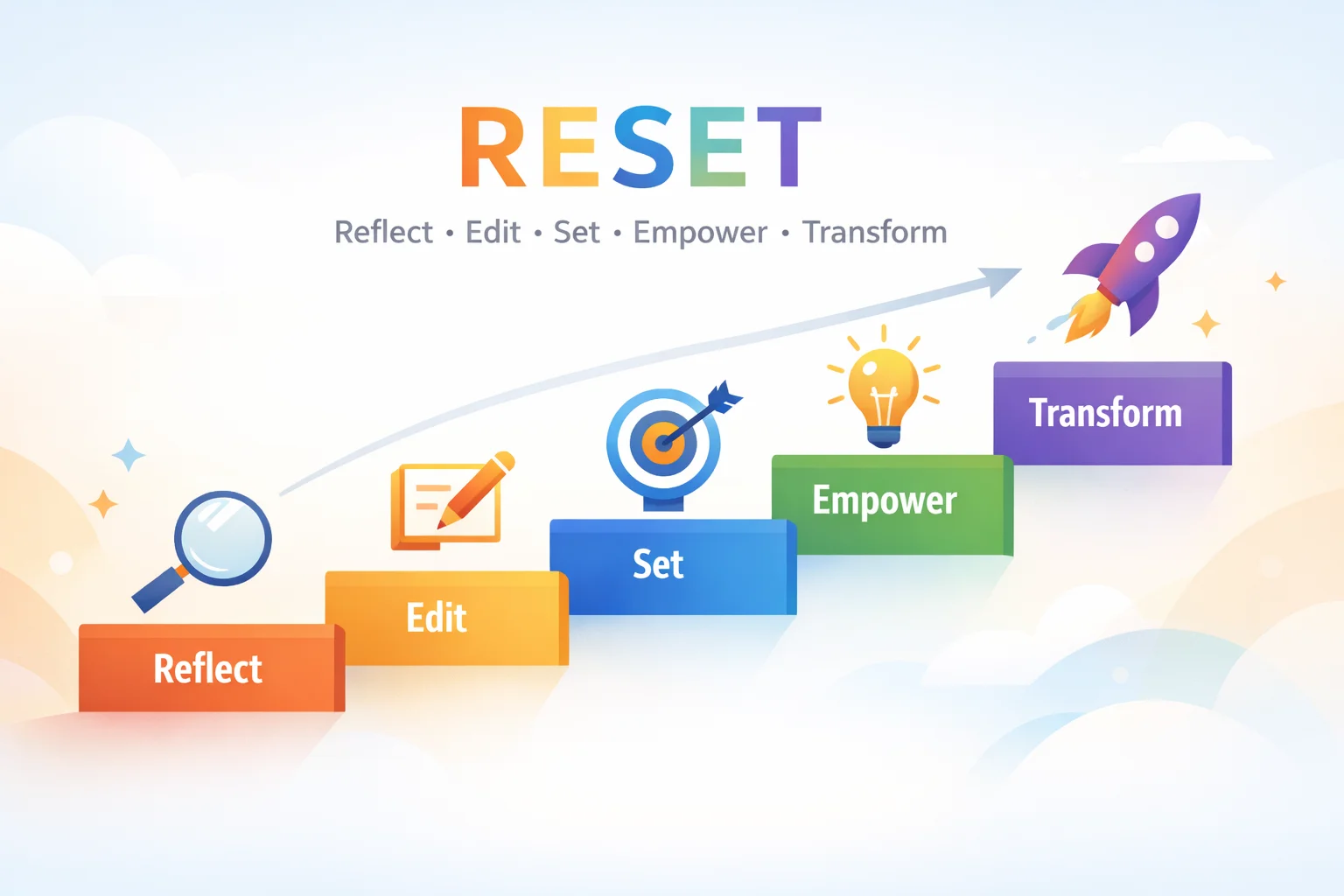 ▲ RESET methodology: Continuous iteration in reflection, no need to get it right in one step
Imagine this: like a rock climber, what would it be like if you broke down every challenge into executable steps and then implemented it with code?
🧗 Vibe Coding Practical Workshop: Use the climbing spirit to write your first program
Climbers don't wait until everything is ready before setting off; they break down the route and attack it piece by piece. The same goes for learning to program - you don't need to be an engineer, you just need to take an idea and turn it into a working digital product step by step.
👉 Learn about Vibe Coding practical workshop now
 ▲Vibe Coding Practical Workshop: Create your digital products step by step with ideas
Insight 6: Create value first, economic returns later
Alex Honnold drew a graph of his career: from the age of 18 to 29, it was almost a flat line. He lives in a van he bought for $10,000 and lives on a few hundred dollars a month, climbing, climbing, and climbing.
He said: “If I had optimized my life for the sake of making money, I would have gone back to finish college and find a job.”
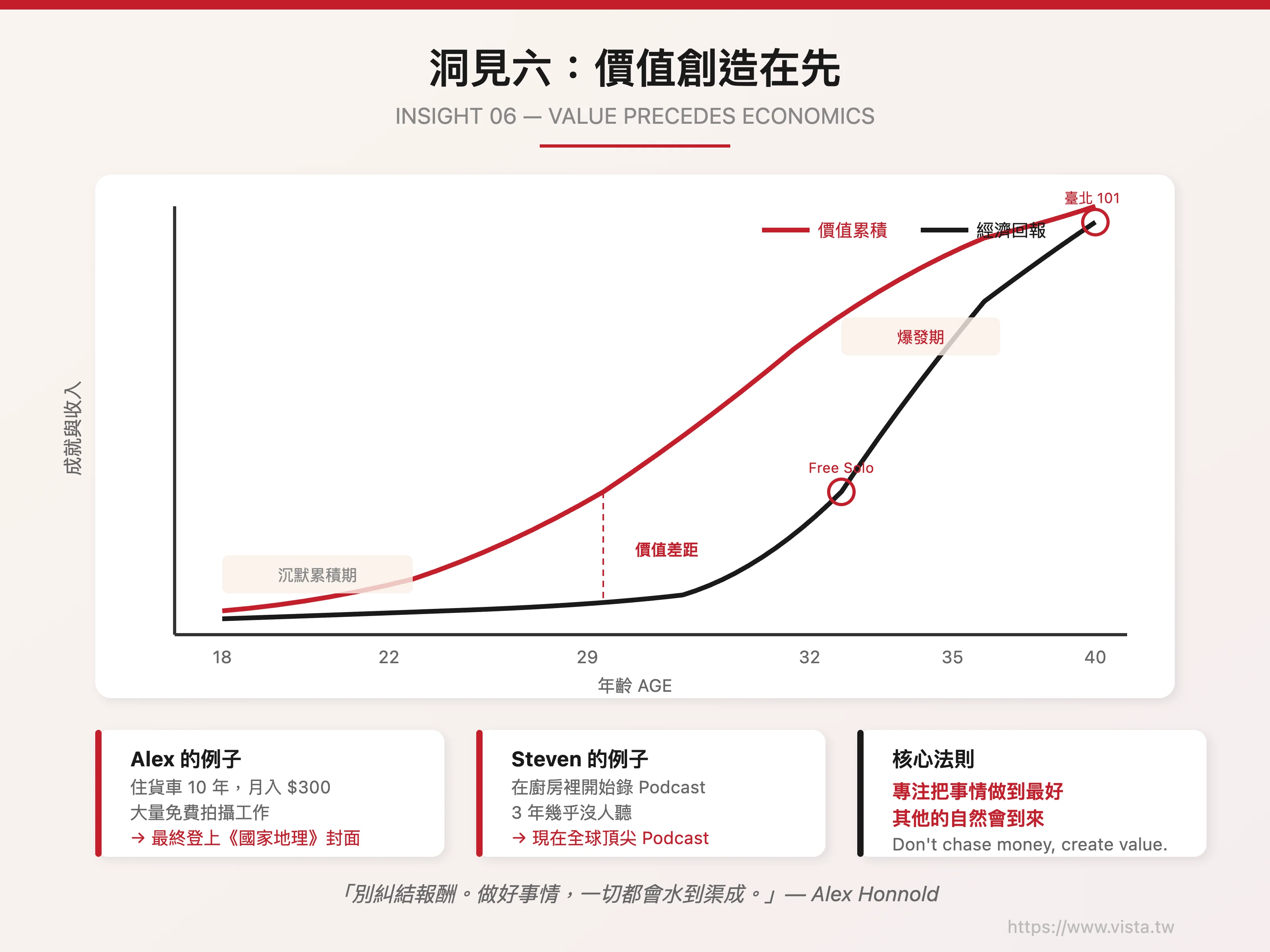 ▲ The focus is never on the reward itself, but on whether what you do is really good enough and valuable enough
But he didn’t. He did a lot of free shooting work, including being featured in a friend’s documentary, regardless of daily salary. As a result, one of the free shoots ended up on the cover of National Geographic, and then “Bare Hands” won the Oscar for best documentary, and his life curve spiraled upward from there.
Well, this pattern is all too familiar to me.
Looking back on my own experience - running the “Content Hacker’ website, writing columns, and setting up the “Vista Writing companionship program” - many things that ultimately bring commercial value started out of pure interest and a sense of mission. It’s not that I’m agnostic, but history has repeatedly proven that real value creation always comes before economic returns.
The focus is never on the reward itself, but on whether what you do is really good enough and valuable enough. Do it and the rewards will come naturally.
Alex Honnold’s compensation for climbing the Taipei 101 building has been hotly debated by the media, but his attitude is very relaxed: “I once paid to go to the observation deck of Taipei 101 to see the scenery. If someone is willing to pay me to climb up to see the scenery, that would be cool!”
Insight 7: The compound interest effect of persistence - greatness does not exist, greatness is just good repetition
In the interview, Alex Honnold quoted Warren Buffett’s compound interest story to illustrate the power of persistence. His career curve and Buffett’s wealth curve have a strikingly similar structure: the early stage is long and gentle, and after reaching a certain critical point, the curve begins to rise sharply.
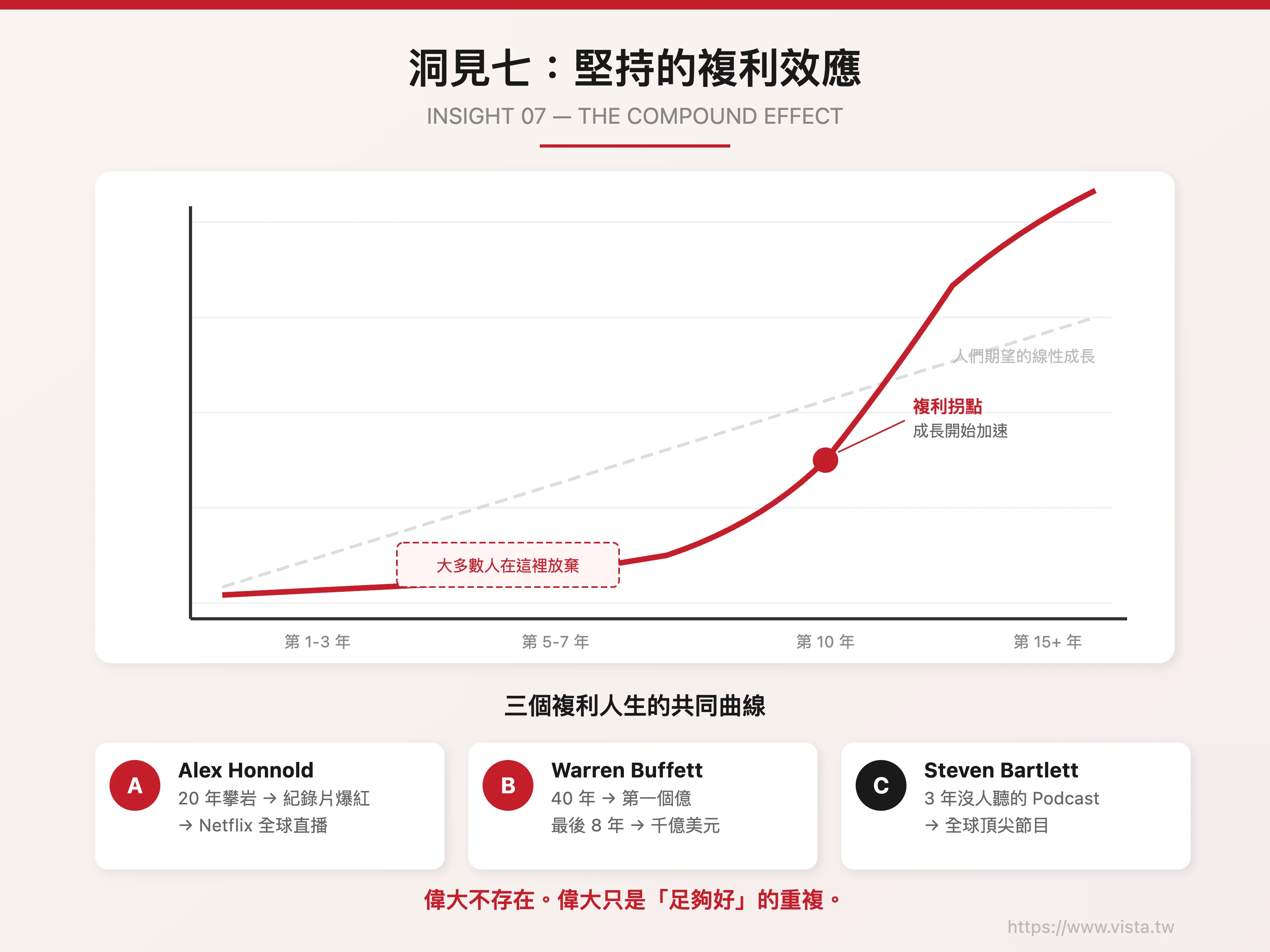 ▲Greatness does not exist. Greatness is just repetition of “good”
Steven Bartlett quoted: “Greatness does not exist. Greatness is just the repetition of ‘good’.”
Alex Honnold’s response went further:
I think it’s a repetition of “good enough”. Because if you keep doing it well enough, occasionally some of it will turn out to be great. You don’t necessarily know which ones they are in advance, but you just keep doing them.
Seeing this reminds me of the nature of content creation. I know too many creators who give up on their 50th article, and what they don’t know is that 51st might be the one that goes viral. I now run a community and promote the “Vista Writing Companion Project”. The belief behind it is the same: continue to output quality content and let the compound interest effect do its work.
Insight 8: Find an area that makes you feel expanded, and then go all in
Alex Honnold shared a very practical criterion when talking about how to maintain long-term momentum:
After some work is done, you feel energized, inspired, and want to learn more. After some work is done, you just want to lie in bed and mindlessly scroll through your phone. Try to do as much of the former as possible.
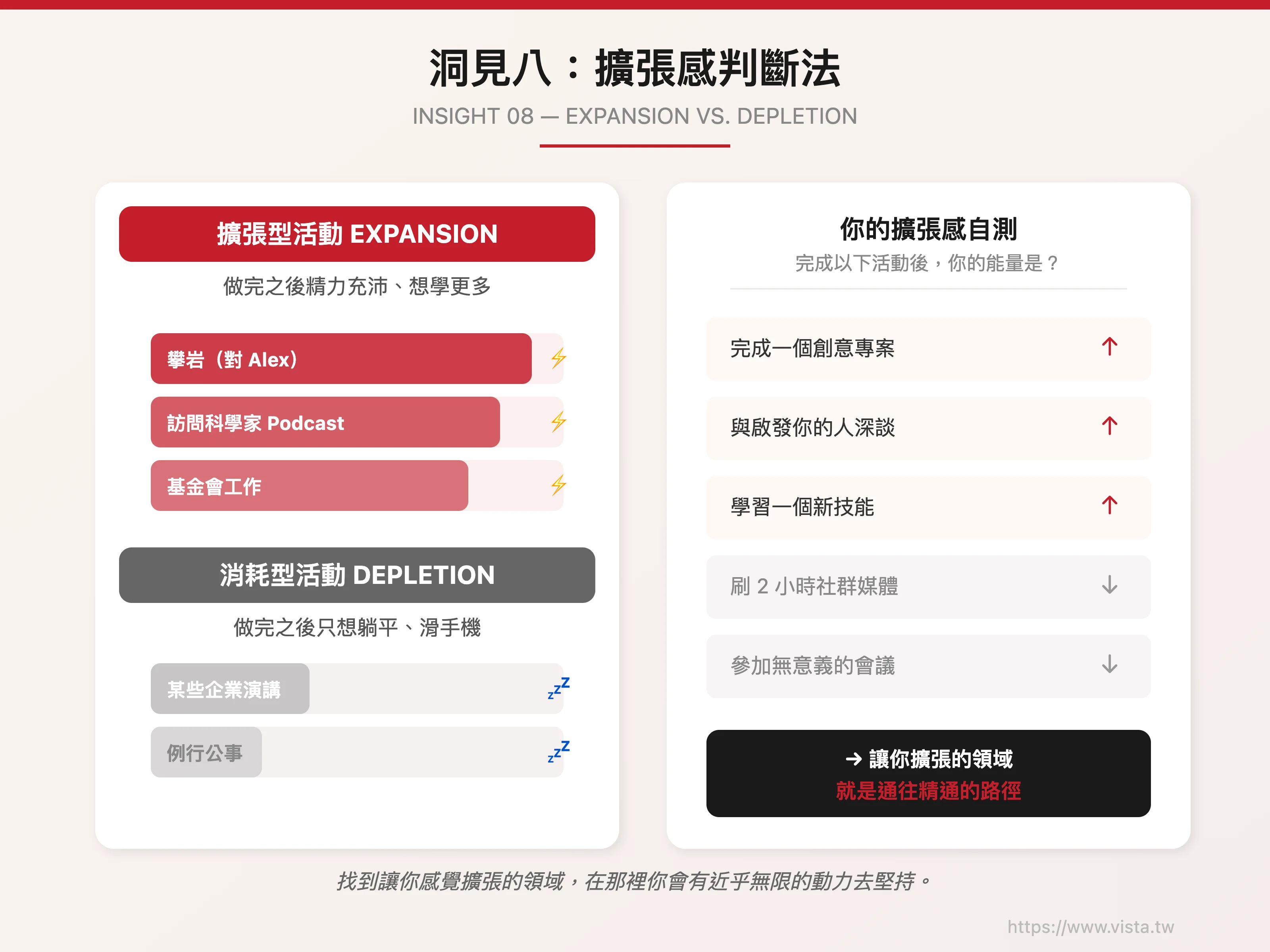 ▲ When you find those areas that make you feel expanded, that’s the path to mastery
He gave the example of his podcast “Planet Visionaries” - after every visit to a marine biologist or environmental scientist, he would feel inspired and want to train harder and learn more. But after some corporate presentations, he just feels hollowed out.
This criterion is surprisingly simple, yet extremely effective.
Over the course of my career, I’ve learned to recognize this ability. Writing makes me feel expanded, teaching makes me feel expanded, and studying the intersection of AI and content creation makes me feel expanded. But some purely routine tasks, even if they pay well, just make me tired after doing them.
When you find those areas where you feel expanded, that’s the path to mastery. Because in that field, you have almost unlimited motivation to persist.
Insight 9: Your Taipei 101 doesn’t really need to have 101 floors – just start from the first floor
There is a paragraph in the interview about Anterior Mid-Cingulate Cortex Cortex, the area of the brain responsible for willpower. Research has found that this area is activated and grows when you do things you don’t want to do but choose to do. This area is usually larger in athletes and smaller in sedentary people.
But Alex Honnold offers a crucial warning:
If you’re that person who just lies in bed and doesn’t want to move, Taipei 101 is not the goal you should set. What you need is Taipei 4. You need to accomplish one small thing first and see that you can do something.
 ▲ A perfect plan is worse than a clumsy action. Your Taipei 101 can wait, but your Taipei No.1 can start today
The program mentions the case of a psychologist who was unable to leave his bedroom and whose goal on the first day was just to move a vacuum cleaner into the room. The next day was to put the plug in. By day 30, the person was able to go for walks and the house was tidied.
The reason people don’t take the first step is often because the first step seems embarrassingly small. But any step forward is better than zero step.
This concept is very simple, but it has profound inspiration for my teaching work. Many students have asked me: “Teacher, I want to start running self-media, but I don’t know what topic to write about, what platform to use, how to design the visual…” My answer is always: “Write the first article first. Write whatever you want. Let’s talk about it after finishing it!”
The reason is simple, because a perfect plan is worse than a clumsy action. Your Taipei 101 can wait, but your Taipei No.1 can start today!
Insight 10: You are going to die, so you better live like you know it
Alex Honnold’s father suddenly collapsed at the airport at the age of 55 and died suddenly of a heart attack. This incident profoundly changed his outlook on life.
Most people don’t do risky things because they mistakenly believe they can live forever. But even if you live to be 78, you’ll still wish you had 22 more years to live. So, instead of living to 78 and doing nothing, it’s better to live to 55 and be proud of your life.
 ▲ Time is the scarcest resource, and most people spend it as if it is infinite
This is not to encourage recklessness, but to remind us that time is the scarcest resource, and most people spend it as if it is infinite.
There was also a segment in the interview that touched me deeply. Steven asked Alex, “Do you know your great-grandfather’s name? Do you know what he was worried about and why he was ashamed?” He replied, “No idea at all.”
Well, that’s the point – if you don’t even know what troubled people in your family three generations ago, do the things you struggle with today really matter on a cosmic scale?
As an ordinary and busy middle-aged man, I know this very well. Sometimes, I will inevitably be frustrated because the click-through rate of an article is not good, and I will be anxious because the feedback from a speech is not as expected. But when I think of Alex Honnold’s words—“You’re going to die, so pick something you care about and go for it!”—those anxieties recede and are replaced by a clear sense of urgency.
The wisdom of rock climbers, the solutions for urbanites
The story of Alex Honnold is moving not just because he did something that ordinary people could not imagine. What’s more, his philosophy of life has a compelling simplicity:
- Choose your risks, rather than letting risks choose you
- Live with fear instead of waiting for it to go away
- Invest time and let the iceberg slowly take shape
- Break down the challenge and conquer it piece by piece
- Accept “good enough” and don’t be kidnapped by perfectionism
- Create value first and let the rewards come naturally.
- Insist on compound interest and let time be your ally
- Follow the sense of expansion and find your infinite motivation
- Start with the first step, even if it’s embarrassingly small.
- Remember death and then truly live
Find something you love and do it day after day. Don’t ask for anything in return, don’t ask for recognition, just because that’s who you want to be.
After reading this conversation, what came to my mind was not the image of Alex Honnold hanging 500 meters in the air, but the time when he was 20 years old, living in a broken van, climbing rocks every day, and living on $300 a month. Alex Honnold, who no one knows yet, who has no documentary yet, and who has no live broadcast on Netflix, is the philosopher of life that I truly admire. Because the seemingly ordinary Alex Honnold made a choice that each of us can make: find something you love, and then do it day after day. Don’t ask for anything in return, don’t ask for recognition, just because that’s who you want to be.
And this may be the best lesson a rock climber can teach us urbanites. With Growth Mindset, take your first step bravely!
Further reading
- After Honnold climbed to the top of Taipei 101: What ordinary people should learn is not to be brave, but to master a blueprint for action
- Writing Coach Vista teaches you how to write good and exciting articles
- Protagonist Model and Growth Mindset: Are you the protagonist of your own life?
📖 深入探索相關主題