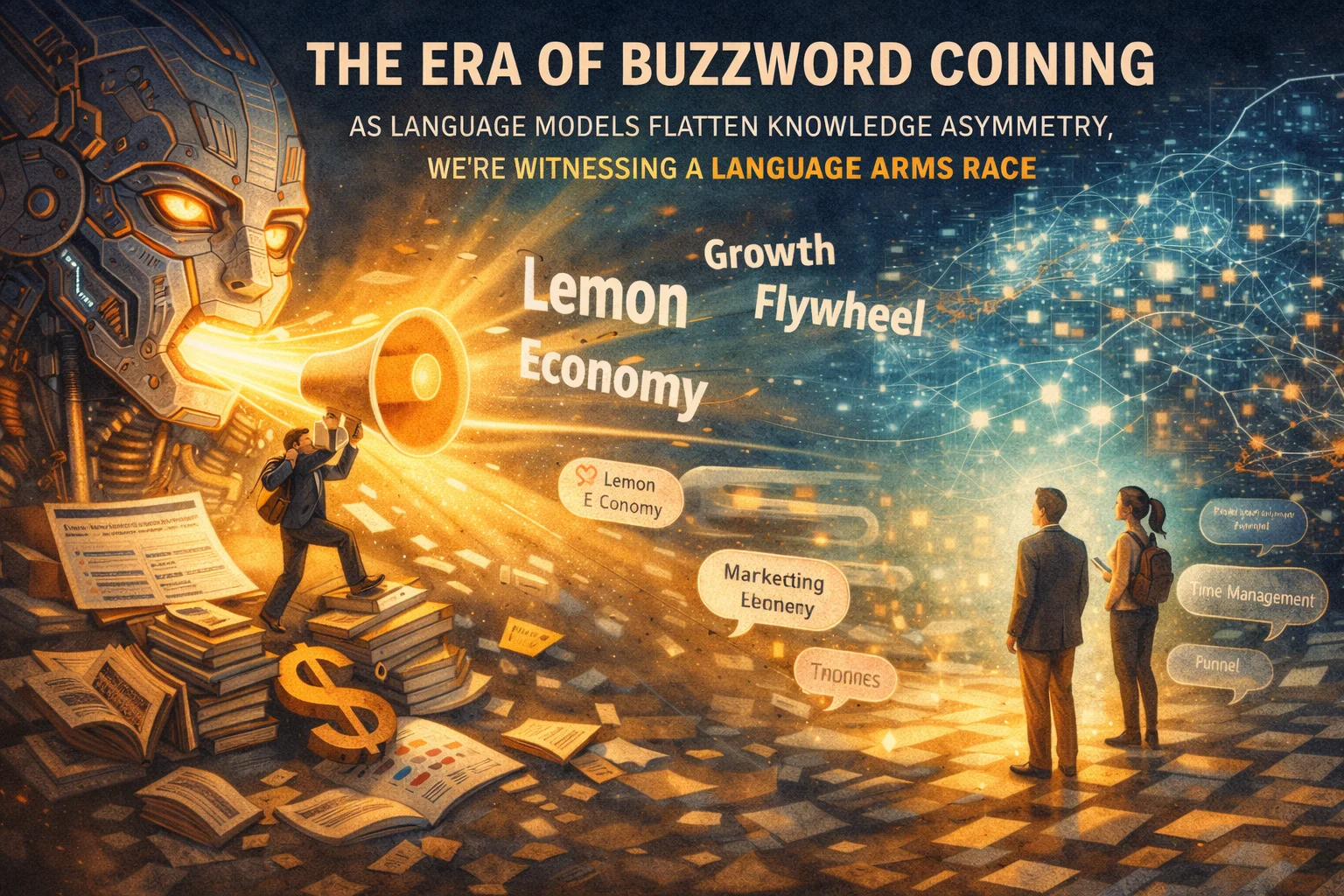
The era of great word creation: When large-scale language models flatten the knowledge gap, we are witnessing a language arms race
Tonight I read 円冏An observation, she mentioned a very interesting phenomenon: those old concepts that have existed for a long time will be repackaged with new terms every once in a while, and they actually tell the same truth. She further deduced that this behavior of coining new words will intensify in the AI era, because large language models (LLM) are cruelly crushing the information asymmetry space on which knowledge payment depends.
After reading it, I feel that this observation is very accurate, but it is also worthy of further exploration from the perspective of communication studies to see what the essence of this matter is? And what does it mean for the future for those of us who work in content production or as lecturers?
Information asymmetry: the original fuel for knowledge payment
To understand why the era of great word-making happened, we must first go back to the most basic economic concept, which is information asymmetry. Nobel Prize winner in economics George Akerlof published in 1970 “The Market for Lemons: Quality Uncertainty and the Market Mechanism> In the paper (The Market for Lemons: Quality Uncertainty and the Market Mechanism), it is explained how the information gap between buyers and sellers affects market operations. The business model of paying for knowledge is, to put it bluntly, based on this gap: you don’t understand what I know, or you know it but can’t use it. The gap in between is the space you are willing to pay for.
In the past two or three decades, knowledge workers could live a good life based on this gap alone. A marketing consultant can rely on AARRR Pirate Model After several years of experience, a lecturer who specializes in teaching management can teach multiple versions of the PDCA cycle for classes. This is not to say that they don’t have real skills, but that “explanation” is valuable in itself – translating difficult theories into language that the audience can understand and operate. This kind of translation ability was scarce in the past.
However, the emergence of large language models has changed the rules of the game. When anyone can open ChatGPT and ask “What is AARRR” and get a well-structured answer within thirty seconds, which is even clearer than many lecturers, the value of the explanation is greatly diluted. This does not mean that explanation ability is no longer important, but that pure knowledge transfer is no longer enough to support the paid market.
When anyone can get a fully structured answer from AI in thirty seconds, the value of “explanation” is greatly diluted. Simply transferring knowledge is no longer enough to support the paid market.
Looking at word creation from the perspective of communication studies: the struggle for symbolic power
Let us change a perspective and look at this matter from the perspective of communication studies. French sociologistPierre Bourdieu Bourdieu proposed an important concept: Symbolic power (symbolic power). To put it simply, whoever can define words and name phenomena has an invisible power. In academia, this is called the right to speak; in the business world, this is called brand positioning; and in the field of knowledge payment, this is the origin of creating new terms.
When a writer or lecturer invents a new term, such as changing empathy to empathy, or changing customer journey to experience flywheel, what he is doing is essentially establishing symbolic barriers. This new vocabulary is like a key. Only those who have learned it know which door this key opens? For people who haven’t learned it yet, they don’t even know what keywords to use to search or ask questions, so naturally they can’t let AI help them bypass the paywall.
Well, this is nothing new. In fact, the academic community has already been doing similar things! Every academic field has its own terminology system, and it takes a lot of time for a layperson to just understand the vocabulary. But academic jargon exists for at least one good reason: accuracy. Academic concepts require precise definitions to avoid ambiguity, which is a necessary cost of knowledge accumulation. The problem is that words in the business world are often created not for accuracy, but to create a sense of mystery, and to make the audience think, “Wow, this thing sounds so awesome, I must learn it.”
This reminds me of the past when I was a reporter. The media are also masters of word-making! The media especially likes to combine traditional concepts with emerging technologies or phenomena to quickly label an emerging trend. For example, have you heard of the delivery economy, slash youth or cloud supermarket?
Whoever can define words and name phenomena has an invisible power. The essence of coining new words is a battle for symbolic power.
Issue setting and framing effect: Communication logic of old wine in new bottles
From the perspective of the Agenda-Setting Theory of communication studies, creating new terms has another function. This theory proposed by Maxwell McCombs and Donald Shaw in 1972 tells us: The media does not necessarily determine what people think, but can it effectively determine what people think? In other words, when you invent a new word and successfully make it popular, you set an agenda and get people talking about what you define, not what others define.
This explains why every few years, the same concept reappears under a different name. Not because the concept itself evolved, but because the attention market needed new stimulation. In communication science, this is closely related to the framing effect - the same information, presented in different frames, will produce completely different cognitive effects. It’s like changing the name of time management to energy management, and changing the name of marketing funnel to growth flywheel. The principles are not much different, but the feeling is completely new. The human brain is born to respond to novelty. This is an instinct left to us by evolution, and the creation of new terms takes advantage of this instinct.
However, in the era of AI, the effectiveness of this strategy is accelerating. Because a large language model itself is a huge de-framing machine - if you ask it any newly coined word, it will try to reduce it to the most basic concepts to explain. When energy management is reduced by AI to time management plus the allocation of physical strength and attention, the carefully packaged mystery instantly disintegrates.
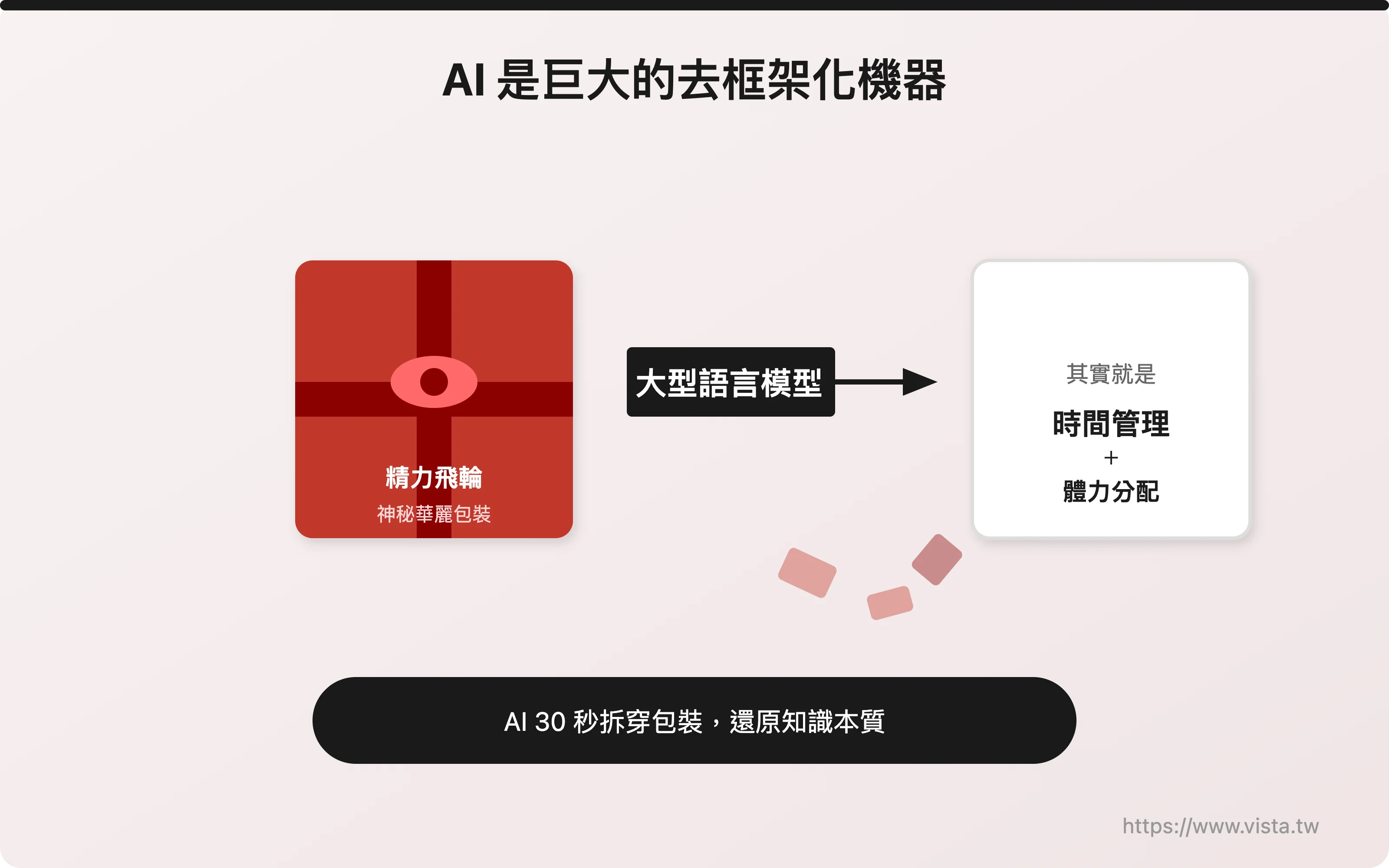 ▲ Large language models are huge de-framing machines: any newly created vocabulary will be reduced to the most basic concepts by AI
The cycle of commodification and decommodification of knowledge
This brings me to an important point in the political economy of communication. Vincent Mosco discusses noreferrer”>Information commodification pointed out that the reason why information can become a commodity is that it is given exchange value. The premise of exchange value is scarcity.
In other words, what large language models are doing now is essentially de-commodification of a large amount of knowledge. Knowledge explanations that you had to pay to obtain in the past are now available for free. This impact on the paid knowledge industry is just like the impact of streaming platforms on the recording industry - it is not that the content disappears, but that the cost of obtaining the content approaches zero, making it difficult to maintain the original business model.
Faced with this situation, knowledge workers have two paths to take. The first way is the neologism strategy observed by 冏冏 - recreating information asymmetry by inventing new terms, so that AI cannot answer directly for the time being. This is an attempt at re-commodification, using new symbolic clothing to repackage old knowledge into merchandise that can be sold.
But there’s a fatal problem with this path: It’s an arms race you can never win. Because the training data of large-scale language models are constantly updated, the new words you create today may be included by AI three months later. You have to constantly create newer words to stay ahead, but the marginal cost of doing so will be higher and higher, and the marginal benefit will be lower and lower. Worse yet, when coinage becomes a common tactic, consumers become aware of the trick and trust is eroded.
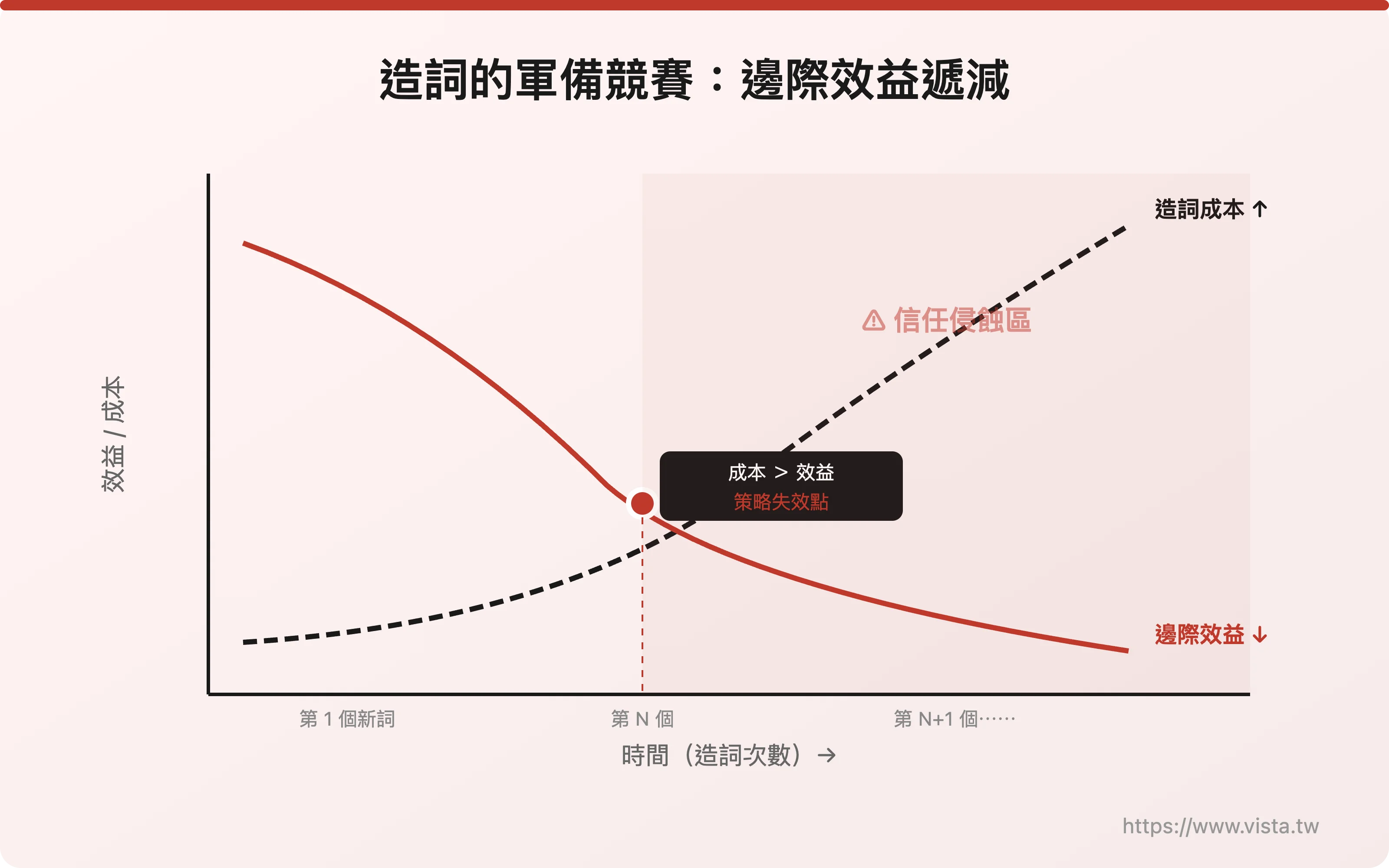 ▲ The arms race of word creation: diminishing marginal benefits, you can never win against a large language model that constantly updates training data
Using coined words to fight AI is like using sandbags to block floods - it may have some effect in the short term, but it is unstoppable in the long term.
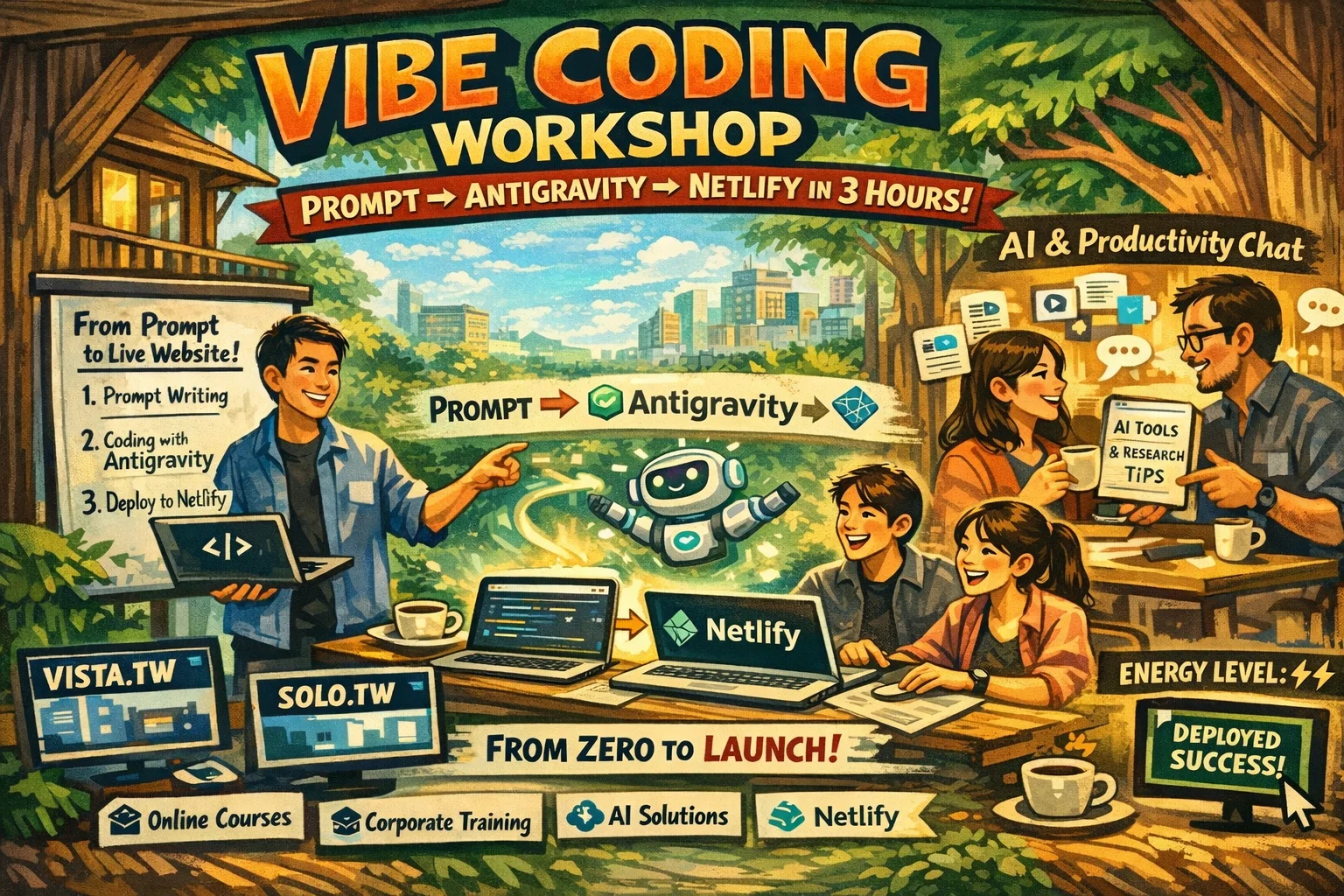
💡 **Want AI to be your superpower multiplier, not just a translation machine? **
I have opened a Vibe Coding Practical Workshop to take you from scratch to use AI to create your own digital product in 3 hours. There is no need to learn programming, as long as you bring your professional knowledge and ideas, you can turn the ideas in your mind into works that can actually be launched online.
From knowledge transfer to experience transformation
The second path, and the one that I think really has a future, is to base value on something that AI can’t easily replicate. Well, what do these things include?
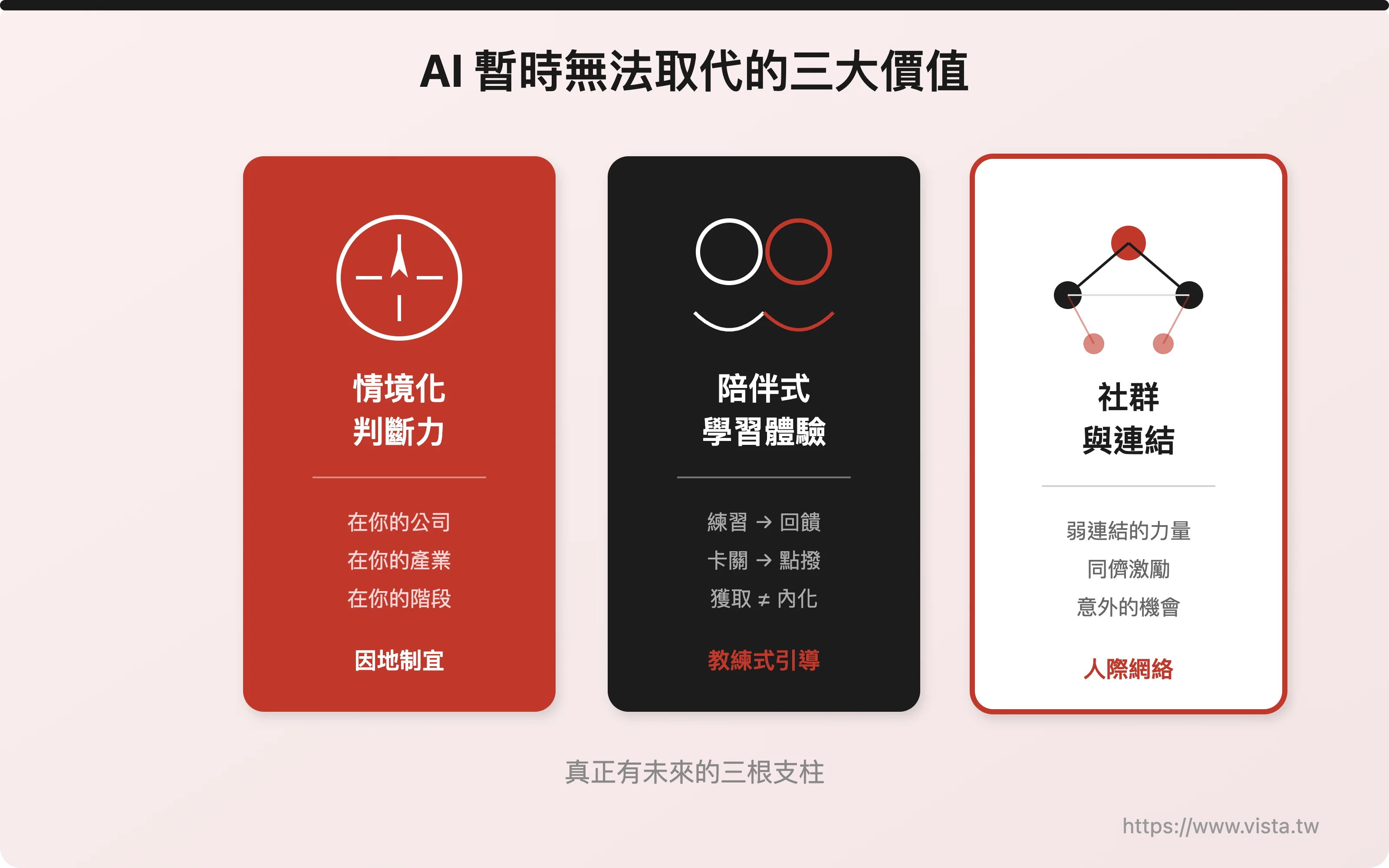 ▲ Three major values that AI cannot yet replace: contextualized judgment, accompanying learning experience, and community and connection
First, there is situational judgment. Although AI can tell you what the five steps of the AARRR model are, it cannot tell you: When you are in this company, this industry, or this stage, which step should you focus your resources on first? This kind of judgment based on local conditions comes from a large amount of practical experience and a deep understanding of specific situations, which cannot be completely replaced by large language models at present.
Secondly, it is a companion learning experience. Acquisition of knowledge and internalization of knowledge are two different things. You can get the definition of AARRR from the AI in thirty seconds, but to really learn how to use it, you need practice, you need feedback, and you need someone to nudge you when you get stuck. This coaching value obviously cannot be completely replaced by a large language model. This is also a point I have repeatedly emphasized in this article turn teaching into long-term assets.
Third, it’s community and connection. People buy online courses, sometimes not just for the knowledge itself, but also to establish connections with people who are also learning about the subject. This is an American sociologistThe power of weak ties advocated by Mark Granovetter in 1974 - classmates met in courses and partners communicated in the community often bring unexpected opportunities and resources. AI can answer your questions, but it can’t help you build these networks.
The acquisition of knowledge and the internalization of knowledge are two different things. AI can give you answers, but it can’t accompany you on the journey from “knowing” to “doing”.
Paradigm shift in communication ecology
From a more macro perspective, what we are experiencing is actually a paradigm shift in the communication ecology. The past knowledge dissemination model was a one-to-many broadcast style: an expert stood on a podium and explained concepts to a group of listeners. The value of this model lies in translation and screening, that is, letting experts help you select the important parts from the vast information, and then translate it to you in a language you can understand.
But now, the large language model itself is a super translator and filter, and it does not rest, charge, or be impatient 24 hours a day. Having said that, this means that the value chain of knowledge dissemination must be reconfigured. The simple steps of translation and screening will be largely replaced by AI; but those steps that require unique human abilities, such as creativity, empathy, judgment, and interpersonal connection, will become more precious.
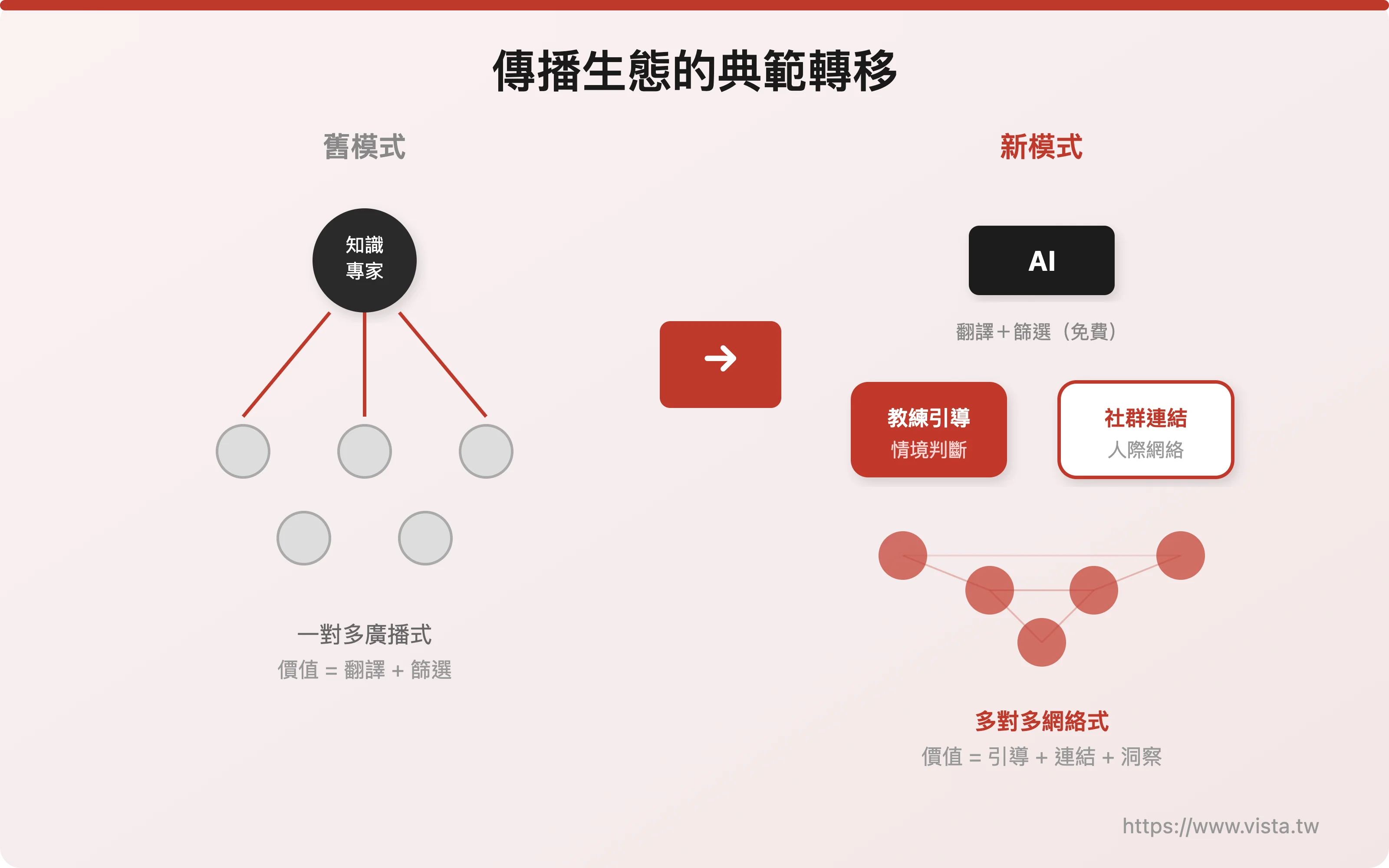 ▲ Paradigm shift in communication ecology: translation and screening are replaced by AI, making creativity, empathy and interpersonal connections more precious
Communication scholarManuel Castel (Manuel Castells) in “The Rise of the Network Society” mentioned a point: In the information society, real power lies not in possessing information, but in being able to organize and interpret information. In the age of AI, this perspective becomes even more relevant. When everyone has access to the same information through AI, the key to differentiation lies in how you organize this information, how you turn it into actionable insights, and how you make the right judgments in specific situations.
In an information society, real power lies not in possessing information, but in being able to organize and interpret it.
Zang’s disapproval of the era of great word creation
Going back to Ji Ji’s observation, I think that the creation of new terms is not a sin in itself.
After all, language is alive, and new vocabulary reflects new perspectives of thinking. This is a normal phenomenon in the evolution of language. It’s like I often see young college students wearing cute baby bags on their backpacks on college campuses recently. To be honest, I had never heard of this term a few years ago. Later, I learned that this originally originated from the Japanese pain bag (pain bag) culture.
So, the question is one of motivation and proportion. If a new vocabulary does capture some subtlety that was difficult to express in the past, it has value. But if the only purpose of coining words is to confuse people and create payment barriers, then it is disrespectful to learners.
From a communication ethics perspective, knowledge workers have a responsibility to make knowledge easier to understand, not harder. When coining words becomes a defensive strategy, and when course titles are deliberately written so that people cannot understand what they mean, this is actually passing on the cost of communication to learners. This is contrary to the basic spirit of communication science—making information circulate more effectively.
Of course, I understand the anxiety of knowledge workers. When you spend ten years accumulating expertise that anyone can get for free from AI in thirty seconds, the feeling of being hollowed out is very real and painful. However, using coined words to fight AI is like using sandbags to block floods - it may have some effect in the short term, but it is unstoppable in the long term. This is also the view I shared in Freelance Survival Guide in the AI Era - rather than fighting the wave, it is better to learn to surf.
Rather than coining new words, it is better to create irreplaceable value
It is true that the era of great word creation is indeed happening, and it will intensify in the short term. But in my opinion, this is a transitional phenomenon after all. When the market is flooded with more and more new words that people cannot understand, consumers’ discernment will also increase. Those who survive in the end will not be those who are best at coining words, but those who can truly help learners solve problems and create changes.
 ▲ The real moat: It’s not that you understand the theories that others don’t understand, but that you can lead others through a road that they can’t go alone.
For myself, the path I have chosen is clear: instead of spending time creating a new term that AI cannot answer, I would rather spend time designing a teaching experience that truly benefits learners. Instead of worrying about AI giving away my knowledge for free, I would rather think about how to use AI to amplify my teaching effect. After all, AI is a tool, not an enemy. What truly makes knowledge valuable is never the term that packages it, but whether it can truly change a person’s thinking and actions.
In this era where AI is flattening all information gaps, the most important moat for knowledge workers is not that you understand theories that others do not understand, but that you can lead others through a path that they cannot walk alone. As for this road, no large-scale language model can complete it for you yet.
What truly makes knowledge valuable is never the term that packages it, but whether it can truly change a person’s thinking and actions.
💡 **Instead of creating new words, it is better to create your own AI content system. **
I have condensed many years of content production experience into an AI content production system workshop to help you build a complete AI writing and distribution process from scratch. There is no need to create new words to package old knowledge, but let your original ideas reach more audiences in a systematic way.
👉 Learn about the AI content production system workshop now →