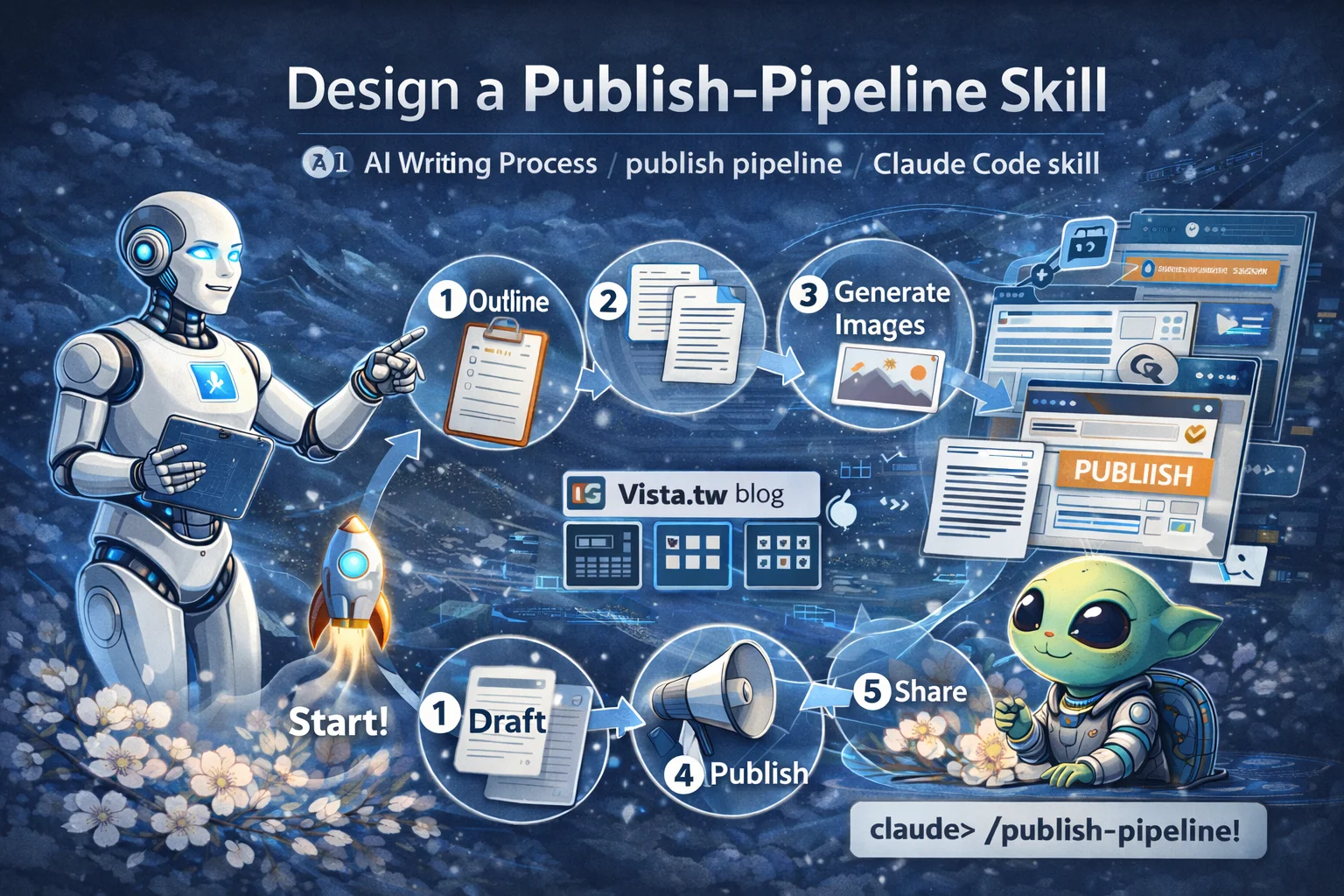
When AI not only helps you write, but also helps you research, format and publish: the content production line I built with Claude Code
Do you use AI to write articles?
If you are like most people, the process may be like this: open ChatGPT or Claude, paste a command, wait for it to generate a first draft, then spend an hour or two by yourself to modify, retouch, find pictures, format, and finally manually paste it to the blog backend for publication.
To be honest, this is already much faster than writing it from scratch. But every time I go through this process, a thought always pops up in my mind: Can the repetitive steps in the middle—checking information, organizing outlines, converting image formats, uploading, and setting tags—can also be handled by AI?
A few months ago, I found the answer. And this answer completely changed the way I produce content.
Let’s talk about the results first: one article from concept to online in one hour
Before sharing the method, I want to let you know the results first, because the results are the reason why you decide whether to continue reading.
Imagine writing a long article like the one you are reading now. The whole process is roughly like this: one hour to find information, half an hour to write an outline, two hours to write a first draft, one hour to revise and polish, half an hour to find pictures and illustrations, and half an hour to adjust formatting and publish. That adds up to five to six hours less talk. If you come across a topic that requires a lot of citations or cross-field research, it’s not surprising to spend a whole day on it.
What now? An article of the same quality can be completed in about an hour. Not because writing is faster, but because almost all of the tasks that are “not writing” have been automated.
The time saved can be used to do the really important things: thinking about opinions, telling stories, and incorporating your own experiences into words. Currently, no AI can do these things for people.
The real efficiency improvement is not to let AI write for you, but to let AI handle everything except writing for you.
Key Turn: From Conversational AI to Command Center
The turning point was when I started using Claude Code.
Most people’s impression of AI writing tools is still in the dialog box - you give it a command and it replies with a text. It’s like sending a letter to a very smart assistant who can only tell you one thing at a time. Efficiency has improved, but the ceiling is obvious.
Claude Code is different. It’s not a dialog box, but an AI command center that can operate multiple tools on your computer at the same time. It can read your files, search for information on the Internet, execute programs, and connect various software, and these things can be completed in one go.
For example: If ChatGPT is a remote assistant that you use LINE to communicate with, then Claude Code is a full-time assistant who sits next to you and can directly operate your computer.
This difference makes the whole thing completely different.
My content production line: complete breakdown in five stages
Next, I’ll use an article I wrote recently as an example to walk you through my complete process.
Phase 1: Research (10 minutes)
In the past, researching a topic meant opening a dozen browser tabs, jumping back and forth between Google Scholar, major media, and blogs, and taking notes while reading. This stage alone can take an hour or two.
Now, I only need to say one sentence to Claude Code, such as: “Help me research the topic of “Changes in Payment for Knowledge in the AI Era” and find out key trends, representative cases and academic opinions.”
It automatically searches the Internet, reads multiple articles, organizes structured research summaries, and even helps me mark which ideas come from which sources. Ten minutes later, instead of a bunch of scattered links, I had a digested research brief.
But the most important step is here. I will not directly adopt the conclusions compiled by AI. I’ll skim through the brief and pick out ideas that resonate with my own experience, ideas that conflict with it, and ideas that I think readers will particularly care about. Then write down my own opinion in a sentence or two next to it.
This step cannot be omitted. Because if you skip your own thinking, the article is just the output of AI, not your creation.
Phase 2: Outline and First Draft (15 minutes)
With the research material and my own opinion notes, the next step is to generate an outline.
I would throw the research brief, along with my ideas, to Claude Code and ask him to come up with an outline for my article. But here’s a trick: I won’t let it flow freely, but will give it clear framework instructions, such as “Organize it with the structure of ‘Observation → Analysis → Strategy → Story → Conclusion’” or “Start the first paragraph with an everyday scene that resonates with the reader.”
These frameworks were slowly explored after I wrote thousands of articles over the past few years. The AI fills in the content, but I decide the bones of the narrative.
Once the outline is confirmed, I let it unfold directly into a first draft. This stage takes about ten to fifteen minutes, depending on the length and complexity of the article.
Stage 3: Manual polishing (20-30 minutes)
This is the stage of the process where I spend the most time, and it’s also the most important.
The first draft generated by AI usually has a good structure and roughly correct information, but it lacks two things: my voice, and my story.
So I will read it paragraph by paragraph and do these things:
First, add personal experience. For example, the teaching scenes and observations of consulting projects mentioned in this article are all my own real experiences. Only I can write these things. No matter how AI edits them, they will never be as warm as they are.
Second, adjust your tone. AI writing is usually more formal and textbook. I would change it to the way I speak myself—more colloquially, more directly, and occasionally a little self-deprecating. If you often read my articles, you should recognize that smell.
Third, delete the nonsense. AI likes to add some sentences that seem reasonable but actually have no information, such as “In this era of rapid change” and “It is undeniable.” Delete all of these. Readers’ time is precious.
Fourth, add internal links. I will think back to relevant articles I have written before and embed the links naturally. This is not just for SEO, but also for readers to follow the context and understand a certain point in depth.
The soul of the article belongs to you, AI just helps you put together the skeleton. If you omit the polishing step, readers will see it at a glance.
Stage 4: Image processing (5 minutes)
This stage used to be one of the most annoying chores.
I need to format each image (convert to WebP to speed up page loading), resize, name, and put it in the correct folder. Each picture takes about three to five minutes. If an article has five or six pictures, it will take half an hour just to process the pictures.
Now, Claude Code does it for me the first time. It will automatically convert the image into WebP format and put it in the correct directory. I only need to quote it in the article. Five minutes, all done.
Phase Five: Release (2 minutes)
The last step is also the most exciting step.
My blog is built using the Astro framework and deployed on Cloudflare Pages. The process of publishing an article is: write the Markdown file → git add → git commit → git push. After pushing it up, GitHub Actions will automatically build and deploy it for me.
Claude Code was able to help me with this entire process. After writing the article and processing the pictures, it will automatically commit and push it up for me. Two minutes later, the article was online.
From start to finish, I don’t need to open any background, manually upload any files, or configure anything.
The core of this system: not tools, but thinking
After reading this, you may think that this process is very powerful and want to learn Claude Code immediately.
But I have to pour cold water on you first:Tools are just the surface, thinking is the core.
我观察到很多人在使用 AI 写作工具时,犯了一个根本性的错误:他们把 AI 当成替代品,而不是加速器。 They want AI to write the perfect article directly for them, and then they just need to press the publish button.
The content produced in this way can be seen by readers at a glance. Because it has no point of view, no warmth, and no story. To put it bluntly, you can’t remember anything after reading it.
I do exactly the opposite. I regard AI as the most powerful administrative assistant in the world, letting it handle everything that does not require my own hands: checking information, doing preliminary sorting, converting image formats, and executing deployment instructions. As for me, I focus on what only I can do: deciding opinions, telling stories, injecting personal experience, and polishing the warmth of words.
This distinction is very important. If you do it the other way around, you’ll end up with a bunch of AI articles that look professional but sound hollow. If you get it right, you’ll have an article that has your soul in it, only it’s five times more productive.
What AI can replace is your administrative work, but what it cannot replace is your life experience and unique perspectives. If you distinguish this line clearly, you will not be replaced by AI, but will be empowered by AI.
You don’t need to know how to program
Seeing this, you may be worried: Claude Code sounds very technical, and I am not an engineer. Is it useful?
I completely understand this worry, because I thought the same way at the beginning.
But the truth is, the way Claude Code operates is by typing. You tell it what you want to do in natural language, and it does it. You don’t need to write any code, just like you don’t need to understand engine principles to drive a car.
Of course, some advanced features do require a bit of configuration, such as installing Skills (you can think of it as a plug-in for AI) or connecting to MCP (a protocol that allows AI to communicate with your note-taking software). But these settings usually only need to be done once, and Claude Code itself walks you through it.
If you can use LINE to send messages, you have the ability to use Claude Code. The bar is really not as high as you think.
💡 **Want to learn this entire content production line and apply it directly to your work? **
I have opened an AI Content Production System Workshop to take you through the complete process from research, writing, multi-format output to cross-platform distribution. Don’t just listen to ideas, but build your own AI content system on the spot, so that an article can automatically turn into six outputs.
👉 Learn about the AI content production system workshop now →

This is not the end, it is the starting point
The process I’m sharing now is actually still evolving.
Next, I plan to integrate the output of the e-newsletter - the core points of the same article will be automatically rewritten into the format and length of the e-newsletter and pushed directly. The next step may be the automatic generation of social posts: a long post is automatically split into five short posts suitable for different platforms.
These things are completely technically feasible, they just take time to adjust and optimize.
Moreover, this method is not only suitable for blogging. If you are a consultant doing market research, a lecturer in education and training, a content marketing planner, or any worker who needs to produce a large amount of text content, the logic of this “AI content production line” is applicable.
The only difference is that your raw materials and output format are different, but the structure of the production line is the same.
The future of content creation is not about choosing between humans and AI. Instead, humans are responsible for the soul and AI is responsible for efficiency. This combination will make creators more powerful than ever.
Extended reading:
- Ulysses + Claude + MCP: Create an AI-driven smart writing system to double productivity
- I no longer “write” a diary: AI lets me use “talking” instead, turning life into a database
- In the AI era, should you follow the trend and transfer knowledge, or delve deeper into originality?
- The era of big word coining: When large language models flatten the knowledge gap, we are witnessing a language arms race