Tools will change, but principles will last: Read "Click to Grow" by Meta Marketing Chief Schutz to regain your judgment in digital marketing
 (opens in a new tab)
*▲ Meta Marketing Chief Alex Schutz’s new book “Click to Grow (opens in a new tab)” not only talks about advertising, but also negotiation. *
It has been several years since I wrote a digital marketing column in “Economic Daily. I sometimes lose track of it myself. But one thing I remember clearly is that over the years, I’ve watched too many new tools be touted as the future of marketing, only to be transformed into another forgotten label after the craze wore off.
For example, from the early EDM to the later LINE official account, from Facebook fan page to Instagram (opens in a new tab) Reels, and then from Google Ads to ChatGPT ad generation - the tools are constantly changing, but outstanding marketers are always a rare resource.
So, when I opened Meta Marketing Chief Alex Schultz’s new book “Click to Grow: Meta Marketing Chief Personal Instructor, Complete Guide to Digital Advertising Placement, Conversion, and Data Analysis (opens in a new tab)” (Click Here), I was not looking for new tricks, but wanted to see a key figure who led Facebook to grow from a few million users to more than 3 billion daily users. What principles did he adhere to that will not be eliminated by the times?
After reading this, I can summarize it this way: This is not a tool book that teaches you how to place ads, but a book that helps you build judgment. Its real value is not to tell you which platform to use now, but to let you see clearly: When the tide recedes, what is truly effective in marketing?
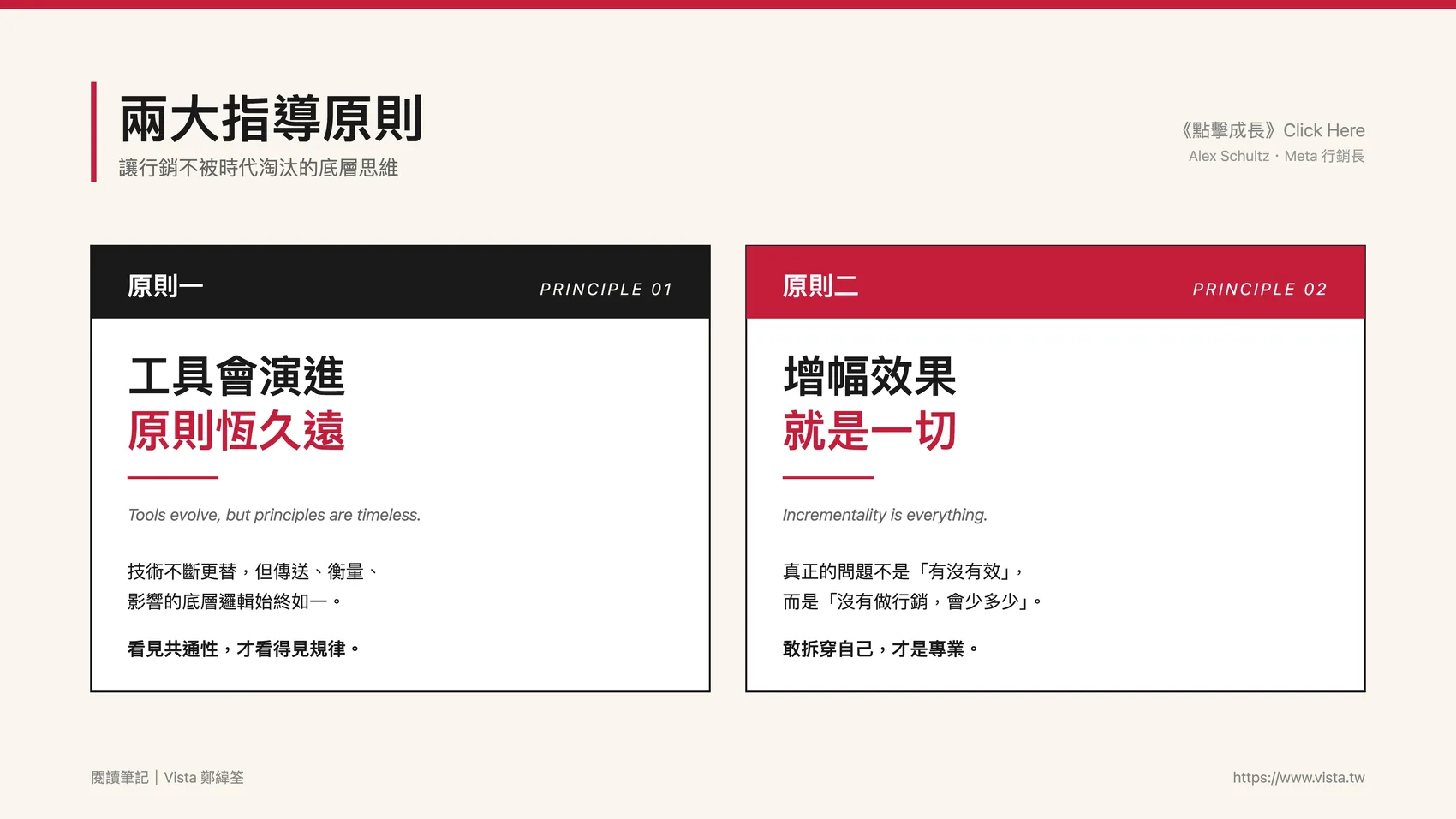 *▲ The essence of the entire “Click to Grow” can be condensed into these two compasses. *
Principle 1: Tools will evolve, principles will last forever
The first guiding principle proposed by Schutz, I think is worthy of every marketer to write down in his work notes: “Tools will continue to evolve, but the principles are eternal.”
He used a very wonderful case to illustrate this matter. Push notifications on mobile apps may seem like a brand new marketing tool, but they are actually the latest descendants of a long lineage. In the 1980s and 1990s, marketers sent DMs—through the post office to doorstep mailboxes. The address must be current, the letter must be compelling to open, and each email must be paid for, so marketers must be able to demonstrate the incremental benefit of sending an additional email.
In the 2000s, DM was digitized and turned into E-mail. Shipping has become virtually free and email headers have become the new opener bait, but you still need a correct email address and messages can be marked as spam.
Then in the 2010s, marketers began to use text messaging (SMS) on a large scale. Conveyable messages are shorter, and like traditional email, you have to pay for each text message. Of course, being marked as spam is still a threat.
In the 2020s, push notifications became the new favorite. But essentially, you’re still doing the same thing: getting the right message to the right person at the right time, and you need to be able to prove that this delivery has a real impact.
In other words, the tool has been changed from sending letters to a notification center, but the underlying logic of delivery, measurement and impact has not changed at all.
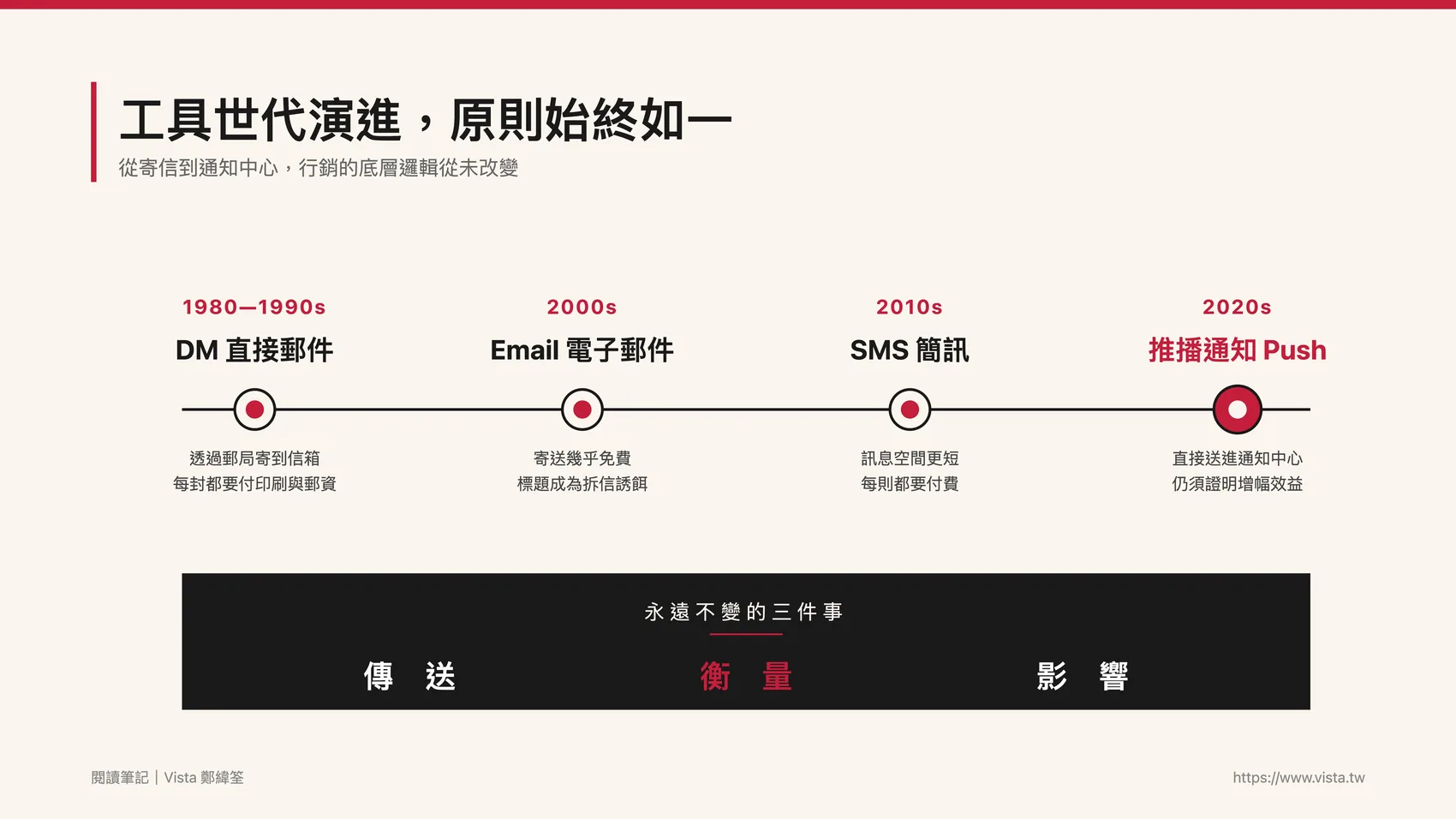 *▲ Tools continue to evolve from generation to generation, but the underlying transmission, measurement, and influence logic remain the same. *
The reason why I am particularly touched by this observation is that it echoes a common dilemma I saw at the consultation site for small and medium-sized enterprises in Taiwan: many business owners feel anxious when they hear about new tools, and are deeply afraid that they will be left behind by the times; but what they really lack is not tools, but a yardstick to judge the quality of tools. When you master the underlying principles, you will find that the so-called new tools are actually just old problems with changed interfaces, and you have already been able to deal with them.
Principle 2: Amplification effect is everything
If the first principle is the pattern, then the second principle is the sharp knife, which directly cuts through the fatness of many marketing budgets.
The second principle proposed by Schutz is: “Incremental results are everything.” Translated into vernacular, it means asking yourself a cold question-if I didn’t do this marketing, would the results still happen?
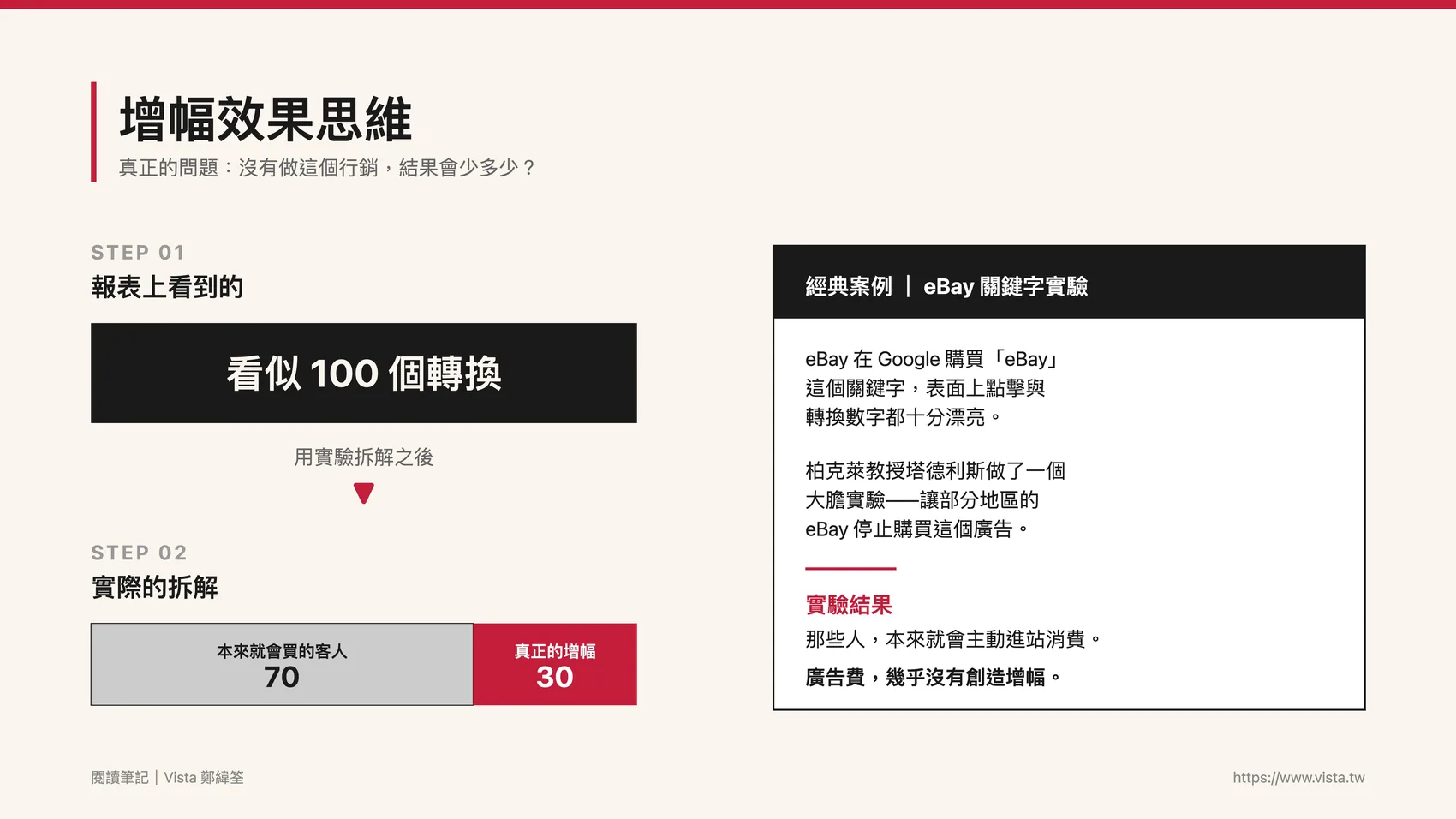 *▲ The thinking of increasing effects is the sharpest knife to test the marketing budget. *
The most classic case in the book comes from the research done on eBay by Professor Steve Tadelis of the University of California, Berkeley. At that time, eBay purchased the eBay keyword on Google so that searchers could click in directly. On the surface, the click and conversion numbers look great, and the ads appear to be creating value. But Tadelis designed an experiment to stop eBay in some areas from buying this keyword advertisement - and found that those people would have opened the browser, entered eBay, and clicked in to make purchases. In other words, what eBay spends a lot of money to buy is a group of customers who would buy in the first place.
If we put this story in the context of Taiwan, the results are simply shocking. How much of our advertising budget is actually spent on repeat customers who will come to us on their own? How many seemingly beautiful clicks and conversions are actually just actions that have already occurred and are recorded again in the report?
Another more dramatic case is Uber. At the height of the ride-sharing war in the late 2010s, Uber invested hundreds of millions of dollars in advertising budgets. Kevin Frisch, then chief marketing officer, did a brave thing - he turned off some of the advertising that was thought to be driving growth, only to find that the growth numbers were barely affected. After digging deeper, he discovered that some partners were cheating the system, pretending that users who would have signed up were the results of advertising, thereby fraudulently claiming millions of dollars in bonuses. Uber sued and won, saving hundreds of millions of dollars in the years that followed.
After reading this, I put down the book and walked to the kitchen to pour a glass of water.
Because, behind this principle, there is actually a deeper reminder: The most addictive thing for marketers is never the tools, but the illusion of “I think I am effective.” We chase the beautiful numbers on the dashboard, but rarely ask, “How much less would this number be without me?” We celebrate the conversions brought about by advertising, but we fail to distinguish between those who are buying in the first place and those who are buying because of the ads.
And the so-called professionalism, to a certain extent, means having the courage to expose yourself.

🛰️ Want someone to accompany you to see clearly in the wave of AI changes?
Almost all the public articles you see are finished products after repeated polishing. But what I cherish the most is the warm judgment before the finished product - this is the reason why I created Vista AI Inspiration Supply Station (opens in a new tab): a weekly thought note for fellow travelers in the AI era, sharing those Yoshimitsu Kataha that will not appear in formal articles with you who are willing to get closer.
👉 Subscribe now and receive weekly emails → (opens in a new tab)
From North Star to Funnel: Giving Decisions a Coordinate
In the first part of “Core Fundamentals of Marketing,” Schutz talked about two concepts that I think are very suitable for inclusion in corporate internal training: North Star and Marketing Funnel.
North star goals do not refer to beautiful KPIs, but the long-term direction that a company should really pursue. An e-commerce company’s North Star may not be the number of orders placed, but annual active users; a media company’s North Star may not be daily active traffic, but the renewal rate of paying subscribers. If you choose the wrong North Star, all your efforts will be pulled back by the wrong numbers.
The marketing funnel tells us that customers’ decision-making is not a straight line. From awareness, interest, consideration, conversion to loyalty, each stage has different measurement focus and content requirements. The blind spot of many small and medium-sized enterprises in Taiwan is to put all their budgets at the bottom of the funnel - that is, the order conversion stage. You may see results in the short term, but in the long term you will find that without the accumulation of cognition and trust from the top, the switching costs at the bottom will only get higher and higher.
I often tell my clients or students: Real growth is to allow each layer of the funnel to flow smoothly. The valuable thing about this book is that it breaks down this sentence into actionable steps.
Strategy map of the four major pipelines
In the third part of the book, Schutz breaks down what he sees as the four most critical marketing channels: product-led growth, alliance partners, search engines, and social media.
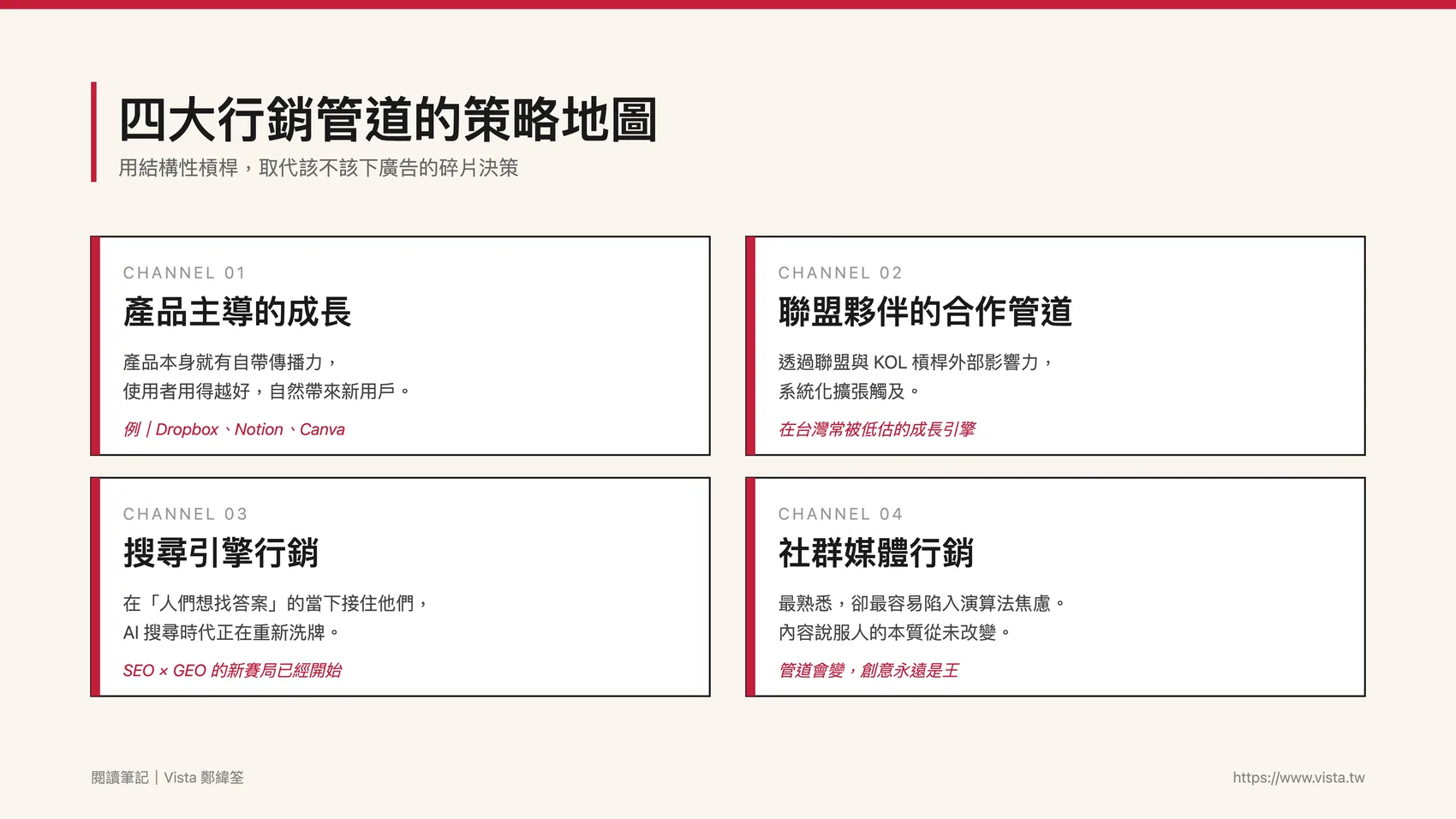 *▲ Instead of asking whether you should place Meta ads, it is better to ask first: What structural levers should my growth mainly rely on? *
The reason why this structure is worth remembering is that it helps you get rid of the fragmented question of whether you should place Meta ads, and instead switch to the strategic perspective of which structural levers my growth should mainly rely on.
For example, product-led growth means that your product itself has its own communication power - when users use it better, it will naturally bring in new users. Dropbox’s early two-way reward recommendations, Notion’s template sharing, and Canva’s collaboration functions are all textbook examples. For Taiwan’s SaaS and content creators, this path is often more sustainable than spending money to buy traffic. When I run these two content websites vista.tw and solo.tw (opens in a new tab), I also regard product strength (that is, the value of the content itself) as the most important growth engine.
The cooperation channels of alliance partners are often underestimated in Taiwan. We have a relatively mature KOL and affiliate marketing ecosystem, but many brands still cooperate with each other at the level of giving discount codes to see sales, and do not operate it as a systematic growth engine.
Search engine marketing, with the rise of AI search, is facing a reshuffle. When people begin to use ChatGPT and Perplexity to replace part of Google searches, SEO methods must also evolve accordingly.
Social media can be said to be the battleground that Taiwanese marketers are most familiar with, but also the one where they are most likely to fall into algorithmic anxiety. The author reminds us: the pipeline will change, but the essence of how content attracts clicks and triggers actions will not change.
In the AI era, what has changed and what has not changed
The fourth part of the book talks about the impact of AI on digital marketing. This is also the question I have been asked most frequently during my lectures at universities and companies in the past two years.
I agree with Schutz’s attitude - he does not deny the drastic changes brought about by AI, but he also reminds readers not to be confused by the complexity of the tools. He wrote: “You can win only by mastering the unchanging principles.” This sentence is simply a nail in the coffin at this moment when generative advertising materials, AI automatic placement, and AI search are on the rise.
My own observation is: What AI really changes is not the purpose of marketing, but the cost structure of marketing. Material production that used to take ten people can now be done by one person plus a set of AI tools. A/B testing that used to take a long time can now be accelerated several times using AI. But these changes have made judgment more scarce and more valuable. When everyone can quickly generate a hundred advertising materials, the real difference comes back to whether you can design a truly insightful message?
In other words - AI lowers the threshold for execution, but raises the threshold for strategy. This is also the core reason why I continue to share content strategies at content.tw (opens in a new tab) and accumulate Substack writing notes at vista.st (opens in a new tab): Strategic thinking is the scarce asset most worthy of long-term investment in the AI era.
To SMEs and content creators: Three things you can do starting tomorrow
After reading this book, I sorted out three things that local readers can start practicing immediately:
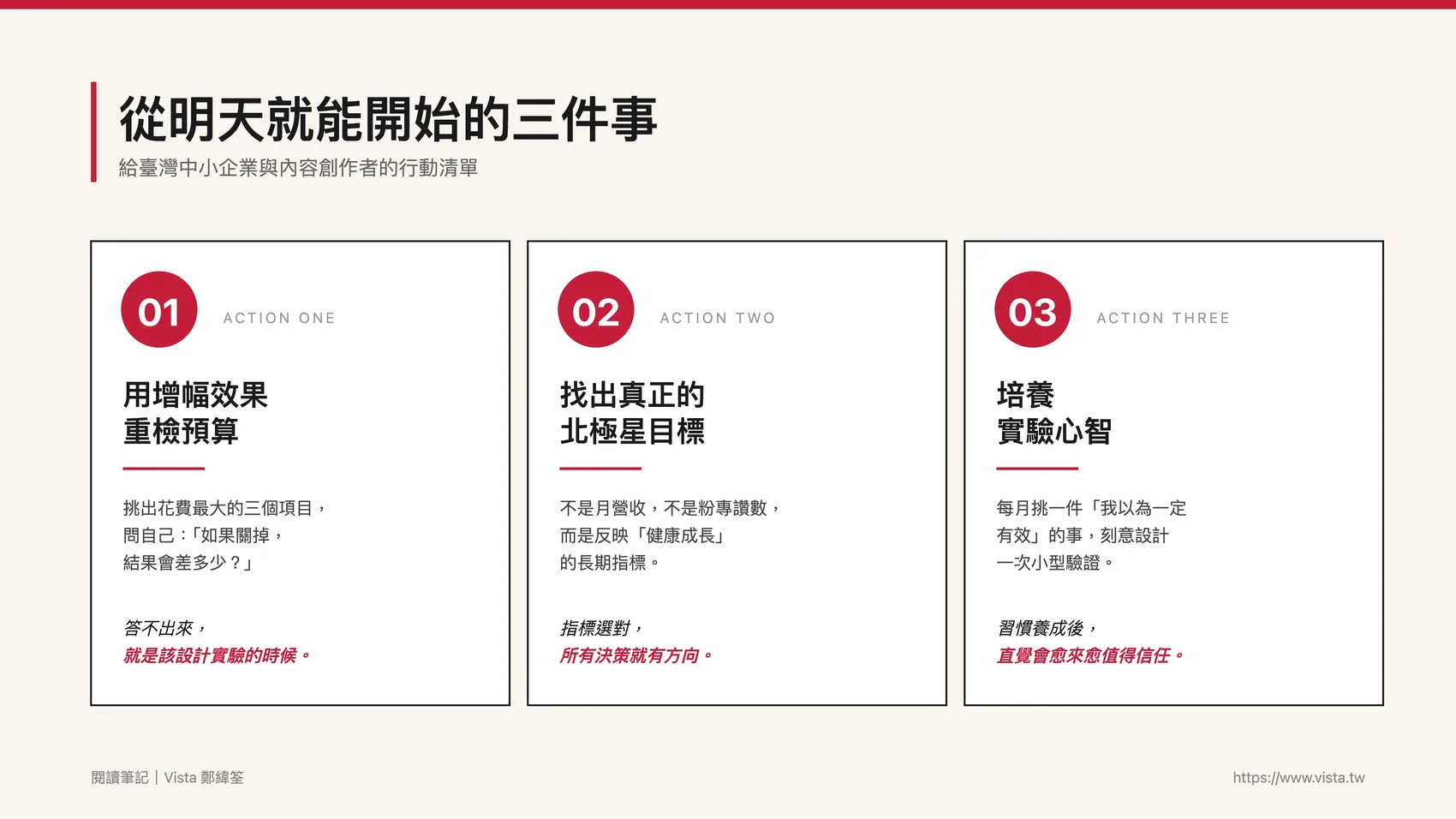 *▲ You don’t have to wait until the next quarter, you can start these three things from tomorrow. *
The first is to re-examine your marketing budget for this year using the thinking of increasing effects. Pick the three most expensive items and ask yourself, “How much worse would the results be if I turned this off today?” If you can’t answer, it’s time to design an experiment. Even just stopping for a week and comparing numbers is more valuable than continuing to blindly invest.
The second is to find the true North Star goal for your career. It’s not monthly turnover or number of likes, but a long-term indicator that reflects healthy growth. For the content community I run, this indicator is not the number of subscribers, but the proportion of members who continue to create and receive feedback. Once the right indicators are selected, all decisions will have direction.
The third is to cultivate an experimental mind. It doesn’t have to be a big A/B test, just choose one thing you think will be effective every month and deliberately design a small verification. After you develop this habit, you will find that your marketing intuition becomes more and more trustworthy.
Conclusion: From click to growth, deeper thinking is required
Back to the title of the book - “Click to Grow (opens in a new tab)” (Click Here). On the surface, this is a book about advertising clicks; but by the end, you will understand that the real key is not the click itself, but what happens after the click: Is the conversion real? Are the results verifiable? Can growth be amplified?
Schutz’s nearly twenty years of experience at Meta allows him to tell readers with first-hand experience: Growth is never luck, but the result of layers of principles, experiments, and rigorous judgment.
For marketers, entrepreneurs, and content creators in Taiwan, I would recommend this book: If you are already proficient in various tools, but feel that you are always doing tactics and lacking strategies - this book will give you the coordinates you need. If you’re just getting into digital marketing, starting with this book will get you further than starting with any short course.
Tools will change and trends will fade, but these two principles - the principle is eternal and the incremental effect is everything - will be your most trustworthy compass in the next ten or twenty years.
If you want to see more of my thoughts on marketing, AI and content creation, welcome to vistacheng.com (opens in a new tab) to get to know me, or follow the vista.tw main website I run, and together we can sharpen our judgment in this changing era.
Next step
Bring this topic to your team
Vista Cheng speaks and runs workshops on AI workflows, writing and content systems for companies, schools and public agencies.