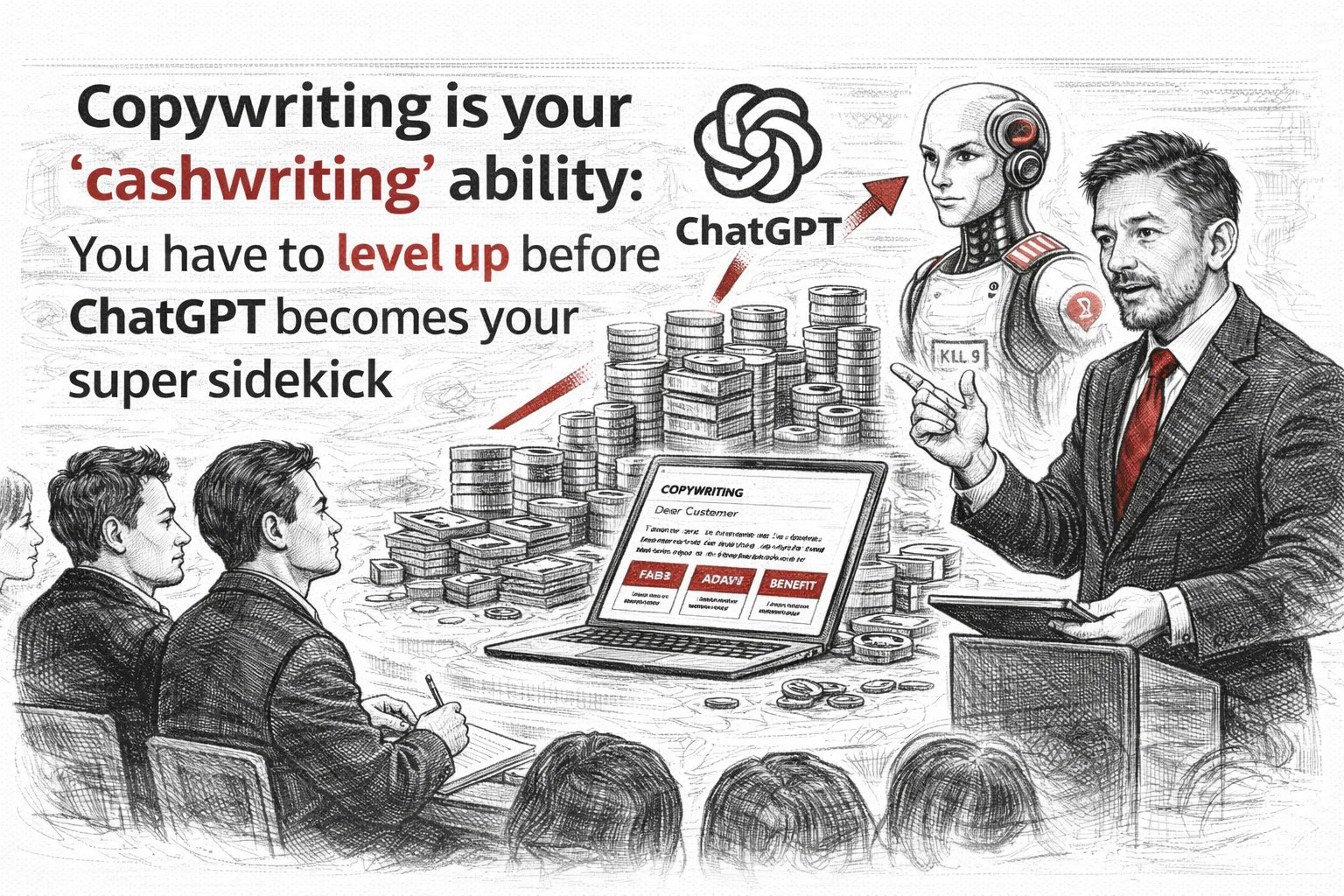
Copywriting power is your “money making ability”: before turning ChatGPT into a godly teammate, you must first make yourself stronger
Editor’s note: This is a summary of the content I shared in a previous lecture held at Hami Bookstore. In addition to sharing with you my new book “Copywriting power is your cash flow ability” What we really want to talk about is a more pragmatic and harsher thing - in an era of scarce attention and content explosion, your copywriting power determines whether you can convert your value into cash flow.
Don’t rush to ask AI to write for you: you must first know why you are writing.
In the past two years, I have seen too many people get ChatGPT, it is like getting a Swiss knife, they want to cut everything, whet everything, and get everything done with it. So the most common sentence is: “Write an article for me.” or “Write a copy for me.”
Yes, you can. It must be written. Let alone one or two articles, even if you write ten articles at a time, it will come out.
But the question is not whether it can be done, but whether it is worth it?
You will quickly discover that the text given to you by various AI tools looks neat, but is like a cup of coffee without aroma. It’s drinkable, but you won’t want to order a second drink.
Because you didn’t make your purpose clear, you didn’t lock in the target, and you didn’t provide a complete situation. Without these three bases, the content you ask AI to produce is essentially text solitaire: the sentences are smooth and the emotions are presentable, but the core is likely to be empty.
Therefore, I repeatedly remind everyone in the lecture: before you open ChatGPT, don’t rush to open your computer or mobile phone. You might as well ask yourself three questions first - why do I write? Who are you writing to? What do you want him to do after reading this?
Once you think about these three things clearly, ChatGPT is likely to become your best friend instead of a language-based noise generator.
If you can’t write the key points in your copywriting, it’s usually not because you are stupid, but because you have stepped on three blind spots.
During the years I have been teaching copywriting and content marketing, the most common question I hear is not “I can’t write” but “I don’t know how to start.”
This kind of stuck is often not a problem of ability, but a problem of thinking.
**The first blind spot is thinking that writing is too difficult. **
Many people regard writing as a talent and expression as a talent, so they mentally sentence themselves to death before they even start writing. But I want to be more straightforward: the focus of workplace writing has never been on writing style, but on explaining things clearly and conveying value to the other person’s heart.
**The second blind spot is the misunderstanding that writing is an essay competition. **
You don’t need to write gorgeous parallel sentences, use rare idioms, or pretend to be a “literary person” you don’t know. What you have to do is: let the reader know in ten seconds - what does this have to do with me?
**The third blind spot is that I can’t get to the key points after writing again and again. **
You have a lot of material, a lot of information, a lot of ideas, but they are like a bunch of scattered puzzle pieces. What you lack is not content, but organizational skills: which part is the protagonist? Which piece of evidence is it? Which part is just background sound?
These three blind spots happen to be where ChatGPT can help the most - but the premise is: you must be able to ask questions.
Don’t think of ChatGPT as a search engine: it is an inference engine, not a database
Many people use ChatGPT like Google, throwing in a few keywords at random and expecting it to spit out accurate answers. This is the most common and most disappointing usage.
Because the strength of ChatGPT is not to find information for you, but to organize context for you, make vague ideas clear for you, and turn scattered materials into structure for you. It’s like an assistant who’s good at answering calls, writing, and organizing—but it’s not your company’s internal think tank, nor is it an encyclopedia that’s guaranteed to be correct.
So, you will see it “seriously talking nonsense”. The more vague you ask, the more confident it will answer. The less context you give it, the more it secretly fills in.
The problem is that what it adds is often the source of the error.
Therefore, a better usage strategy is to first confirm whether it understands what you are talking about? You can ask it first and let it express its understanding of the topic; if it answers nonsense, you will know to make up the context instead of going directly into deep water to ask questions.
This small action may seem redundant, but it can often save you half an hour of wasting repeated revisions.
Let AI change from addition to multiplication: you need a framework for asking questions
I often use a metaphor: For people who can use AI, AI is multiplication for them; for people who can’t use AI, AI is just addition for them.
What is addition? It’s like “Please help me think of two sentences of copywriting” - it gives you two sentences, you can change them and then you can deliver.
What is multiplication? You treat it as a “system of joint work”, and let it help you break down the problem, help you find angles, help you formulate hypotheses, help you design A/B test versions, help you catch the differences in tone, and finally you can use your own judgment to finalize the draft.
To do multiplication, you need a question frame. In this lecture, I mentioned a very practical direction: first define the role, then provide the goal, then limit the scope, and then specify the format.
You can ask it to act as a writing coach, a marketing director, a senior editor, or even a picky client. You can also ask it to output in a table, in a six-paragraph structure, or in two tones. The point is not about the bells and whistles, but whether you have directed it towards the output you want?
That’s the nature of asking questions: you’re not just chasing answers, you’re crafting a high-quality conversation.
A 7-11 Slogan, demonstrating what “giving AI good questions” means
I gave an example at the scene: 7-11 used to have a slogan - “Explore the city in the city.” It reads like a charm, but you can’t tell it’s selling coffee.
So instead of asking it directly “Write a few slogans for me”, I added restrictions: it should continue the artistic conception of the original sentence, but not too fancy, and it should be in line with the brand tone. It is best to use a table to present it and provide multiple versions.
As a result, the suggestions it gave, such as “Explore the city and find good coffee” and “7-11 is your best partner for urban exploration”, are actually of a certain standard. There’s no need to mythologize it, of course – it might just be 60 or 70 points, but at least you’re not starting from scratch.
You will find that AI is very strong in the early stage of generating ideas and options; but in the end, the 20 points of accuracy and the 10 points of scent still depend on you. Because that comes from your judgment of the brand, the audience, and the sense of language, not its corpus.
Writing is not just about succession: it is more like a set of careful courses of action.
There’s nothing wrong with the transition, but it’s too abstract. Many people still don’t know how to write after listening to it.
I prefer to use a set of logic that you can implement immediately: first observe, then describe, then speculate, and finally act.
- Observation is whether you really see people’s difficulties and desires;
- Description is whether you can say it in clear language;
- Thinking refers to whether you can dig out meaning and provide insights from phenomena;
- Action is whether you can write insights into content and make readers willing to take the next step.
When you use this process to write, the role of ChatGPT is clear: it can help you describe more accurately, think about more angles, and act more structured. But the sensitivity of observation still comes from yourself.
The bottom layer of copywriting: don’t just write what you want to say, write what the other party wants to know
In the end, everything will come back to one sentence:
Don’t just write what you want to say, write what the other person wants to know.
Well, this is also the spirit of FAB (Feature / Advantage / Benefit). If you want to know more details, you are welcome to spend 30 seconds to test your copywriting attractiveness!
Let’s be honest, writing copy may not be difficult, but what consumers really want to know is – what does this have to do with me? What can it save me? What do I get? What to avoid?
If you look at Apple’s copywriting, you will find that of course it lists specifications, but it also knows how to talk about value, experience, and “you will become a better you.” It’s not about glamour, it’s about strategy.
The starting point of strategy is always empathy.
AI will not replace you, but it will amplify you
Many people have asked me about my attitude towards AI. It’s actually very simple: cautious optimism.
I do not believe that AI will completely replace human thinking, creativity, and emotion in the short term; but I am also certain that AI will eliminate those people who do not think and act on their own and just want to outsource all work. Because it will amplify your strengths and naturally expose your weaknesses.
So what you should do is not to work harder to compete with AI, but to work harder to create your own opinions, judgments, tone and value propositions. Because that is your real “money ability”.
In this sharing, I would like to leave you with a very pragmatic reminder: ChatGPT can certainly help you write, but it cannot write your soul; it can help you write faster, but it cannot be faster than your understanding of the world; it can also help you produce, but it cannot produce your personality and beliefs.
So, before turning AI into your own divine teammate, please make yourself stronger first.
This is not a bowl of chicken soup for the soul, but a fact that is still valid in 2026 and will become increasingly cruel.
If you are willing, start today: writing is no longer just for liberal arts students, but your most substantial asset allocation in this era.
Extended reading:
- Can you use AI to write
- It’s not that you don’t work hard enough, it’s that the value proposition is not attractive enough
- A cruel watershed in the AI era: Why has the income of 95% of freelance workers been cut in half, while the income of 5% has doubled?
Further reading
- Four steps to play copywriting magic
- Welcome to “Vista Copywriting Health Check Tool”
- “Digital Marketing Product Copywriting” course experience: Writing power is your superpower!