The child has not come yet, but the power has come: I met it in "Future Son"
Recently, I often think about whether I am old enough to be a grandpa, so when I walk on the road and see children running and jumping and talking in childish words, my heart will be inexplicably melted. Not because I really want to be someone’s elder, but because the vitality is so real that it pulls people away from the complexity and fatigue of the adult world to a cleaner place where they are more willing to believe.
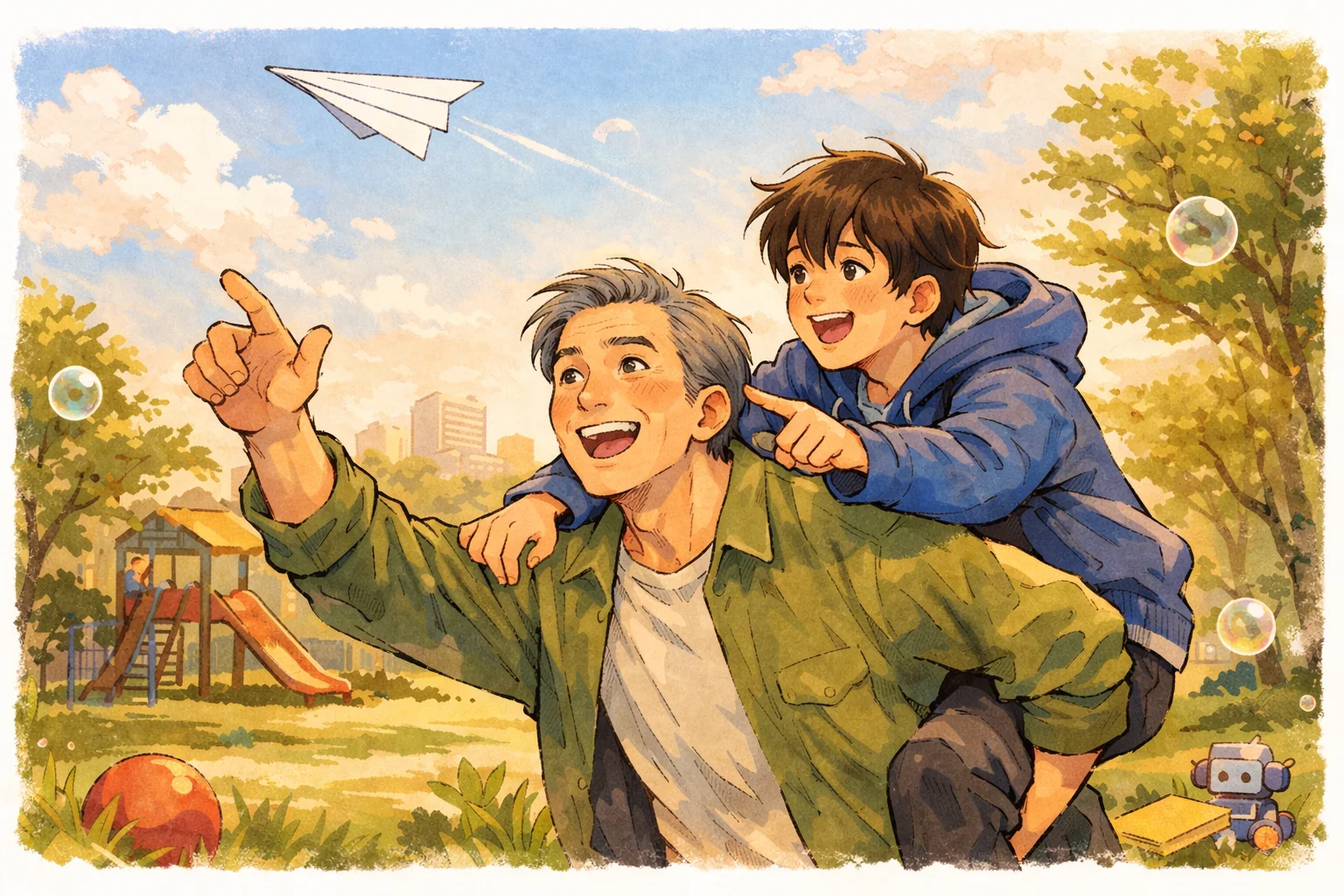
Under this emotional background, I encountered “Future son》. The setting of this Japanese drama is actually a bit exaggerated (and therefore very charming): 28-year-old Miku Shiokawa still has dreams, but his life is stuck. Then, one night, a 5-year-old boy who claimed to have traveled from 2036 unexpectedly appeared and said that he was her son.
From that moment on, mother and son had to live together, and she was forced to face it again: What kind of life did she want to live? Who do I want to be? This drama stars Mirai Shida, and the original work is from Shueisha’s “Nonャン+” comic series “Miku no のムスコ~Lovers 10 Years of Private Noise Child が Falling ってきた!” ”, adapted into a TBS drama series scheduled for January 2026, followed by LINE TV in Taiwan (launched on 1/13 in Japan, updated on 1/14 in Taiwan).
But what really hit me was not the plot of time travel itself, but the vulnerability.
Her fragility is not weakness, but an honesty that has been cut to the bone by life.
I have written novels before, and I know that many scripts will portray the heroine’s low point as a temporary cloud, as if the rain will clear up in the next episode; but Shikawa’s future fragility is closer to the one we are familiar with: instead of breaking down and crying, you still have to go to work (or work part-time) after waking up, you still have to pretend that you are fine, you still have to face the fact that the message cannot be read back, the deposit number is embarrassing, and the dream sounds like a joke.
There is something very stinging in her fragility - not the self-blame of not working hard enough, but the melancholy of having to work hard for a long time, but her dream still fails.
Perhaps, many people dare not say this sentence because once it is said, it is like admitting failure in life; but this Japanese drama is very cunning. It uses a son from the future who suddenly appears to translate this sentence into another language: You are not a failure, you are just still on the road, and you deserve to be accompanied for a while.
The power that her future son brings to her is actually three very adult rescues.
I think the most powerful thing about this Japanese drama is that it does not write the son as an all-powerful little angel; he is not here to save her, nor to teach her, but to pull her out of the trapped life in three ways:
1) He made her feel again: I can’t only be rated, I can also be needed
The adult world is cruel, and we often live by various rating scales: have we achieved anything, are we behind on marriage, and where has the wealth of people of the same age accumulated?
But the appearance of this unexpected son took her directly off the score sheet - because care is not a KPI, and companionship is not performance. When you are needed by someone, you will suddenly remember: I actually have the ability to give love and carry a small piece of the weight of life.
To put it more realistically: it’s a way to reconnect with your sense of self-worth. Not relying on other people’s applause, but relying on the fact that I can make another person feel more stable.
2) He forced her to face a choice: you can continue to delay, or you can start sorting out your life
The plot revolves around the main theme of finding out her biological father. On the surface, it looks like a love suspense, but in reality it is: she has to take stock of her interpersonal relationships, look back at her own inertia, admit some escapes, and at the same time cut off some unhealthy interpersonal relationships.
In other words - what the five-year-old boy brings is not an answer, but a mirror: Will the life you are living now lead to the future you want?
3) He made the future concrete: not a distant slogan, but a look that calls you mom
I have always felt that many people’s low points are not because they don’t have dreams, but because their dreams are too abstract, so abstract that it is difficult for you to get up early for it.
When you become a person in the future who will eat with you, quarrel with you, and pull your sleeve when you collapse, you will start to be willing to do some things that seem small but are actually crucial.
For example: go to an interview, go to practice, go to clarify, or take the initiative to leave those unsuitable relationships.
Back to myself: single, no children, but also have the life I want.
Watch “Future Son”, a very real feeling kept popping up in my mind: Even if I don’t become a parent, I will still have life issues.
Some people need to maintain a relationship, some people are working hard for a career, and some people need to take care of themselves who have not been taken care of for many years.
Me too.
Although I don’t have children, there are actually many things in my daily life that I need to be responsible for, such as: my creations, my projects, my commitments, and the kind of person I want to be. It’s just that these things don’t call me like children, and they don’t shake me awake in the middle of the night, so I occasionally procrastinate, evade, and pretend that nothing is wrong.
And this Japanese drama reminds me very gently: the real turning point in life is often not when you meet a noble person, but when you are finally willing to take responsibility for a certain future.
So, that future son is more like a metaphor for me: Suppose that one day in 2036, a version of me walks back, sits in front of me, and says, “Where will the choices you make now take me?”
I think I’ll start living more seriously.
This Japanese drama brings me hope: in addition to children’s laughter, I also hope for a more stable life.
After watching the first three episodes, my biggest wish is not just romantic love and family fantasy, but a future where I can love more bravely.
That future, in addition to marriage and children, is more likely to include:
- I hope to become a stronger yet gentler person
- I hope that I can have more rhythm and leeway in my creation and work.
- I hope that I can really live like the kind of adult I admire: one who has the ability to take care of others and the ability to take care of myself.
And “Future Son” The best thing is: it doesn’t ask you to get better immediately, it just quietly puts the fact that you can get better back into your sight.
I think the reason why “Future Son” hit me at this moment is because it makes something very difficult to explain clearly: vulnerability is not a hole in life, it is often the entrance to your new beginning.
And strength does not necessarily come from you suddenly becoming stronger, but from your finally being willing to believe that you are worthy of being loved and worthy of being responsible for your own future.
Further reading:
- From Chaos to Conquest: A personal transformation blueprint to completely turn your life around
- AI as my editor: A writer’s experiment in human-machine collaboration
- Finding strength in change: The wisdom of embracing change