When Content Is Mass-Produced, What Makes People Remember You? Hormozi Breaks Down Dolly Parton's X Factor

Alex Hormozi (opens in a new tab) This short talk of less than fourteen minutes is titled “What if I started running a personal brand in 2026”, but the content is almost entirely about one person: Dolly Parton. I was a little surprised at first. Why would an entrepreneur who is famous for his M&A and customer acquisition methodologies spend an entire video analyzing a country singer? After reading it, I realized that what he wanted to deal with was a word that everyone often talks about but never can clearly explain: X factor. His attempt was to translate this “unspeakable thing” into “something that can be used.”

▲ Alex Hormozi〈If I Started A Personal Brand In 2026, I’d Do This〉, the complete short talk can be watched directly here
After unlimited content, what is scarce is the deliverer
His starting point was practical. How do you stand out in a world where anyone can produce tons of content at the press of a button? The answer is quality, but quality really has two halves: the message itself, and the person who says it. A boring statement from a celebrity can attract millions of views, relying on the messenger; an anonymous account that no one knows suddenly becomes famous, relying on the message. The two are intertwined to form the entire weight of a piece of content.
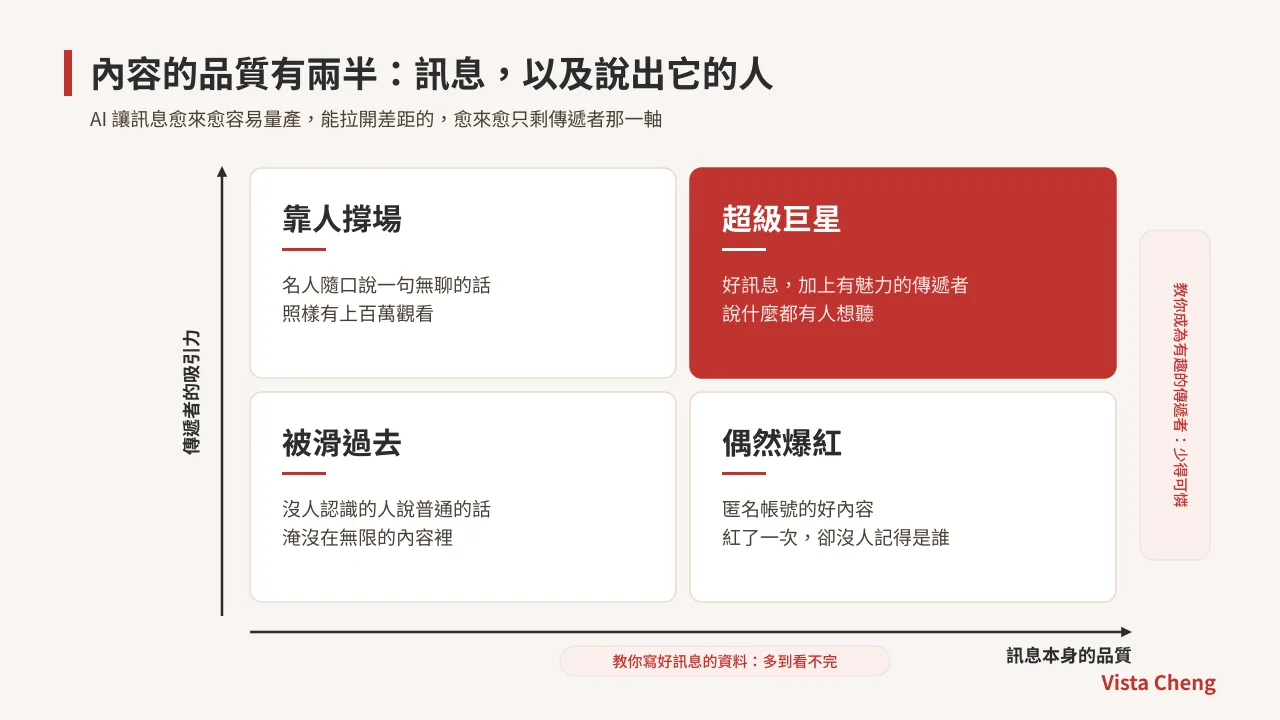
▲ Quality has two halves: the message and the deliverer, both are strong to be a superstar
This passage reminds me of a common anxiety after the popularization of AI writing tools: everyone uses the same tools and the same prompt words, and the things they write become more and more similar. What Hormozi points out is that there are endless amounts of information on the market to teach you how to create a good message, but there are very few strategies to teach you how to make the “deliverer” interesting. When the cost of producing a message approaches zero, the only difference is the person speaking.
X Factor: Stacking of Rare Traits
There is a saying in French called je ne sais quoi, which literally means “I don’t know what it is.” Hormozi’s point of view is interesting: Since we recognize someone with that trait, it means there is a pattern behind it, but our ability to recognize the pattern runs faster than our ability to put it into language.
His definition is: A person exhibits multiple rare skills or characteristics at the same time, and these characteristics are not usually found in the same person, so they arouse a high degree of interest from others. The more rare elements are stacked, the rarer and more attractive the person becomes.
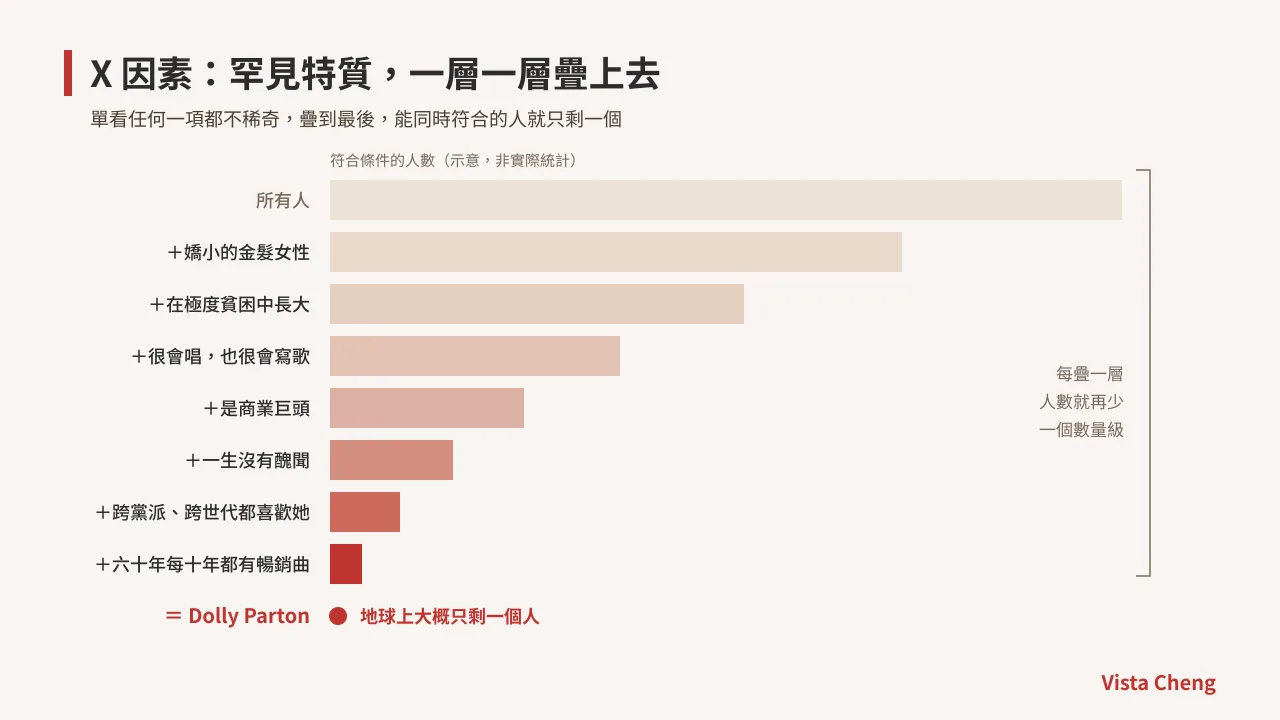
▲ Every time a layer of rare traits is stacked, the number of qualified people decreases by one order of magnitude (indicative)
He layered Dolly Parton on top of one another: a petite blond woman who grew up in extreme poverty, was smart, could sing well, could write beautiful songs, was self-aware, was a business magnate but retained her femininity, had no scandals in her life, was liked across parties and ethnic groups, was married for more than fifty years to a husband who rarely appeared in public, had a hit song in every decade for sixty years, and always gave credit to God and good luck when receiving praise. It’s not unusual to look at any one of them alone, but at the end of the stack, she’s probably the only one left on earth.
Rare is not enough, it is better to contradict each other
I think the most valuable sentence in the entire film is here: The reason why these qualities are powerful is not just because they are rare, but because they contradict each other. She is sexy and saintly. She is a girl from the countryside who is also a business magnate. She is a sex icon and a songwriter. She is still influential even when she is older. She is a superstar but very humble.
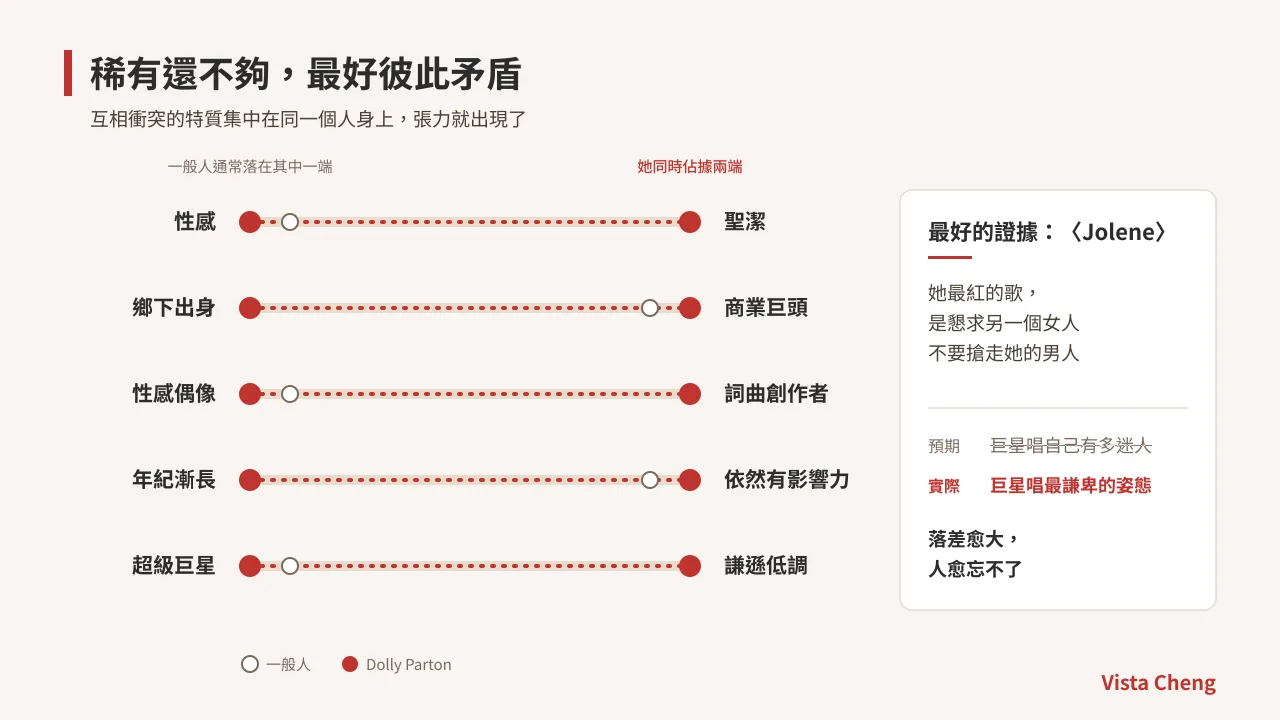
▲ When contradictory qualities are concentrated in the same person, tension appears
The evidence he gave is wonderful. Dolly’s most popular song “Jolene” is about begging another woman not to steal her man. A superstar with incredible wealth and dazzling appearance, her masterpiece is that she can write the most humble posture, instead of showing off how charming she is in her songs. Hormozi also reminded that an important reason why she can have so many aspects at the same time and always be likeable is that she has never been involved in politics and has always remained approachable.
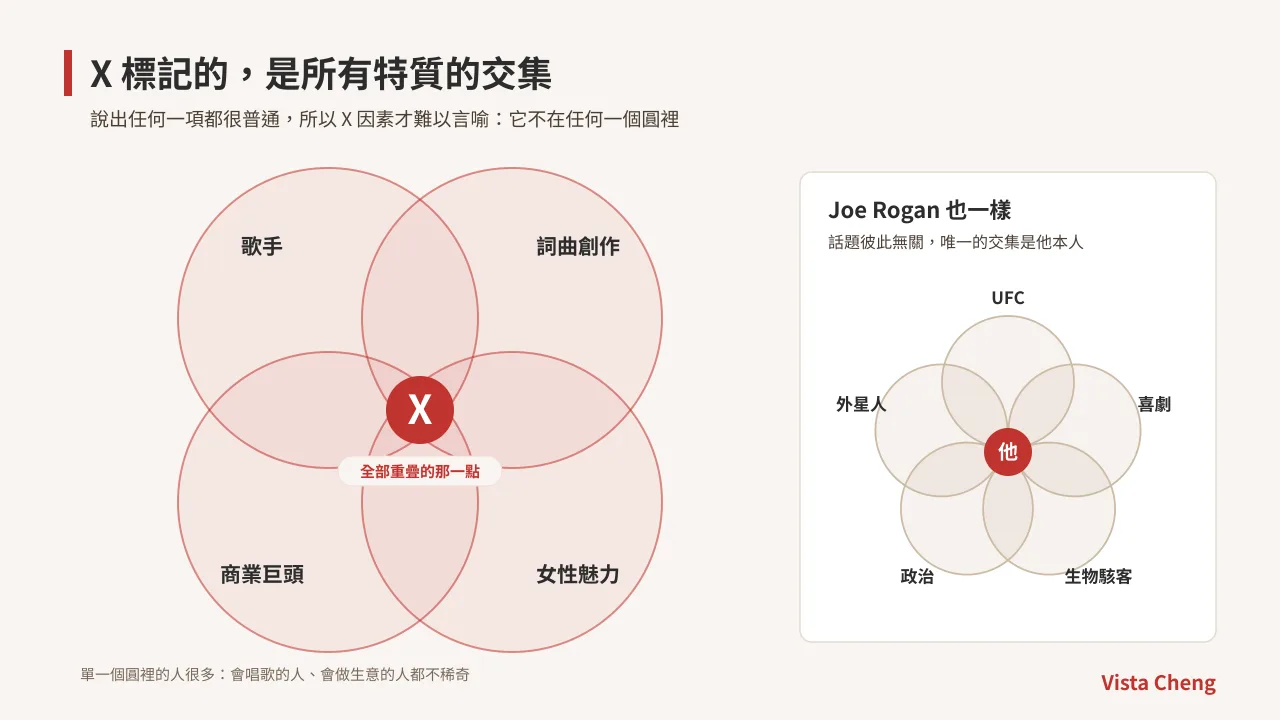
▲X marks the intersection of all traits, with only one person left in the center
This also explains why The X Factor is so hard to put into words. If you name any of them, it sounds very ordinary: there are many people who can sing, and there are many people who can do business. The meaning of X is like the “X mark” on a treasure map. It is not in any circle, but only at the point where all the circles overlap. Hormozi also cited Joe Rogan: UFC, comedy, biohacking, politics, aliens, these topics have nothing to do with each other, the only intersection is him himself.
Most people get their personalities from the shelves
After talking about superstars, he turned the camera to ordinary people. Why don’t most people have this attraction? His statement is a bit harsh: because everyone’s personality is taken directly from the shelf. He cites a meme: White men in their thirties wondering whether their new hobby should be barbecue or craft beer. People put themselves into these boxes because they feel like it’s the only accepted option in society. The result is one that blends in but never stands out.

▲Personality taken off the shelf: every option is reasonable, but the combination is unmemorable
He then takes the audience through an exercise: Imagine a man wearing a trucker hat and a flannel shirt. You know nothing about him, but if you want to bet, you can probably guess his political stance, what kind of car he drives, what religion he believes in, what kind of coffee he drinks, whether he is a vegetarian or not, and you can even guess whether you will like him. How is this possible? Because people recognize patterns, people who dress like this will probably behave similarly.
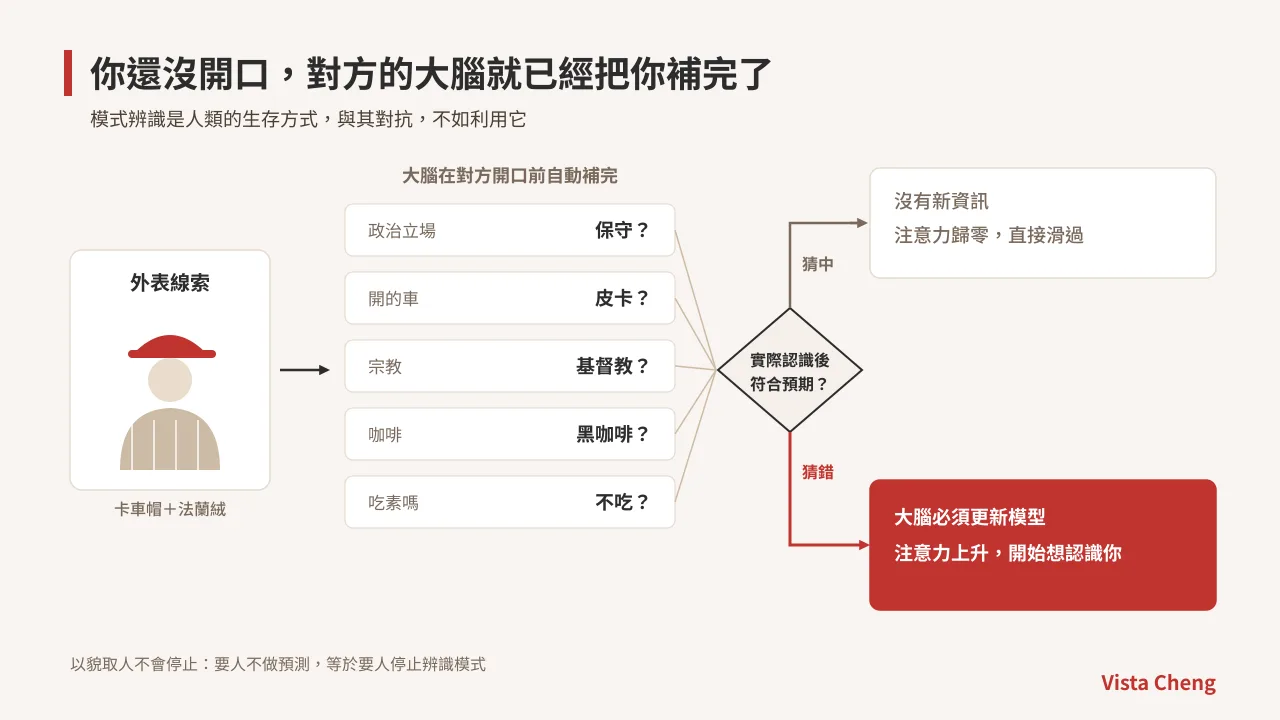
▲ Your brain has already finished filling you in before you open your mouth
Hormozi puts it bluntly: This thing will never stop. Asking humans to stop judging people by their appearance is tantamount to asking humans to stop recognizing patterns, which is how we survive in the world. Since this is human nature that cannot be changed, the question becomes how to use it.
Break the mold and make people like the way you break it
His answer was to break the mold and become something others didn’t expect. The same man in a truck hat suddenly becomes interesting if he drives a Tesla, is an atheist, prefers Frappuccinos to black coffee, eats vegetarian food, is a world-class hacker, and plays the violin. The reason is not the labels themselves, but the fact that they imply that the person is thinking for themselves and not living according to preset options.
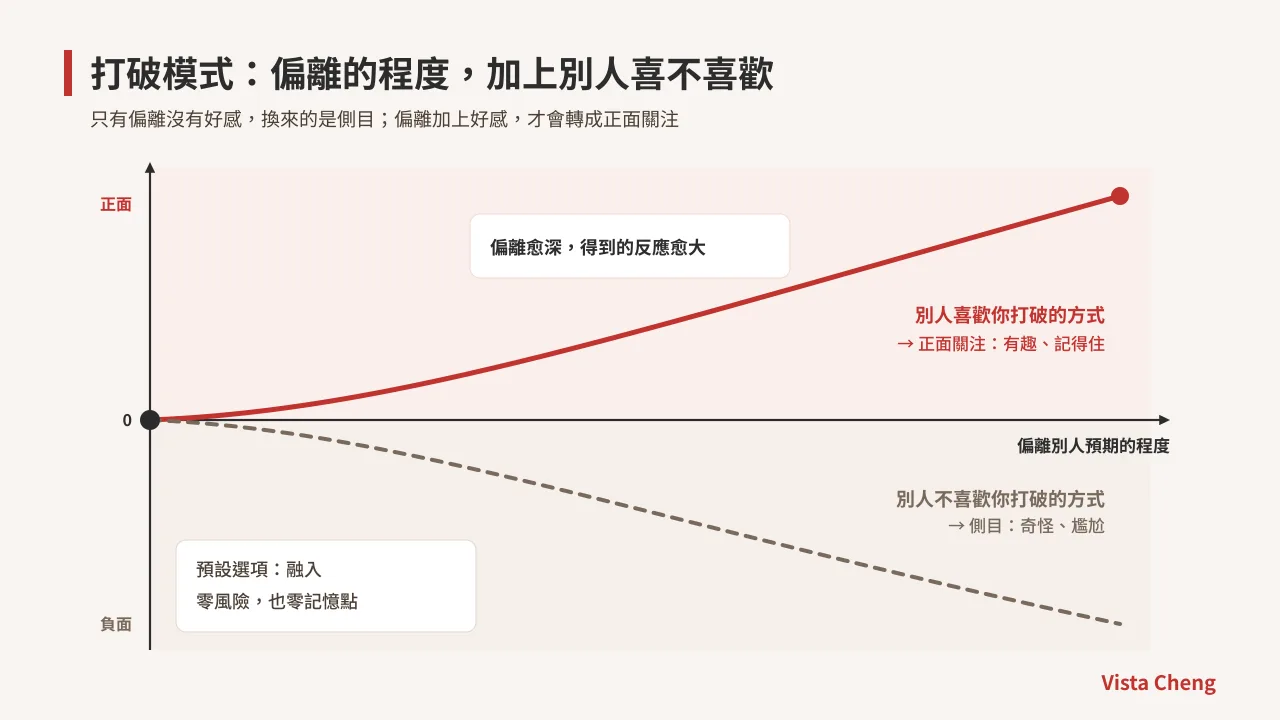
▲ The degree to which you break the pattern, plus whether others like the way you break it, determines whether you get attention or sideways glances
There’s a detail here that’s easy to skip: He’s talking about the degree to which you break the pattern, plus others like the way you break it. Only deviations without favorable impressions will result in side glances; deviations coupled with favorable impressions will turn into positive attention. And those qualities that make you unique are often the parts of you that you hide out of fear of being judged and ridiculed, the parts that others find strange, embarrassing, and out of place. He asked: If you are not different, how can you stand out?
He also used himself as an example. During his career, someone firmly gave him four pieces of advice: Don’t do YouTube or appear on camera, because you won’t do it well; in the business world, you have to wear a suit to look serious; don’t talk about your philosophy of life, no one cares; don’t talk about how much money you make, it’s embarrassing. He violated all the last four because they were not in line with his nature. Ironically, what people most often stop him on the street to say is his philosophy of life mixed with business content.
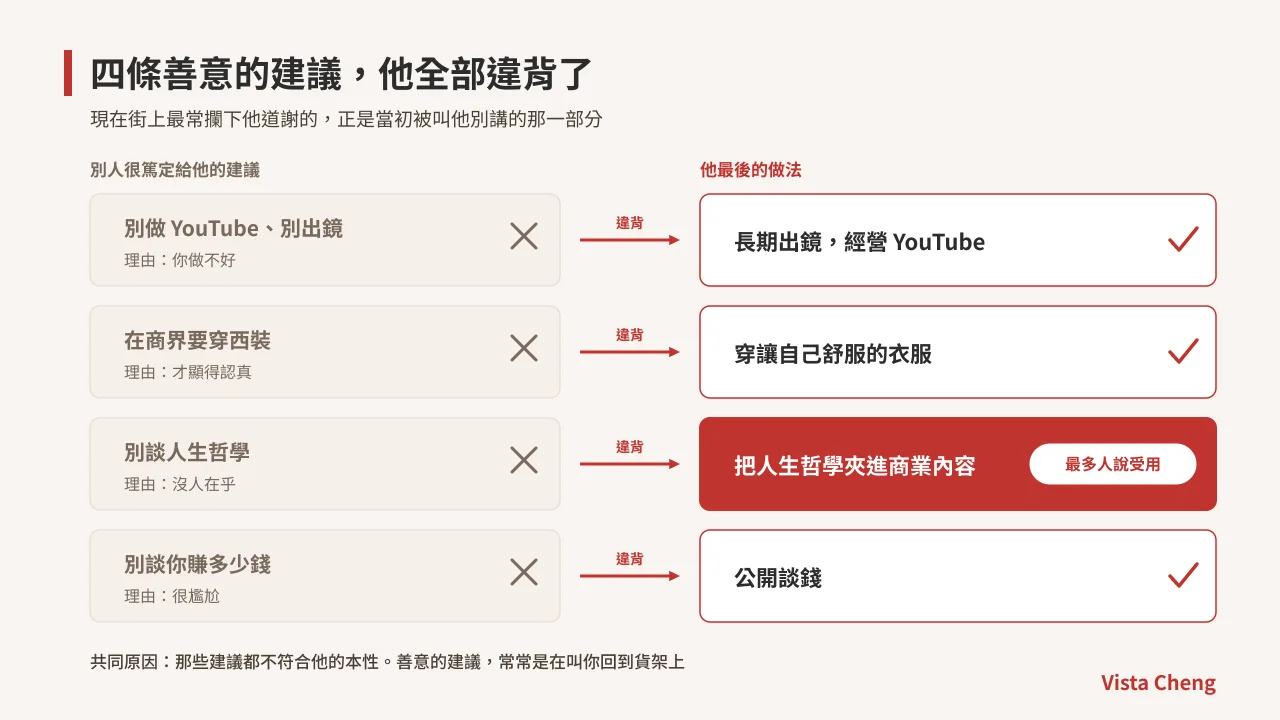
▲Four well-intentioned suggestions and his final approach
But the premise is that you must be very good first
If the video stopped at “Be brave enough to be yourself”, I would probably think it was just an inspirational short film. What really made me agree was his final twist: He made it clear that he didn’t want to conclude with “be yourself”. If Dolly couldn’t sing and write those songs, she wouldn’t be a star. You have to be really, really good, simple as that.
But there are many very good people in the world who are either not stars or have become famous for a short time. He gave two reasons: first, they were good, but not good enough; second, even if they were good enough, they didn’t have anything else. The X-factor is not about owning one thing, but about having them all, a complete experience.
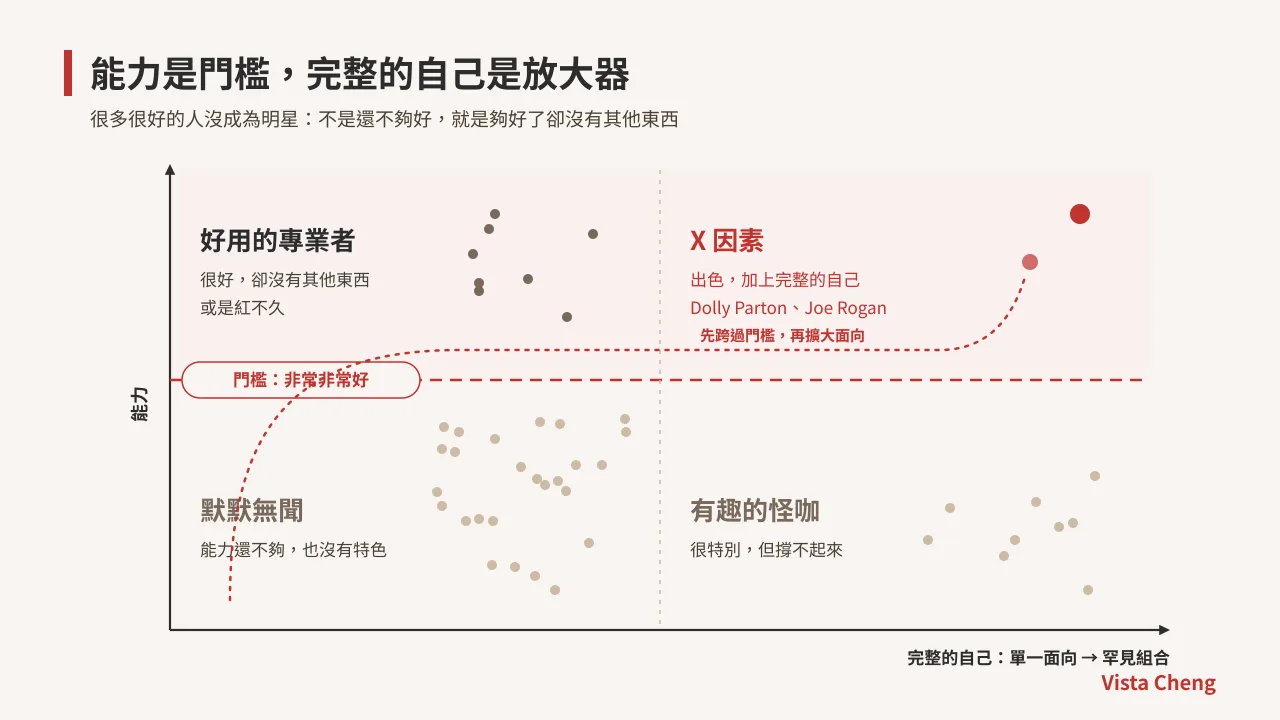
▲ Ability is the threshold, and the complete self is the amplifier. Without one or the other, you cannot reach the upper right corner
He also added a benefit that I rarely hear people talk about: the wider your interests, the wider the audience you can attract. Some people will admire your courage, and some people will see their own reflection in you. A “man on the shelf” will only attract people who carry the same set of goods as him; for a person with rare combinations, every aspect is a door.
My thoughts after viewing: Take out the hidden half and take inventory
After reading it, the first thing I did was go back and check my own content. To be honest, after running a personal brand for a long time, the most common mistake to make is the kind of “shelving” that Hormozi said: write whichever topic has good traffic, and use whichever tone is safe. Although the things written after a long time are not wrong, they have no memory points. AI tools make this easier because they inherently pull you toward the mean.
I want to turn this video into an inventory process that can be run quarterly. First, list all your professional abilities, quirks in life, and interests that others think are incompatible, without judging whether they are good or bad first. Then use two questions to screen: Can this trait have a chemical reaction with my major? Will it be interesting to others when they see it, or just weird? For the remaining characteristics, pick two or three combinations that seem to be the least compatible with each other, try them out on a small scale in the content, and then decide whether to expand based on readers’ responses.
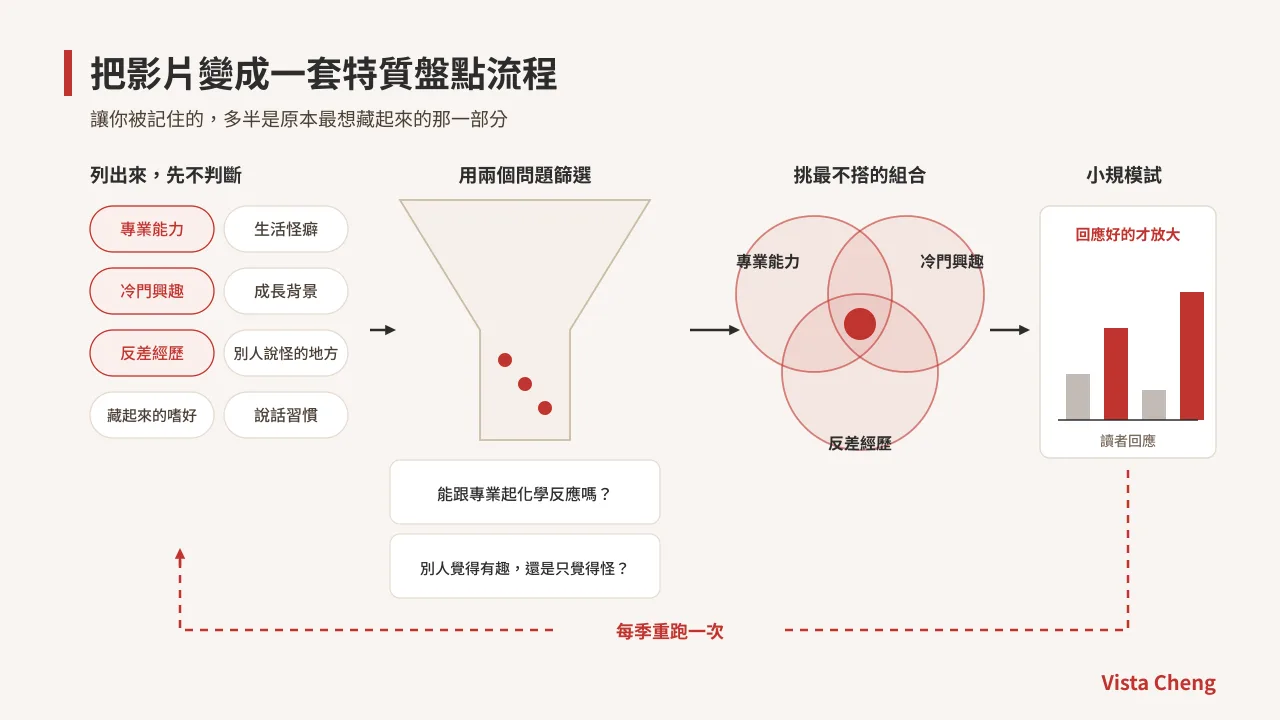
▲ Convert the video into a trait inventory process that can be run quarterly
I’d like to note a final reminder from Hormozi at the end: happiness and excellence are two different goals that sometimes overlap and sometimes don’t. Integrating into a group makes sense from an evolutionary standpoint, but it doesn’t make sense from a pursuit of excellence standpoint. This is not to say that everyone should strive to be a star, but if you choose to run a personal brand, you have to accept one thing: what makes you remembered is probably the part of you that you most want to hide.
Next step
Bring this topic to your team
Vista Cheng speaks and runs workshops on AI workflows, writing and content systems for companies, schools and public agencies.