When information is no longer valuable, what should creators sell to the market - Listen to Jasmine Star talk about hybrid solutions

The Nathan Barry Show (opens in a new tab) The title of this episode is very emphatic: Stop selling courses. But after listening to the more than seventy-minute conversation, I felt that what Jasmine Star (opens in a new tab) was really talking about was not the survival of the course, but something more fundamental: the transfer of delivery responsibilities. In the past, creators delivered content, and whether they learned it or not was the buyer’s own responsibility; now she advocates delivering results, and takes the responsibility of “whether it is achieved or not” from the buyer’s shoulders back to her own hands. This shift may seem like just another way of saying it, but it actually affects pricing, service design, marketing, and even the entire organization.

▲ The Nathan Barry Show exclusive interview with Jasmine Star, the complete conversation can be watched directly here
A person who has been pushed by the market for ten years
The reason why Jasmine’s words carry weight is that she herself is the beneficiary of every wave of dividends and is also the first to notice every ebb. In 2016, she was still a wedding photographer. Her first online course for $197 sold $255,000 in five days. She launched two more courses in the same year, and the sales of a single course exceeded seven figures. The following year, a student wanted the content to continue to be updated, so she signed up for a $29 monthly membership and made a rare decision at the time: new members could not see past content, and back issues had to be purchased separately. As a result, the revenue contributed by new members in the first three months was actually higher, and the old problem of “unsubscribing after watching once” was avoided.
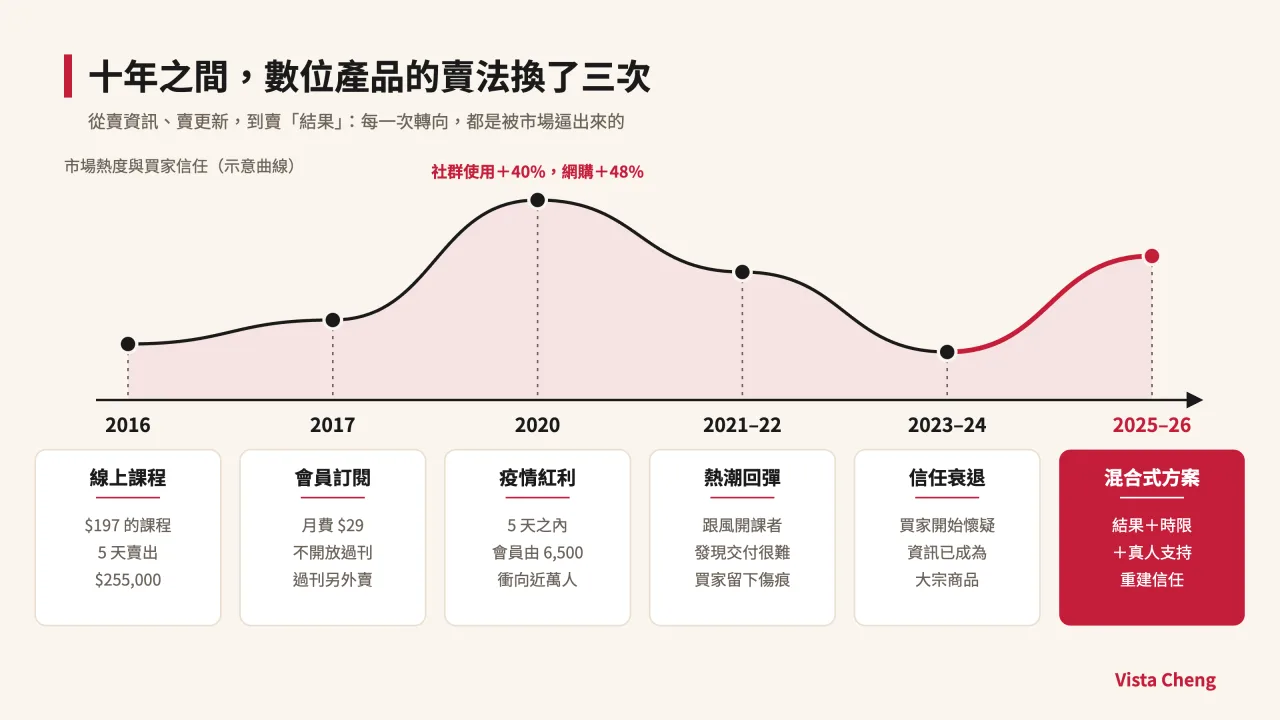
▲ In the past ten years, the sales method of digital products has changed three times
In 2021, she turned the membership system into software and introduced AI very early. However, the following year she realized that she could not outperform OpenAI. During the same period, the epidemic bonus allowed her membership to increase from 6,500 to nearly 10,000 in five days, and also attracted a large number of people to follow suit and start classes. These people soon discovered that delivery and customer service were another profession and exited, leaving behind a group of wounded buyers. She calls the market after 2023 a “trust recession.” I think these four words are the foundation of the entire conversation: the problem is not the format of the course, but that the buyer no longer believes that “it will get better if you buy it.” This also echoes what I wrote before: “Traffic will return to zero, but trust will not”: In the AI era, trust is the real lever for a one-person company.
Hybrid approach: results, timelines, support
There is only one sentence in her prescription: help a person achieve a specific result within a limited time and with support. Figures she cited were that the average course completion rate was about 8 percent, and the average membership stay was less than three months. This is what she said in the interview. I have not verified it otherwise, but the logic behind it is tenable: there is no result if it is not completed, and there is no repurchase without results, and there will be no recommendation.
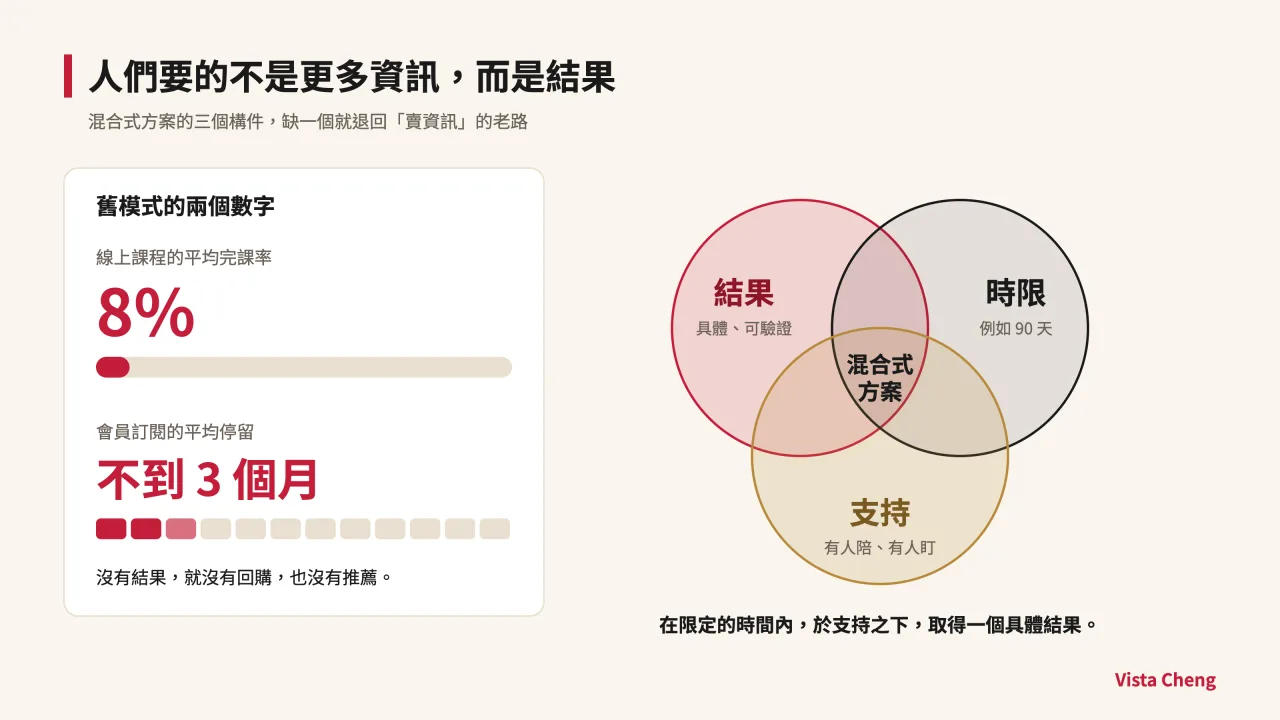
▲ What people want is not more information, but results
The examples she gave are very suitable for teaching. “I help women in their 40s lose weight” sounds focused enough, but in fact it is still a class that teaches everything, and the students are like drinking water from a fire hydrant. “I help premenopausal women lose 10 pounds in 90 days and get a good night’s sleep” is a promise that can be bought. Nathan (opens in a new tab) Here I added an observation that I like very much: when most people talk about niches, they only narrow down “who to speak to”, and she also narrows down “how to serve”. The more specific the conditions, the more the method moves from art to science, and it becomes possible to train others to deliver.
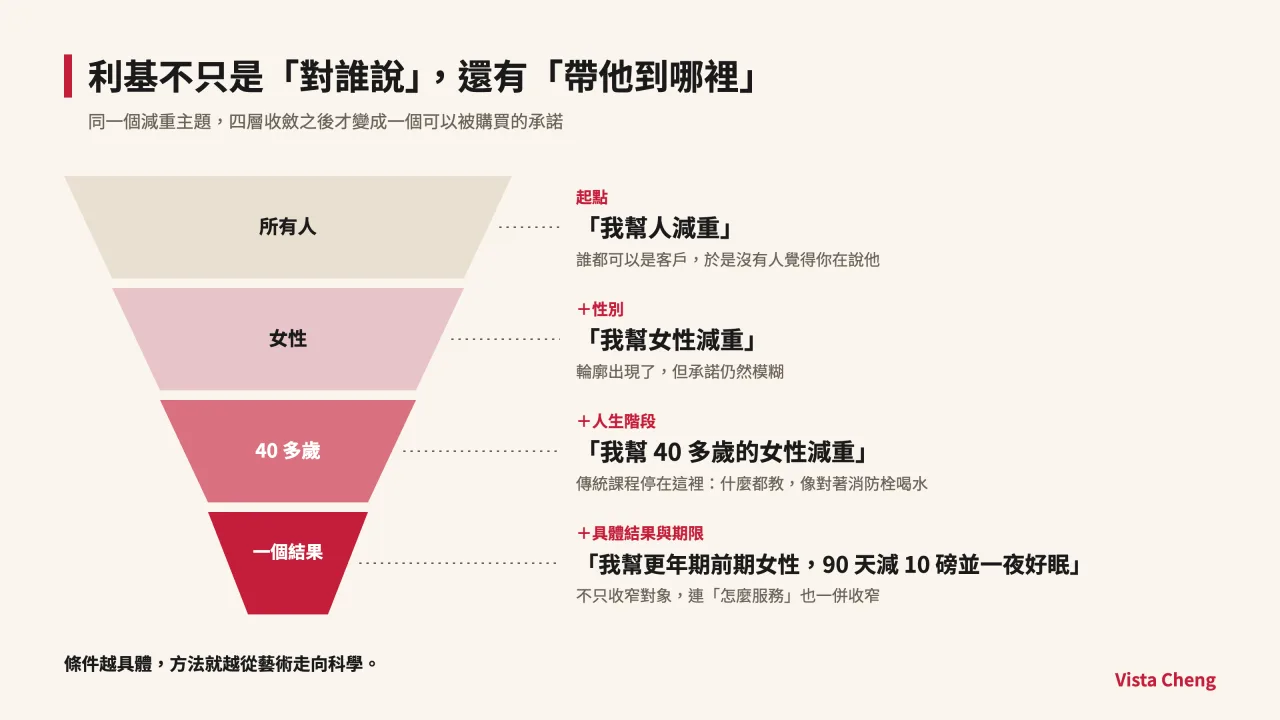
▲ Niche is not only about “who to say it to”, but also “where to take him”
As for support, she doesn’t see it as an add-on, but as a guarantee of results. Students will definitely encounter travel, life changes and self-doubt. At this time, someone replies “I see you” and the brand is truly established. She said that a brand is not a name or logo, but how you make the other person feel; a person who is seen will be willing to fight for you.
Pricing: Price is a quote for certainty
This paragraph is the most methodologically valuable part in my opinion, and it should be interpreted at two levels.
The first level is Nathan’s discount deduction. The buyer has a mental “fingerprint” value for an outcome, let’s say $10,000. But in reality, he would give three discounts in a row: he would have to wait 90 days to see it; he was not sure whether this method was the right one; even if the method was right, he was not sure whether he could complete it. After discounting it three times, it’s back to the familiar $97. This deduction made me figure out one thing: If you want to increase the price of pure information courses, it will be useless no matter how much you add content, because the content only affects the second item, and may even make the third item worse. The more you teach, the less you can finish it. There are only three real levers: shortening the time limit, using specific cases to prove the method, and using companionship to reduce execution risks. Hybrid solutions can sell for between $2,000 and $5,000, which is the result of three levers being pulled simultaneously.
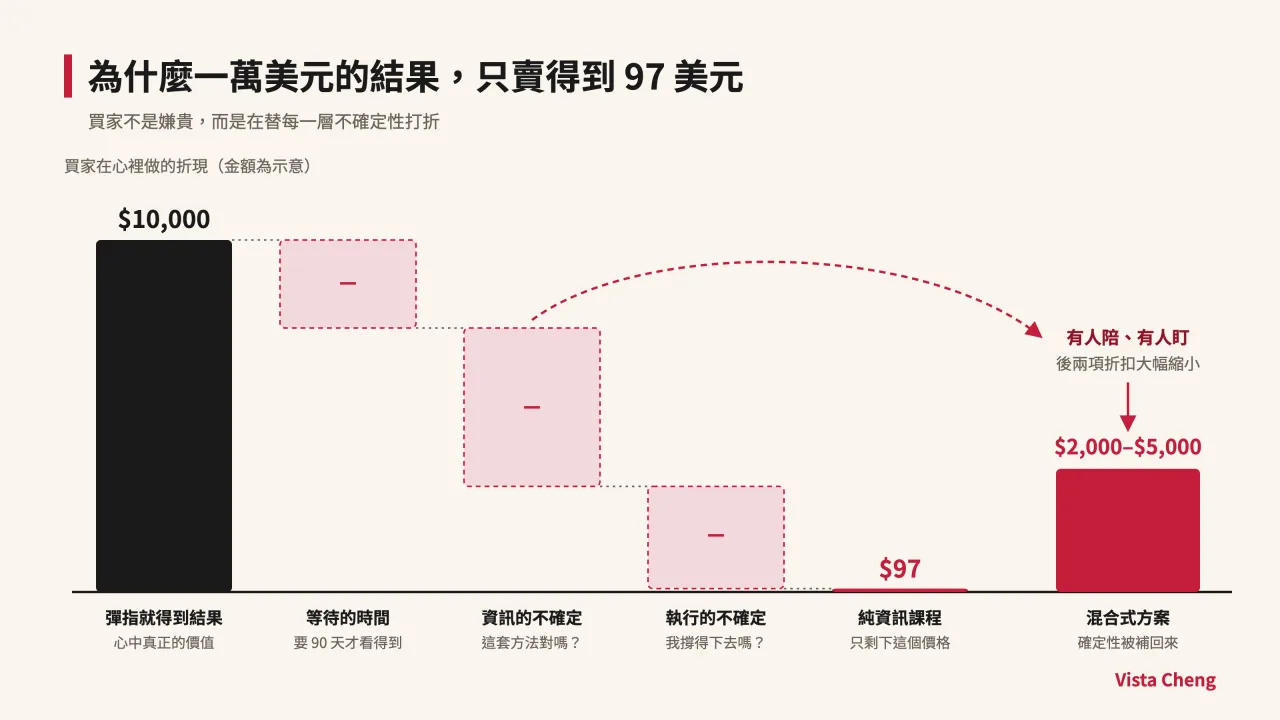
▲ Why the result of 10,000 US dollars was only sold for 97 US dollars
The second level is Jasmine’s process. She has seen too many creators think of their own products and set their own prices. After launching, only one or two percent of people buy them, and then they blame themselves. She reversed the order: she entered the market with only two assumptions, that is, who she wanted to serve and what results she thought she could bring; then she interviewed ideal customers without any sales pitch, asking them to tell themselves how much they were willing to pay for which change, and tested two or three changes at the same time, letting different promises compete with each other; finally, she used a small-scale seed sale to actually collect money, and let the payment behavior replace the verbal willingness. She said that eight out of ten people would resist “I can’t charge such a high price.” People who originally only dared to sell for $87 ended up selling for $500 to $1,000.
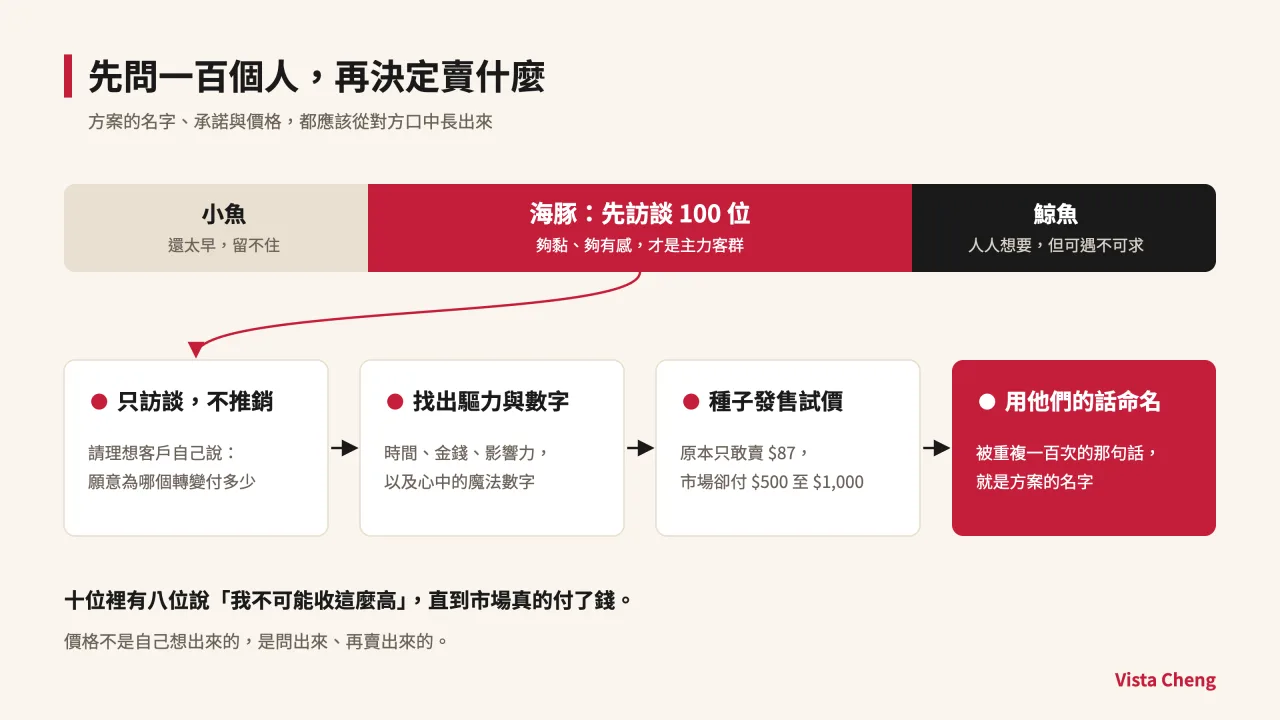
▲ Ask a hundred people first before deciding what to sell
This is how her own plan got its name. In hundreds of interviews, she kept hearing the term “financial freedom” and asked for the definition. The answer she got was “ten thousand dollars a month” over and over again, so the plan was called Consistent 10K. What’s intriguing is that after the name was decided, the other person said it was “too good to be true.” She continued to ask what would truly change their lives, only to find that for most clients, an extra $4,000 a month, and being able to do it from home, was enough to turn that reality around. My experience is that the vision people say and the numbers that actually make them willing to act are often not the same. You can name it with vision, but the sales conversation should start from that credible first level.
The interview subjects are also particular. She suggested finding a hundred dolphins, neither whales that you can meet and find, nor small fish that you can’t keep, but main customers who are sticky and empathic enough, and first identify whether the other party’s main driving force is time, money or influence, because the same product’s commitment is written in completely different ways under the three driving forces. If you are also thinking about how to price professional capabilities, you can read it together with “8 ways to monetize knowledge, you need to re-evaluate when moving to Taiwan”.
Finally, the guarantee is actually part of the pricing. Her terms are: If she actually implements but does not earn back her tuition within 90 days, she will stay with her for another 90 days. She will not refund the money, because refunding will give the students another reason not to go all out, and the interests of both parties are mutually exclusive; if they stay with each other for a while, both parties will only be in the same direction. Someone suggested “I’ll pay after I earn it.” She refused with a cute and honest reason: I believe in myself, but I don’t know if you will show up. It’s a clear allocation of risk, with the seller guaranteeing the approach and companionship, and the buyer guaranteeing execution.
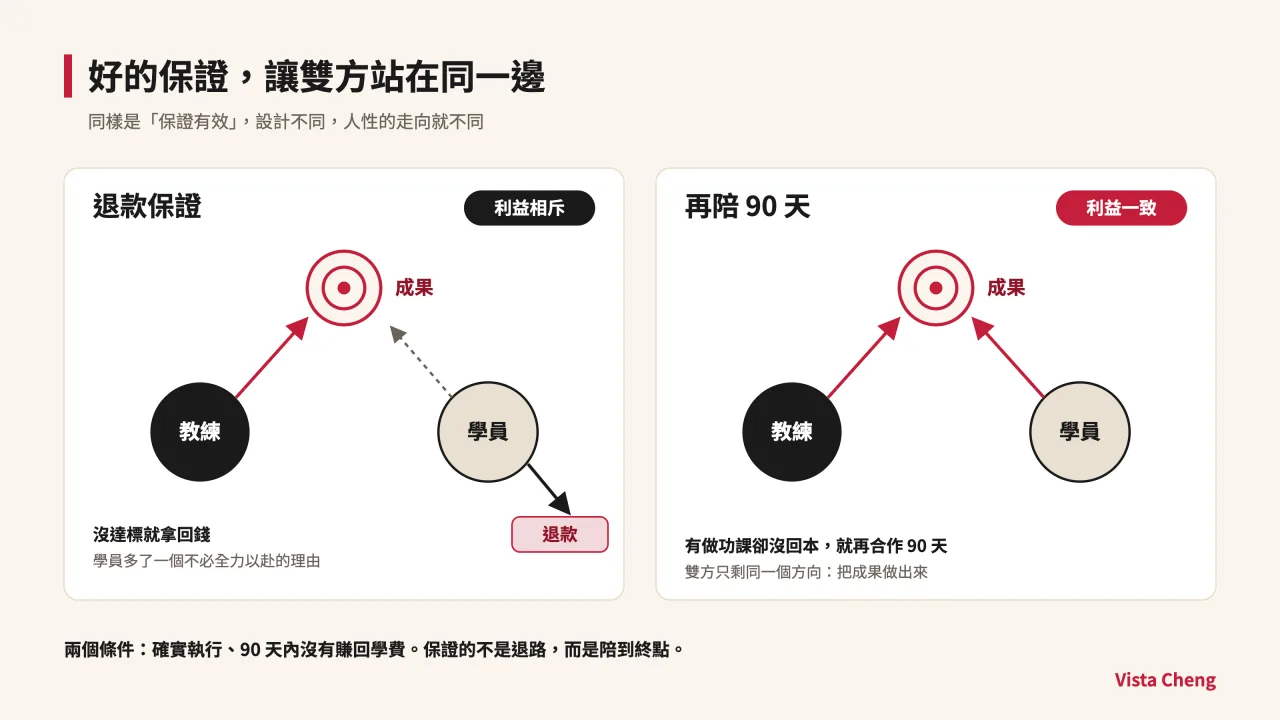
▲ A good guarantee keeps both parties on the same side
Asynchronous Coach: Change service from session to loop
If pricing sells certainty, then asynchronous coaching is a mechanism that produces certainty.
Her course once cost $3,000 for the self-study version, and you can also purchase four to six weeks of live Q&A, but students still said: I really wish someone was standing behind me and watching. Her initial reaction was “Oh! This won’t work.” Then she asked herself “What conditions must be true for this to work?” and then devised the current approach.
Traditional coaching, a 30-minute weekly call, has two structural flaws. The first is that students lose momentum within a day or two after the call; the second is that when stuck, they think “wait until next time to ask”, a small question can eat up a whole week, and the total of 90 days is only twelve or three weeks. Her design allows students to ask questions when they get stuck, and the instructor will respond with videos and corrected worksheets that day, allowing them to ask five questions and answer them five times a day. More importantly, every reply ends with a promise with a date: “When will you finish?” On that day, the coach takes the initiative to ask about the results. The example she gave was content output: “Are you going to publish one article or four this week?” Follow up again at the weekend: “I’ve only published two articles so far. I have to publish them again on Saturday, otherwise I won’t reach the goal. Can you promise?”
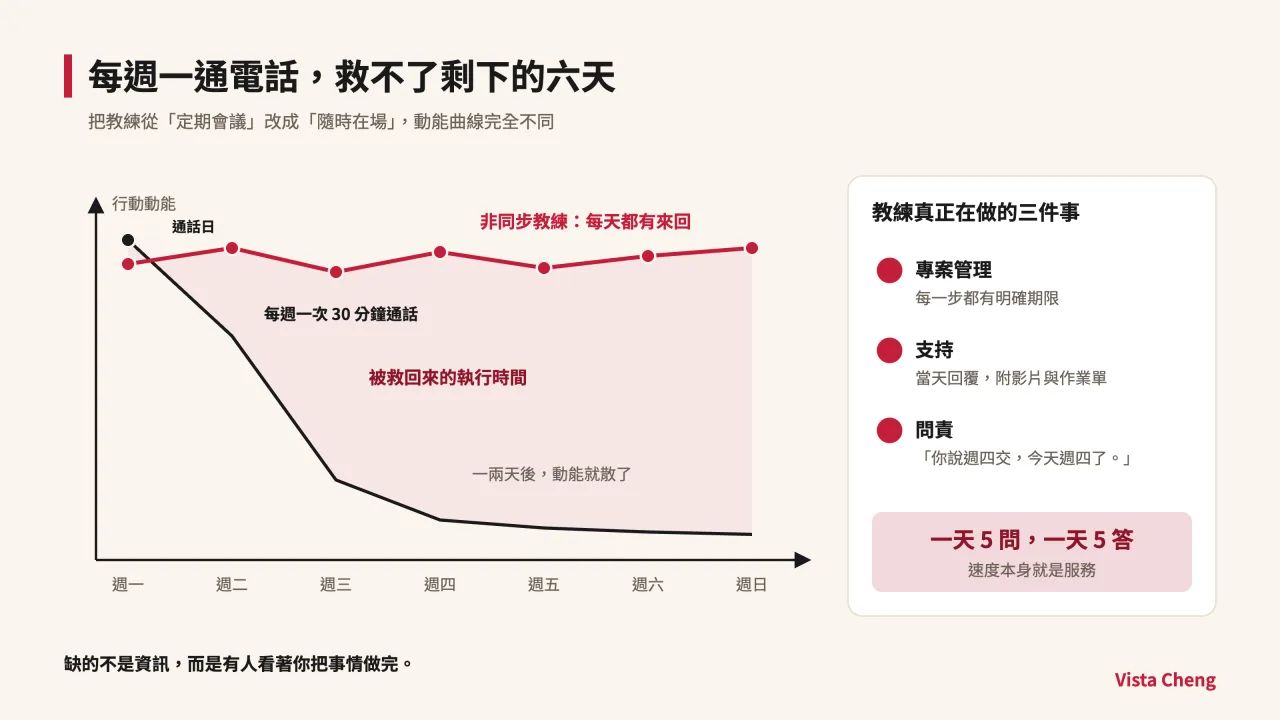
▲ A phone call every week can’t save the remaining six days
So the role of a coach is actually a combination of project management, support and accountability. Her judgment is that the students do not lack “who don’t know how to do it” and the process has been laid out in front of them for a long time; what they lack is someone to watch them do it. The real resistance comes from the fear of being judged, of failure, or even of success, which cannot be solved by information. This is almost the same as my experience in “The most difficult thing about a one-person company is not self-discipline, but that no one is waiting for you”. Nathan’s comments hit the nail on the head: We default to using phone calls to optimize the transmission of information, but students already have the information, and those thirty to ninety minutes should be used to do things.
She also became a client herself. At the beginning of this year, she bought a high-priced nutrition and fitness coaching service. Every calorie was watched by someone, and she had to upload training videos. She described it as having an extra part-time job, but she got results that she had never experienced before in her life. Getting results makes people want to keep them more, she said, which is paying someone to keep an eye on their value.
There are several humble but necessary conditions behind the operation of this approach. There is only one method. She said there are 1,200 roads from California to New York, and she only teaches one of them, so that the coaches can be trained and the responses will be consistent. The coaches all have practical qualifications, but they must obey this system; she is looking for people who are good at leading people, but don’t want to develop customers themselves, which is equivalent to operationalizing the half of what they don’t want to do. All conversations remain in Slack, and she reads every one without necessarily getting involved in order to see trends and gaps. She calls in coaches every eight weeks to talk about the vision. As for the person who insists on weekly calls, she will tell you straight away that this plan is not for you. Pre-screening is itself quality management.
In an era of declining trust, win with stupid methods
Regarding marketing, I only note the most counter-intuitive point: she almost deliberately chose an approach that is difficult to scale. The plan was launched only about half a year ago. She first only used a private message funnel to prove that strangers could be converted into high-price customers. Later, she added live briefings and email micro-training specifically to catch those who did not attend.
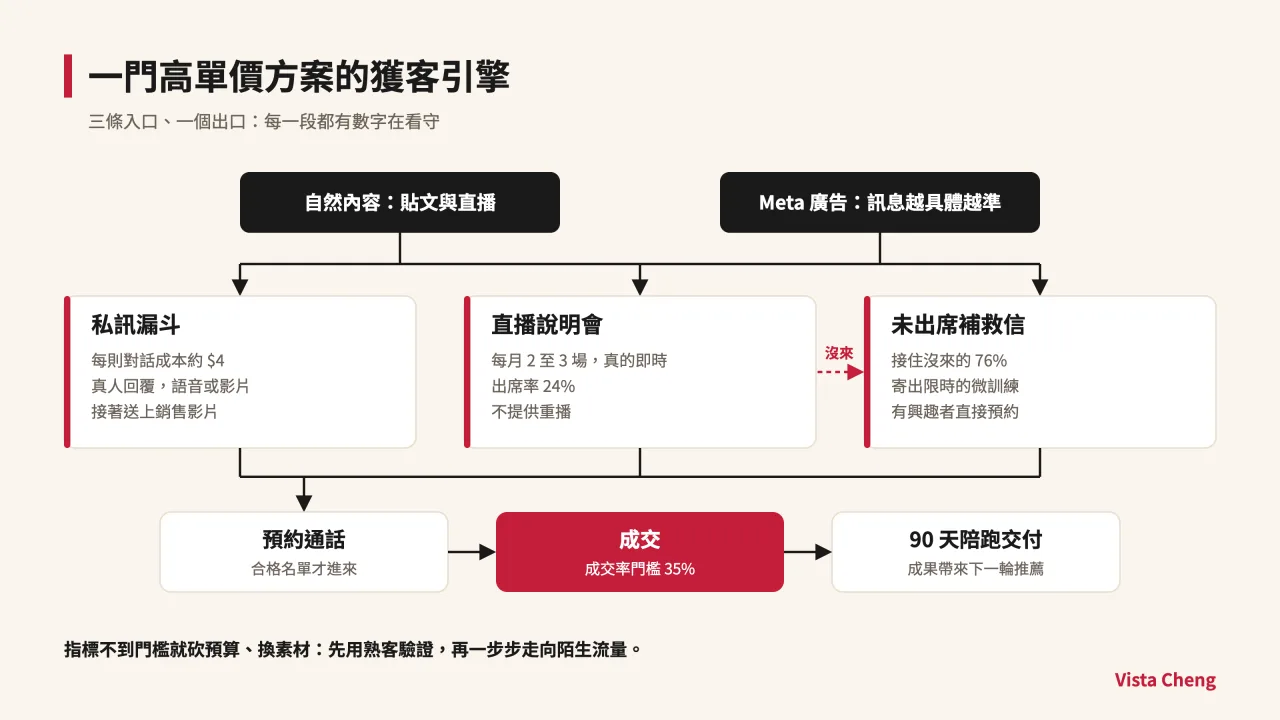
▲ A customer acquisition engine with a high unit price plan
She has tested automated replies and real-person replies, and the difference in response rate is more than 80%. When she was suspected of being an AI, she changed the transmission to voice, or even a video of someone with messy hair after exercising early in the morning. During the live broadcast, she would hold up her phone for everyone to see the date, proving that it was instant. She said it’s important to respond quickly, but not so quickly that people don’t trust you. When all content is cut into a six-second rhythm, unmodified content becomes a rarity. If you want to see another way to repair the funnel by spreading it out, you can refer to “Spread the sales funnel in the sun”.
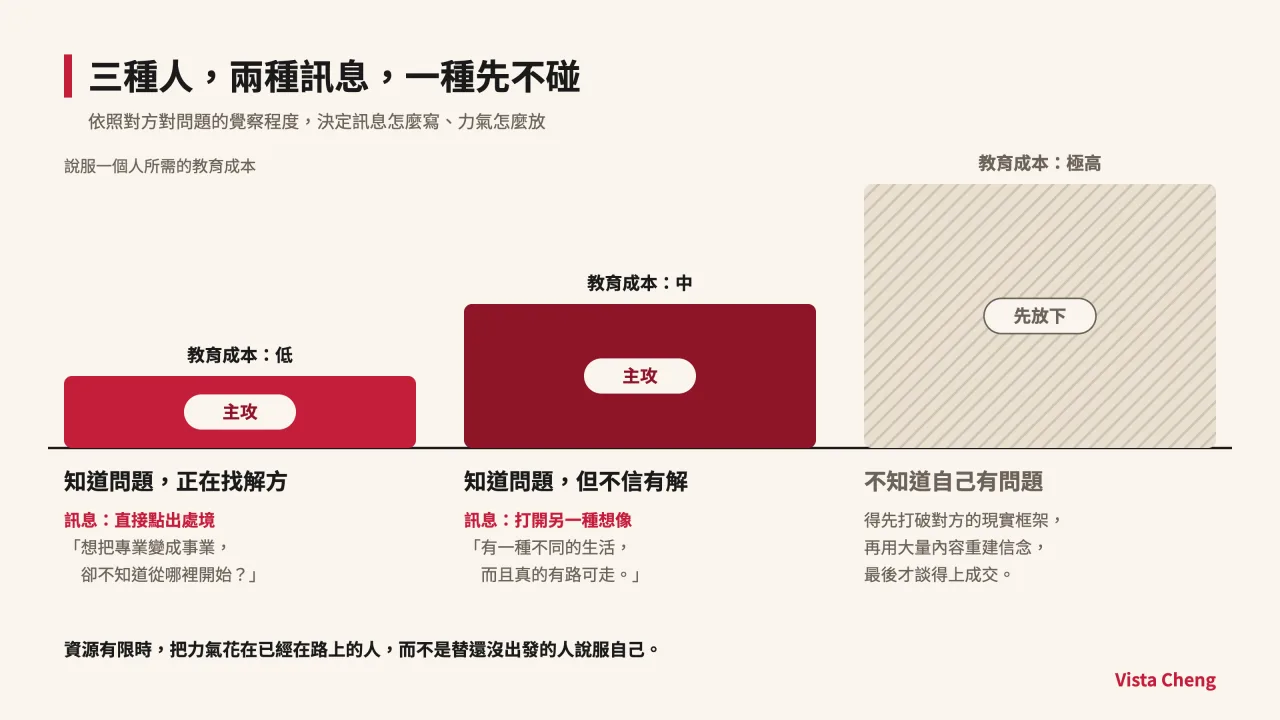
▲ Three kinds of people, two kinds of messages, don’t touch one kind yet It’s very exciting to listen, but you have to stay calm. This is a one-person business. She herself said that she was overwhelmed by this model. Whether the quality can be magnified with the number of people, there was no answer in the dialogue, and there was no explanation of how many students a coach can bring. The plan is still in the verification period. We have no way of knowing how many successful cases there are and how large the base of “stable monthly income is 10,000 US dollars”. She first used the regular customers accumulated over ten years to verify her business, and then gradually moved towards unfamiliar traffic. This starting point is not available to everyone. In addition, the warranty terms are tied to “whether they are actually executed”, and the right to determine it lies with the seller. If there are no verifiable standards written in advance, sooner or later it will become a dispute. Another thing she didn’t talk about: When a coach is always available, accountability can quietly degenerate into dependence.
(opens in a new tab)
Return certainty to learners
Looking back at this conversation, I found that what impressed me most was not any one technique, but what she said before the four-step formula: What I will talk about next will not be eye-opening to you. Clarifying a message, marketing to a type of person, entering into a conversation, building a system, which one of these things do we not already know? She and Nathan said the same thing again and again: simple, but not easy. The most common trap that knowledge workers fall into is mistaking “knowing” for “doing”, and then assuming that the same is true for students.
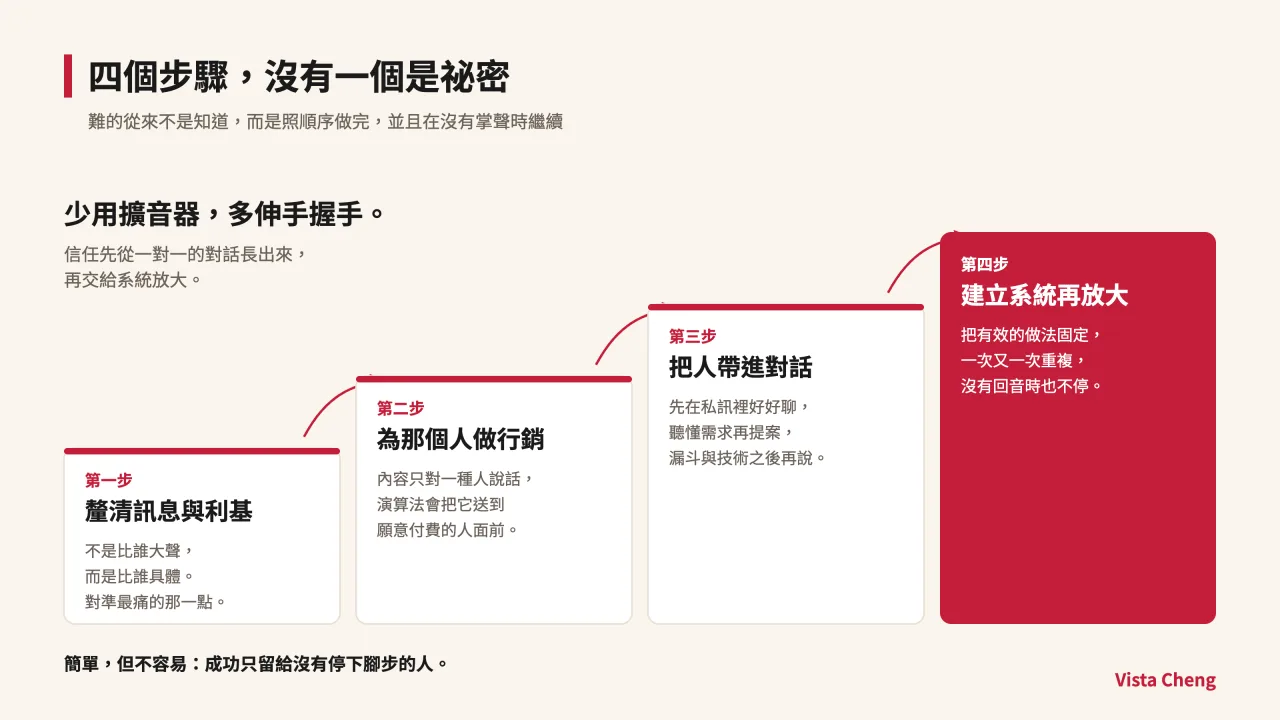
▲ Four steps, none of which are secrets
This made me re-examine my teaching over the years. I write books, give courses, and do in-house training, and I am very accustomed to putting value on the completeness of the content and the beauty of the structure. Just like what I expressed after the course in “Design, Marketing and Operation of Millions of Online Courses” many years ago, it was mostly about how to polish the course. But the six days and three months after the students leave the classroom are where the results really happen or do not happen, and I was mostly not present during that time. What Jasmine reminds me is that presence itself is the product. It doesn’t have to be a weekly live broadcast, it can be a reply on the day, a reminder “You said it was due on Thursday”, or a homework sheet with the next step and date clearly written.
So I want to start small. Pick an existing course, find less than ten students, commit to a verifiable result within four to six weeks, use the simplest tools to make daily reports, and each reply ends with the next step and date. Before setting a price, I first interviewed readers and students who I thought I knew very well, and listened to their own words about how much the changes they wanted were worth, and then used a small seed sale to verify it. After running a round, I will know how many people I can accompany and how much I should charge.
AI has made information nearly free and unlimited supply of content. There will be no turning back. In such an era, what creators can still sell are things that information cannot provide: a certain result, a certain period of time, and a person who will definitely appear. All three are expensive and difficult to replicate, which is exactly what makes them valuable. After all, what Jasmine sells is not a newer product than the course, but a very old-school promise: I will walk with you there. Whether we can fulfill this sentence may be the real test question for knowledge workers in the next ten years.
Next step
Bring this topic to your team
Vista Cheng speaks and runs workshops on AI workflows, writing and content systems for companies, schools and public agencies.