Digital assets for knowledge workers: I built a briefing library and a tool laboratory using AI
✍️ This article was originally published in “Vista Newsletter” No.124, originally published in iamvista.substack.com (opens in a new tab). If you like this kind of content, welcome to free subscription to “Vista Newsletter” (opens in a new tab) to receive my observations and methods first-hand every week.
Hi, I’m Vista.
In the last issue of the newsletter, I talked to you about Personal Brand Tags: Let the right people remember you with the right tags. After I posted it, a reader wrote back and asked me a very practical question: I have thought clearly about labels, what next? Just posting the content on the social media will disappear in three days… Um, do you want me to chase the algorithm for the rest of my life?
Well, that’s a great question. So in this issue, I want to take you to visit my two websites: one is the public briefing library slides.vista.tw (opens in a new tab), and the other is the AI Tool Lab lab.vista.tw (opens in a new tab). They work for me 24 hours a day, without clocking in or taking vacations, and they were not built by engineers. They were built brick by brick by me using AI.
I want to use these two practical cases to talk to you about a topic that knowledge workers will face sooner or later: Does your major have a home?
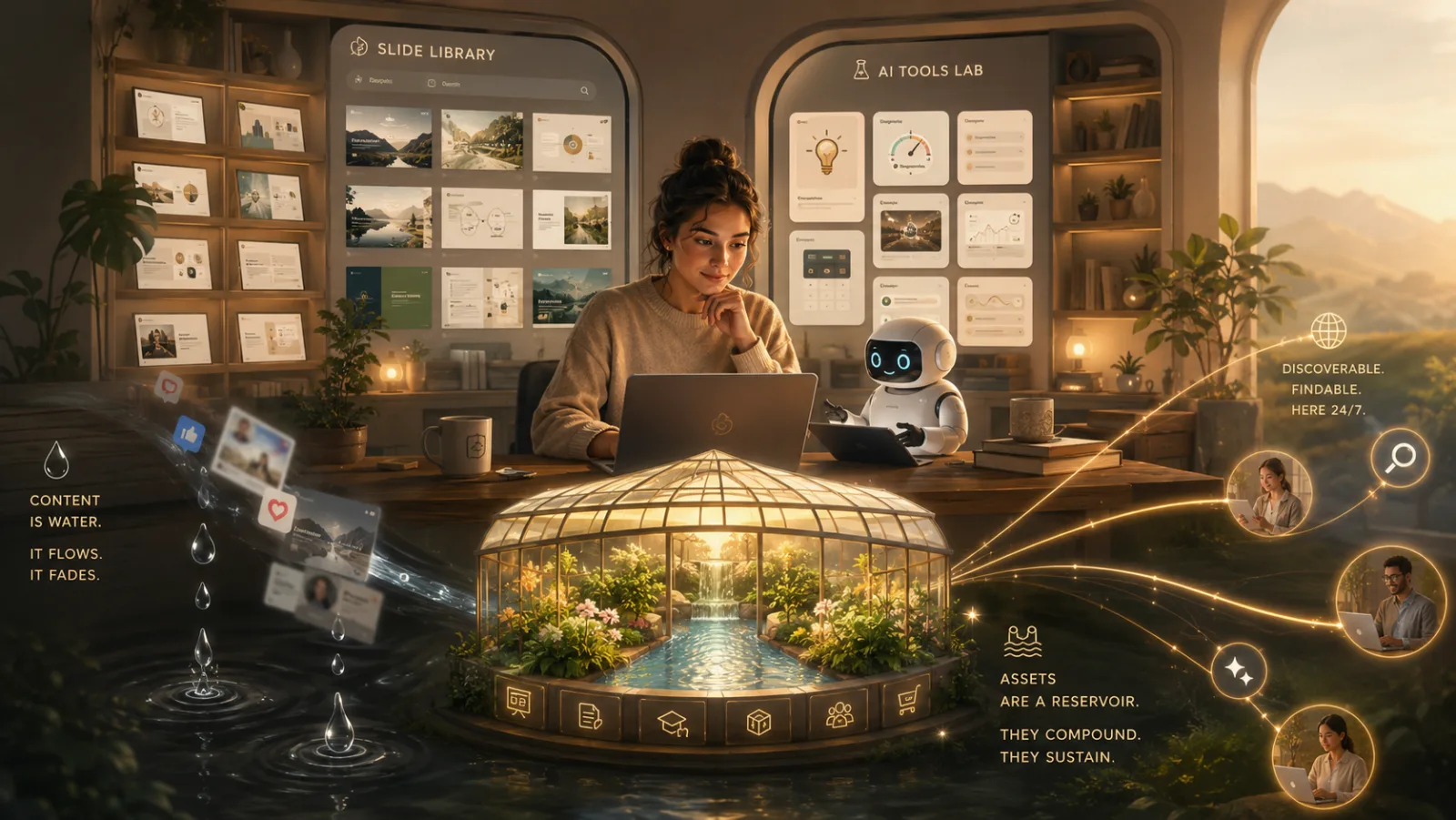
Most people’s content strategies are essentially just pouring water.
Let me start with a cruel observation: the content strategy of most knowledge workers is essentially just pouring water.
For example, you spend an hour writing a Facebook post and the reach goes to zero within forty-eight hours. You spend two weeks preparing a speech, and when you’re done, the brief sits deep in the back of your hard drive, never to be seen again. You give wonderful advice in a certain consultation, and then it evaporates in the air. When the next client comes, you have to give it again.
Effort is real, but accumulation is fake because no one can see it. Because there is no place where these precious outputs can be continuously found, used and cited.
On the contrary, the logic of the asset is to store water. The same three hours, the same two weeks, if the output is placed in a fixed location, it will start to work for you: it will be indexed by search engines, read by AI, and silently reviewed by potential customers at a moment you don’t know. I mentioned GEO (Generative Engine Optimization) in the last issue: When someone asks ChatGPT who is good at a certain field, the AI will find the answer from the content it has read. Having said that, do you have a stable output home, which directly determines whether you will appear in that answer?
After understanding this difference, I conducted two experiments.
Experiment 1: slides.vista.tw, move hundreds of presentations online
The first experiment is slides.vista.tw, which is my public presentation library.
As a lecturer, I give at least dozens of lectures and workshops every year. The previous process was: preparing lessons, giving lectures and archiving afterwards, and then this hard work was locked in the cold palace. One day I did some calculations and found that there were hundreds of presentations lying on the hard drive, each representing several days of in-depth compilation, and their number of views only stopped at the one hundred or so people on the day of the speech.
Well, isn’t that a pity? So I moved them online and made a briefing archive that anyone can browse. It is currently divided into seven theme areas: AI tutoring class ten module courses, Claude Code and Vibe Coding, knowledge management and sub-brain projects, academic writing and research, enterprise AI applications, media content narrative, and entry and public service templates. After each lecture, it will be put on the shelves the same day.
After going online, three things happened that I didn’t expect.
First, it becomes my three-dimensional resume. When a company’s human resources window evaluates a lecturer, what they want to know most is what exactly does this person teach in class? Instead of filling your proposal letter with a self-introduction of 1,800 words, why not include a sentence: My past presentations are all public here, please refer to them for your own reference. As you can imagine, trust is built at completely different speeds.
Second, it becomes the entrance to invited classes. One organizer wrote directly after reading a certain briefing, requesting in-house training on that topic. I didn’t do any more selling, the brief made the sale on its own.
Third, it becomes nourishment for GEO. These pages are pure web pages, searchable text, and can be read by search engines and AI. For example, when someone asks AI who teaches Gemini Notebook or Claude Code in Taiwan, this briefing library is my answer candidate.
Of course, the price is discipline: put it on the shelves as soon as you finish talking. It sounds simple, but execution requires a set of process support. My approach is to turn the shelving into a fixed step at the end of lesson preparation, as natural as turning on and off the projector. Assets are not created by inspiration, but by processes.
Experiment 2: lab.vista.tw, turning repeated suggestions into tools
The second experiment is lab.vista.tw, my AI lab.
The starting point is an observation: I have given some advice dozens of times in classes and consultations. For example, it helps students check whether an idea is worth pursuing, helps writers converge vague ideas into clear positioning, and helps graduate students ask better research questions. Every time, it is spoken orally, drawn on a whiteboard, and then disappears after speaking.
I asked myself: Can these repetitive thinking frameworks be turned into tools that others can use for themselves at any time?
The answer is obvious, of course it is possible. My AI lab has currently accumulated 32 gadgets, each of which turns a certain judgment process in my mind into an interactive web page. Here are a few examples: Idea Physique Self-Test Package (opens in a new tab), which helps you check the physique of an idea before investing in it; Viewpoint Preliminator (opens in a new tab), which forces you to think clearly about your position before writing; Positioning Convergator (opens in a new tab), which converges divergent self-descriptions into one sentence; GEO Physical checker (opens in a new tab), check whether your content is friendly to generative engine users; Research question scaffolding (opens in a new tab) and Literature review matrix (opens in a new tab) are scaffolding for academic writers.
What’s more worth talking about than the tool itself is the operating mechanism of this website. Only some of the tools in the AI Lab are fully public, and the rest are placed in the members area. Each tool has a public date: subscribers can use it as soon as possible. When the date comes, the same URL will be automatically opened to the public, without moving or modifying the link.
This ingenious design solves two problems at once. For subscribers, the reason for subscribing becomes concrete: not to support me in the abstract, but to be the first to use all new tools. To me, every tool has two lives: first as a membership benefit, and then as a public business card. One job, hopefully two paybacks.
You don’t have to be an engineer, you just need to be able to direct
After reading this, you probably have a voice in your mind: It sounds great, but I am not an engineer.
I understand, because neither am I. These two websites, from layout, functions to membership gates, were all completed by me using Claude Code and Vibe Coding: I describe what I want in Chinese, AI writes the program, I accept it, and I modify it back and forth until I am satisfied. The whole process is more like directing an engineer rather than writing the program yourself.
This is exactly the new normal of One-Man Company I have been talking about: there is no one else in the company, just you and an AI army. What used to have to be outsourced or teamed up can now be done by one person plus AI. The bar has really gotten lower, so low that you can start today.
Further, these tools are just amplifiers, and the real value is what you amplify: the expertise you deliver repeatedly. This means that the starting point is not to learn technology, but to take stock of yourself.
Three steps to start accumulating your digital assets
If you want to start accumulating your own digital assets, I recommend starting with these three steps.
The first step is to take stock of your assets. Open your hard drive and cloud and make a list of presentations, teaching materials, templates, or checklists you’ve worked on over the past two years. Think about it again, what three pieces of advice have you repeated more than ten times at work? Write them down and this is your shortlist of assets.
The second step is to pick the smallest one to start with. Don’t start out trying to build a whole library. Pick one of your strongest briefs, or one of your most repeated suggestions, from your list and turn it into a web page that you can share publicly. Well, just one is fine.
The third step is to let AI be your engineer. Open Claude Code or any AI tool you are used to, and state your requirements clearly in Chinese: I want a one-page website to store my briefing directory; or, I want an interactive self-test tool. The title is as follows… Make the first version first, send it to three friends for trial, and then iterate.
After three steps, you will have the first asset that works for you 24/7. What happens after that is repetition and accumulation.
Give your tags and build a home
Now, let’s go back to the reader’s question at the beginning: Now that we have thought clearly about labels, what next?
My answer is: build a home for your label! Labels are the impressions in other people’s minds, and assets are the entities that support this impression. The impression will slowly fade, but the physical things can accumulate. When your briefing library interviews for you and your gadgets serve potential clients for you, you change from a person who runs after the algorithm to a person who can be found by others.
Welcome to visit my two experimental websites: slides.vista.tw is a briefing library, and lab.vista.tw is a tool laboratory. Among them, Idea Physical Self-Test Package (opens in a new tab) and AI Personality Generator (opens in a new tab) are currently fully public, and you can experience them directly.
Also feel free to write back and tell me: If you were to build the first digital asset for your profession, which briefing and which recurring piece of advice would you start with? I will read every reply carefully.
See you next time!
Next step
Bring this topic to your team
Vista Cheng speaks and runs workshops on AI workflows, writing and content systems for companies, schools and public agencies.