Embracing the multi-modal AI era: How small and medium-sized enterprises can use full perception capabilities to reshape operations and per capita output value
This article was originally published in the expert argument column of “TechNice Technology Island (opens in a new tab).
Speaking of generative AI, everyone is quite familiar with it by now. In the past few years, SMEs’ understanding of AI has mostly been based on pure text instructions. Whether it’s writing business copy, translating emails, or producing meeting minutes, corporate proposals, etc., as long as you give a few prompt words, AI can immediately do it at your fingertips.
It is true that these applications bring many conveniences, but as the time series enters the second half of 2026, companies will begin to face different challenges, that is, real business operations are not limited to pure text content, but also include diverse information presentations. For example, voice messages from customers, on-site photos, estimates in PDF format, casual design sketches, and structured data in ERP are intertwined into daily scenes in the workplace.
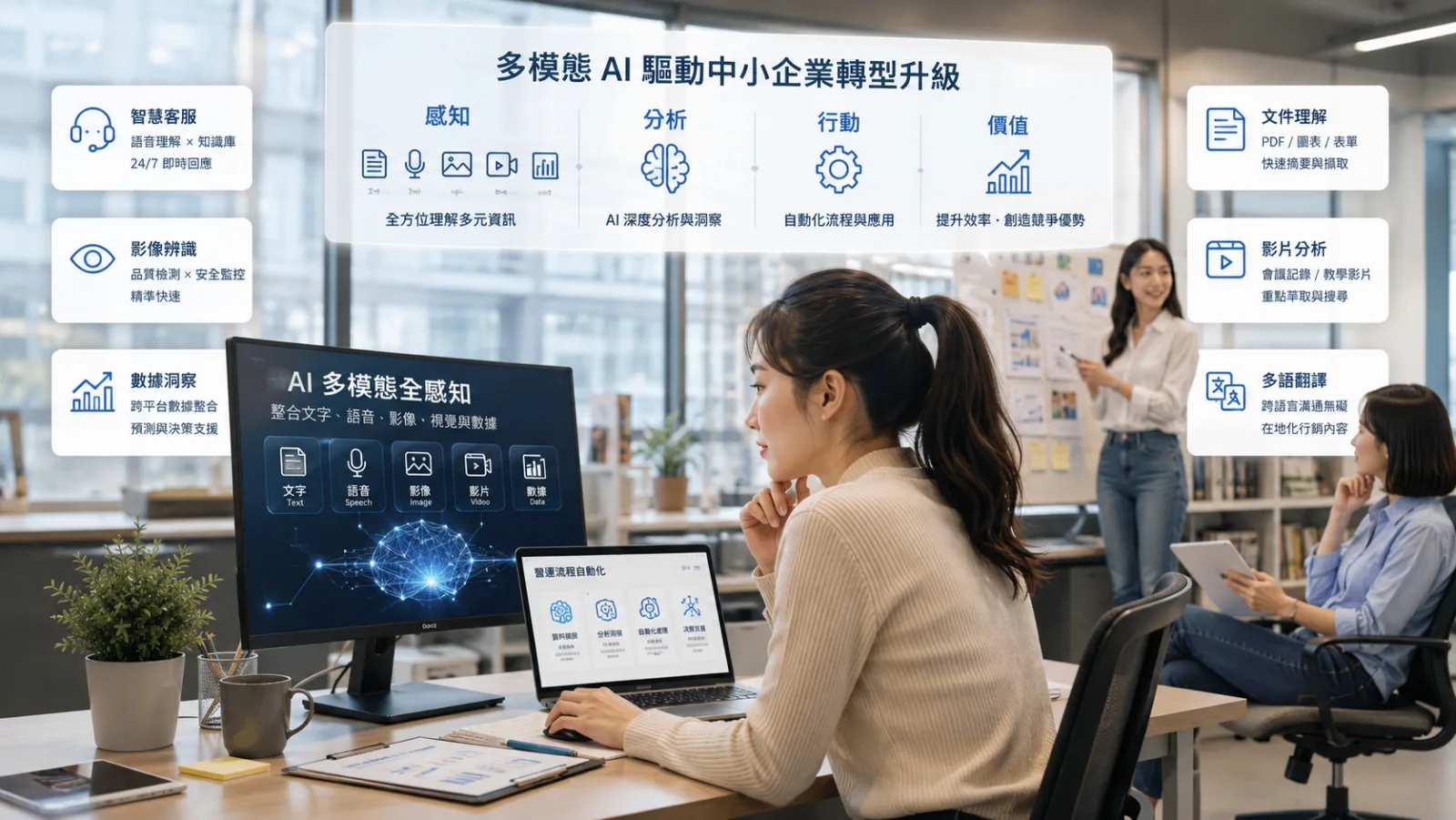
The rise of multimodal AI (Multimodal AI) has given artificial intelligence the full ability to perceive text, speech, images, visual layout and videos. For small and medium-sized enterprises that generally have limited resources and lack large IT teams, this is undoubtedly the strongest lever to break data silos and double their per capita output value.
Let’s ask a more basic question first: What is multimodality?
To talk about the impact of multimodal AI, we must first understand what multimodality is.
From a communication perspective, multimodality is essentially the most natural communication state for humans, because human communication is never one-dimensional. The social semiotic theory of communication masters Gunther Kress and Theo van Leeuwen has long pointed out that when people convey messages, they often use two or more symbol systems at the same time, such as words, images, sounds, bodies and spaces, to jointly create meaning.
In this communication situation, any single symbol is incomplete, and a synergistic effect will be produced between different modes, making the final overall meaning greater than the sum of the individual ones.
For example, when we watch the movie “The Odyssey”, the protagonist Odysseus experienced the Trojan War and many years of wandering at sea. Facing the trauma of killing, the oracle and the lamentation of the destruction of civilization are moving. Any dialogue spoken by the protagonist must be intertwined with his eyes at the time, the background music and the tone of the picture, so that the audience can understand the most real emotions and context.
From printing, broadcasting to short videos, media is becoming multi-modal all the way
From the perspective of the evolution history of communication media, human society has gone from pure text-based print media, to radio and television that combines sound and images, to today’s social platforms full of short videos and interactive modes.
This development path is actually the process of continuous multi-modalization of media. The existence of multi-modality is to break through the communication limitations of a single medium and allow information to flow between people more three-dimensionally and more conveniently.
When we put the concept of multi-sensory collaborative communication in communication into the field of technology, we can understand what multi-modal AI is and why it has become an indispensable tool for enterprises.
Simply put, multimodal AI refers to an artificial intelligence system that can simultaneously receive, understand and integrate two or more different types of data, such as text, images, audio and video. This technology essentially allows machines to adapt to the most natural way of communication for humans, breaking the cold current situation of human-machine interaction in the past.
If you want to have a concrete feeling first, you can take a look at the path of Gemini Notebook from a note-taking tool to a voice learning coach, which is the easiest multi-modal application for ordinary people to get started with.
Three places where small and medium-sized enterprises are really stuck
Let us return to the operational scenario of small and medium-sized enterprises. The most common bottlenecks seen in the workplace are nothing more than the labor cost of transcription caused by cross-format data, communication errors caused by asynchronous information between on-site and back-end information, and gaps in experience inheritance.
The reason why multi-modal AI is favored by the industry is that it can truly understand complex forms, flow charts, architectural design drawings and invoice layouts, and accurately understand structural intentions; it skips the delay of converting speech to text and then throwing it to the language model, directly captures the speaker’s emotions, intonation and background sounds, and quickly responds and triggers administrative triggers; it can also be combined with smartphones or wearable devices to analyze on-site photos or short videos, compare standard operating procedures and give immediate feedback.
For small and medium-sized enterprises, the emergence of multi-modal AI is important because it can significantly improve communication and operational efficiency within and outside the enterprise.
Traditional enterprises are filled with a large amount of complex unstructured data, such as technical manuals containing engineering drawings, customer complaint letters with product photos, or audio and video recordings of online meetings. In the past, this data required manpower from different departments to separately read, organize, and cross-department check; now, multi-modal AI can quickly understand these multimedia data, automatically align product photos, customer voice complaints, and background text records, capture the core of the problem and provide a solution in a few seconds, eliminating the cumbersome cross-system integration process.
This kind of files that fill the hard drive but no one organizes is the biggest hidden asset of most companies. I talked about the same thing in Lecturer’s Digital Asset Management Technique: the information is not insufficient, but it is scattered everywhere and not connected.
I would suggest that when introducing multi-modal AI, you should focus on your company’s actual needs and process automation, rather than purely considering technical or budget issues. This echoes what I wrote previously Five Key Points for Small and Medium-Sized Enterprises to Import AI: What really gets stuck in an enterprise is never the technology, but whether it has found the right scenario.
Three international cases: from factory, car cabin to retail store
For example, Japan is bringing multimodal AI into physical AI in the real world. If multimodal AI acts as a full-sensory brain that transcends single text and can simultaneously see images, understand sounds, and read text, then physical AI gives AI body and physical mobility, allowing the brain to be closely integrated with mechanical hardware.
In recent years, FANUC, a major machine tool manufacturer, has cooperated with Google Gemini Enterprise to introduce multi-modal AI agents on factory robot arms. The lens on the arm can instantly understand the complex engineering blueprint (image), combine it with the vibration and noise of the sensor (audio), and read the technical specification manual (text). This allows the robotic arm to independently understand how to grab and assemble new-shaped parts without the need for engineers to manually write cumbersome automation codes, and automatically issue early warnings before minor wear and tear occurs on the equipment.
The German automobile giant Mercedes-Benz chose to break away from the traditional command-based voice and cooperated with Liquid AI to embed native multi-modal large models directly into the vehicle chip. The latest driver assistance system can monitor road conditions and the driver’s eyes (vision) through cameras outside and inside the car, while listening to the driver’s intonation and words (audio). This allows the vehicle to not only avoid collisions during autonomous driving, but also act like a human co-pilot with a sense of space: when you turn your head to look at a building outside the window and ask “What is that?”, the AI can immediately identify the target of your vision through spatial alignment, and guide you through the history of the attraction through voice.
In addition, Walmart, the global retail leader, has also deployed multi-modal AI in its supply chain and stores. On the logistics side, the AI agent combines meteorological satellite cloud maps (images), regional supply chain reports (text) and real-time transportation sensor data. It can autonomously re-plan the routes and inventories of multiple distribution centers within minutes before natural disasters such as hurricanes and earthquakes strike. In retail stores, Walmart has introduced an AI visual anti-theft system. The camera lens at the checkout counter can recognize the customer’s scanning movements (dynamic vision) and compare the RFID tags with the item records (text data) of the POS system to accurately detect missed scanning or theft, greatly reducing the loss rate while protecting privacy.
It is worth noting that Walmart does not simply use the power of technology to solve all problems, but introduces suitable solutions according to different scenarios.
From the above-mentioned international success stories, it can be clearly seen that the common success mindset for enterprises to introduce multi-modal AI is not just to introduce cutting-edge technology, but to fundamentally redesign the data flow and application scenarios. Only through such a strategy can AI no longer be just an auxiliary tool, but can truly replace repetitive and error-prone manual processes, greatly improve efficiency and accuracy, and create sustainable business value.
Tips for introduction to small and medium-sized enterprises in Taiwan: Light assets, focus on processes
Considering that more than 90% of companies in Taiwan are small and medium-sized enterprises, for these companies with limited resources, I suggest that when introducing multi-modal AI, they should not blindly invest in the development of expensive customized large models, but should adopt an asset-light and process-heavy strategy.
Start by taking an inventory of your internal operations and identify those frequently repeated nodes that require manual conversion of photos, PDFs, or speech into typed data.
Next, give priority to using mature commercial APIs or software packages that have integrated AI functions on the market, use automated tools to combine AI with existing systems, and quickly conduct small-scale testing.
In the process of promoting digital transformation, companies must also establish strict information security regulations, prohibit employees from uploading sensitive personal information or business secrets, and at the same time shift the focus of talent training from simple instruction writing to critical thinking and verification skills, allowing employees to exercise judgment and act as the ultimate gatekeeper.
Regarding data governance, in my article Looking ahead to the new era of agents in 2026, I listed four questions that should be answered by internal corporate standards: which data cannot be uploaded to the cloud, which tasks must be manually reviewed, which outputs need to be marked with sources, and which decisions must not be completed by AI alone. If you cannot answer these four questions, no matter how fast you introduce it, it will only amplify the risk.
(opens in a new tab)
Write at the end
The core value of multimodal AI has never been to replace human labor, but to equip every employee with a digital assistant with all-round perception capabilities. This is also the point I keep emphasizing: AI will not replace you, but people with AI workflows will.
When a small company with less than 20 employees can use this technology to process cross-format data and customer service volume equivalent to a hundred people, corporate budget and scale will no longer be an absolute moat. Operational agility and per capita output will be the key to winning or losing the competition.
The sooner small and medium-sized enterprises understand this reality and are willing to actively take inventory of their own unstructured data processes and integrate multi-modal technology into daily operations, the better they will be able to realize business benefits at extremely low marginal costs.
Next step
Bring this topic to your team
Vista Cheng speaks and runs workshops on AI workflows, writing and content systems for companies, schools and public agencies.