Is PARA really the key to information management in the AI era?
Today, Tiago. Tiago Forte published a long and eye-catching article on social media As the founder of the “Second Brain” methodology, every time he speaks touches the nerves of productivity enthusiasts around the world.
But this time, his anxiety was more obvious than before.
Anxious Manifesto from the Godfather of Productivity
He mentioned that he recently did something counterintuitive: he deliberately left his computer desktop and download folder unorganized for a whole month, leaving files piled up, scattered, and messy. A month later, he counted a very eye-catching figure: a total of 222 files had accumulated on the desktop and download folder.
More importantly, these 222 files are not homogeneous garbage, but real content that spans work and life: financial documents (taxes, retirement accounts, insurance forms), work materials (promotional pictures for upcoming classes, interview videos), personal photos, and various content he wants to read and study (such as a PDF about information overload). In other words - these are the fragments of data that naturally arise when a person’s life is functioning.
Then he took the second step: manually archive these 222 files into his original file system using PARA’s structure. The result made him very proud, because it only took 36 minutes, which translates to an average of about 9.7 seconds per file.
The purpose of this experiment is not just to tell you that organizing is fast, but to elaborate on his subsequent argument: even if AI can help you organize, organizing is still worth doing by yourself, and the value is not in saving time.
The AI myth he wants to refute: Organizing is not a matter of efficiency
Tiago. In this article, Forte clearly pointed out a popular statement he saw: Many people claim that AI tools like Claude Code can help you organize files, so file organization will be replaced by AI. This seems to be a very intuitive and tempting imagination: humans finally no longer have to worry about those trivial filings.
But he believes this statement only scratches the surface. His core rebuttal is:
The real value of organizing is never about efficiency or time saving; the value of organizing lies in the act of organizing itself, which triggers your human consciousness.
Therefore, he repositioned organizing as a psychological and cognitive level operation rather than a data transfer.
Three non-efficiency values of organization: reminder, refreshing, and saving
Then, Tiago. Ford proposed three effects of organization. And these three effects, he emphasized, cannot be obtained equally by AI.
**First, organizing will remind you what to do next. ** When he puts a PDF into a folder, he will think “I want to send this to a colleague.” In other words, organizing is not about moving files away, but about returning you to the original intention of saving it. This intention often only exists in the context of your mind, not the file content itself.
**Second, organization makes the workspace clearer and allows you to focus better. ** He believes that clutter on your desktop or in your inbox creates a kind of background noise—a hidden distraction that you feel even if you’re not looking at it all the time. What tidying up brings is not visual tidiness, but psychological tranquility; and psychological tranquility is closely related to creativity and concentration.
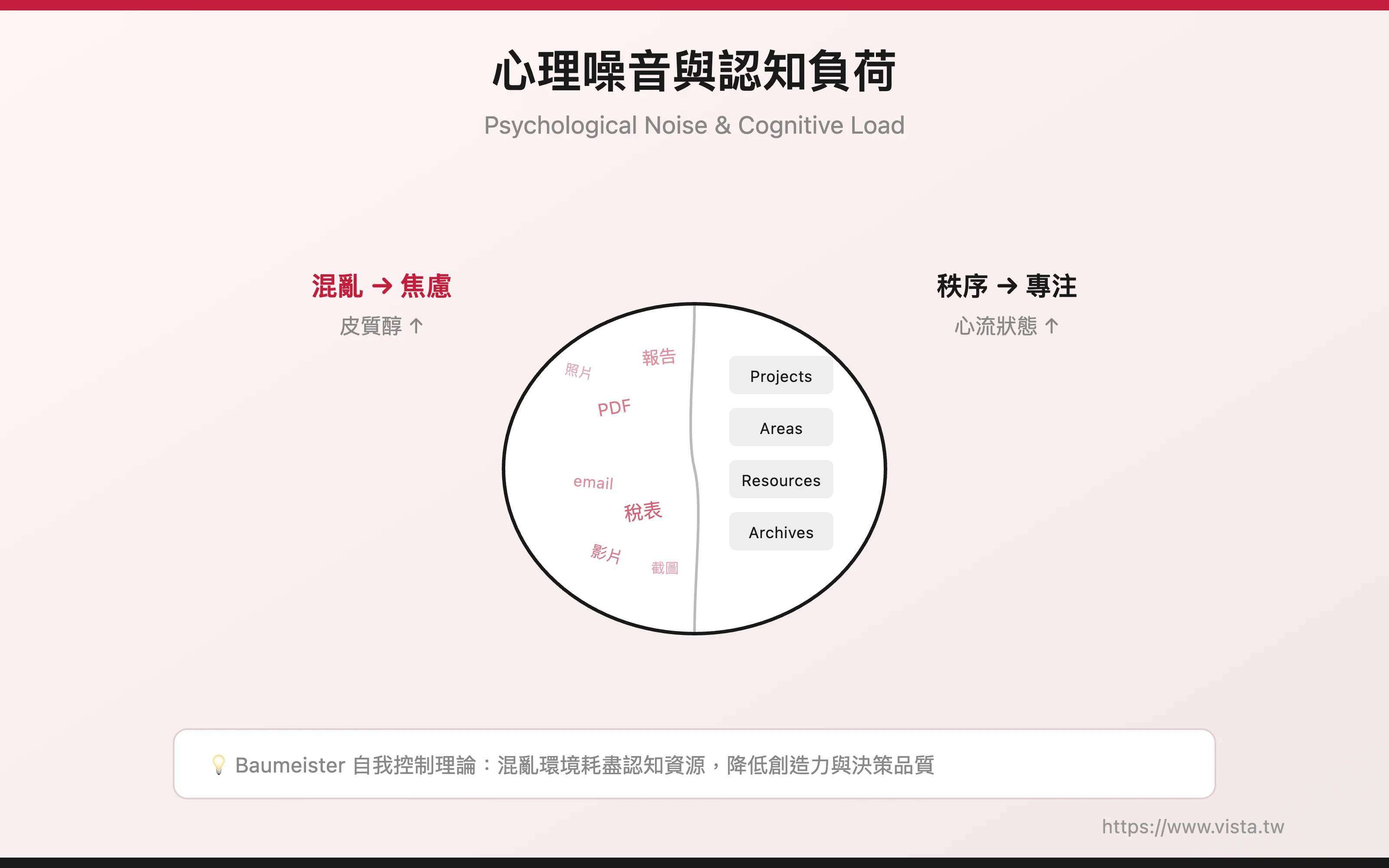 ▲ The chaotic digital environment will continue to consume your cognitive resources. Organizing brings not only visual tidiness, but also psychological tranquility
**Third, sorting is for future recyclable value. ** Many files are not for immediate use, but will be used again someday in the future, such as research materials, reusable materials, or compliance documents that must be preserved. Over the long term, these accumulate into your personal data assets.
The fourth value he wants to emphasize most: the AI era makes organization more important
The above three points are actually sufficient, but Tiago. Forte goes on to lay out his real claim: that the age of AI has given rise to a fourth, and possibly the most important, reason.
Organizing is to make your data can be used by more powerful AI.
He reminded readers: The emergence of AI has instantly increased the value of any ready-made database (including those messy files in our computers). Because AI can do many things with this data: writing, analysis, review, expansion, summary, generation of strategies and output documents. In other words, data from your past becomes a mine of context that can be reused.
However, there is a seeming contradiction here: he also admitted that you do not need to organize the data perfectly and consistently before it can be used by AI; you can throw messy data to the model and it can handle it.
Well, then why is decluttering important?
Because of Tiago. Forte believes that there are two practical limitations of AI tools that make it necessary for you to be able to select the content that should be given to it:
- The effective situational window of AI is limited, and you cannot feed the entire life data into it at once.
- The search can only find similar files, but it cannot automatically form a situation package that suits your working style.
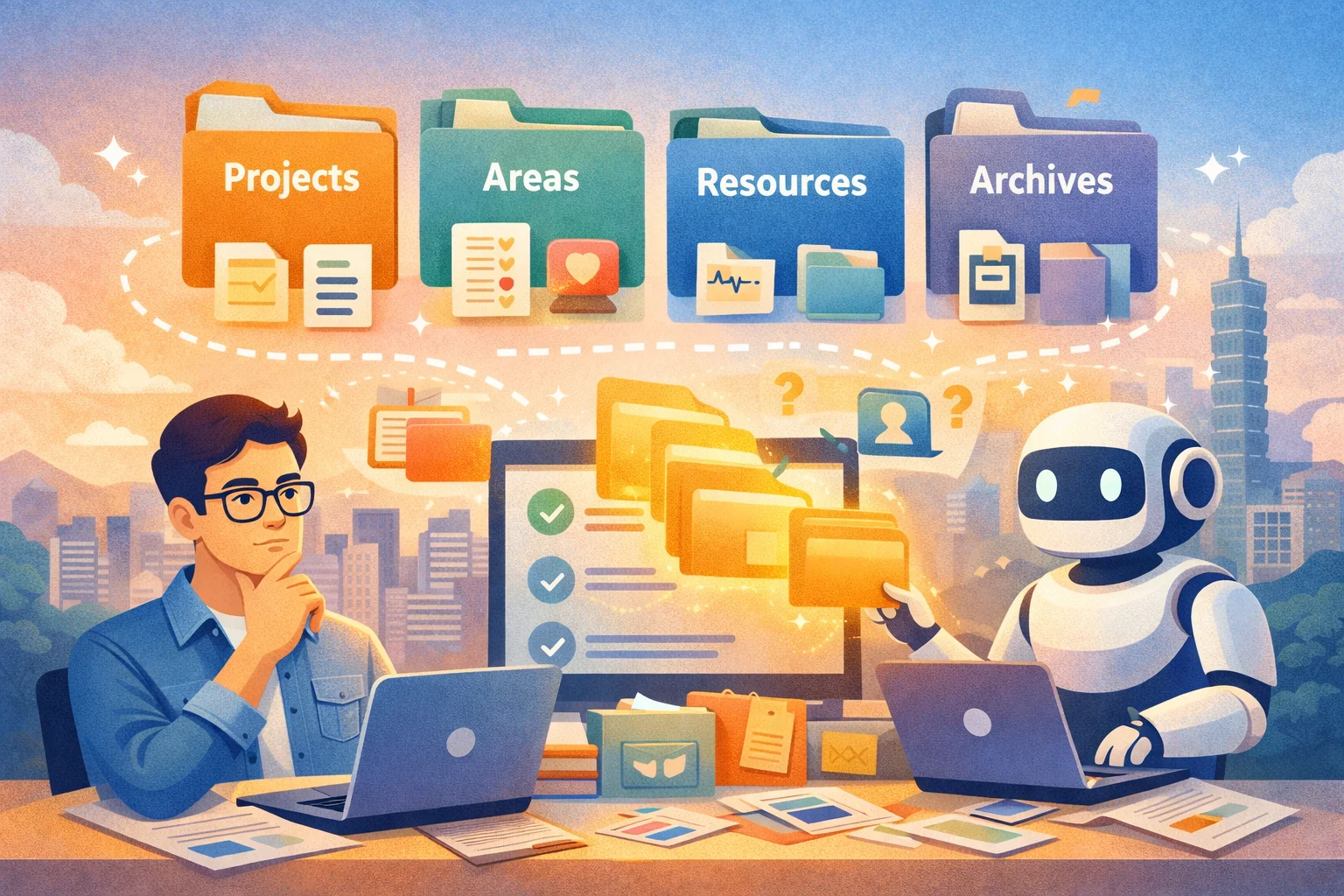
Therefore, he advocates: you need context that has been packaged in advance, and the four categories of PARA happen to be the most natural way to package situations.
PARA’s role in AI collaboration: turning the scattered world into a pointable situation
Tiago. Forte described a very specific case of frustration: He once asked Claude to help him write a proposal to potential customers, but the AI got into trouble when it needed to find background information—because the information was scattered in different places such as Google Drive, Notion, or blog pages, the connector might not be connected, permissions might be stuck, and even reading a web page would fail. When your context is scattered across a dozen platforms, and each platform is like an island, the AI will run into walls everywhere.
PARA’s solution is: you don’t let the AI hunt, you directly package the prey into a usable folder and hand it over to it.
- You want AI to help you with a certain project → point to the Project folder
- You want AI to help you handle long-term responsibilities → point to Area
- You want AI to help you explore your interests → point to Resource
- You want AI to help you review the past → point to Archive
These four types of folders are equivalent to four modes of operating your life. In other words, AI wants to intervene in your work and life, what you need most is the framework of how you operate, rather than the scattered fragments of files.
What AI still cannot replace is the importance and association
Finally, Tiago. Ford returned to the bottom line he most wanted to defend: What AI cannot yet reliably do is help you determine what is important, what you should do next, and those associations that only you can understand.
Why does a screen recording file remind you to send it to an editor? Why do a bunch of photos remind you of your child’s graduation photos next week? Why does an old folder suddenly remind you of some advice I should give to a friend?
These are not things that can be inferred from the archives themselves, but are the products of human life experiences and situational associations. AI can do a lot of things for you, but it can’t live your life for you.
So he condensed these thoughts into a very simple conclusion: Even if each file takes an average of ten seconds to put into place, it is still worth it, because what you are organizing is not the file, but the commitments, actions, and structure of your life.
His core proposition can be summarized into three levels: First, the value of file organization far exceeds efficiency. It can remind you of the actions you should take, keep your work space clean, and save reference materials for the future. Second, AI tools require structured local archives as context, and PARA’s four categories (Projects, Areas, Resources, Archives) just provide a pre-assembled package of the minimum viable context. Third, there are some cognitive functions—such as triggering distant associations from the process of organizing a file—that AI cannot currently do.
Tiago. Ford’s discussion is insightful, but it feels like there are some areas that need to be discussed. As a lecturer and consultant who has long studied AI applications, I would like to provide a more complete assessment from three dimensions: information science, cognitive psychology and AI technology.
Tiago. What was Ford right about?
To be fair, his article does touch on several real and important issues.
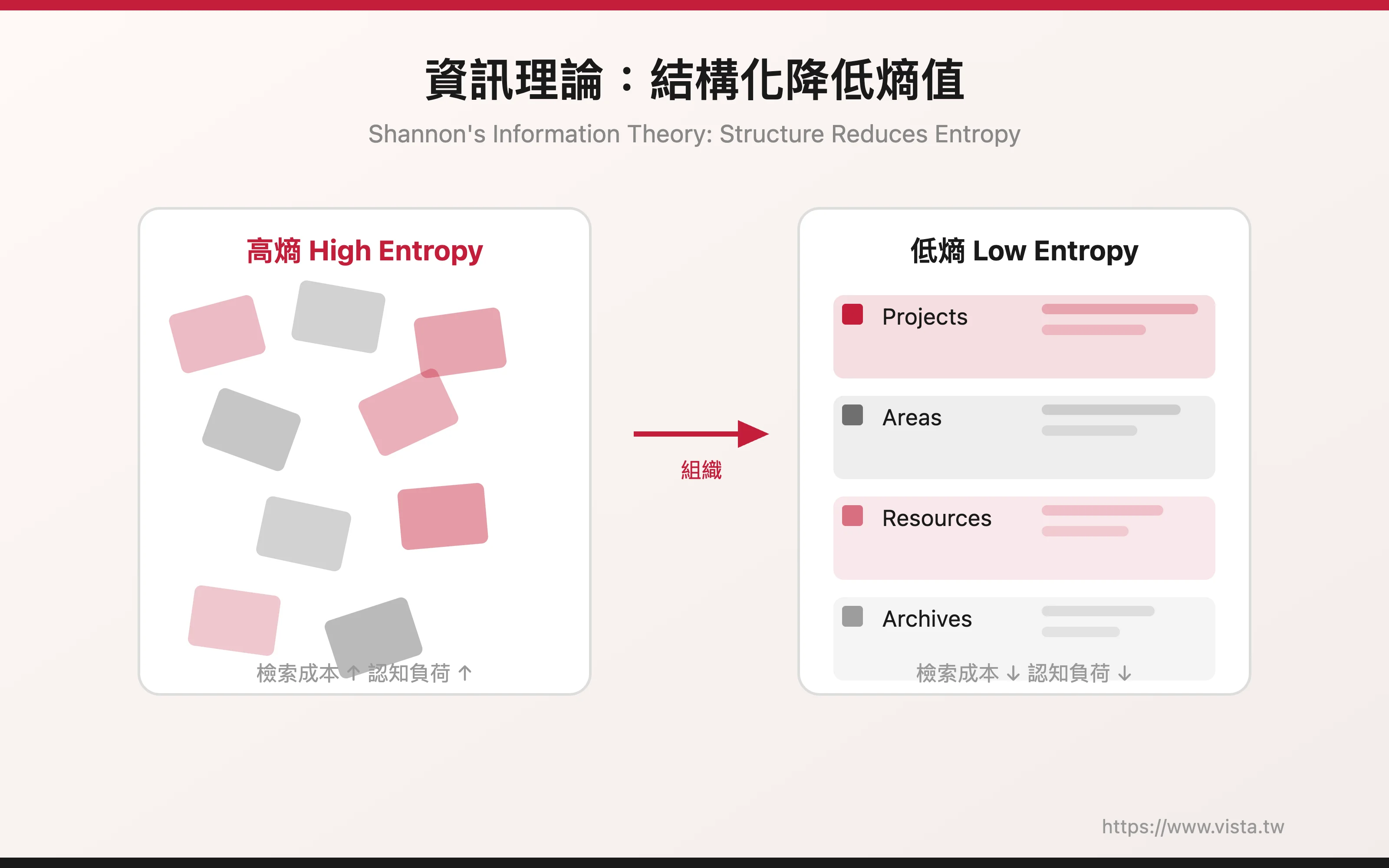 ▲ Shannon’s information theory tells us that structured data can reduce entropy and reduce the cognitive cost of future retrieval
First of all, the idea that “organization is more than just efficiency” is highly consistent with the basic principles of information science. Claude Shannon’s information theory tells us that structured data can reduce entropy, making the system easier to navigate and utilize. When you archive a PDF into the correct project folder, you’re not just storing it, you’re reducing the cognitive cost of future retrieval.
Second, the “mental noise” reduction effect he describes has a solid scientific basis. Attention researcher Roy. Roy Baumeister’s ego depletion theory points out that willpower is a limited resource, and a chaotic environment will continue to consume cognitive resources. Neuroscience experiments at Princeton University in the United States also confirmed that cluttered objects in the visual environment compete for attention resources and reduce the efficiency of working memory. Keeping your digital desktop tidy can indeed lower cortisol levels and promote the entry of flow state.
Third, he emphasized that the organizational process can “remind action”, which accurately echoes the Zeigarnik Effect in psychology: unfinished tasks will continue to be active in memory.
When you see a screen recording on your desktop and think of sending it to the editor - this kind of association is indeed difficult for current AI to complete autonomously.
Fourth, PARA’s “Archives” category serves as a mechanism for forgetting without deleting, similar to how human long-term memory operates. Ebbinghaus’s forgetting curve research shows that information decays over time, but properly structured storage can reawaken it when needed. This design is truly elegant.
Gap in Information Science: PARA is not the only solution
However, from an information science perspective, Tiago. There is a fundamental framework bias in Ford’s discussion: he presupposes that hierarchical classification is the best way to organize information, and ignores the multiple methodologies of modern information architecture.
PARA is essentially a four-tier hierarchy, but modern information retrieval systems have long transcended this paradigm. The tagging system allows the same document to belong to multiple categories, solving the classic dilemma in the hierarchical structure of “Should this document be classified as Projects or Resources?” Graph databases can capture semantic relationships between files, not just attribution relationships. Full-text search engines, such as Elasticsearch, can perform semantic searches in unstructured data without the need for pre-categorization at all. More importantly, his claim in the article that “searches can only find exact matches for individual files” may now be out of date. Vector search and semantic embeddings technologies—through vector databases such as FAISS, Pinecone, and Chroma—can understand the semantic intent of queries and find documents that are conceptually related but have different text. When you search for “Customer Proposal Strategy,” the system can find a document titled “Q3 Business Development Plan,” even though the two don’t have any keywords in common.
This means that what the AI era really needs may not be a more refined folder structure, but richer metadata and semantic indexing.
PARA provides a human-readable organizational framework, but for AI, a well-tagged and embedded flat file system may be more efficient than four-layer folders.
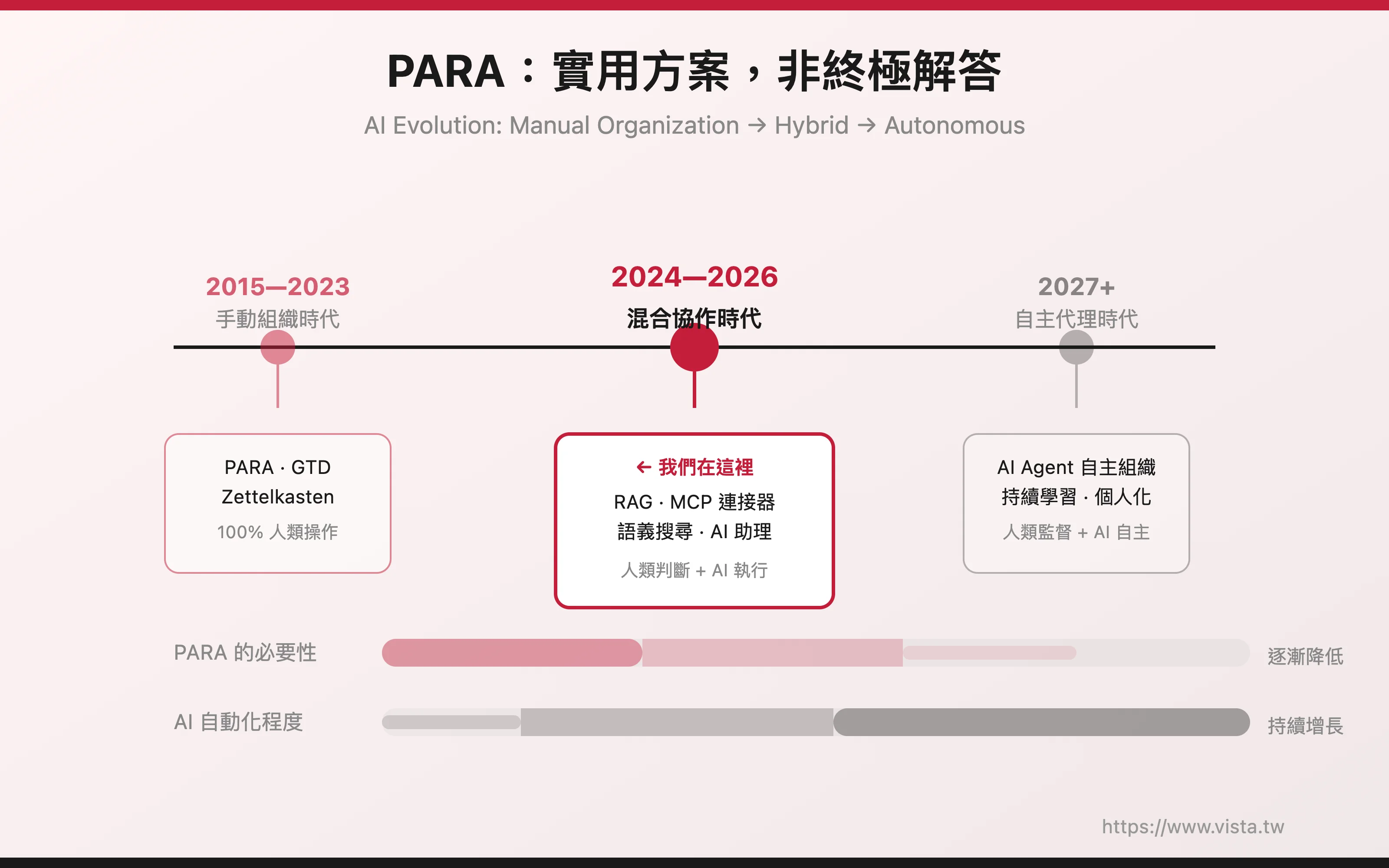 ▲ PARA is an effective transition solution, but from the perspective of AI technology development, it may not be the ultimate answer
Supplement to Psychology: Neglected Individual Differences
Tiago. Although Ford’s psychological discussion is in the right direction, he may have made a common mistake, which is to promote his cognitive style as a universal law.
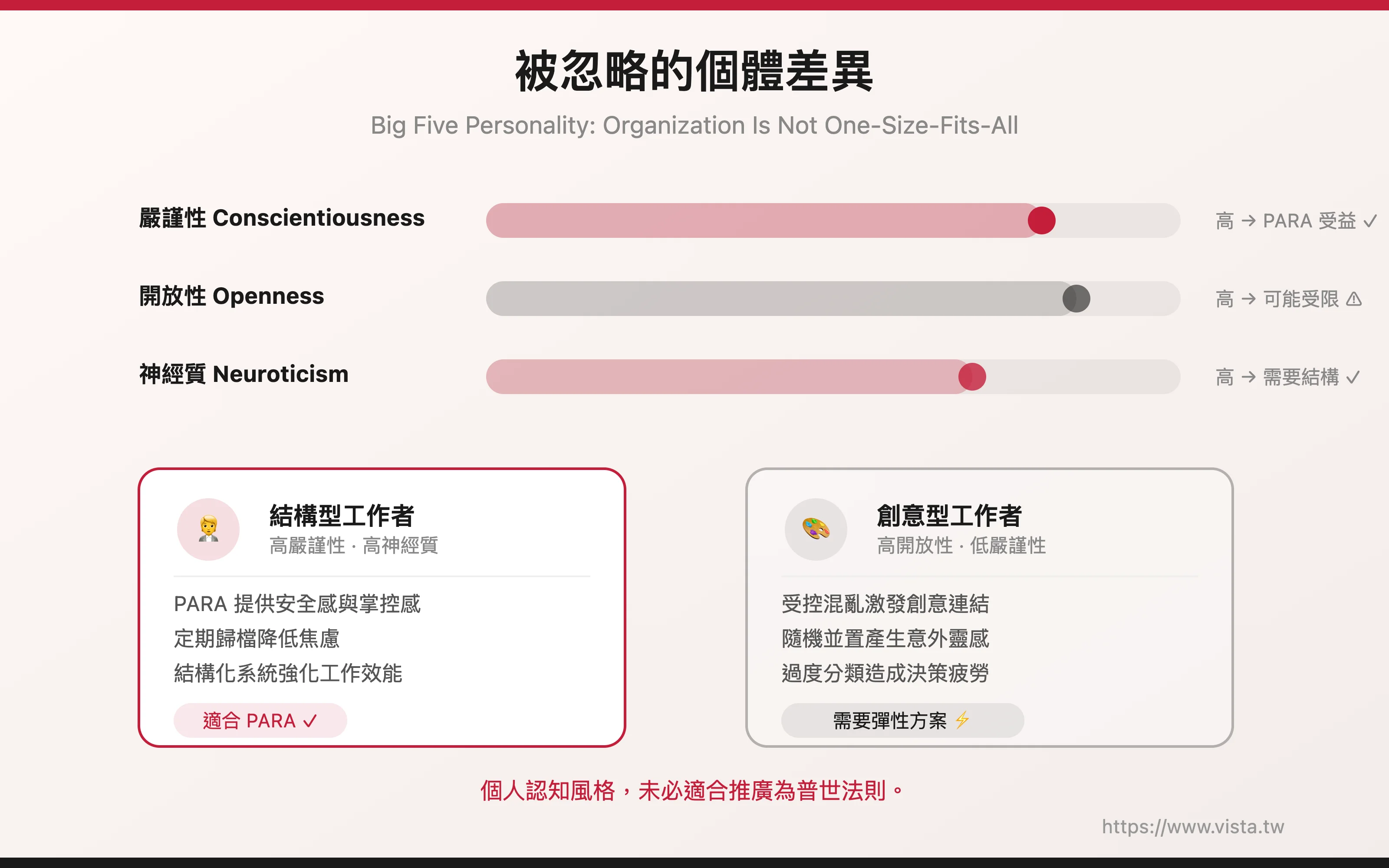 ▲ The five personality traits model reminds us that the benefits of organizational behavior vary from person to person – some people are more creative in “controlled chaos”
The Big Five model in personality psychology reminds us that the benefits of organizational behavior vary from person to person. People with high neuroticism and conscientiousness can indeed gain a sense of security and efficacy from structured systems. But people with high openness may find that excessive organization limits creative free association. Some creatives deliberately maintain controlled chaos because random juxtapositions can spark unexpected connections.
In addition, the calculation in his article that each job takes about 9.7 seconds may ignore the opportunity cost and decision fatigue. Psychologist Kathleen. Research by Kathleen Vohs shows that each classification decision consumes limited cognitive resources. The existence of 222 files means 222 micro-decisions of “Where should I put this?” For some, the cognitive load of those 36 minutes may offset the mental refreshing feeling of decluttering.
Even more concerning is the risk of digital amnesia. Besti. A study published in Science in 2011 by Betsy Sparrow and others found that when people know that information is stored by an external system, they will reduce the memory encoding effort of the information. Overreliance on any organizational system—whether PARA or AI—can weaken our metacognition, the ability to know what we know.
PARA is very practical, but it may not be the ultimate answer
This is what I think Tiago. What needs to be challenged most is Fort’s argument. He positioned PARA as the key to the AI era, but judging from the development trajectory of AI technology, PARA is indeed very practical, but more like a transitional solution.
First, he may have underestimated the ability of AI to handle messy data. In the article he acknowledges that you can feed large language models the data in all its chaotic glory, but then the argument still needs to be organized in advance. However, modern AI toolchains already have the capability to automate organizations. Frameworks like LangChain and Semantic Kernel can scan entire directories, extract semantics, and automatically cluster. Multimodal models can simultaneously analyze the semantic associations of images, PDFs, and text. The RAG (Retrieval-Augmented Generation) architecture allows AI to accurately extract relevant context from large amounts of unstructured data without the need for humans to put files into the correct folder in advance.
Tiago. The experience that Forte described in the article “Claude tried to help me write a proposal but couldn’t find the relevant information” reflects not the necessity of PARA, but the temporary limitations of current AI tools in cross-platform integration. This problem is being solved quickly - Apple Intelligence’s device-side semantic search, Windows Copilot+‘s Recall function, and various MCP (Model Context Protocol) connectors are all moving towards allowing AI to seamlessly access all your data.
Let’s look at what he said: “AI cannot achieve long-distance association.” This is partially true on a technical level - current large language models do lack persistent situational awareness. But this limitation is being gradually broken through by memory systems, personal knowledge graphs and agent architectures. The AI assistant of the future is likely to proactively remind you when you are sorting through your vacation photos, “Your friend David is planning a similar trip. Do you want to send him a list of recommendations?”
This is not a science fiction fantasy, but a functional direction that is currently under development.
Motives in perspective: Why Tiago. Ford said this
If you want to truly understand Tiago. Forte’s article cannot ignore his identity and background.
His entire business—books, online courses, certified coach training, Forte Labs premium content—is built on PARA and the Second Brain methodology. When an AI tool is marketed as automatically organizing your profile, it potentially undermines its core value proposition.
So, this article is essentially a masterful brand repositioning: not to deny the capabilities of AI, but to upgrade PARA from an organizational approach to an infrastructure for the AI era. His argument strategy is to first admit that AI can do a lot of things, then argue that PARA allows AI to do it better, and finally add that there are some things that AI cannot do as a safety net.
Of course, this is not to say that his views are without value. Because, he does point out some real issues. But readers should have a clear understanding of the context and make a decision that suits them. For example, a truly neutral analysis might lead to a different conclusion: perhaps what the AI era needs is not PARA, but a new model of human-machine collaboration organization.
My point: Embrace hybrid strategies, reject single dogma
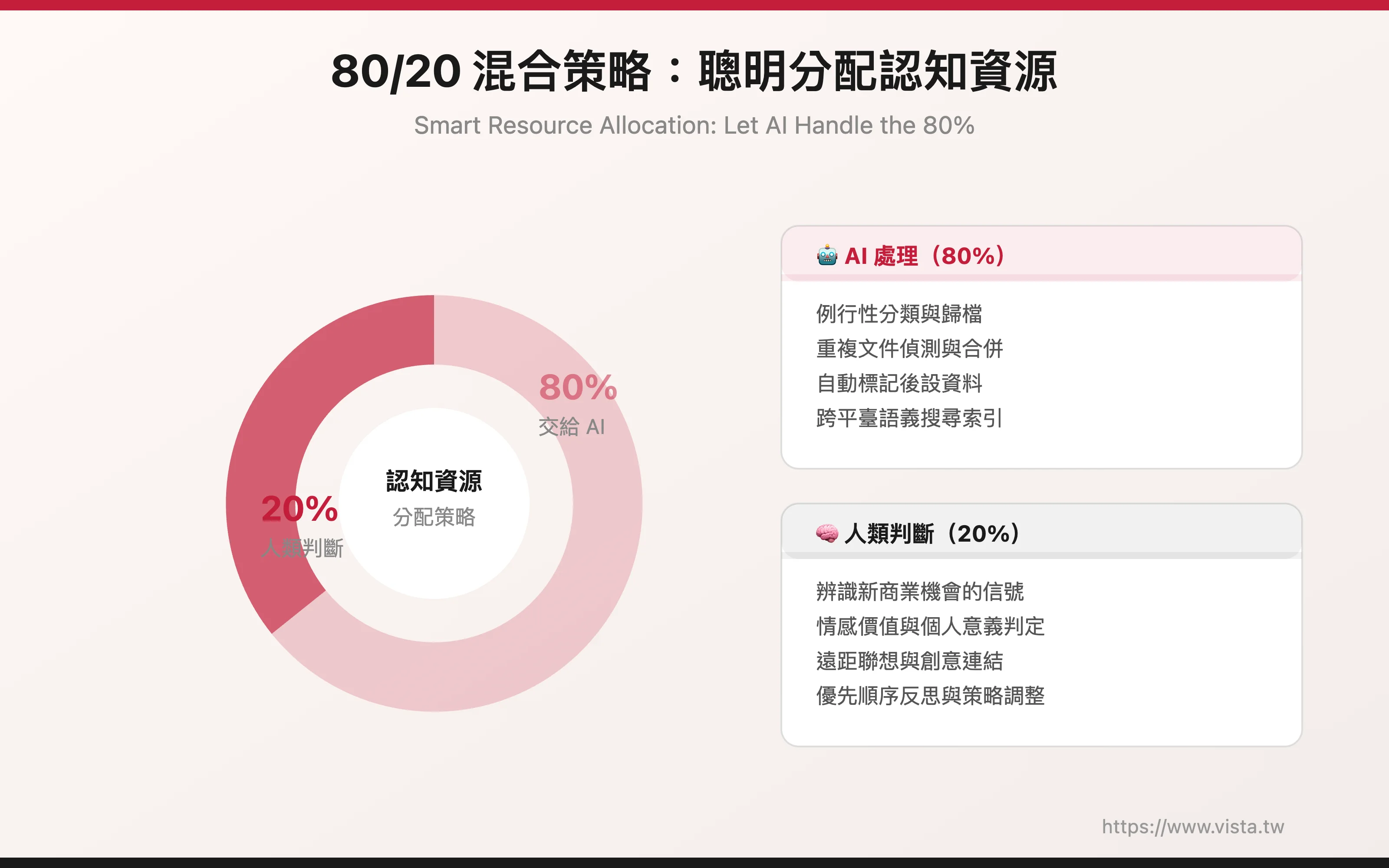 ▲Leave 80% of routine classification to AI and reserve cognitive resources for the 20% of decisions that really require human judgment
Based on the above analysis, I believe that personal information management in the AI era may not require loyalty to any single system, but a flexible hybrid strategy. Here are my specific suggestions:
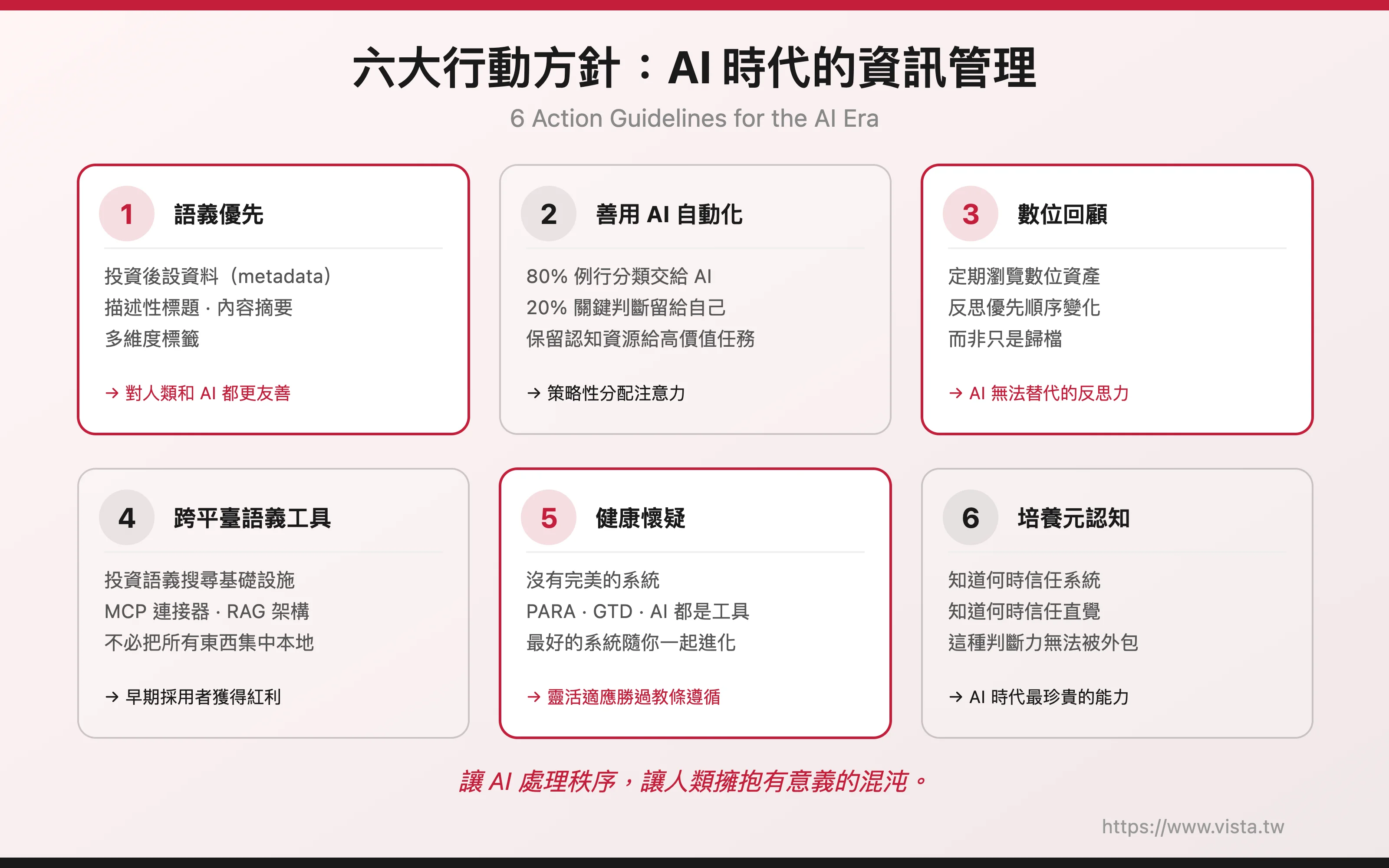 ▲ Personal information management in the AI era requires not loyalty to a single system, but a flexible hybrid strategy
**First, establish semantic-first organizational habits. **Instead of spending energy on deciding which folder the file should be placed in, it is better to invest in enriching the metadata of each file - the title should be descriptive, the content should be summarized, and the tags should reflect multi-dimensional relationships. This is more valuable to both humans and AI.
**Second, make good use of AI’s automation capabilities to handle 80%. **The classification of most files is routine and can be left entirely to AI. Reserve your cognitive resources for the 20% of decisions that truly require human judgment—for example, whether a certain document represents a new business opportunity or whether a certain photo has special emotional significance.
**Third, conduct regular digital reviews instead of just digital sorting. **His 9.7-second filing method focuses on putting things in the right place, but a more valuable approach may be to browse your digital assets regularly and ask yourself: “What do these things tell me about my current priorities?” This kind of reflective review is the cognitive activity that AI cannot replace.
**Fourth, invest in cross-platform semantic search tools. **Instead of trying to collect everything into local folders and organize it into a perfect structure, take advantage of semantic tools that can search across platforms. Technology is moving rapidly in this direction, and early adopters will reap huge productivity dividends.
**Fifth, maintain a healthy skepticism about any system. **Whether it is PARA, GTD (Getting Things Done) or any emerging AI-driven methodology, they are just tools, not beliefs. I must say, I love these tools! However, the best system is one that you are willing to continue to use and that can be adjusted as technology and needs evolve.
Sixth, develop your metacognitive skills. In an era when AI is increasingly adept at replacing our memories and organizations, the most precious human ability is knowing when to trust a system and when to trust intuition.
This judgment cannot be outsourced and should not be replaced by any system.
Between order and chaos
Honestly, Tiago. Forte’s anxiety is understandable - when you’ve spent ten years building a methodology and see that AI might make it unnecessary, it’s natural to want to find a new reason for its existence. But history tells us that every technological change will eliminate some methods and retain some principles.
PARA’s core principles—action-oriented organization, the wisdom of forgetting in time, and personalized information architecture—are still valuable in the age of AI. However, specific practical methods such as manual filing into four folders are likely to be replaced by smarter human-computer collaboration mode in the next few years.
So, as I see it, the real question is not whether PARA is the key to the AI era? But in an era where AI is getting smarter and smarter, where should humans spend their cognitive resources? My humble opinion is to spend time on judgment, reflection and creation, rather than dragging files into folders.
Let AI handle order and let humans embrace meaningful chaos.
Extended reading:
- Anytype + Claude: Create an AI-driven second brain to make your notes come alive
- AI note-taking is not only fast, but also a secret weapon to help you build long-term advantages
- Dont let your efforts be forgotten, skillfully use AI to create a second brain for your career
- Let AI become a thinking partner, not just a machine that produces answers
- Cognitive gap is the real wealth code
External Resources:
- Why PARA is the key to the AI era (original text by Tiago Forte)
- Building a Second Brain official website
- The PARA Method: A Universal System for Organizing Digital Information