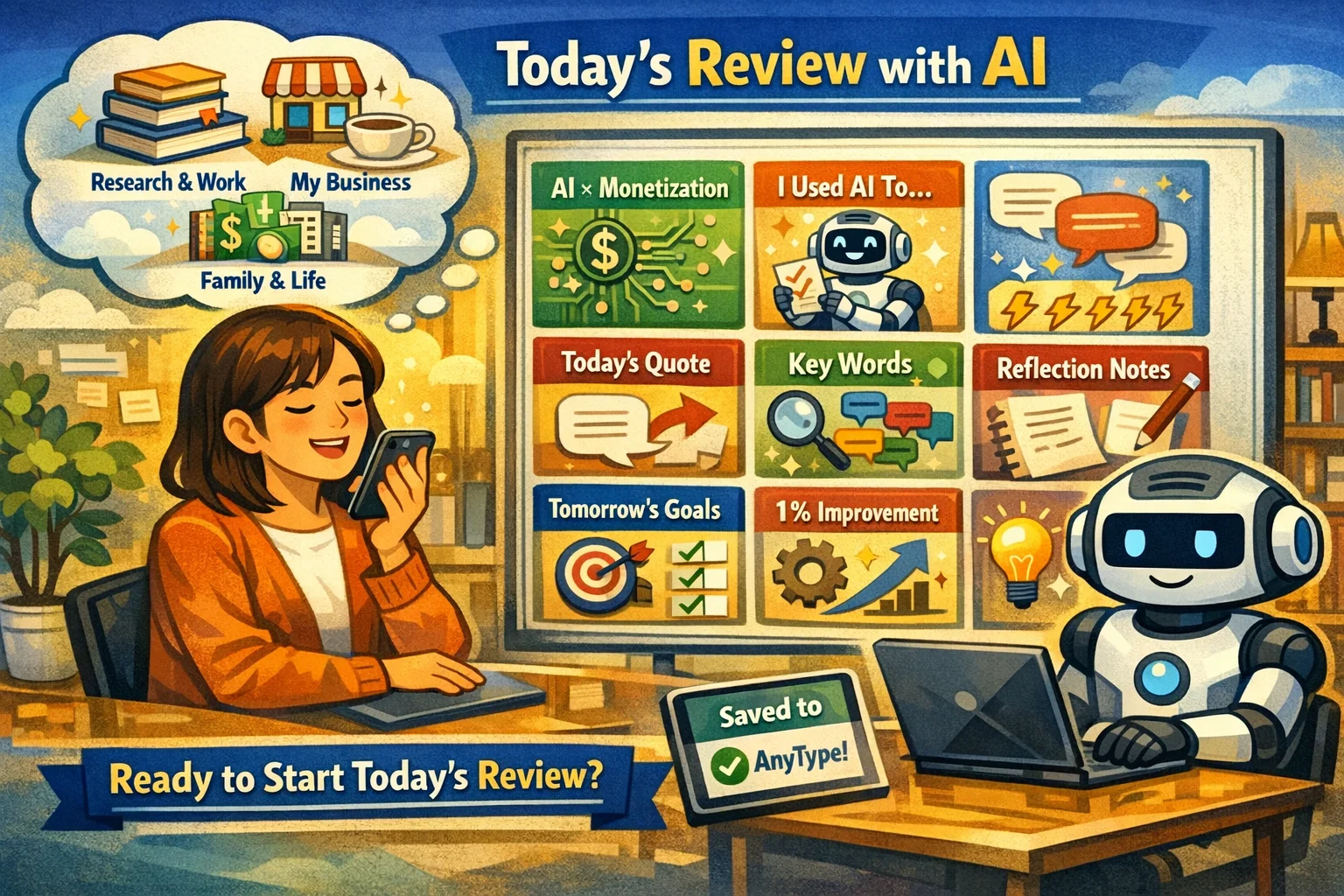
Podcast note-taking: 6 steps to build a content flywheel with Podwise + Anytype
Opening: Are you like this too?
If you like listening to podcasts like me, I guess you may have a long list of things to listen to on your phone or laptop?
I totally know that feeling. Every time I swipe open Apple Podcasts or Spotify and see that red unread number, I feel a little nervous. After subscribing to 50 programs, probably less than 10% actually listened to them from beginning to end. What’s even worse is that after finally listening to an episode, I immediately thought, “Wow, this point of view is so powerful” and “I must try this method.” What was the result? Three days later, you can’t even remember what that episode was about.
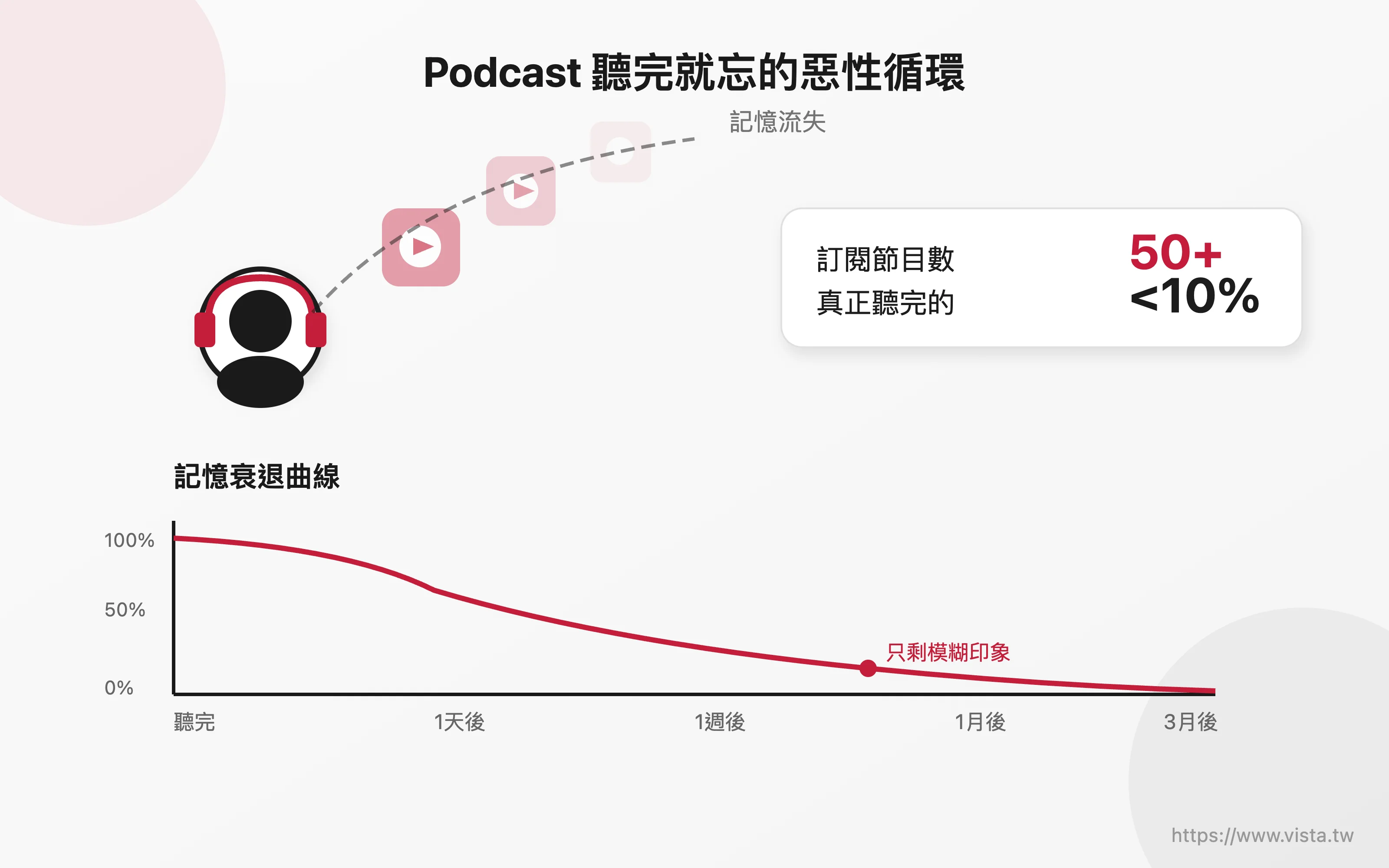
This is not your problem, this is the default mechanism of the human brain.
Auditory information comes and goes quickly. Unlike reading, where you can go back and highlight key points, podcasting is a one-way street, and the sound flows past it. Unless you do something deliberately, those wonderful insights, the unique experiences of the guests, and the host’s sharp questions will all become vague impressions of having been heard before.
What’s more ironic?
When you sit in front of the computer and want to write something, and your mind goes blank, and you feel uninspired and don’t know what to write, your ears have actually received several hours of high-quality content in the past week. Those contents just flowed by without turning into anything.
I used to be like this too.
As a content creator, I listen to podcasts on my daily commute. Technology trends, entrepreneurial stories, productivity tips, writing tips… listen to everything. I thought I was studying very seriously, but when I really wanted to produce content, I found that my mind was empty. The things I had heard slipped through my fingers like sand.
Until one day, I asked myself a question: “Can I turn podcasts from consumer goods into raw materials for production?”
This question changed everything.
From there, I started designing a system. This system allows me to efficiently convert the podcasts I listen to every week into my own articles, e-newsletters, and even reference sources for course content. It’s not plagiarism or laundering, but truly standing on the shoulders of giants, adding your own opinions and experiences, and producing valuable original content.
You can think of this system as a content flywheel.
Why is it called a flywheel? Because it takes a little effort to push at first, but as you continue to turn it, it will become more effortless with each turn. The more notes you accumulate, the more materials you can link to; the more materials you can link, the faster you can write articles; the more articles you write, the better your judgment will be on which topics have information and which angles have readers. This is a positive cycle.
In this article, I will completely dismantle the 6 stages of this system, including the tools I use, my specific operating procedures, the pitfalls I have stepped on, and the prompts I use regularly. This is not a theory, this is a process I actually run every week. You can follow it after reading it.
Are you ready? Let’s get started!
My Content Flywheel Overview
Before I dive into each stage, let me give you the big picture of the system.
My content flywheel has 6 stages, forming a closed loop:
Phase 0|Pre-setup → Phase 1|Select a program → Phase 2|AI processing → Phase 3|Import notes → Phase 4|Convert to article → Phase 5|Weekly routine
Then, the output of Phase 5 will be fed back to Phase 1, letting you know better what kind of content is valuable to you, forming a flywheel effect.
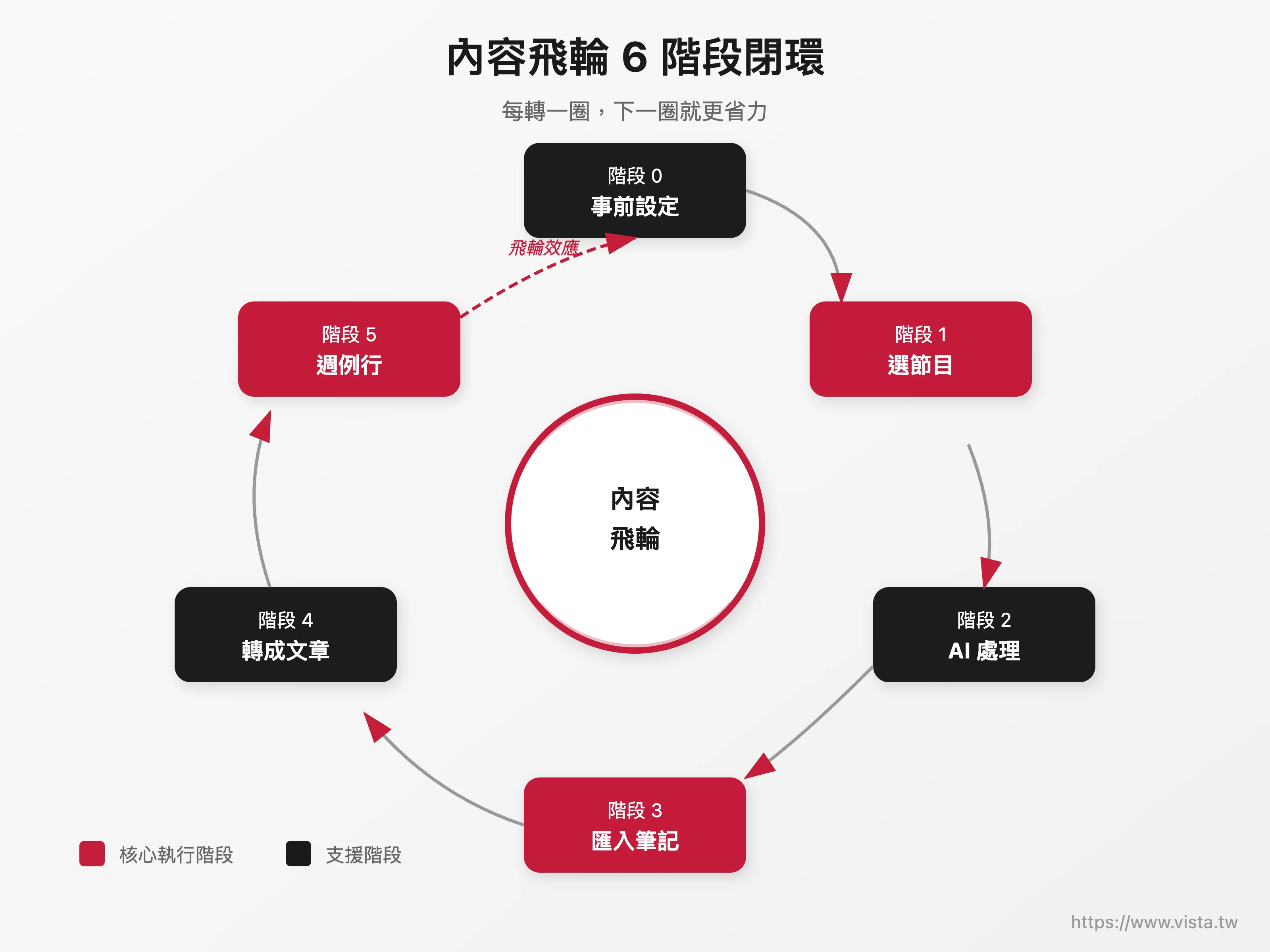
The core logic of this system is: Every link must reduce the resistance of the next link.
When selecting a program, you must consider whether the topic discussed in this episode can be used as reference information for the article; when processing with AI, you must produce a format that can be directly pasted into notes; when organizing notes, you must establish a structure that facilitates future searches and links. In other words, each step paves the way for the next.
Many people like to take notes, but the problem is: they take a bunch of notes, but then forget about their existence. I opened it three months later and looked at the scattered words. I couldn’t remember why I wanted to remember this in the first place.
The system I want to build is different from others. For example, the moment each note enters the database, it has been marked in which direction it can be developed? This is not sorting out after the fact, this is preparatory work that is being processed and planned at the same time.
Sound complicated? Don’t worry, every step is easy when you take it apart. A complex system works because it is broken down into simple actions.
Let’s start with stage 0.
Stage 0: Pre-setup - setting up the tools
Before you start turning the flywheel, you need to get your tools ready. The good news is that this setup only needs to be done once, and then it’s pure execution.
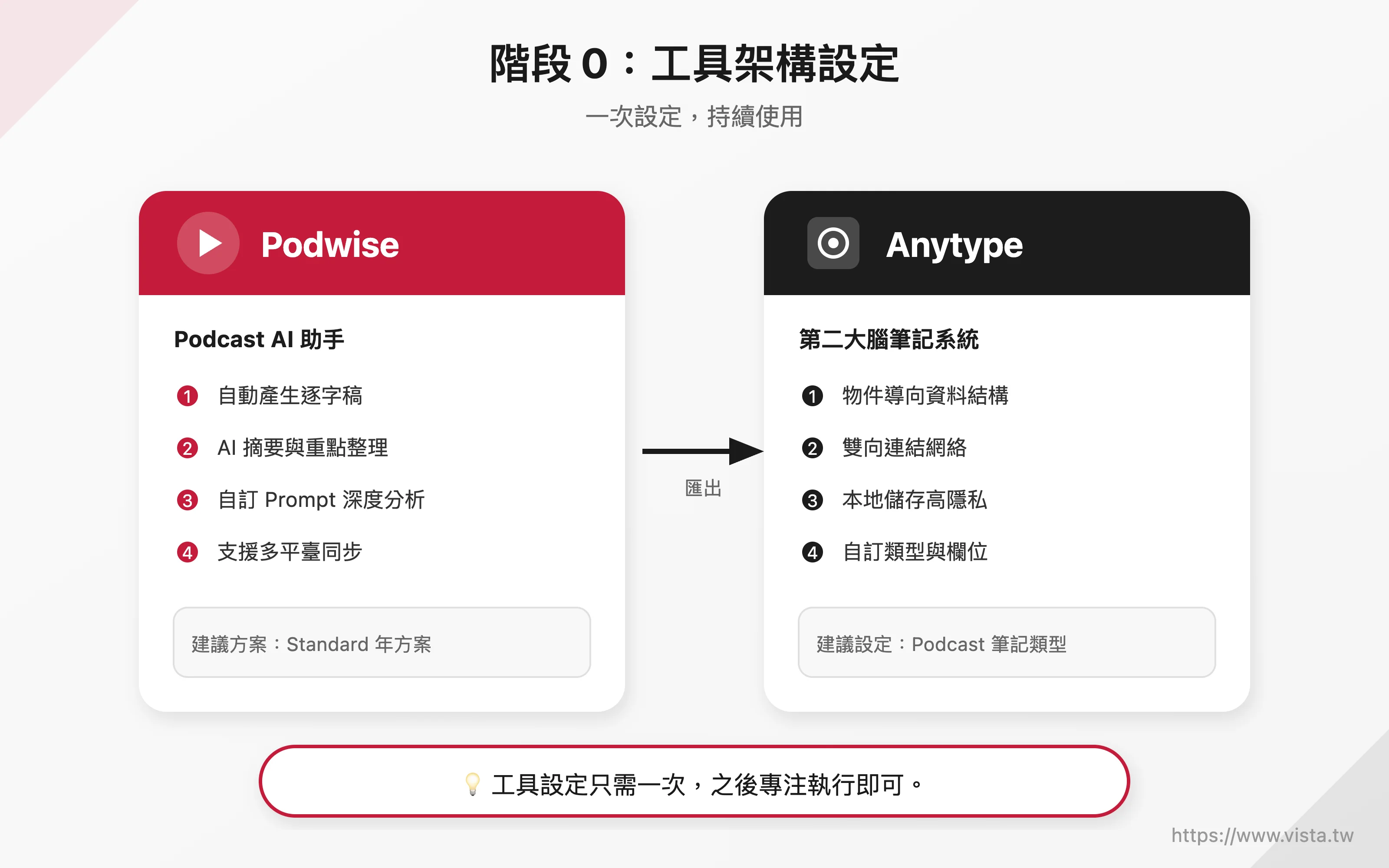
Podwise: Your Podcast AI Assistant
Podwise is an AI tool that specializes in processing podcast content. It can automatically generate verbatim drafts, summaries, key points, and also allows you to ask questions about the content.
Setting steps:
-
Register an account: Register at Podwise.ai. The free version has basic functions, but if you want to run this system seriously, I recommend directly upgrading to the Standard plan. It’s one or two less cups of coffee a month, but the time saved is definitely worth it.
-
Connect to your Podwise: Podwise supports platforms such as Apple Podcasts, Spotify and YouTube, and you can also enter keyword searches.
-
Just subscribe to 6-8 core programs first: This is a mistake many people make - subscribing to dozens of programs at once, thinking that they should be collected first and listened to later when they have time. The result? It will never come again. My suggestion is: first choose 6-8 programs that you can actually listen to and that are directly related to your creative theme. Bit off more than you can chew, less is more.
Core shows I currently subscribe to (FYI):
- Productivity related: “Star Arrow Broadcast”, “Acquired”
- AI related: “Latent Space”, “The AI Breakdown”
- Writing related: “The Researchers’ Writing Podcast”
- Entrepreneurship related: “Charlie’s Entrepreneurship Compound”, “Silicon Valley Easy Talk”, “How I Built This with Guy Raz”
Anytype: Your second brain
Anytype is a decentralized note-taking software. Its most powerful function is object-oriented and two-way links. You can think of it as a hybrid of Notion and Obsidian, but with its own unique design philosophy.
Setting steps:
-
Download and Install: Go to Anytype.io to download the desktop and mobile versions of the App. It’s free, and data is stored locally, providing great privacy.
-
Create the “Podcast Notes” type: This is the key step. In Anytype, you can create a custom type (Type), which is a bit like the table structure of a database.
-
Design Fields: My Podcast note type contains these fields:
- Program Name (linked to another “Podcast Program” type)
- Episode title (text)
- Listening Date (date)
- Topic Tags (multi-select tags)
- One Sentence Summary (Text)
- Key Insights (Context block)
- **Can it be written into an article? **(single choice: yes / to be evaluated / no)
- Article development direction (text)
- Related Notes (Related)
Tips: It may take 30 minutes to an hour to set up the first time, but it is a one-time investment. After setting it up, you only need to fill in the fields every time you add a new note, which is very fast.
If you haven’t used Anytype yet, I have written an article before Anytype + Claude: Building an AI-driven second brain. You can read that article first and then come back.
Phase 1: Choosing a show – how not to be overwhelmed by podcasts
After setting up the tools, the first question to be solved is: With so many programs, which ones should I listen to?
This may sound like a small problem, but it is actually the most critical aspect. If you choose the wrong program, it will be useless no matter how perfect the subsequent process is. Do you spend time processing a bunch of content that has no value to you, and then get stuck at the conversion step because you have no idea what to write about?
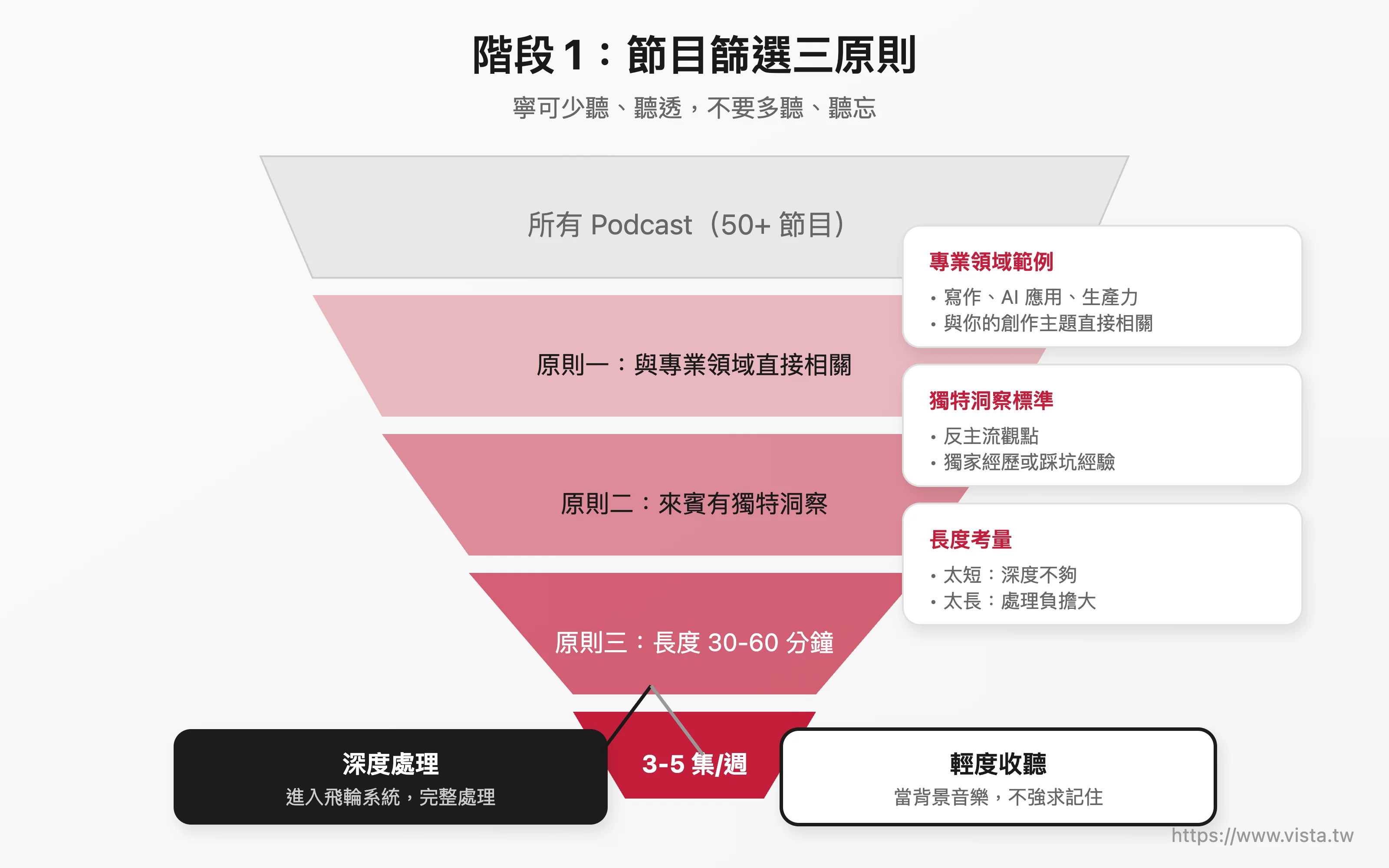
My three principles of screening
After this period of experiments, I summarized three screening principles:
Principle 1: Directly related to my field of expertise
For example, my creative themes are writing, AI applications, and personal productivity, so I will give priority to programs that are directly related to these three areas. It’s not that it might be related, but it’s directly related.
For example, a program about the latest developments in blockchain may be interesting, but it is not directly related to the theme of my creation. It’s great to expand my knowledge, but I probably won’t take the time to process this kind of content in depth. Yes, at most it’s fine as background music.
Principle 2: Guests have unique experiences or counter-mainstream views
The most valuable thing about podcasts is that they allow you to hear things that you can’t read in books. The stories of guests’ personal experiences, pitfalls they have stepped on, and counterintuitive discoveries are the real treasures.
For example, if the contents of an episode are all correct answers that everyone knows, then there is little value in processing. When I choose a program, I will pay special attention to what experiences the guest has that I don’t know about, or has he said anything that surprised me?
Principle 3: Control the length within 30-60 minutes
Programs that are too short usually don’t have enough depth, and programs that are too long are too tiring to process. Shows that are around 30-60 minutes long are kind of my sweet spot.
If there’s an episode that’s particularly good but 2 hours long, I save it to my to-list and work on it when I have more time on the weekend. During the usual commuting time, just listen to those that are just the right length.
Only 3-5 episodes processed per week
This is another key mentality: It is better to listen less and hear thoroughly than to listen too much and forget.
I only do 3-5 podcast episodes a week in depth. In-depth processing means: listening completely, running through it with AI, organizing it into notes, and thinking about whether it can be turned into an article. 其他的节目呢? Just keep them on your “To Listen” list. Listen when you have time, forget it if you don’t. Don’t be obsessive about listening to everything. That will make you very stressed, and in the end you won’t want to listen to anything.
To put it simply, I divide podcasts into two categories:
- In-depth processing: Directly related to the creative theme, the guest has unique insights, and the length is moderate
- Light listening: interesting but not urgent, used as background music, for relaxation
For deep processing, enter the flywheel system. For those who listen lightly, just listen and don’t insist on leaving anything behind. This classification makes my mental burden much lighter and allows the system to continue to operate.
Phase 2: Running the AI in Podwise – my standard Prompt group
After selecting the program and listening to the content, the next step is to hand over the content to AI for processing.
The core function of Podwise is to convert podcast audio into text, and then allow you to use AI to ask, summarize, and analyze the content. This step is the link with the highest CP value in the entire system - if you spend 5 minutes running a few prompts, AI will save you at least 30 minutes of manual sorting time.
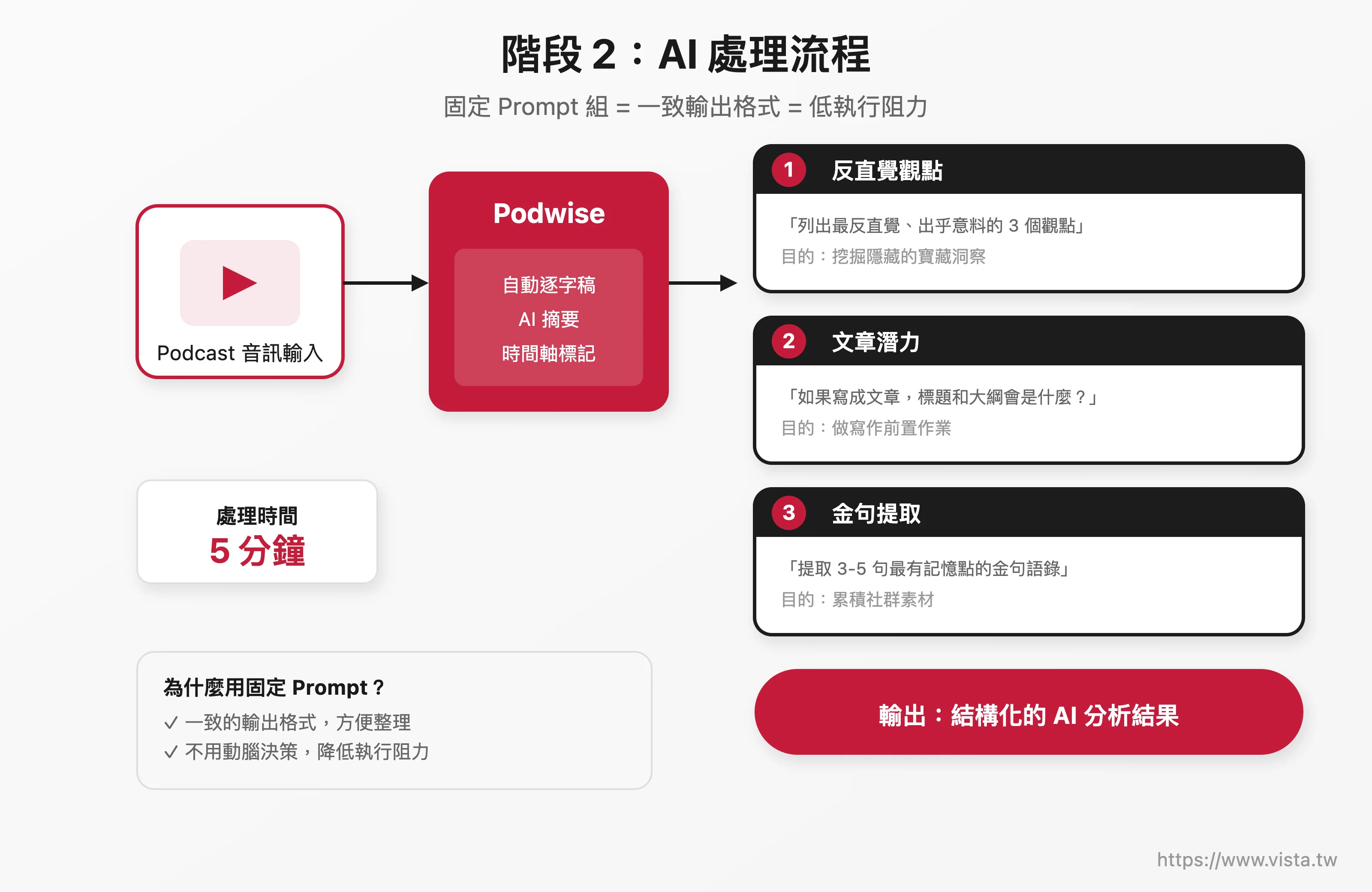
Introduction to Podwise’s AI functions
When you open a podcast episode in Podwise, it automatically generates:
- Verbatim: A complete text record that can be searched and copied
- AI Summary: Key points of automatic crawling
- Timeline Marker: Cut content into paragraphs for easy jumping
But these automatically generated contents are just raw materials for me. The real value is to be discovered using customized prompts.
Three Prompts that I use regularly
After repeated testing, I finally settled on three standard prompts. I will use this method for every podcast episode. The output format is very stable and easy to organize later.
Prompt 1: Counter-intuitive view
Please list the 3 most counterintuitive and unexpected ideas in this podcast episode. Please summarize each point in one sentence, and then explain why this point of view goes against common people’s cognition.
The purpose of this prompt is to dig for treasure. Many times, the most valuable thing about a certain podcast episode is not the main content, but a certain sentence or a counterintuitive experience that the guest said inadvertently. And these topics are often the best writing materials.
Prompt 2: Article potential
If you were to turn this podcast episode into a blog post, what would you suggest:
- What title attracts readers the most?
- What will be the outline structure of the article?
- What specific problem can this article solve for readers?
This prompt directly helps me do the preparatory work for writing. The AI will provide title suggestions and outlines based on the content, and while I won’t necessarily follow them all, it gives me a good starting point.
Prompt 3: Extraction of golden sentences
Please extract 3-5 most memorable quotes or key quotes from this podcast episode. These sentences should stand on their own and be quoted powerfully on social media.
This prompt is naturally to help me create community materials. Good quotes can be used directly at the beginning of a newsletter, a Threads/X post, the title or summary of an article. Dig them out first and keep them there, so they will be ready when you need them.
Why use fixed prompt?
You may ask: The content of each episode is different, why use the same prompt?
The answer is: Establish a consistent output format and let subsequent processing become muscle memory.
If you have to think about what the episode is going to ask every time, you’ll spend a lot of time making decisions, and you might end up not bothering to do it. But if your Prompt is fixed, the whole process becomes “Open Podwise → Paste Prompt 1 → Paste Prompt 2 → Paste Prompt 3 → Copy the result → Next step”. It’s completely brainless and has very low execution resistance.
Of course, occasionally when I encounter a particularly interesting episode, I will ask some additional questions. But that’s the exception, not the rule. The normal state is these three prompts, stable output.
Stage 3: Import Anytype - Structured integration into the second brain
After the AI is processed, the next step is to collect the content into Anytype.
Many people will rush through this step - it’s just a matter of copying and pasting, so what’s the difficulty? But in fact, how you collect it determines whether the content can be used by you in the future.
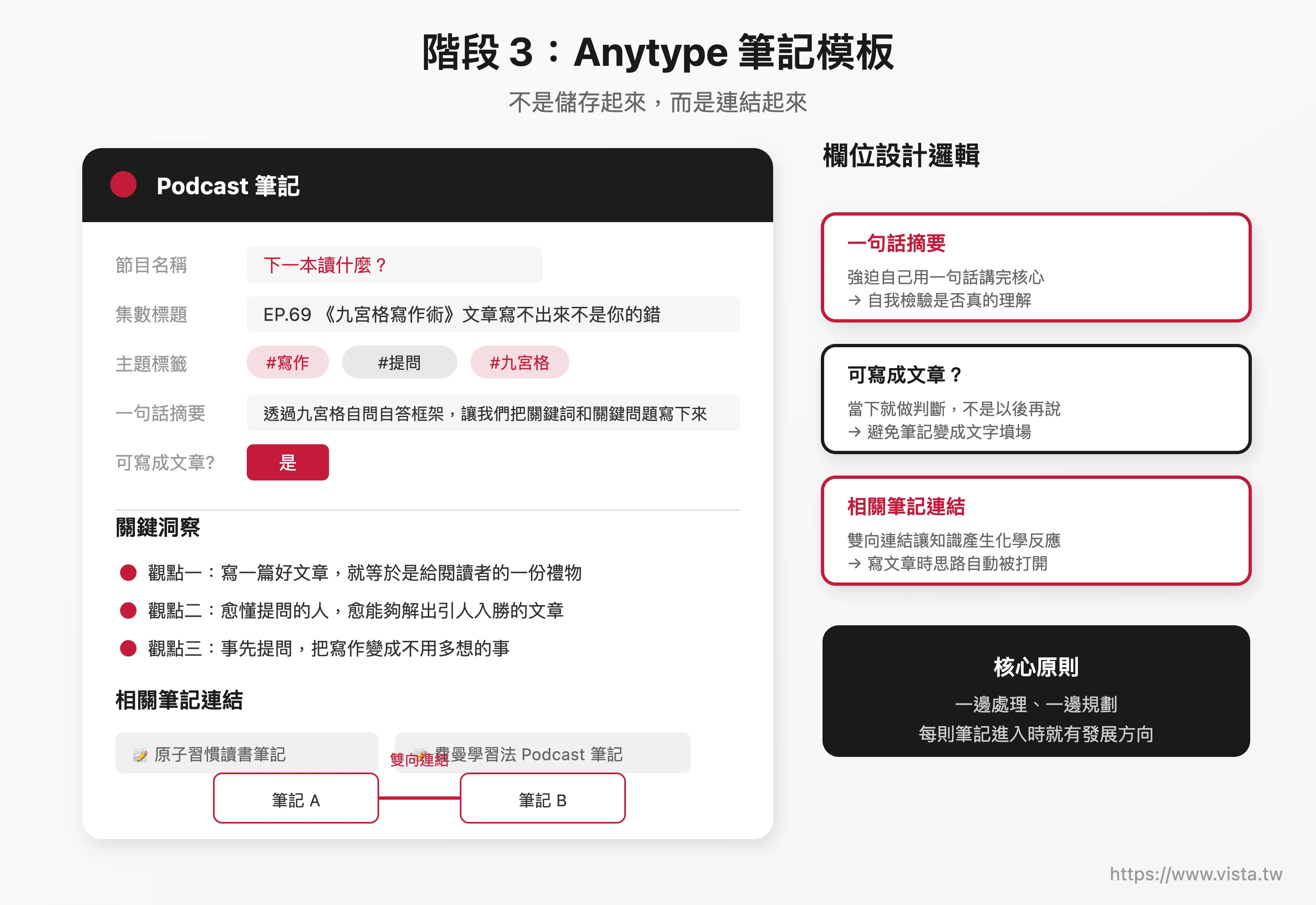
My note template
In Anytype, each of my podcast notes looks like this:
Top block (structured fields):
- Program name: [Link to program object]
- Episode title: EP.123 — How to establish a writing habit
- Listening date: 2024-12-15
- Hashtags: #writing #habit-building #productivity
- One Sentence Summary: Writing for 30 minutes a day is more effective than writing for 3 hours on the weekend
- Can it be written into an article? : Yes
- Article development direction: You can write a general article “Why a small number of times is better than a large number of times”, which is not only suitable for writing
Content block:
Key Insight
- Counter-intuitive point of view 1: [Compiled from the results of Prompt 1]
- What this means to me: [my own thoughts]
- Counter-intuitive view 2: [Compiled from the results of Prompt 1]
- What this means to me: [my own thoughts]
- Counter-intuitive point three: [Compiled from the results of Prompt 1]
- What this means to me: [my own thoughts]
Article direction suggested by AI
[Pasted from results of Prompt 2, may be slightly edited]
Golden Sentence Collection
- “Golden Sentence One”
- “Golden Sentence Two”
- “Golden Sentence Three”
Extended Thoughts
[My reflections after listening, other concepts that can be connected, application scenarios that come to mind]
Logic of key field design
You may have noticed that my note template has a lot of fields. This is not complicated for the sake of being complicated, every field has its function:
One sentence summary: Force me to finish the core of this episode in one sentence. If I can’t explain it, it means I didn’t understand it. This field is a self-test.
Can it be written as an article: This is the most important field. You have to make a judgment now when you are sorting it out, not later. If you feel that it is possible but not sure, select the items to be evaluated and review the items to be evaluated every month.
Article development direction: If you judge that it can be written into an article, you should write down the possible directions. It doesn’t need to be very detailed, just one or two sentences will do. This is to leave clues for your future self.
Extended Thoughts: This is the most valuable part of the entire note, because it is my thing. The content produced by AI is the starting point, but my own reflection is the key to making this note unique.
Key point: It’s not about saving, it’s about connecting them.
The most powerful feature of Anytype can be said to be two-way connections. Each note can be linked to other notes, and it is bidirectional - A is connected to B, and B will automatically be linked to A.
For example, when I am writing extended thoughts, I will deliberately think about: What is this concept related to what I have memorized before? Then build the link.
For example, if this episode talks about deliberate practice, I might link to the “Peak” reading notes I took before, the notes from another podcast about Feynman’s learning method, and an article I wrote about learning methods.
These links are not decorative; they serve a purpose as you write your article. When you open a note and see other notes it is linked to, your thoughts will automatically open up: “Yes, this point of view can be combined with that one”, “These two examples together will be very convincing.”
The real value of note-taking software is not storage, but connection and rediscovery.
Phase 4: Convert to articles – from insights to publishable content
Okay, now you have a bunch of structured notes, each marked with articles and development directions. The next question is: how to turn this into a real article?
This is where a lot of people get stuck. I’ve taken a bunch of notes, but when it comes to writing, I still don’t know where to start?
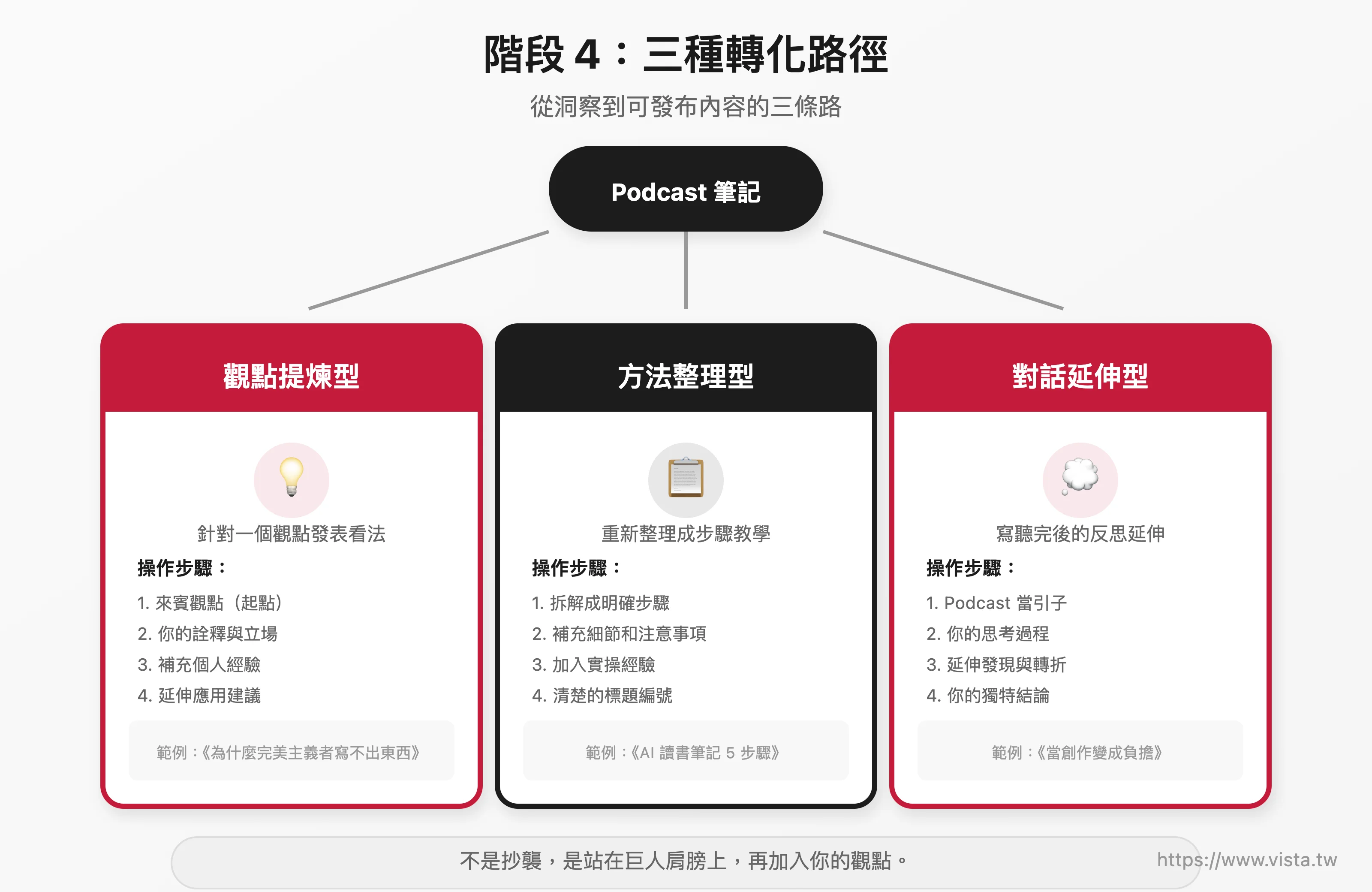
My solution is: Clearly define three conversion paths, and then choose the appropriate path based on the characteristics of the material.
Path One: Opinion Refining Type
Appropriate to the situation: The guest brought up a point that touched you very much, and you want to express your own opinion on this point.
How to operate:
- State the guest’s point of view clearly in one sentence (use it as the starting point of the article)
- Add your own interpretation: why do you agree or disagree?
- Add your experience: Do you have similar or opposite experiences?
- Extended application: How can this idea be applied to readers’ lives?
Article Structure Example:
- Beginning: Introduce the source of this point of view (what so-and-so said on a certain program)
- Middle section: your interpretation and experience
- Ending: Action suggestions for readers
Actual case: I listened to a podcast episode before, and the guest said, “The biggest enemy of writing is not lack of time, but perfectionism.” This sentence hit me, and I took it as a starting point and wrote an article about why perfectionists can’t write anything. I added my own methods of overcoming perfectionism and turned it into a three thousand word article.
Path 2: Method sorting type
Suitable for the situation: The guest shared a set of methods or processes, but it was scattered, and you want to reorganize it into a more structured teaching.
How to operate:
- Break down the method explained by the guest into clear steps
- Add details and precautions for each step (additional information may be required)
- Add your actual operating experience and adjustments
- Use clear titles and numbers to make it easy for readers to follow
Article Structure Example:
- Beginning: What problem can this method solve?
- Middle section: Step 1, Step 2, Step 3… gradually disassembled
- End: FAQ or advanced tips
Actual Case: I heard a certain episode talk about how to use AI to take reading notes. The guest talked about many techniques, but it sounded rather divergent. Later, I referred to this idea and organized it into an article about using AI tools to read. Each step was attached with specific prompts and pictures, turning it into a very practical teaching article.
Path 3: Dialogue extension
Appropriate to the situation: The content of the podcast stimulated your thinking, but what you want to write is not to summarize what the guests said, but what I thought after listening to it?
How to operate:
- Use podcasts as a starting point or introduction
- What you write is your own reflection, extension, questioning, or new discovery
- The content of the podcast only accounts for a small part of the article, the main part is your thoughts
Article Structure Example:
- Beginning: Listening to a podcast one day made me think about a certain issue
- Middle section: My thinking process, discoveries, and turning points
- Ending: My current conclusion or issues I am still exploring Actual Example: I listened to a podcast about “creator burnout,” but what I really wanted to write about was not “what the guests said” but “my own experience of burnout.” So I wrote an article “When Creation Becomes a Burden: My Burnout Cycle and Recovery Record.” The podcast was just the opportunity mentioned at the beginning, and the entire article is my story.
Reminder: Do not plagiarize, but stand on the shoulders of giants
It is wrong to just transfer or copy other people’s content, and there are also concerns about infringement. I hope you can add your own opinions, experiences and interpretations.
Therefore, if you want to quote an idea from a certain program, it is best to clearly indicate the source (for example, “I heard ooxx’s statement on a podcast program and found it interesting and made me think.”).
Most of our ideas or ideas are based on those of our predecessors. In addition to respecting the original creator, the key point is, have you digested, pondered and added value, and then said it again from your perspective and point of view?
Podcasts are the input, articles are the output, and the processing in between is your unique value.
Phase 5: Weekly Ritual – Turning System into Habit
After talking about the operation of each stage, the last thing I want to talk about is: how to make this system continue to operate?
The answer is: Turn it into a ritual and put it in your schedule.
No matter how good the system is, if it relies on doing it when you have time or thinking about it, it will eventually break. Only by turning it into a routine with fixed time and fixed actions can you continue to turn the flywheel.
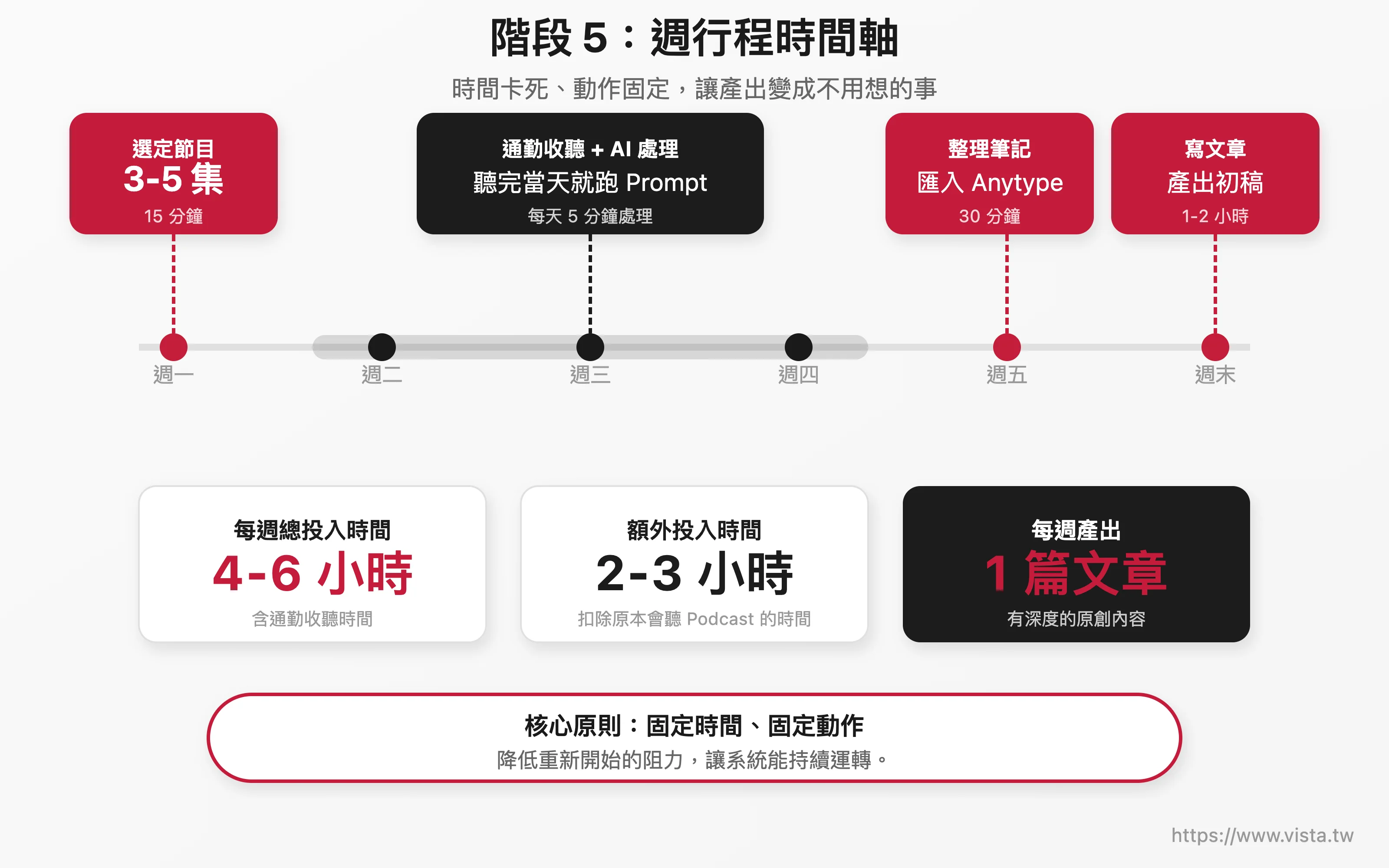
My weekly schedule
The following is my regular weekly schedule:
Monday: Select this week’s content
- Take 15 minutes to browse updated podcasts from the past week
- Select 3-5 episodes to be processed in depth
- Add them to Podwise’s to-do list
Tuesday-Thursday: Listen during your commute
- Listen to those 3-5 episodes while commuting (I commute about 30 minutes each way, so I get 2-3 hours a week)
- After listening to an episode, run AI on Podwise that night (this step only takes 5 minutes)
- Key point: After listening, process it while your memory is still fresh, don’t procrastinate
Friday: Organized into Anytype
- Spend 30 minutes to organize the content processed by AI this week into Anytype notes
- Fill in the fields and create links for each note
- It’s harvest time this week
Weekend: Convert into articles
- Pick an insight with potential for development from this week’s or past notes
- Spend 1-2 hours writing this as a first draft of the article
- You don’t need to finish it all in one go, just have a first draft.
Time stuck, action fixed
The most important design principle of this itinerary is: Time is stuck and movements are fixed.
I won’t wait for free time to choose a show because free time will never come. I just choose on Monday, and after I choose those episodes, I won’t change them again.
I wouldn’t wait for the weekend to tackle all the AI again as that would become a big project and too mentally stressful. I deal with it as soon as I listen and spread it out every night.
I will not wait for inspiration to write an article, because inspiration is not reliable at all. I just write on weekends, open the note library, pick one and start working on it.
Make content production a no-brainer.
Well, that’s the power of the system. You don’t have to ask yourself every week what you’re going to do this week, because the schedule already tells you. All you have to do is do it.
Of course, there are occasional exceptions. The system may be suspended during the week when you are sick, when you are abroad, or when you are busy. That’s okay, that’s normal. The point is that after the exception ends, you must be able to seamlessly return to the system and continue to rotate.
This is why routine is important – because, it reduces the resistance to starting over.
The true value of this system
After talking about the operation process, let us raise our perspective and see what the real value of this system is.
On the surface: Solving the problem of having nothing to write
The most direct benefit is that you will never be in a daze facing a blank document again.
When you have accumulated dozens or even hundreds of structured podcast notes, each of which is marked with an article that can be written and a direction for development, what you have to do is no longer thinking about inspiration, but choosing a topic.
To be honest, the psychological burden of these two things is completely different.
Thinking of inspiration is open-ended. You have to start from scratch and find a feasible direction in the chaos. It’s tiring, and it’s easy to fail.
On the other hand, topic selection is closed-ended. When you have a list, you just pick one from it. It’s easy and doesn’t fall flat.
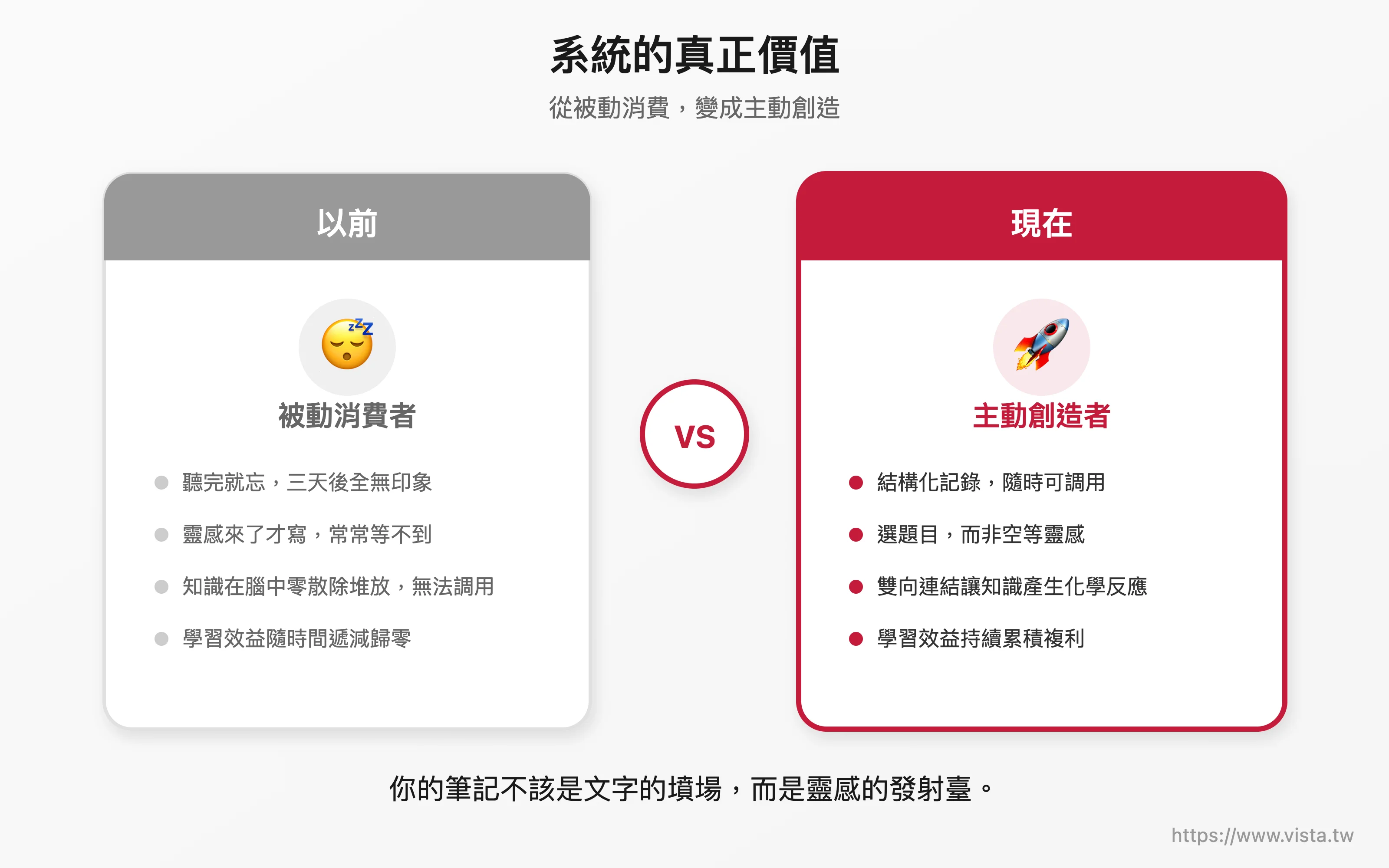
Deeper meaning 1: From passive consumption to active creation
However, I think what is more important than having something to write is a change in mentality.
When I used to listen to podcasts, I was just a consumer. I’m taking in information, passing the time, and keeping up with trends. That’s it for now, see you in the next episode.
Listening to the podcast now, I might as well be the creator. I’m looking for material, hunting for ideas and building assets. Every wonderful episode may become the starting point for my next article.
How will this subtle change in mentality affect how you listen in the future?
The consumer mentality when listening to podcasts is to be relaxed, passive, and let everything take its course. Listening to podcasts with a creator’s mentality is focused and proactive. I often ask myself, what is the use of this to me?
Well, it’s not that consumers have a bad mentality – sometimes, I just want to relax. But if you want to produce content, you need to switch to a creator mindset at some point. This system can help you establish this switching mechanism.
Deep meaning 2: Build your opinion database
Over time, your Anytype note library will become a huge database of ideas.
In this database, there are insights from experts in various fields, counter-intuitive opinions, quotable quotes, and your own reflections and connections.
When you need to write an article, prepare a speech, or even just chat with friends about an idea you want to quote, you no longer need to rely on memory, you can search it in the database.
The sentence “I remember someone said…” will become “There is… in my database”.
This feeling of having something to call upon will make you more and more creative.
Deep meaning three: Let every learning turn into an asset that can compound interest
Finally, and what I think is the most important: this system turns learning into compound interest.
In the past, after listening to an episode of podcast, its effectiveness diminished over time. You will remember 80% of it after a week, 30% of it after a month, and you may not even have heard of it after three months.
Now, after listening to an episode of podcast, its effectiveness can continue to accumulate. It will be recorded as notes, linked to other notes, converted into articles, and cited in future creations. These contents will not depreciate in value over time; they will increase in value as your network of notes becomes denser.
This is the concept of compound interest. Every note is laying the foundation for your future.
Your notes should not be a graveyard of words, but a launching pad for inspiration.
This sentence is a reminder I gave to myself, and now it is also given to you.
Conclusion and call to action
Finally, let’s review this content flywheel:
6 stages:
- Stage 0: Pre-setting (Podwise + Anytype)
- Stage 1: Program selection (3-principle screening, 3-5 episodes per week)
- Phase 2: AI processing (3 fixed prompts)
- Stage 3: Import notes (structured fields + two-way links)
- Stage 4: Convert to article (3 conversion paths)
- Stage 5: Weekly routine (time stuck, actions fixed)
Weekly time commitment:
- Selected program: 15 minutes
- Listening: 2-3 hours (using scattered time such as commuting)
- AI processing: 15-20 minutes (spread across each evening)
- Organizing notes: 30 minutes
- Writing an article: 1-2 hours
That adds up to about 4-6 hours per week, but 2-3 of those hours are time that would otherwise be spent listening to podcasts. The only real extra investment is 2-3 hours.
Use these 2-3 hours to produce an in-depth original article. This ROI is very cost-effective.
Act now
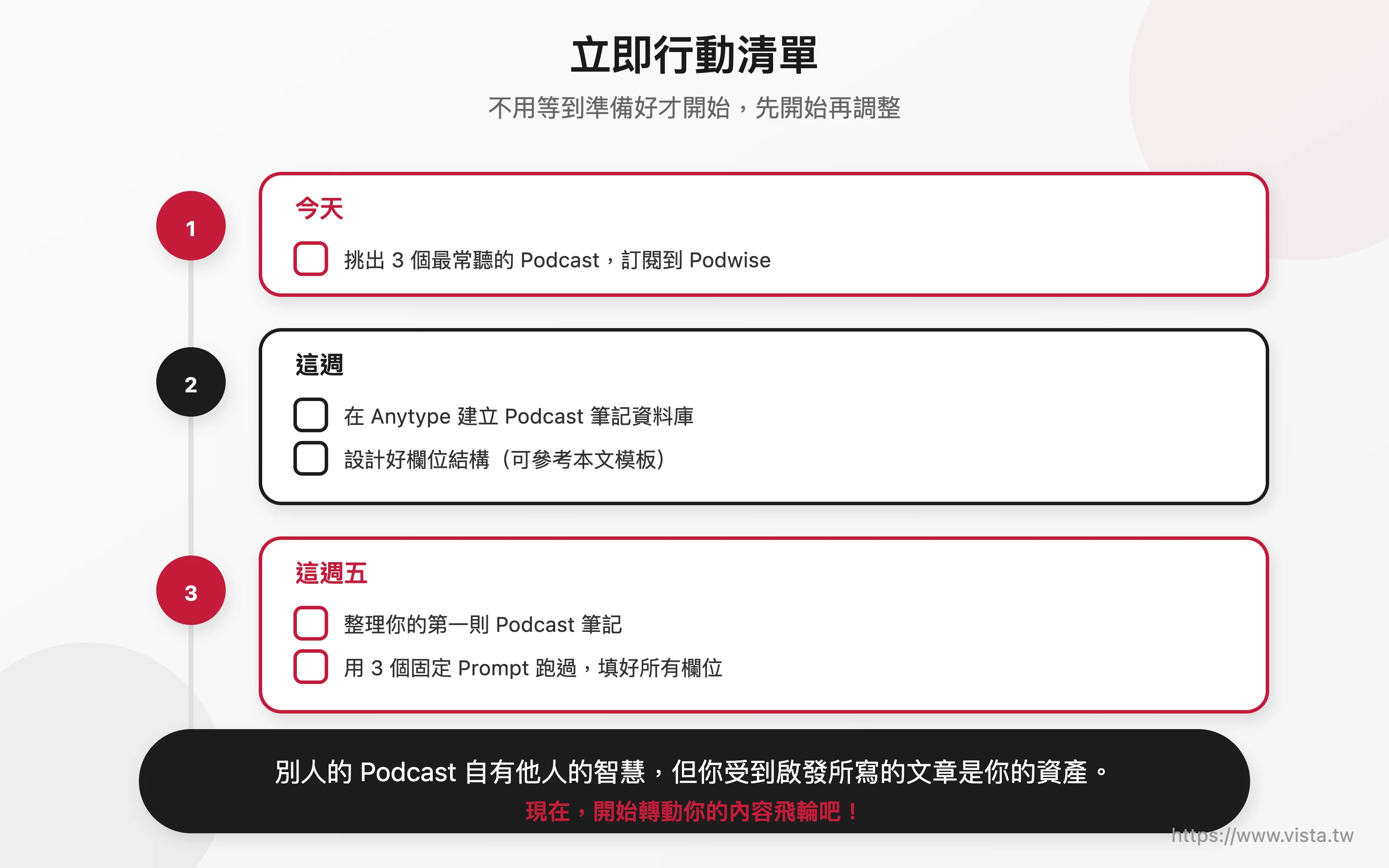
After reading this article, if you think it makes sense, I hope you will do three things now:
Today:
- Pick the 3 podcasts you listen to most and subscribe to Podwise
This week:
- Create a podcast note database in Anytype (or the note-taking software you are accustomed to using)
- Follow my column design, or adjust it to your needs
This Friday:
- Organize your first note
- Run through my 3 Prompts, fill in the fields, and create the link
Hey, don’t wait until you’re ready. Start by taking action, then adjust as you go.
Every system takes time to develop. The process I am sharing now took more than two years of iteration to become like this. Your version doesn’t have to be like mine, you’ll develop a rhythm and tools that work for you.
But the first step is to start turning the flywheel.
**Other people’s podcasts come from other people’s wisdom, but the thoughts and opinions that stimulate you are valuable assets. **
**Start spinning your content flywheel now! **
*If this article is helpful to you, please share it with your fellow creators who also don’t know what to write. *
Further reading
- Anytype + Claude: Create an AI-driven second brain to make your notes come alive
- When AI Becomes My Editor: How a creator used AI to revive content plans that had been shelved for years
- AI Board Method: A set of dialogue methods that will make your thinking more clear
- Stop “reading hard”, AI is rewriting your reading efficiency and knowledge absorption method