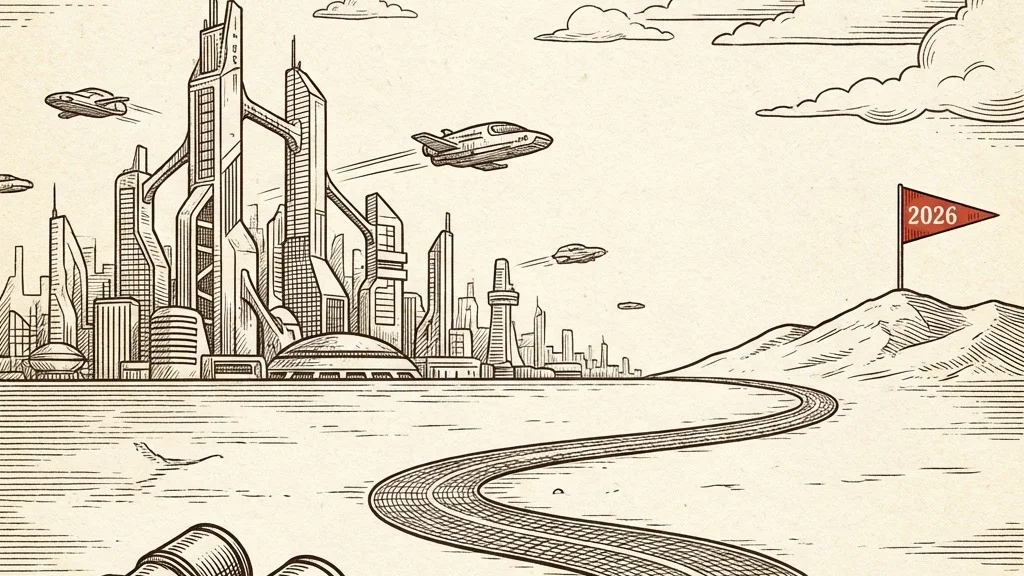
The command economy is coming! AI is rewriting the rules of the business game in the next decade
✍️Originally published in “Technice Island”
Over the past two decades, the script of the digital economy has long been written: brands are responsible for production and shelves, and consumers are responsible for browsing, comparing, and then adding their favorite products to their shopping carts. From department stores to e-commerce platforms, we have long been accustomed to a swipe, swipe, and click model—that is, shopping with our eyes and selecting with our fingers.
But with the advent of generative AI, the script is being rewritten. We are moving from the “Browsing Economy” to a new world - the “Prompt Economy”.
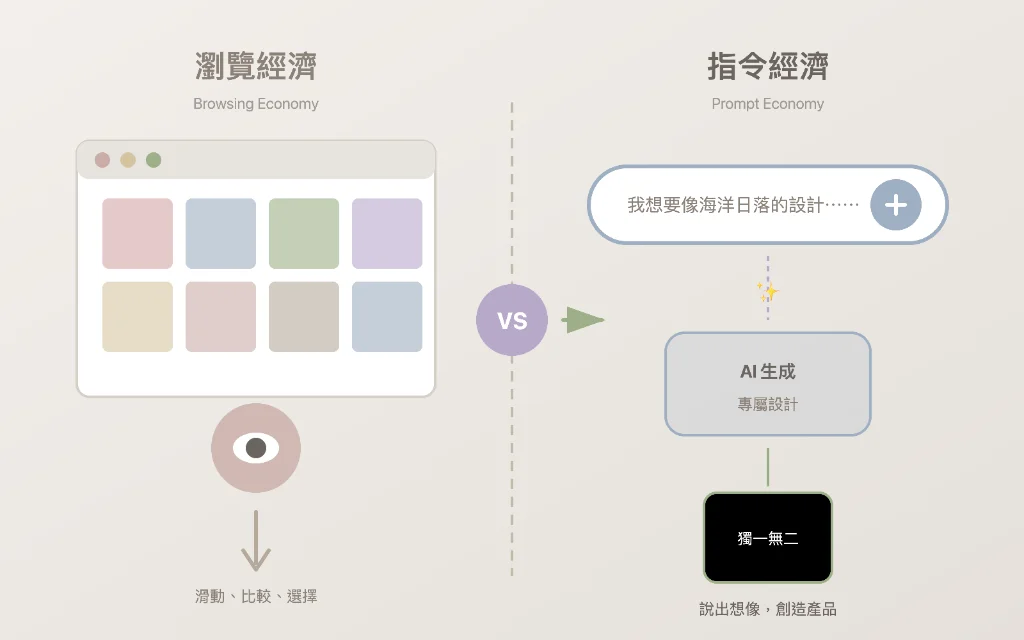 ▲ We are moving from the “Browsing Economy” to a new world - the “Prompt Economy”. (Photo/Provided by Zheng Weiquan)
In the world of command economy, consumers are no longer just passive choosers, but can turn the imagination in their minds into goods, content or services through a command. This is not just fine-tuning the existing menu, but starting a new production process with one sentence.
Recently, Swatch launched an interesting AI project: consumers only need to enter a sentence on the website, which may be a mood, a poem, or an abstract image, and the system will use generative AI to help generate an exclusive surface pattern. The brand will then actually make this design into a watch and send it to the consumer. On the surface, this looks like a very topical marketing campaign; but if we take a step back, we will suddenly find that this is actually a preview of Future Business.
Because in this process, the roles are quietly reversed. It’s not that brands design a whole season’s worth of watches first, and then let consumers go online and slowly choose. Instead, we say a word first, and the machines and factories in turn serve our words. This model that starts with instructions is what I call the “command economy.”
This change may seem like just an idea for a marketing campaign, but behind it is actually the reorganization of the entire business logic: who will design, who will define the needs, who will control the production rhythm, and who has the right to speak in the data will all be rewritten accordingly.
Design is democratized
In this new world, consumers are no longer just the ones paying the bill, but are officially pulled into the front-end of product development and become the co-designer of the brand.
In the past, there were layers of hurdles to go from inspiration to finished product: professional design software, engineering specifications, internal evaluation meetings, proofing, and modifications. Most people’s creativity is stuck in their minds because they neither understand design tools nor can they accurately “translate” the images in their minds to designers.
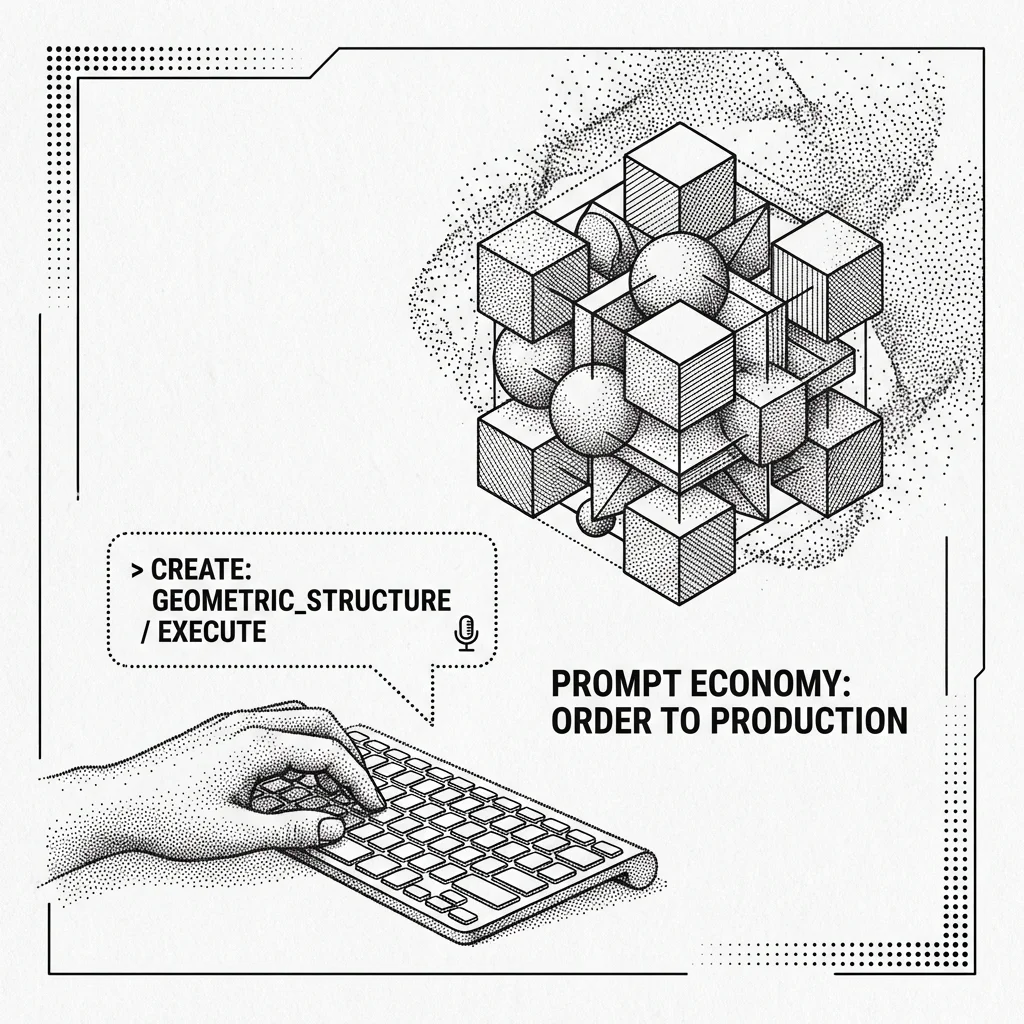
Today, generative AI takes over this translation job. As long as you can speak and type, you can create professional-level design results. This is the key to the democratization of design - the threshold for creation is no longer the ability to operate tools, but whether you can clearly describe what you want.
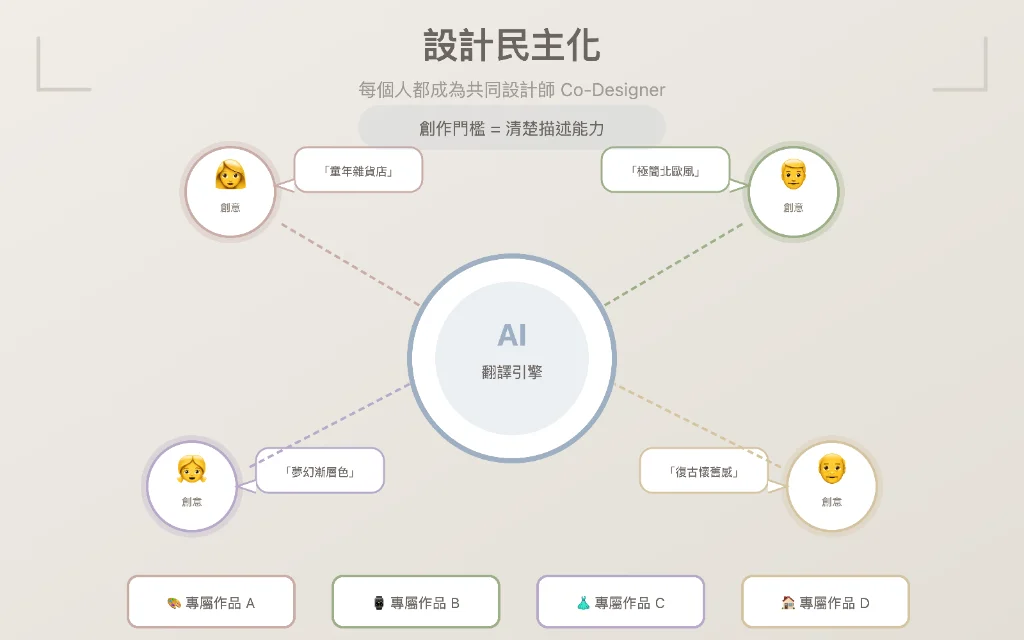 ▲ The key to democratizing design - the threshold for creation is no longer the ability to operate tools, but whether you can clearly describe what you want. (Photo/Provided by Zheng Weiquan)
Such changes have at least two obvious impacts.
First, long-tail needs that were ignored in the past because they were too niche are beginning to have the opportunity to be met. For example, someone wanted a blue-green surface that looked like it had been washed by sea water and the color was a little faded; someone wanted a design that hid the memory of a childhood alley grocery store in the picture. The traditional market will not open a mold for such ultra-personalized needs, but AI can. The command economy turns these small wishes that were originally ignored into new markets that can be undertaken in large quantities.
Second, participating in the design itself will amplify the psychological value of the product. When you know that this design is “I say, AI will help me grow it”, the emotional connection, sense of ownership and showoff are difficult to compare with mass-produced models. You’re not just buying a watch, you’re fulfilling an image that only exists in your mind.
As a result, personalization has moved forward from customization of color and size selection to true hyper-personalization. The brand no longer just provides a product line, but provides a creative tool and a design playground. You are not choosing, you are creating.
##Business model reconstruction
When a single instruction from a consumer can start design and production, the business logic that companies are accustomed to has to start over.
In the past, companies used predictive production: they first determined market preferences and sales forecasts, then put into production, stocked and distributed goods, and finally used marketing to launch the products. The risk of the entire chain lies in the inaccurate forecast - if there are too many, it will become inventory, if there are too few, it will be out of stock.
The command economy makes another model feasible: direct production by demand, which is the ultimate version of C2M (Consumer-to-Manufacturer). As a result, the entire process becomes instructions first, and then the product is born. The Prompt placed by the consumer is not just an order, but also a directly usable design draft or specification.
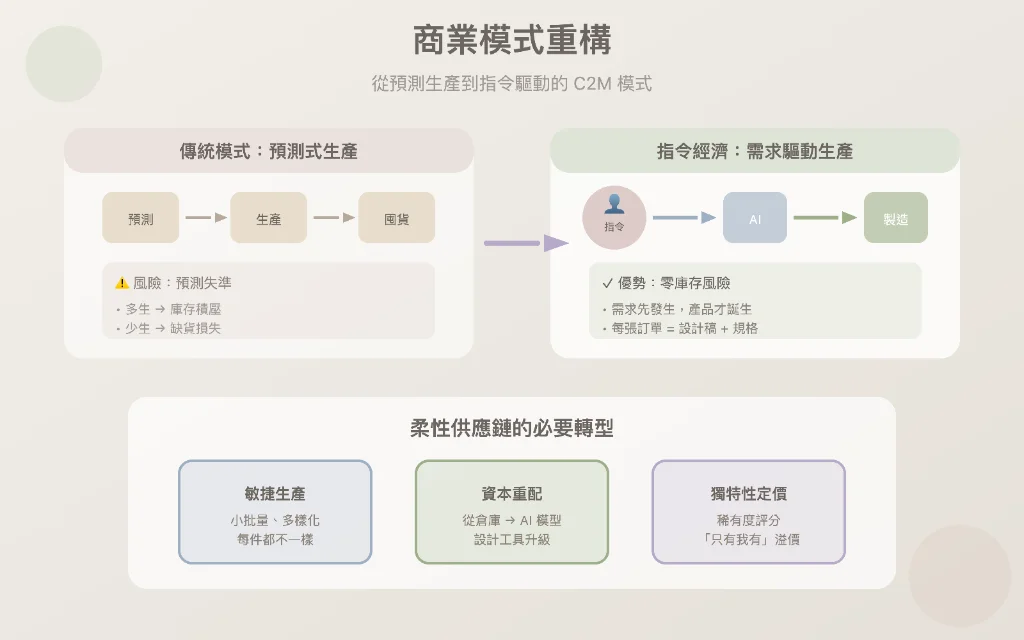 ▲ The command economy makes another model feasible: production is directly guided by demand, which is the ultimate version of C2M (Consumer-to-Manufacturer). (Photo/Provided by Zheng Weiquan)
At this time, the supply chain must become more flexible and agile. You can no longer just launch large batches of standard products, but you must be able to accept small batches and diversified customizations that are different for each piece. This is a challenge for the manufacturing side, but it also happens to be an opportunity for companies that master AI and digital manufacturing capabilities to overtake.
At the same time, inventory risks have also been significantly reduced, and even near-zero inventory operations have been achieved in some categories. The money that companies originally put in warehouses can be transferred to AI model training, design tool optimization, or production equipment upgrades. The center of gravity of capital allocation is quietly shifting, but this movement will determine who has the ability to run faster in the command economy.
Pricing strategies will naturally change accordingly. When everyone’s design is different, the value is no longer just the material and brand premium, but also adds a layer of unique pricing. The more complex the instructions and the rarer the element combinations, the higher the selling price may be.顾客愿意为只有我有的这件事多付一点钱,这是一种心理层次的定价,需要品牌重新设计游戏规则,例如加入稀有度评分、限量生成次数等机制。
行销战场转移
If we say that products are generated by instructions, then the focus of marketing will naturally move accordingly. In the past, we focused on SEO, keyword placement and content distribution; in the future, what brands need to learn is how to guide consumers to issue better instructions.
This can be understood as a new “PO” (Prompt Optimization, instruction optimization).
In this world, those who are best at writing prompts will not only get more beautiful pictures and more diverse copywriting, but also get products that are more suitable for them. Therefore, the responsibility of the brand is not just to sell things, but to teach users how to say what they really want.
Next, you will see more and more brands start to teach instructions: teach you how to describe the feeling of color, the atmosphere of style, and the level of details; tell you how to write a prompt if you like a certain artist or a certain city. This may seem like just content marketing, but it actually helps consumers develop new vocabulary and imagination.
At the same time, brands can also design command suggestions, just like the keyword suggestions we see in the search bar today. When you enter “dream”, the system may recommend you “blue-green like the mist at the seaside in the morning”, “childhood memory with a little hand-painted texture”, etc., to help you bypass the stuck points that you don’t know how to explain, and further explore the creative space brought by AI.
From a data perspective, these prompts actively entered by users are themselves a gold mine of data. Unlike traditional click records, Prompt directly reveals inner preferences and unmet needs. When a brand accumulates enough command data, it will be able to see some potential trends that have not yet been commercialized-maybe that product is not yet available on the market, but consumers are already “saying” what they desire.
This makes product development no longer just a matter of product managers deliberating in a conference room, but can go back and read the statements of real users and directly convert the desire corpus into the next generation product line.
New lessons for branding
Of course, the command economy is not just a beautiful consumer romance story, it also brings a bunch of new problems, especially in intellectual property rights, brand management and digital gaps.
The first is intellectual property rights. When the design is generated by AI based on user instructions, who is the creator? Is it the person who entered the command? Or the company that trains the model? Or is it a service provider that provides platforms and computing resources? This is not only a legal technical issue, but also directly related to whether users dare to create with confidence - if I make a great design today, can the brand use it for secondary use? Do I have the right to use it elsewhere? These require clear answers in terms of service and actual operations.
Second is the brand guardrail. When design rights are partially handed back to consumers, brands can no longer manage vision and style in a fully controlled manner. At this time, the role of brand designers will change from drawing each model personally to that of curators and gatekeepers - they are responsible for setting the boundaries that AI can create, deciding what kind of designs can be regarded as an extension of the brand, and what must be blocked.
This includes aesthetic consistency, safety considerations, and implementation of values. For example, no matter how open Swatch is, it is impossible for AI to generate designs that are completely unmanufacturable or that violate the spirit of the brand. These need to be set in advance through AI guardrails.
Finally, there is a new digital gap: Prompt Literacy(Prompt Literacy). People who know how to write prompts can create more beautiful works that are more in line with their own ideas; people who are not so familiar with it may always stay at the weird results. Over time, even on the same platform, the user experience will be divided into two worlds.
Therefore, if a brand really wants to expand the command economy instead of just serving a few high-end players, it must reduce this gap by designing interfaces, providing templates, teaching content, and even one-click fine-tuning. People who don’t understand professional terminology can also enjoy the creativity given by AI by selecting situations, dragging elements, and voice descriptions.
Convergence and Outlook
Command economy is not a beautiful term, but a whole process of reshuffling power. When a prompt can be a requirement description, design draft, order instruction and data source at the same time, the focus of business is no longer just who has the factory and who has the access, but who controls the entrance to the instructions and who has the ability to convert the instructions into stable value.
For companies, this means at least three things that must be started:
First, redesign your product development and production processes and treat generative AI as the key engine of C2M, rather than just a tool for making a few visuals. From the moment the user issues an instruction, the entire system should be able to flow downstream with this demand, and finally turn into a finished product that is actually handed over to the user. Second, consider Prompt Engineering as a core capability that the team needs to strengthen. Marketing, product and customer service teams will all need to learn to use commands to collaborate with AI and learn how to guide users to express clearer, more specific and more imaginative needs. At the same time, you must also learn how to read the trends and insights hidden in these instructions.
Third, redefine the role of the brand. A brand is no longer just a party that recommends products to you, but becomes a platform that allows you to create. Your value will increasingly be reflected in the stability and creativity of the AI model, whether the interface is easy to use, whether the guardrails are clear and fair, and how you handle every design, story and data created by users.
Starting from a Swatch watch that can be generated with just one sentence, we have actually had a glimpse of the prototype of business in the next ten years: consumers use instructions to make wishes, AI turns wishes into manufacturable designs, and brands and factories are responsible for making it safe, stable and beautiful.
In this new world, instructions are the new productivity. Whoever can understand, amplify and make good use of instructions will be more likely to dominate the business in the next decade.
📖 深入探索相關主題