Use AI to drive creativity to create an innovative workplace problem-solving blueprint for Generation Z

This article was originally published in the expert argument column of “Technice Island (opens in a new tab)”.
While the popularity of generative AI has smoothed the information gap, the business world has fallen into a deep dilemma of ineffective efficiency. Standardized SOPs and optimization processes that were regarded as standards in the past have rapidly depreciated under the impact of algorithms that quickly generate templated output. Especially in the eyes of Generation Z, who attach great importance to individual subjectivity, sense of work meaning and experience value, cold efficiency numbers can no longer bring recognition. Only sensible innovation that hits the pain points, is warm and inspiring, is the core driving choice.
To break this homogenization deadlock, organizations and individuals must establish a new problem-solving logic, no longer obsessed with a single answer, but through deep empowerment of AI, construct a set of second-answer workplace solutions with practical paths, methodological support and international evidence.
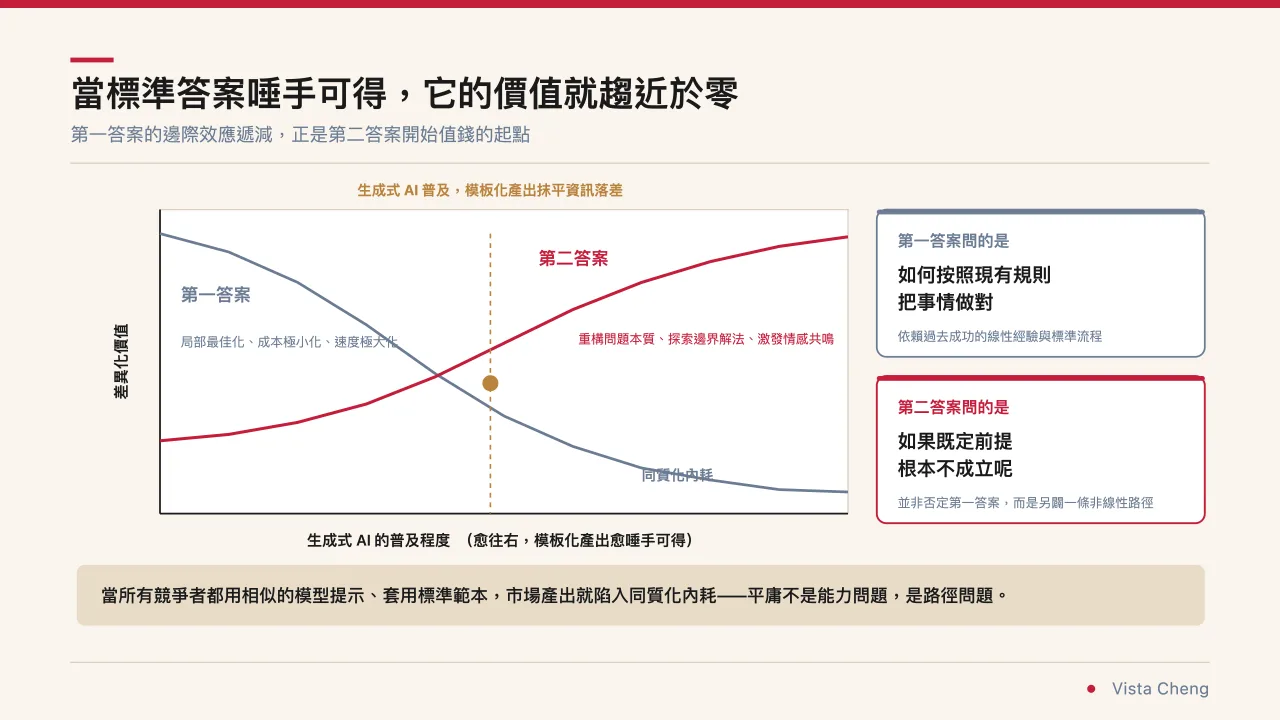
The diminishing marginal effect of the first answer and the definition of the second answer
For a long time, problem-solving thinking in the workplace has always focused on the first answer (also known as the correct answer). The first answer essentially pursues local optimization, cost minimization and execution speed maximization. It relies on past successful linear experience and standard processes to respond to known problems. However, when AI can quickly produce plans, copywriting and analysis reports with complete structures but uniformity, the first answer quickly becomes synonymous with mediocrity. When all competitors adopt similar model prompts and apply standard templates, market output will fall into serious internal friction of homogeneity.
In contrast, the second answer is not a blind denial of the first answer, but a non-linear thinking framework that focuses on reconstructing the essence of the problem, exploring boundary solutions, and stimulating emotional resonance. The first answer addresses how to do things right according to existing rules, while the second answer explores how we can create new value if the established premise is not true at all.
This solution emphasizes upgrading AI from a simple foundry execution tool to a cognitive collision engine, opening up alternative solutions with uniqueness and differentiated competitiveness outside of conventional paths, so that innovative results can have real and profound resonance within the organization and in the external market.
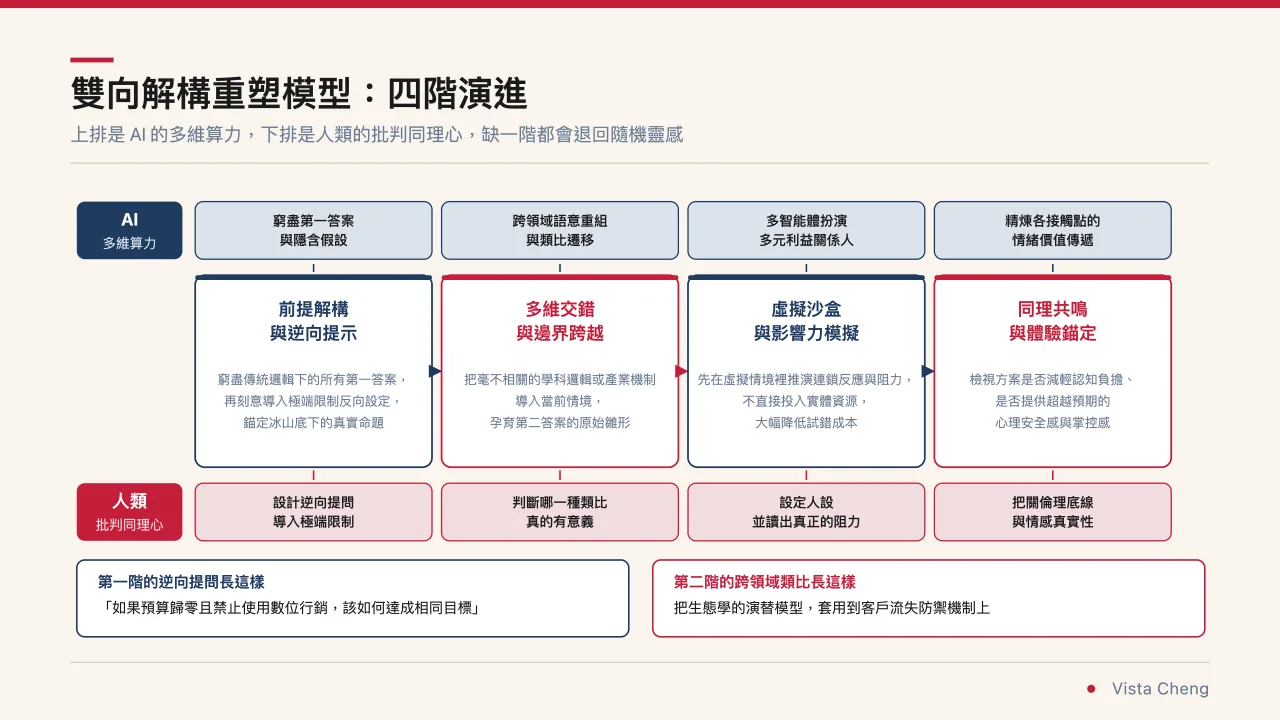
Problem-solving architecture methodology: two-way deconstruction and reshaping model of fourth-order evolution
If you want the second answer to escape the contingency of random inspiration, you must establish a rigorous and replicable operating methodology. This two-way deconstruction and reconstruction model combines human critical empathy and AI’s multi-dimensional computing power to complete the leap from routine to breakthrough through four specific stages:
- Premise deconstruction and reverse prompting: For example, when faced with a specific business pain point, the team first uses AI to quickly exhaust and list all the first answers to the problem under traditional logic and their implicit assumptions. Then, through reverse questioning instructions, extreme restrictions or reverse settings are deliberately introduced, such as “If the budget is zeroed and the use of digital marketing is prohibited, how to achieve the same goal” or “If the product does not have core functions at all, what is the deep psychological compensation for customers to buy”. By using AI to forcefully deconstruct the established premise, the team was able to escape from the blind spot of experience and anchor the real proposition hidden under the iceberg.
- Multi-dimensional interweaving and boundary crossing: At this stage, the team guides AI to perform semantic reorganization and analogy transfer of cross-domain knowledge bases, introducing originally unrelated subject logic or industrial mechanisms into the current situation. For example, apply ecological succession models to customer churn defense mechanisms, or apply dynamic difficulty adjustment in game design to workflow design for cross-department collaboration. This cross-border interweaving of computing power can provide the team with a new perspective that breaks out of the existing industry paradigm and breeds the original prototype of the second answer.
- Virtual Sandbox and Influence Simulation: After proposing alternative solutions, the team does not directly invest in physical resources for verification, but uses AI’s multi-agent collaboration technology to establish a virtual situation sandbox. By setting the personas of multiple stakeholders for different AI individuals, such as conservative financial executives, highly sensitive Generation Z consumers, or cross-department execution windows, the chain reactions and potential resistance that the plan may cause during organizational promotion and market feedback can be simulated in advance. This kind of deduction greatly reduces the trial and error cost of exploring new solutions, allowing the second answer to have a higher strategic maturity before implementation.
- Empathy and experience anchoring: This is the key transformation step for the second answer to achieve empathy. At this stage, AI is responsible for refining the emotional value delivery of the solution at each touch point, and assisting the team to review whether the solution can effectively reduce the user’s cognitive load and provide a sense of psychological safety and control that exceeds expectations. Human workers focus on checking the ethical bottom line and emotional authenticity, ensuring that the final delivered solution has both commercial feasibility and human warmth.
Workplace implementation blueprint: three-layer reconstruction of organization, collaboration and individual
To transform the above methodology into sustainable organizational capabilities, a three-layer implementation blueprint spanning strategy, collaboration and personal growth must be laid out in the workplace to ensure that the second answer can take root at all levels:
- Organizational strategic layer (institutional safety net): Enterprises must promote the reorganization of exploratory fault-tolerance mechanisms and multi-index structures. Traditional performance indicators often use short-term output rate and error rate as the evaluation benchmark, which directly suppresses employees’ willingness to seek second answers. The first step in the organizational blueprint is to establish a second answer sandbox budget that allows the team to invest a certain proportion of resources and man-hours in the exploration of non-standard paths. At the same time, the evaluation criteria should shift from whether it complies with the SOP to whether it proposes an effective alternative to break the inertia, providing institutional guarantee for breaking through the routine.
- Process collaboration layer (cross-context alignment): Organizations should fully introduce AI cross-context negotiation interfaces to reshape the cross-department communication ecosystem. The sectionalism between different departments is often the breeding ground for rigid first answers - engineering pursues stability, marketing pursues highlights, and operations pursues compliance. It is easy for dialogue to fall into mediocrity after compromise. By embedding AI nodes with an objective and neutral perspective in the collaboration process, the system can instantly translate and align cross-department technical terms and core demands into semantics, proactively derive a second-answer collaboration plan that takes into account the interests of multiple parties in addition to the existing positions of all parties, and end internal friction in communication.
- Personal Empowerment Layer (Role Repositioning): The core of the blueprint is to reshape the role of workers and transform Generation Z employees from executive cogs to strategic questioners. By providing regular second-answer guidance coaches, young employees can use AI at any time to perform situational calculations and decision-making exercises when facing complex problems, and receive immediate feedback and psychological empowerment. This ability to quickly iterate on cognition in a safe environment can not only significantly shorten the learning curve for new employees, but also allow the younger generation to regain dominance and a sense of accomplishment at work.
International Empirical Case: How the Second Answer Reshapes Business and Organizations
Looking at some of the world’s leading companies, they have the courage to go beyond the first answer and intuitive solutions, often creating disruptive and felt value:
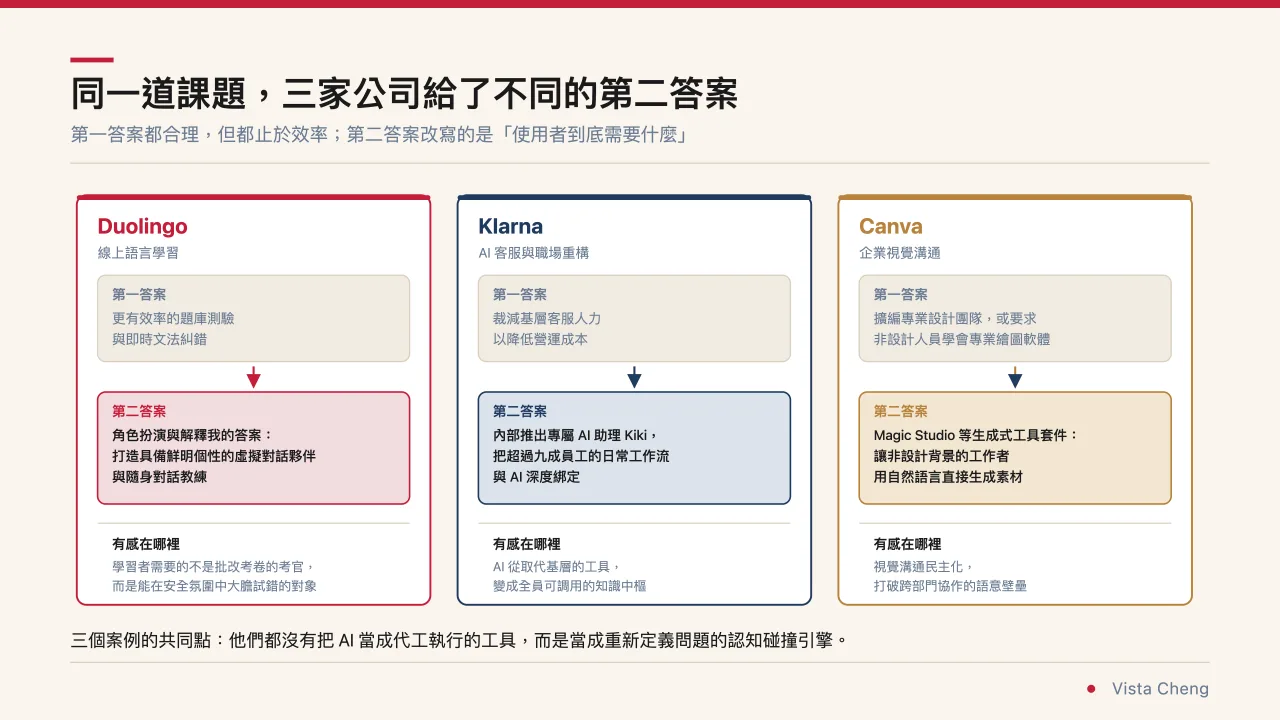
Duolingo: From standard problem solving to immersive and empathetic learning solutions
The first answer to online language learning is usually more efficient question bank tests and real-time grammar correction, but this standardized solution often causes learners to lose due to boredom or frustration. When Duolingo integrated GPT-4 and launched Duolingo Max, it proposed a second answer: Roleplay and Explain My Answer.
They no longer regard AI as a simple automatic scoring machine, but instead create virtual conversation partners with distinctive personalities (such as the arrogant French character Lily) and portable conversation coaches. This solution redefines the nature of language learning: what learners need is not an examiner to correct test papers, but a dialogue partner who allows people to boldly try and make mistakes in a safe atmosphere and have an emotional connection. It successfully transforms cold algorithms into an interactive experience that is loved by Generation Z.
Klarna: Reconstructing the workplace from human substitution to global empowerment
While most financial technology companies position AI customer service as the first answer to cutting grassroots customer service and reducing operating costs, Swedish buy now, pay later giant Klarna explores the second answer. Although Klarna has handled millions of routine customer service inquiries through its AI assistant, its core change lies in the internal launch of its exclusive AI assistant Kiki, which deeply binds more than 90% of internal employees’ daily workflow with AI.
AI is no longer just a tool to replace the grassroots, but has become a knowledge center for all employees, allowing young employees to cross regulatory, financial and technical thresholds and directly use complex data to make business decisions. This internal and external layout frees employees from repetitive work and instead focuses on higher-dimensional product innovation and user experience.
Canva: A collaborative revolution that shifts from professional barriers to visual democratization for all employees
In the field of corporate visual communication, the traditional first answer is to expand the professional design team or force non-designers to learn complex professional drawing software, which often results in traffic jams and communication friction in the design department. Canva has launched a generative AI tool suite such as Magic Studio, which provides a second answer: completely lowering the threshold of visual design and marketing planning, allowing cross-generation workers with non-design backgrounds such as business, marketing, and project managers to directly generate high-quality presentations, charts, and social media materials through natural language.
Promote the democratization of visual communication, break down the semantic barriers of cross-department collaboration, enable younger generations of workers to independently control creative expression, and achieve agile and sensitive organizational collaboration.
From internal effectiveness to external brand: the transformation path of perceived value
The deep value of the second answer solution is not only limited to improving the operational flexibility of the internal organization, but also the unique competitiveness that it will inevitably spill over to the external brand. When a company generally develops a culture that does not rely on standard answers and is used to redefining problems from a multi-dimensional perspective, the products and services it develops will naturally get rid of the traces of templates in the market.
When facing consumers, brands with the second answer gene no longer provide standard customer service responses that are polite but cannot solve the problem. Instead, they can gain insight into the hidden pain points in the consumption process and provide customized experiences that are unexpected but directly touch the soul. What the external market, especially Generation Z, who pursue a sense of authenticity and meaning, will no longer see is a technology company that shows off its computing power and technology stack, but an innovative partner that truly has a keen sense and can deeply resonate with the pulse of its life.
This complete closed loop extending from internal problem-solving thinking to external brand value is the shortest path to transform AI technology strength into substantial brand premium.
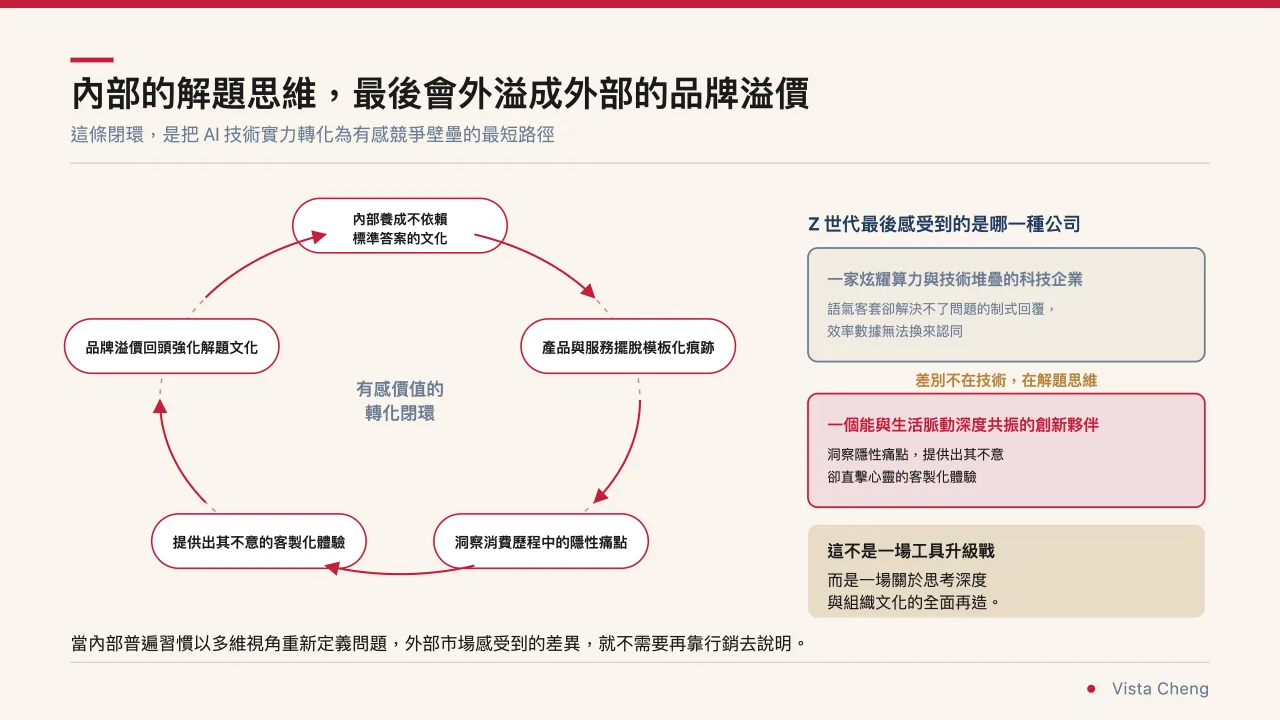
Combining AI and innovation is never a simple battle to upgrade tools, but a comprehensive reinvention of the depth of thinking and organizational culture. When the standard answer becomes readily available, its value approaches zero; only the second answer that has the courage to break the rules and explore by following a clear methodology can inject irreplaceable creativity into the workplace and establish unshakable barriers to competition for brands in an era dominated by algorithms.
Next step
Bring this topic to your team
Vista Cheng speaks and runs workshops on AI workflows, writing and content systems for companies, schools and public agencies.