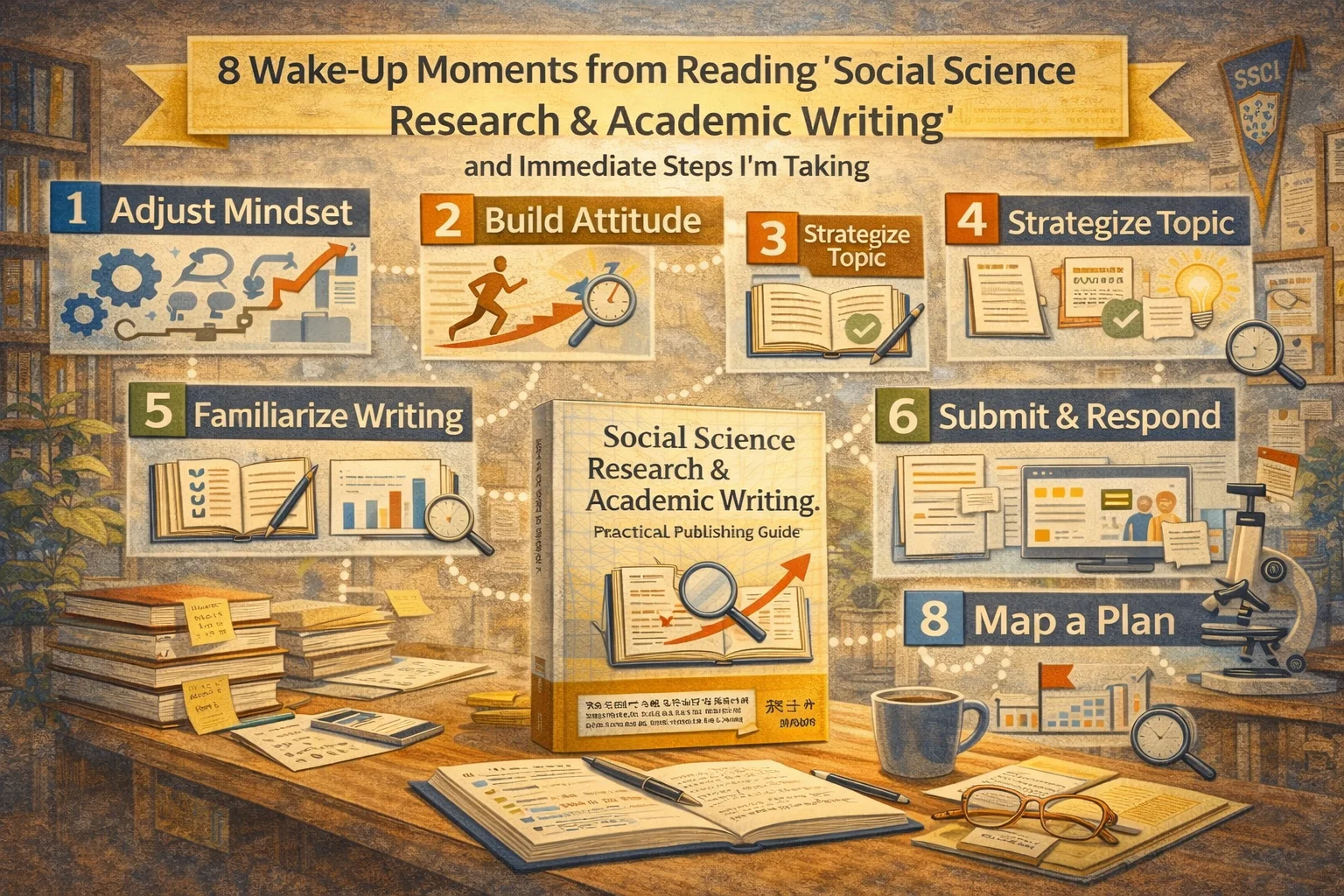
Eight enlightening moments when I read "Social Science Research and Thesis Writing": From cognitive correction to systematic submission
I have always believed that academic writing is not done better by smarter people, but by people who know how to run the process smoothly. After reading Professor Cai Jinzhong’s “Social Science Research and Paper Writing: Tips for Successful Publication” (Fourth Edition), the clearest picture in my mind is not some gorgeous theory, but a very pragmatic path: first correct the understanding of research, then adjust the attitude to a state of long-distance running, then talk about topic selection, strategy, writing, submission, reply and role ethics, and finally return to the topography of the journal world. It is like a navigation map that takes you from graduate school all the way to the door of international journals. It may not seem romantic at first glance, but it is extremely effective.
This book does not teach you how to write from the perspective of the author, but also reminds you from the perspective of the editor: What are editors and reviewers looking at and what do they care about?
More importantly, this book does not teach you how to write from the perspective of the author, but also reminds you from the perspective of the editor: What are editors and reviewers looking at and what do they care about? Why do you feel that you may be rejected in the first screening even though you work hard at writing? When you understand the invisible review table, you will no longer write papers with the mentality of handing in homework, but will start to submit papers with the mentality of product delivery - not to please, but to be precise.
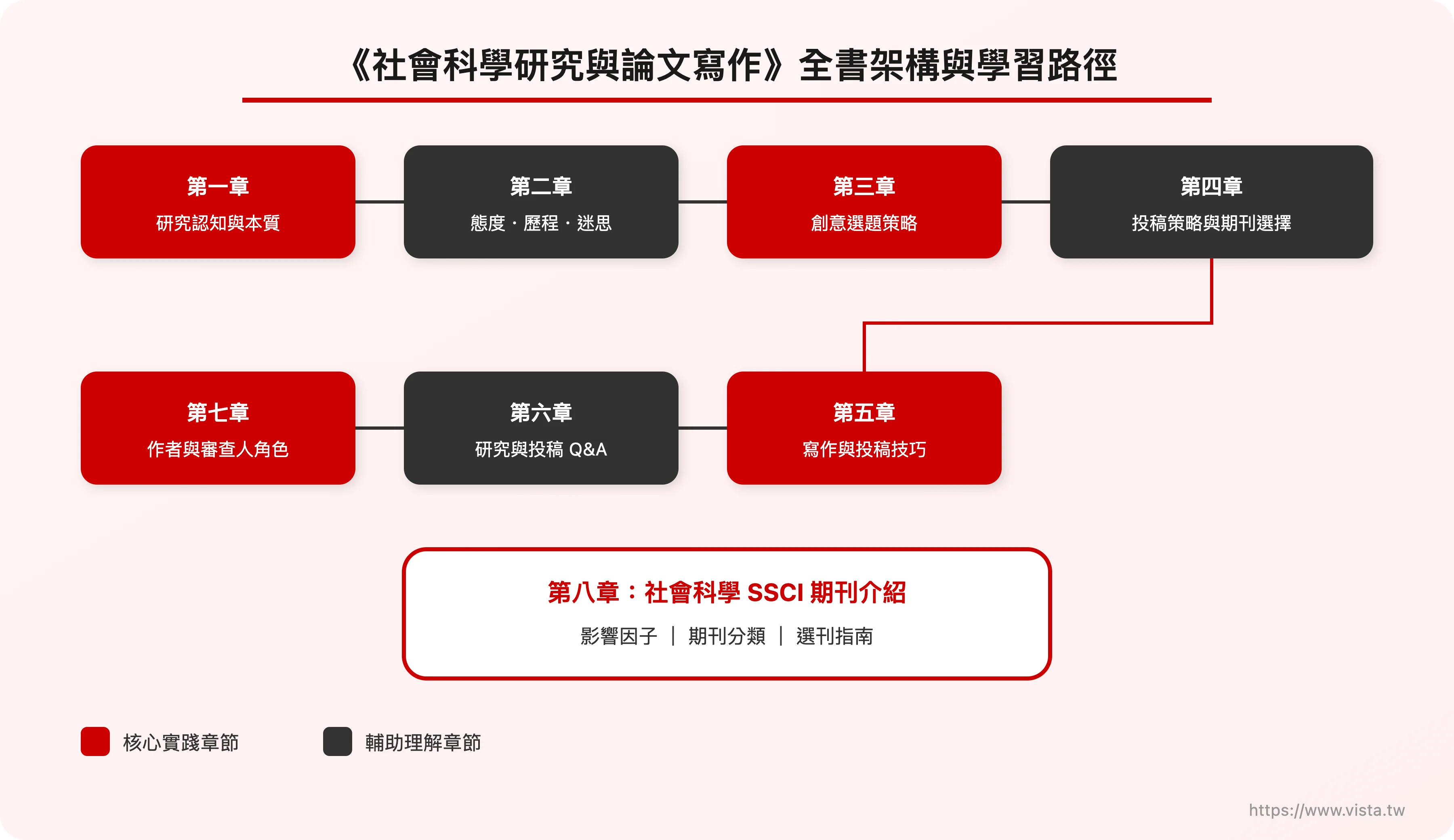 ▲ The structure and learning path of the book “Social Science Research and Thesis Writing”
Research is not a myth, it is a systematic understanding of people: first adjust your cognition correctly, so that you can avoid taking the wrong path
In the first chapter, I talked about the nature of social science research. What I read was not a textbook definition, but four reminders: complexity, context, value involvement and reflexivity. The object of social science research is people. People can see the direction of the wind, interpret situations, and even change their behavior because of being studied (The Hawthorne Effect is that reminder that is most often mentioned and most ignored). Therefore, it is difficult for you to lock in all variables and make clean causal claims like natural science. What you can do is to clearly explain how you approach the truth within a reasonable research design and argumentation logic.
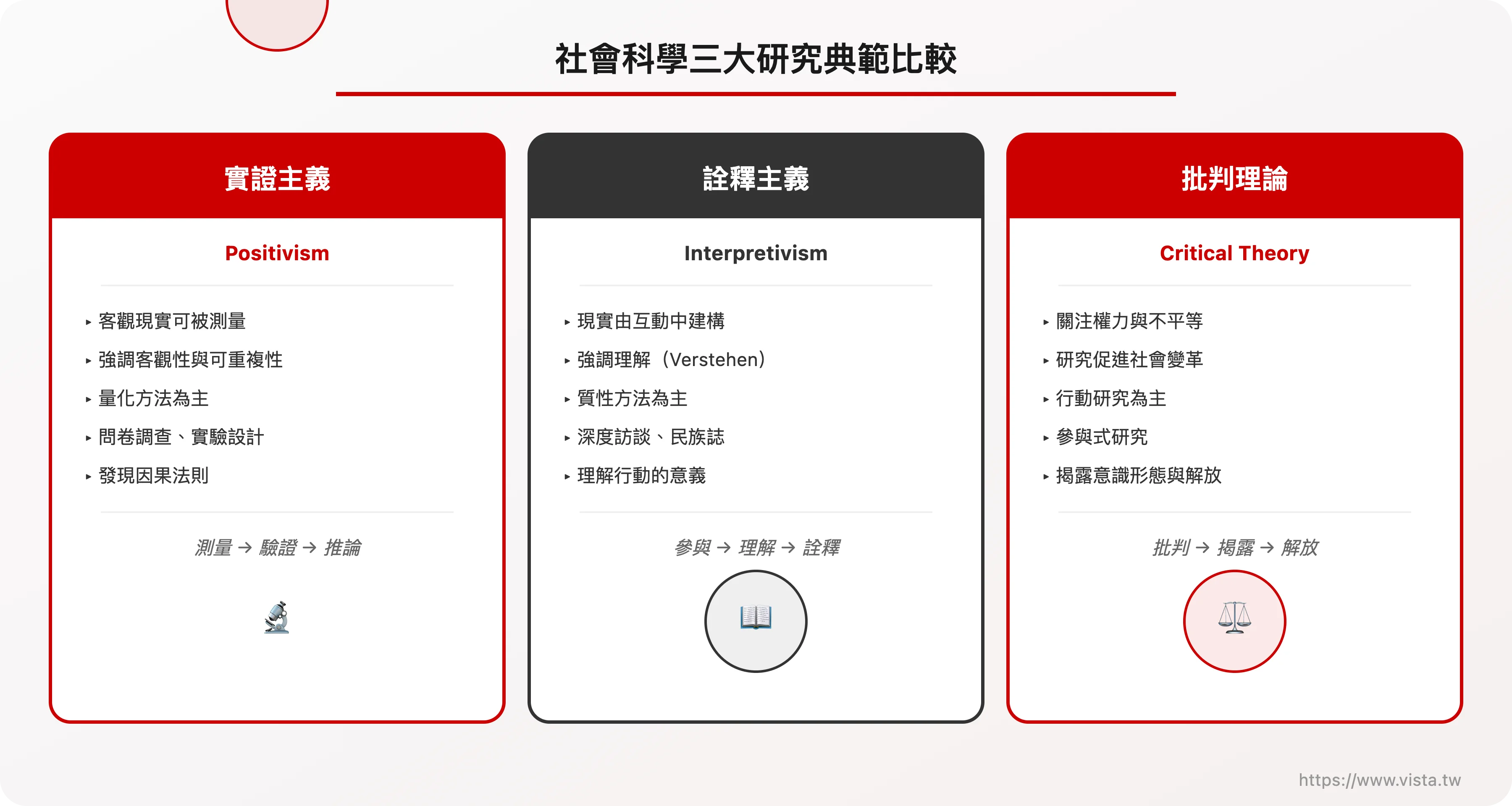 ▲ Comparison of three major research models in social sciences
This part is also connected to the three major paradigms discussed by Professor Cai: empirical evidence, interpretation, and criticism. Many people get stuck because they want to take route A (for example, they want to use quantification to prove cause and effect), but when they write, they use the language of route B (for example, they start to use an interpretive tone to talk about meaning), and in the end, both sides are incomplete. This book reminded me: a model is not a decoration, it is the skeleton of your entire paper. If you don’t choose your frame first, it will be difficult to build muscles.
The passage that particularly struck me was when Professor Cai discussed the maturity of researchers from the perspective of knowledge: A naive knowledge perspective will expect a fixed answer, while a mature knowledge perspective will understand that conclusions are always temporary and subject to revision. This sentence is especially cruel and true for doctoral students. Because doctoral training ultimately forces you to accept that you are not here to write a perfect answer, you are here to hand over a set of methods and arguments that can be tested, debated, and extended. In other words, the sooner you accept this, the less likely you will be held back by the idea that you have to be perfect before you dare to submit.
Chapter 2 is most like a slap: Attitude is not an inspirational article, it is a system for whether you can continue to produce
If I were to sum up the second chapter of the thesis in one sentence, it would be: Research is not a sprint, it is a marathon. Professor Cai used his experience from cattle herding class to Harvard and Columbia, and then to long-term submission and serving as editor-in-chief of academic journals to talk about the same thing - you should make rejection a part of the research process, rather than treating rejection as a trial of self-esteem.
We can re-translate several of the attitudes he mentioned from a systematic perspective:
The so-called proactive, not passionate, is to turn document tracking, seminar participation, academic network building, and asking seniors for advice into a daily schedule, instead of waiting until inspiration comes. The so-called “perseverance” is not about holding on, but about establishing a work rhythm that allows you to take a small step forward even if your condition is not good. The so-called openness and humility does not mean a low profile, but the ability to break down the editorial board’s review opinions into an executable list and not tie oneself to the paper. The so-called critical thinking is not to sing the opposite, but to be able to identify whether you are just quoting authoritative documents without real argument?
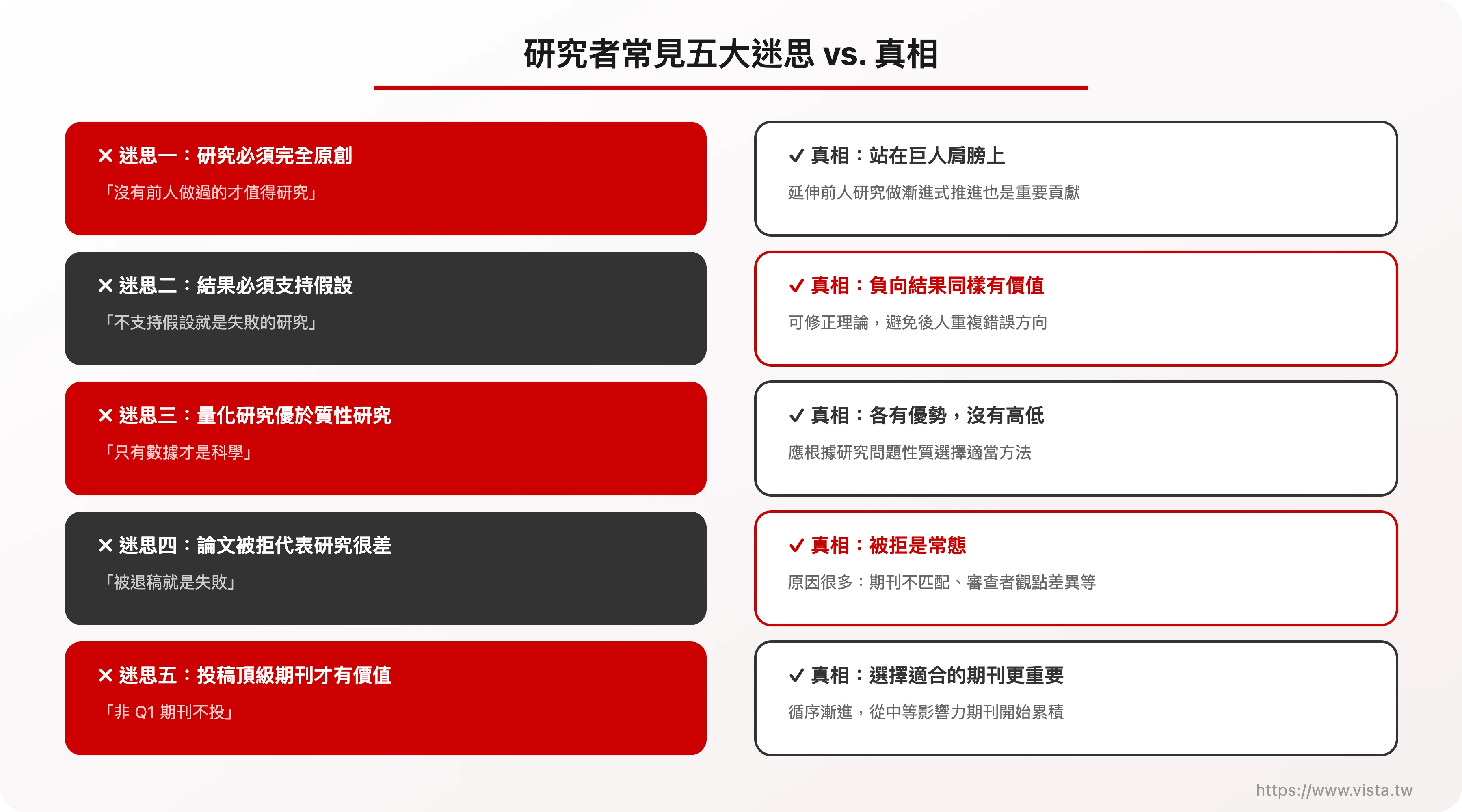 ▲ Five common myths vs. the truth among researchers
My favorite part of this chapter is Professor Cai’s dismantling of research myths: research does not have to be completely original, results do not have to support hypotheses, quantification does not have to be higher than qualitative, rejection does not mean bad, and non-Q1 journals do not mean rejection. These words may seem cliché, but for many academic novices who have just started to submit manuscripts, they actually eliminate the most terrifying devil in your mind: “If I am not a genius, I should not submit.” Professor Cai told us frankly: The real masters are often the ones who are most willing to throw their works into the market to be criticized and criticized.
You need to make rejection a part of the research process, not a test of your self-esteem.
Chapter 3 Give me an operational definition of the topic: Creativity is not imagination, meaning is your moat
I have always felt that the word “innovation” can easily be said to be illusory. Fortunately, Professor Cai brought it back to the ground: a good topic must be creative and meaningful at the same time. Creativity can come from cross-field, reverse thinking, new technology application and context transformation; the meaning must be tenable: theoretical contribution, practical value, methodological innovation and social concern. This set of matrices is important because when you think of a problem, you don’t just stop at what you think is interesting, but immediately ask: “What can it advance? Whose problem can it solve? Which gap can it fill?”
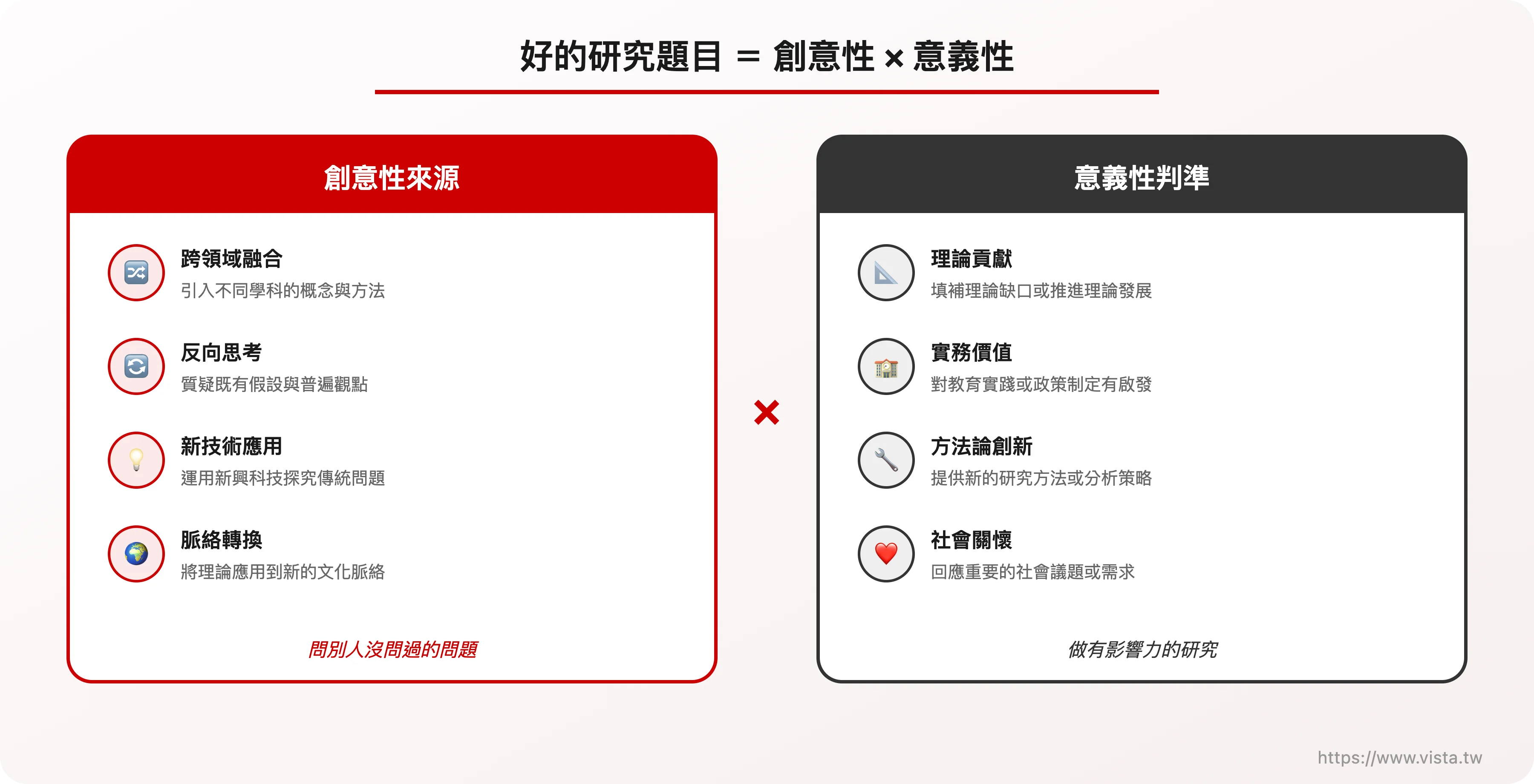 ▲ Good research topic = creativity × significance
In the book, he also provides very pragmatic strategies for selecting topics: read a lot of literature, read systematic reviews, track future research suggestions from top journals, catch trends from seminars, find gaps from practical problems, form teams to complement each other, and make good use of tools to catch up with new literature. Especially the reminder with a strong sense of numbers - a literature review usually needs to be able to support at least 30-50 articles, and the time span is extended to at least the past five years - it seems like a bottom line to me: if you don’t have enough literature density, it will be difficult to write a truly strong gap argument.
You want each paper to be like a different chapter of the same story universe, so that the international community will slowly remember that you continue to move forward on a certain issue.
But the most Ph.D.-level sentence in Chapter 3 is to establish the main line of research (research program). Professor Cai mentioned that many people do research as if they are fighting guerrilla: one article today, one article tomorrow, and there is no accumulation of each other. What Professor Cai means is: You should make each paper like a different chapter of the same story universe, so that the international community will slowly remember that you continue to move forward on a certain issue. This is a very realistic strategy for researchers who want to produce stable output in SSCI journals - not every paper must be a hit, but every paper must be able to catch up with the previous one.
Chapter 4 made me think of journal selection as a strategy game: not random shooting, but matching, rhythm and filing
Chapter 4 of this book felt like I was taking a journal market analysis class. Professor Cai breaks down journal selection into four dimensions: scope, influence ranking, review cycle acceptance rate, and submission strategy planning. For beginners, the most fatal mistake is often not poor research, but submitting the paper to the wrong place. Just imagine, if the research topic and the journal’s positioning are not consistent, no matter how hard you work, you may be rejected by the desk.
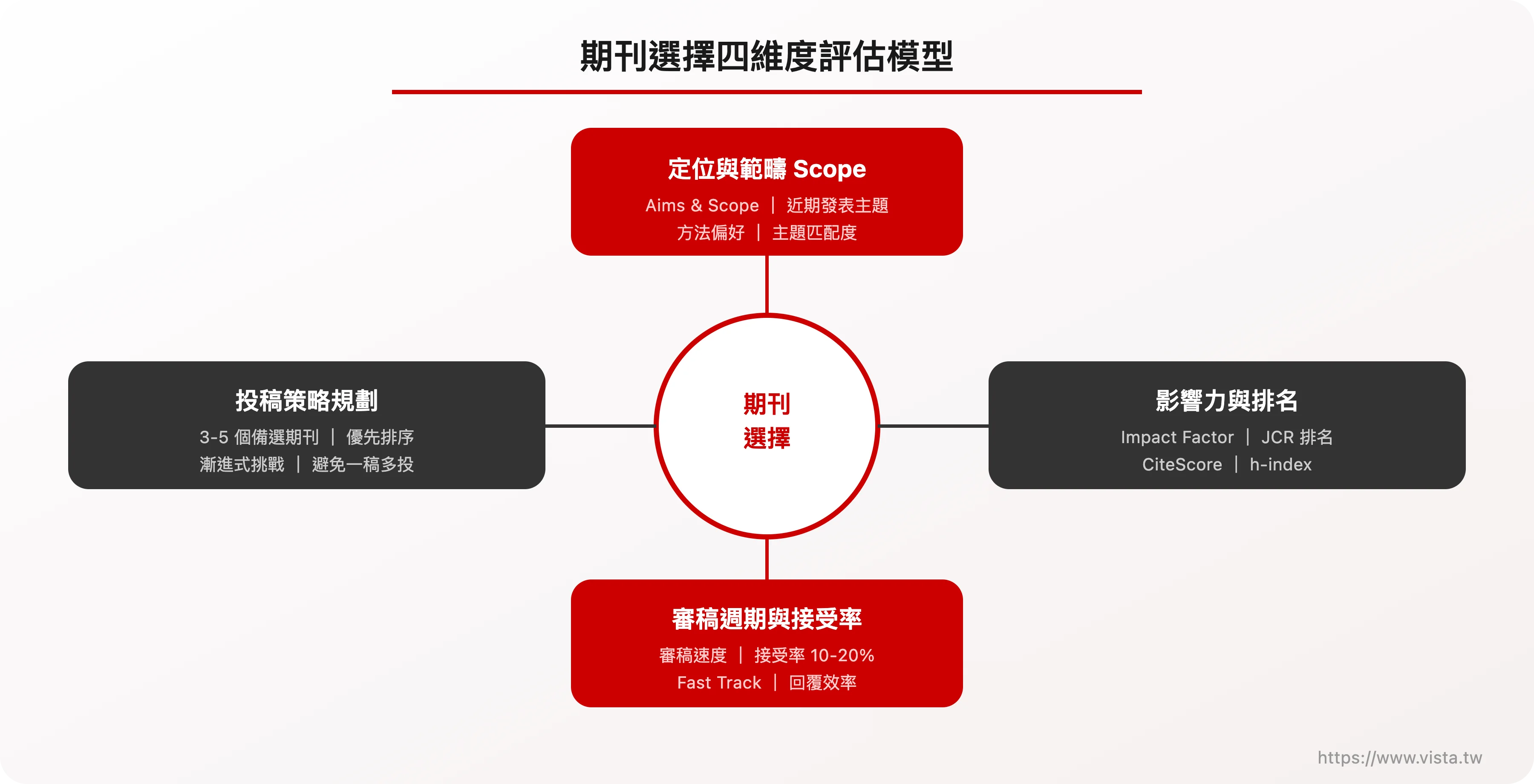 ▲ Four-dimensional evaluation model for journal selection
The most interesting thing I read was when he talked about the preliminary screening process by editors: before submission, the editor will first determine whether it meets the scope and basic quality of the journal. About a considerable proportion (Professor Cai pointed out that it may be as high as 30–50%) will be directly rejected at this level. This reminds me of one thing: the first hurdle for submission is not the reviewers, but the editor’s quick judgment. Therefore, the first few paragraphs of the cover letter, abstract, and research contribution are actually the entrance experience of whether we can survive the initial screening.
Professor Cai’s suggestions for rejecting manuscripts also sound very reasonable: calm down for two or three days before reading the comments; divide the comments into three categories: “I agree and can change”, “I can compromise” and “I think it is unreasonable but needs clarification”; then decide whether to supplement the information, redo the design, or switch to a more suitable journal. The more important bottom line is: don’t just switch to the next academic journal without revising it. Because that is not a strategy, that is replaying the same problem again, or even repeating the same mistakes.
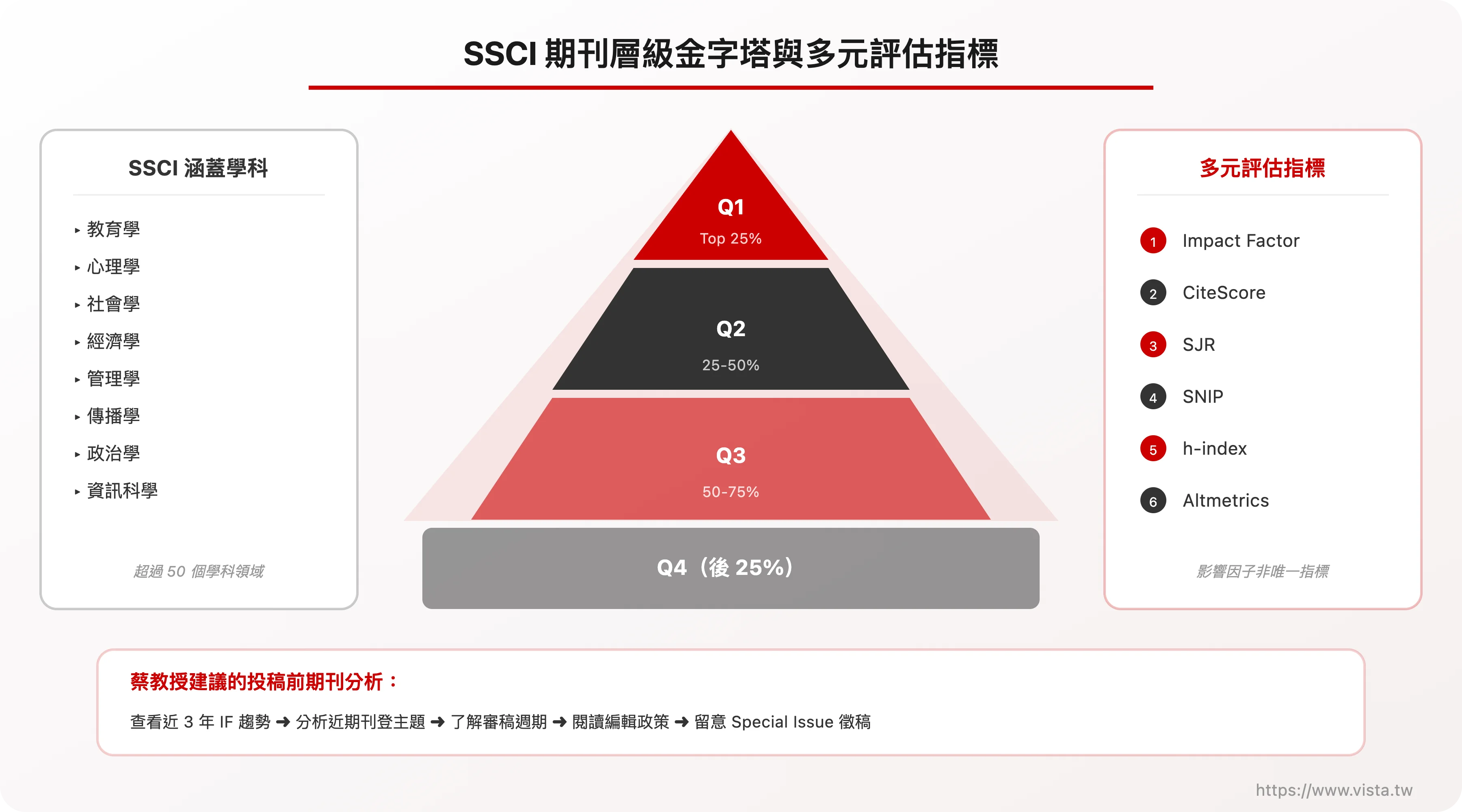 ▲ SSCI journal hierarchy pyramid and multiple evaluation indicators
Chapter 5 is the most like a writing coach: IMRaD is not a format, it is a persuasive structure
If you are a graduate student, you have probably heard of IMRaD (Introduction, Methods, Results and Discussion). In fact, many books have talked about IMRaD, but Professor Cai’s statement is particularly easy to understand, as if an editor is reminding himself: Every section of the paper is actually completing a persuasive task.
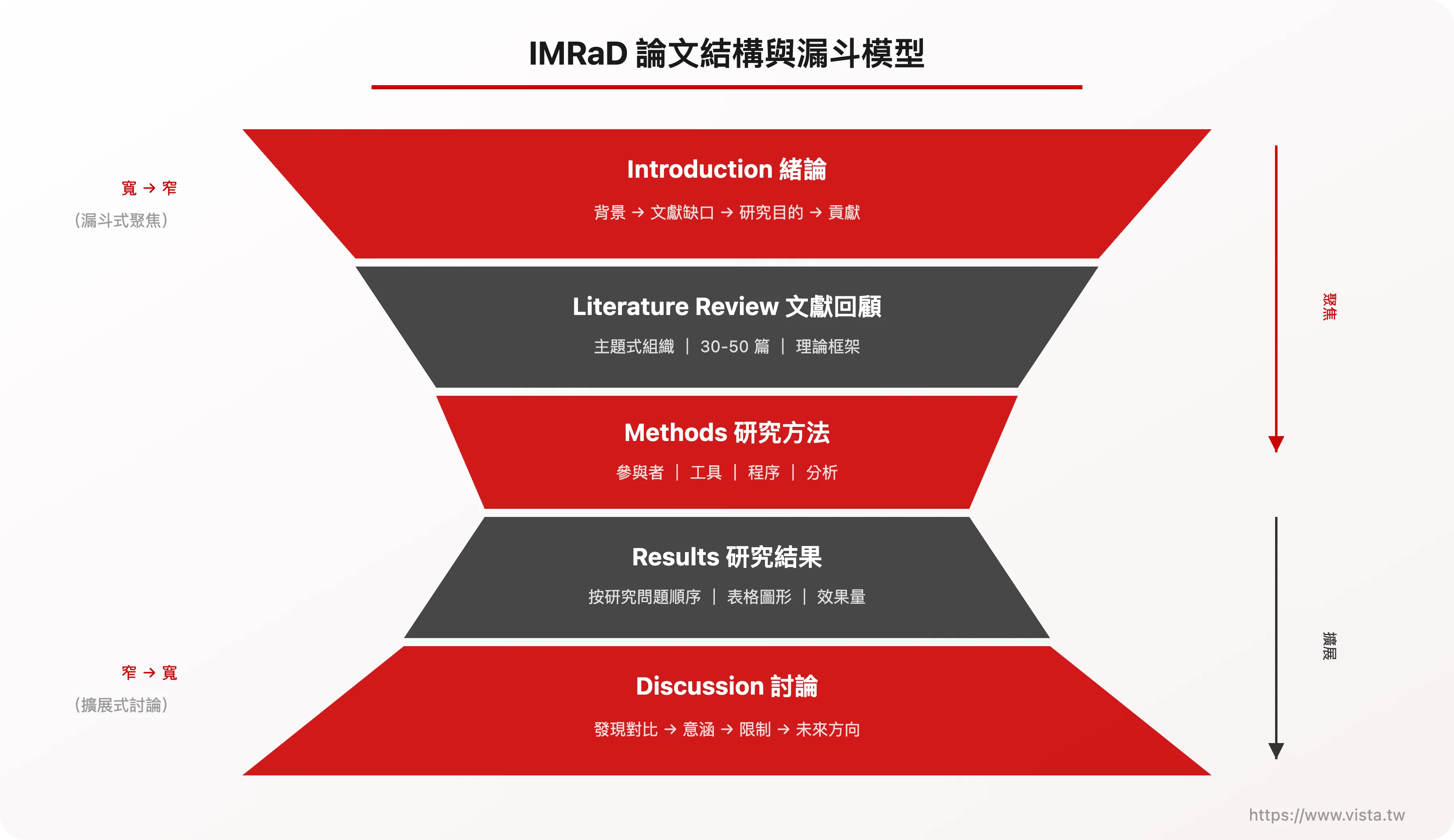 ▲ IMRaD paper structure and funnel model
For example, the funnel structure of the introduction is not to look good, but to allow readers to understand in the shortest possible time: why is your research problem important, where are the gaps in the literature, how will you fill them, and how will the world change after you fill them? The purpose of the literature review is not to stack abstracts, but to integrate and analyze thematically, and finally to naturally lead to your research questions or hypotheses. The research methods should be written so that others can repeat them; the results should be presented objectively, make good use of tables and graphics, and do not rush to comment; in the discussion chapters, answer “why is it important”, “how to advance understanding”, “what are the limitations” and “what to do next”?
I also agree with the writing process mentioned by Professor Cai in the book: write Methods & Results first, then go back and write Introduction & Discussion. This is not laziness, but because methods and results are the most concrete. Fix the skeleton and evidence first so that the introduction and discussion will not float. In addition, he reminded that although the abstract is written last, it is read by editors and teachers first - this sentence is so important that it deserves to be posted on every researcher’s desk. Because the fate of many manuscripts may be roughly set within 30 seconds after the editor reads the abstract.
Although the abstract is written last, it is read by the editor first - the fate of many manuscripts may be roughly set within 30 seconds after the editor reads the abstract.
In addition, I really like the part where he talks about keyword strategy and reference management. These things may seem trivial, but they are actually explicit signals of professionalism. Wrong citations, messy formatting, or insufficient literature in the past five years are not just minor mistakes to the editor, they are evidence that your research habits are not rigorous. Details like this will quietly lower the trustworthiness of your entire paper. Seeing this also reminds me of my past submission to a TSSCI journal. Before my paper even reached the editing desk, I received a letter from my assistant, telling me that the format was wrong and needed to be revised. Although it took some effort to modify it at the time, it was indeed a good nutrient for growth.

💡 Research done well requires digital tools to accelerate it. Want to build your own academic tool, research dashboard, or personal website using natural language? Teacher Vista’s Vibe Coding practical workshop will help you turn your ideas into operational digital products without writing programs. Whether you are a researcher, doctoral student or academic worker, this class can help you extend your research energy into the digital world.
Chapters 6 and 7 elevate submission from skills to ethics and roles: you are not just writing a paper, you are also becoming a member of the academic community
I think the most valuable addition to the fourth edition of this book is the responsibilities and interactions of the three roles of author-reviewer-editor. Professor Cai made peer review very transparent: editors will conduct preliminary screening, find reviewers, comprehensively judge and make independent decisions; reviewers should be specific, constructive, and prioritize; authors should have academic integrity, writing quality, cooperation with the process, and point-by-point responses.
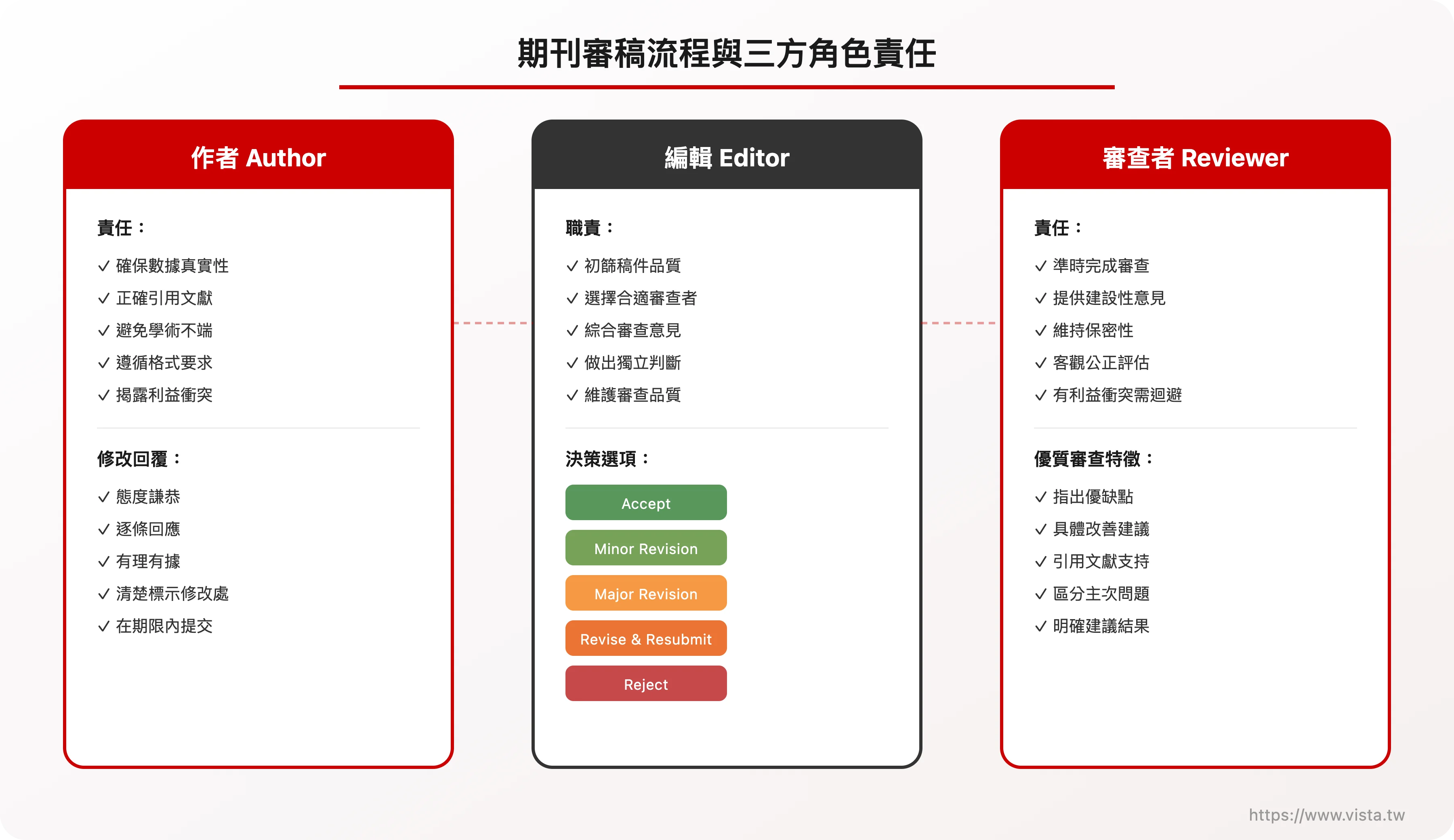 ▲ Journal review process and the roles and responsibilities of three parties
His requirements for response letters are basically “researcher’s social skills”: be humble but not humble, respond point by point without being evasive, be reasonable and well-founded without being emotional, and clearly indicate the modification position to save the other party effort. This is actually a workplace ability - you are collaborating with a group of people who don’t know you to push your work to a higher standard. People who can do this are usually not too bad in any field.
He also talked about the ethics of authorship: opposing honorary authors, opposing pseudonyms, and emphasizing contribution and responsibility. This paragraph made me very alert when I read it, because the academic world is about knowledge production on the surface, but it is still a market of trust in its heart. Once you are doubted in terms of academic ethics, all subsequent efforts may instantly go to zero.
I read this book into three immediate actions: Make submission a controllable system
After reading it, I don’t want to just leave my inner feelings. If possible, I want to turn it into a rhythm that can be actually acted on. Below are the three things I most want to do immediately. It’s not just about shouting slogans, it’s about making preparations that can increase the probability of publication.
The first thing is to establish the research main line and journal map. When I want to submit a manuscript in the future, I will first write down the main line of my research in one sentence, then list three to five highly matching journals, and break down the common topics and method preferences of each journal in the past two or three years to form my own submission list. In this way, when planning each research article, you are already aiming at the goal, instead of starting to look for an outlet after writing it.
The second thing is to make the literature review a cumulative asset. Read it not just for this paper, but for the main line of your own research. I will make good use of Publish or Perish, organize 30-50 core documents into themes, and regularly update new documents in the past five years, so that the literature review will no longer start over every article, but will pile up faster and more steadily like building blocks. Paired with knowledge management tools such as Anytype, the library can continue to grow.
The third thing is to turn rejection of submission into a process node rather than an emotional event. When I receive review comments, I will use a three-category method to break them down: changeable, compromiseable and requiring clarification; and write the modification action, modification position and corresponding reasons for each comment. Then, use this reply letter as a quality checklist for your next submission. As time goes by, you may find that what really makes you improve is often not the parts that you feel are well written, but the sharp opinions from anonymous reviewers.
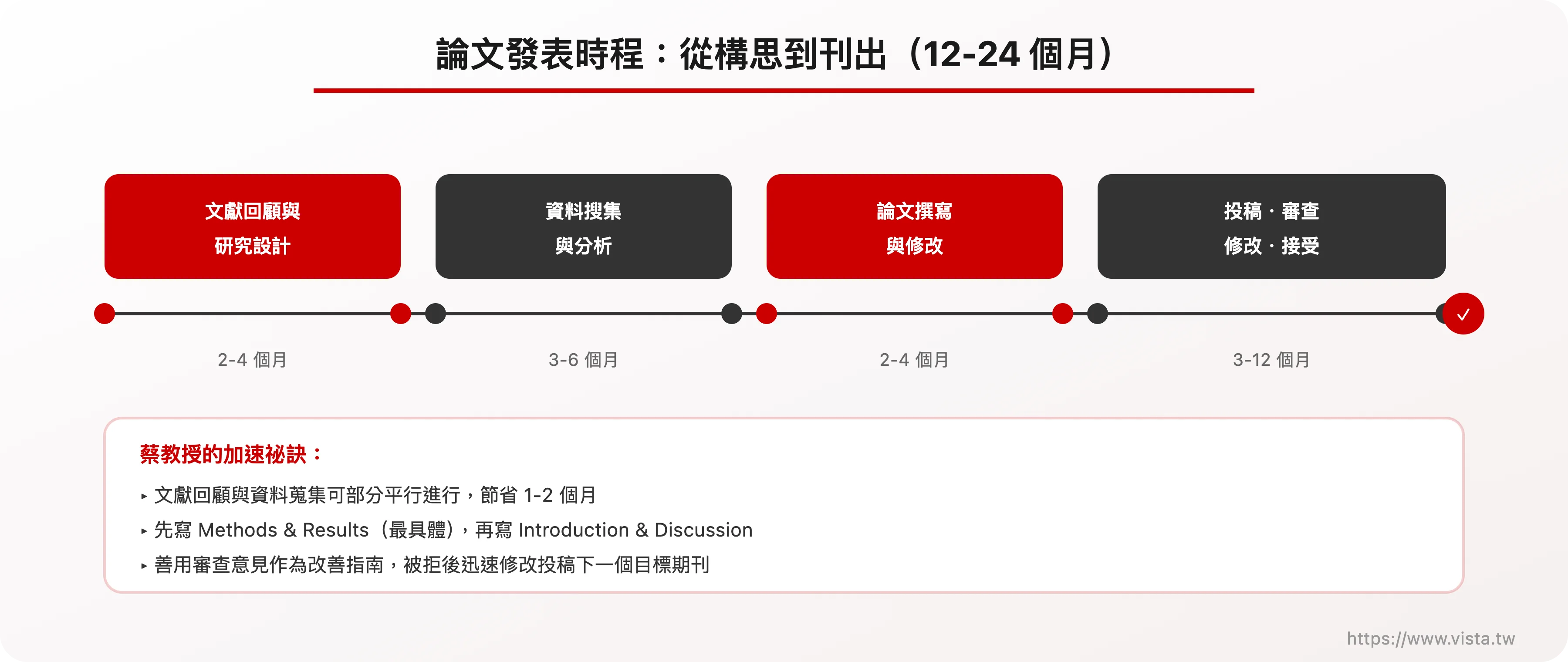 ▲ Paper publication time: from conception to publication (12-24 months)
Final Thoughts: This book does not teach you how to publish, but teaches you how to become someone who can publish consistently.
If we compare academic publishing to creators publishing their works in the market, then I guess: Professor Cai Jinzhong’s book is to help everyone bring their inspiration back to the professional system. It does not myth the success of academic research. The book reveals the reality: an international journal article may take 12-24 months from conception to publication; reviews may be repeated; rejections are common; editors’ initial screening is strict; details determine trust; and the reply letter determines whether you can pass the next level?
As long as you are willing to regard research as the long-term main line, submission as a systematic process, and review as a free coach, you are not gambling on luck, but improving your winning rate.
However, this book also gives us a very powerful belief: as long as you are willing to regard research as a long-term main line, submission as a systematic process, and review as a free coach, you are not gambling on luck, but improving your winning rate. To me, this book is most like a lamp on the table: it illuminates not the end point, but how to take each step so as not to run out halfway.
I am sure that in the future, whenever I want to procrastinate, wait for more perfection, or doubt myself because of rejection, I will think of the implicit sentence in this book: You are not lacking in talent, you just need a research and submission system that can be run repeatedly. And this system can be started starting today…
If you are also working hard on the path of academic writing, you might as well use a growth mindset to look at every submission and rejection. After all, the balance of input and output is the key to sustained output.
Further reading
- Huang Huiru talks about writing methods: raise a pond and have concise short articles at your fingertips
- Huang Huiru’s long form writing methodology: from motivation to structure, create in-depth and good writing
- Writing Coach Vista teaches you how to write good and exciting articles
📖 深入探索相關主題