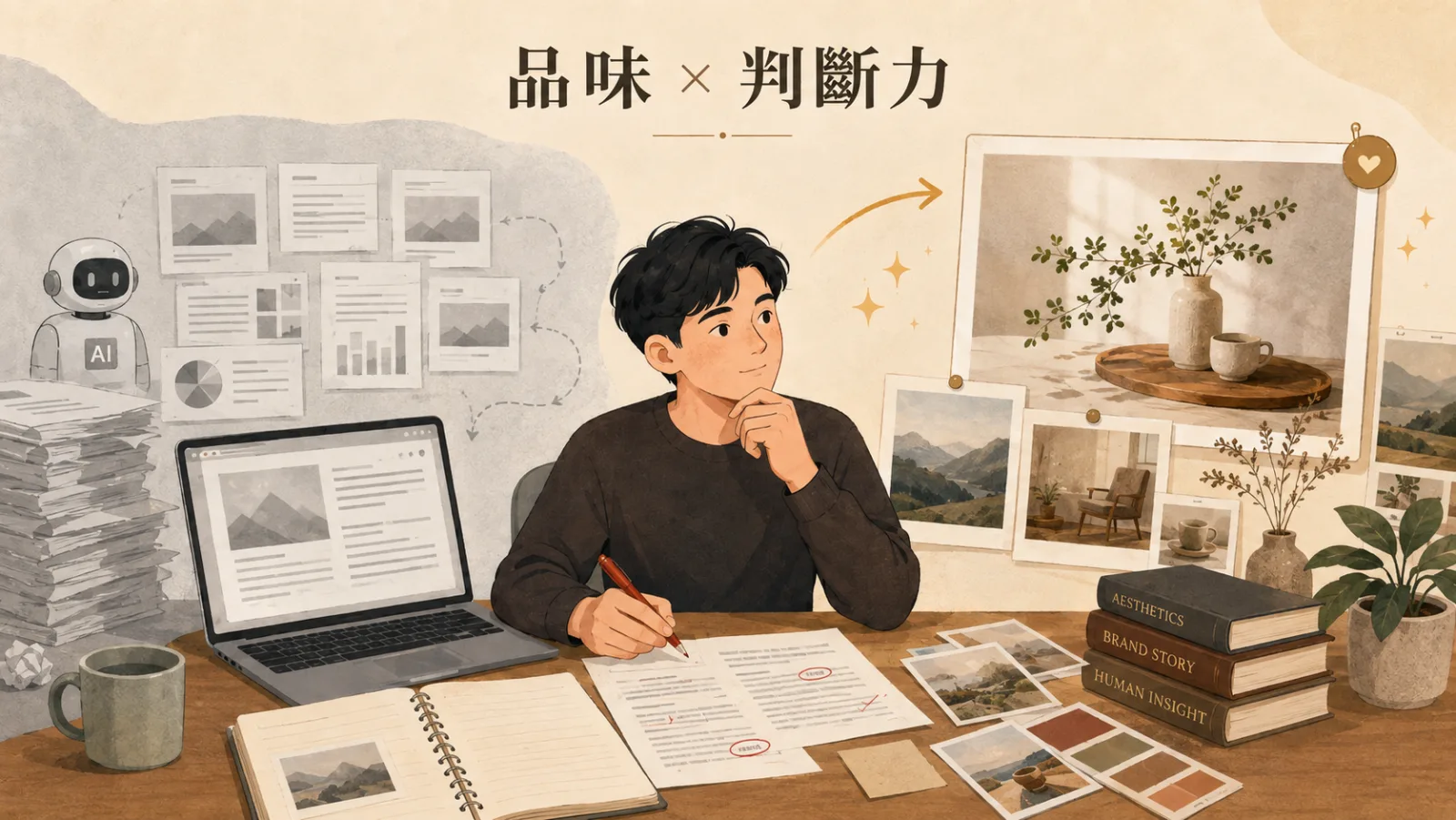
Taste × Judgment: Two weapons for professionals in the AI era to refuse to be reduced to machine OEMs
This article was originally published in the expert argument column of “TechNice Technology Island (opens in a new tab).
Do you agree? The end of mediocrity has arrived. This is not alarmist, but the cruel reality we are experiencing. The comprehensive popularization of generative artificial intelligence has completely rewritten the rules of survival in the modern workplace. In the past years, as long as an ordinary office worker could quickly organize meeting minutes, write a decent business letter, or piece together a logical market analysis report, it would be enough to find a foothold in the company and even obtain stable salary and promotion opportunities. However, what once took hours or even days of manual labor is now only a matter of seconds in front of various large-scale language models.
Artificial intelligence has ruthlessly raised the floor of productivity, which means that marginal output standards have become equated with the machine’s preset output. If the brainchild you hand over reads like the unvarnished standard answer from ChatGPT or Claude, then your irreplaceability in the workplace is approaching zero. The cruel watershed in the AI era that I talked about before also confirms the same thing: with the same use of AI tools, some people’s income is cut in half, while others double their income. The difference is never whether they use the tools, but what is left after taking away the tools. We are at a new watershed in human history. The industrial era thinking that purely pursues output speed and information volume has completely failed. The workplace of the future does not belong to those who are the fastest typists and the best at giving instructions, but to those who possess qualities that machines can never calculate through data algorithms, such as profound taste and sharp judgment.
Taste: Identifying the gap between “okay” and “amazing”
To understand how to break out of the AI flood, we must first deeply analyze what taste is. Simply put, taste is more than just an aesthetic preference for typography or superficial pickiness about the color palette of a brief; it is an intuitive understanding and deep insight into the standards of excellence in the field.
Taste is when you gaze at a work and be able to instantly capture the invisible gap between acceptable and amazing. Veteran broadcaster Ira Glass once accurately stated the eternal pain point of creators in a widely circulated interview video “The Gap (opens in a new tab)>: In the early stages of our careers, our tastes are often far ahead of our actual output capabilities. We know clearly in our minds what a stunning masterpiece is, but our hands can only produce clumsy, green, half-finished products. In the pre-AI era, the only way to cross this gap was through countless days and nights of deliberate practice and painful polishing.
However, the intervention of artificial intelligence has completely changed this equation. Now, machines have become extremely efficient manufacturing hands. It can generate code for you, draft article skeletons, and even structure seemingly rigorous business logic. However, the machine itself is tasteless. The underlying logic of its operation is a probabilistic model, which relies on a large and homogeneous database to predict the next safest and most reliable word. When a machine is on unsupervised autopilot, it inevitably slides toward extreme mediocrity. The content it produces has a complete structure but lacks soul, and a polite tone but no character. It is like a glass of lukewarm plain water that quenches thirst but leaves no aftertaste. It is at this time that your taste will become your sharpest weapon in the workplace. It is also one of the unique human abilities that I have compiled in <Five Things AI Can’t Do>.
Cultivating this irreplaceable taste requires you to consciously and almost rigorously immerse yourself in “extreme excellence” for a long time. You can’t expect to develop an eye for great works by swiping through the fragmented information that quickly slides through social media every day, or just by reading the bulleted summaries generated by AI. You must force yourself to chew on in-depth knowledge and read academic documents and classic works that require high concentration to digest; you must enter the real world to observe how a brilliant speech can mobilize the emotions of the crowd, and to understand the complex human considerations behind an excellent business decision. If you are used to using AI to assist learning, don’t forget to go back and internalize what you read into your own judgment. This is exactly what I talked about in <Smart use of AI, major functional upgrade>, rather than one-way information transfer.
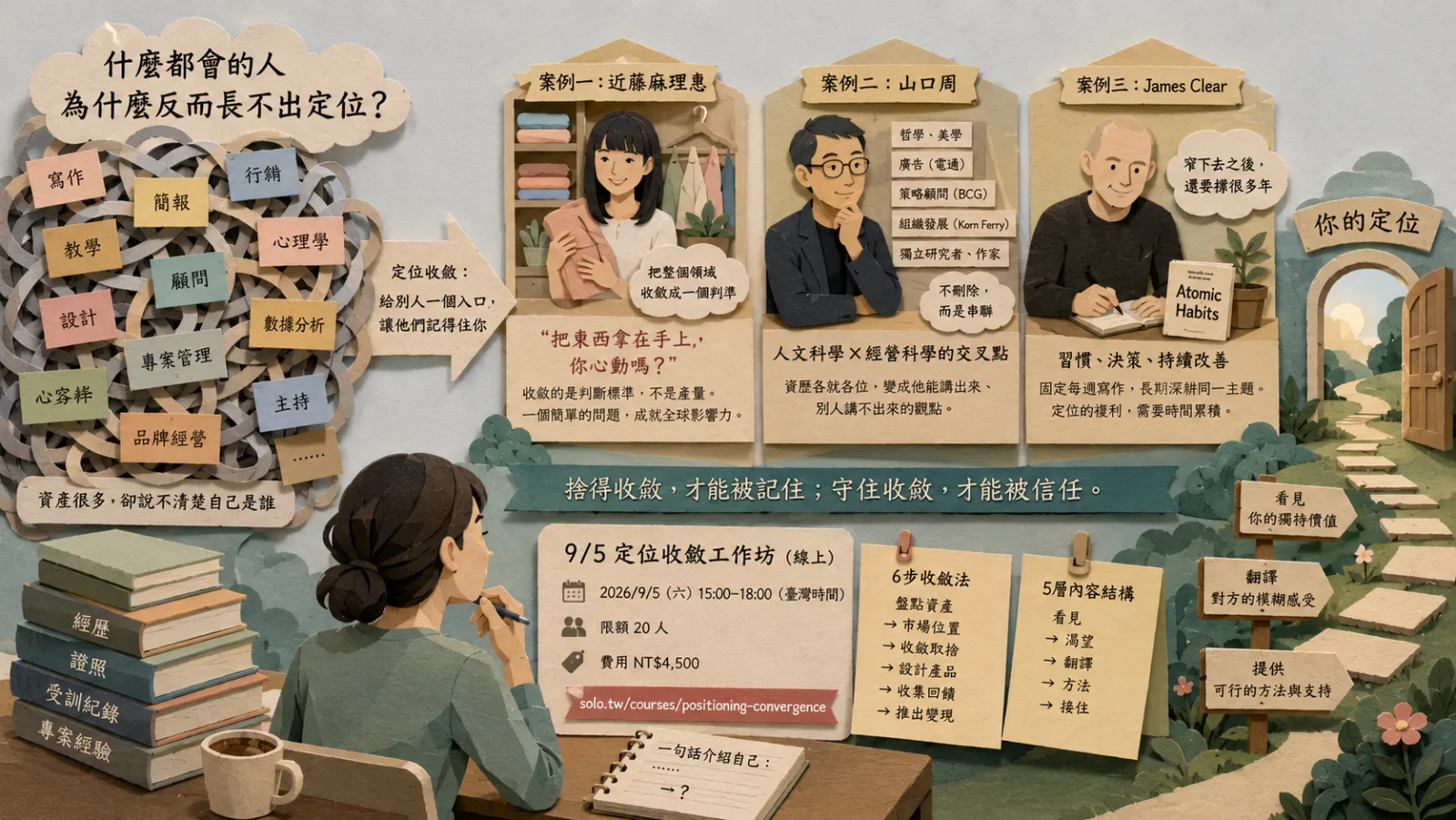
As James Clear (opens in a new tab), author of “Atomic Habits”, said, comparison is an extremely effective way to cultivate taste. In the AI era, this comparison is no longer about comparing your own weaknesses with the achievements of others, but ruthlessly comparing the initial results of your collaboration with AI against the industry’s top and most soulful human masterpieces.
For example, when you get a proposal drafted by AI, you must constantly ask in your mind: What is missing from this proposal compared to the most touching and convincing proposal I have ever seen? If it just looks like a bunch of correct nonsense, then your taste is the wake-up call that forces you to go back to square one, reboot the machine, or go out and do a drastic reinvention yourself.
Judgment: the antidote to AI flattery and hallucinations
Taste allows you to see the outline of excellence, while judgment is the guide that guides you to carve rough rough stones into brilliant diamonds. Of course, this is the only antidote to AI flattery and hallucinations. In working with generative AI, the biggest danger is often not the limitations of the technology itself, but how easily it lulls us into intellectual laziness. The language model is designed to please humans extremely. It can always deliver a seemingly perfect answer to you in a confident and impeccable tone. Even if its underlying logic is full of flaws, clichés, and even ridiculous “hallucinations”, it can still be packaged to look real.
This is the trap that modern professionals are most likely to fall into. When you accept the first draft of the machine in pursuit of temporary efficiency and give up the right to question and think, your ability to think independently begins to shrink. Before you know it, you’ve been reduced to a production line operator who just keeps pressing “generate” and “copy and paste” buttons. To break out of this algorithmic comfort zone, you must develop an almost critical sense of judgment. You cannot regard the output of AI as the final authoritative answer, but as a piece of rough clay, waiting for you to use your experience and wisdom to violently knead and finely carve it.
This irreplaceable judgment comes from your profound life experience, empathy, and ability to perceive complex situations. These are precious assets that do not exist in any machine training data. A powerful AI tool may be able to write marketing copy that complies with all SEO rules and has perfect grammar, but it will never be able to understand the subtle changes in market sentiment; it has never sat in a cafe on the street in Taipei’s Minsheng Community and quietly observed the real reactions between people’s eyebrows when talking; it has not experienced the suffocating anxiety before the project deadline, and it cannot understand the intricate organizational political operations within your company that are not written in the employee handbook.
Your judgment is the only bridge between the cold logic of machines and the complex reality of humans. You must bravely inject your unique life experience, profound academic insights, and a strongly personal worldview into the cold output of the machine. You must have the courage to make a big move, ruthlessly delete the indifferent pleasantries written by the AI, discard the seemingly gorgeous but empty rhetoric, and fill in the specific details, real pain points and strong opinions that only humans can resonate with. An article without the author’s personality and expertise will not have any deep memory after reading it, let alone selling professional services or building a personal brand through such content.
From OEM to Editor-in-Chief: Inspiration from MUJI
For example, MUJI (opens in a new tab), a Japanese brand known for its minimalist design taste, still maintains its unique style even today when AI can generate countless types of typography, design solutions and trend analysis. For MUJI designers, their task is not to press the “generate” button, but to use their long-term intuitive taste to set ultra-high standards that are difficult for machines to match.
MUJI designers will think about: What kind of minimalist style can convey a unique philosophy of life? AI may be able to generate a perfect MUJI-style greeting card pattern, but MUJI designers will use their taste to select textures that are slightly flawed and warmer, delete those seemingly gorgeous but empty rhetoric, and personally fill in details that only humans can resonate with.
Overall, this workplace revolution triggered by AI is essentially a reshaping of identity. We must completely bid farewell to the old era of purely being content producers, and fully transform into editors-in-chief and directors with final discretion. Your future core value in the workplace will no longer depend on how many words of report you can produce per unit of time, but on which words you decide to keep, which words to delete, and how you give these scattered information deep meaning and soul.
Granted, this is a process that requires a complete change of mindset. You can no longer face work with the mentality of “just do it”, but use the eagle eye of the editor-in-chief to examine every detail. Every future collaboration with AI should be a game of raising standards. Please bravely refuse to accept those boring mediocre works, and refuse to let your name be linked to soulless words. Use your extraordinary taste forged through long-term accumulation to set an ultra-high standard that is difficult for machines to match; and use your keen judgment rooted in the real world to boldly edit, correct and guide until the final product exudes the brilliance of humanity and unique value that cannot be ignored.
The arrival of the AI era is definitely not the end of human creativity. Instead, it is a powerful catalyst that forces us to shed our mediocrity and move towards higher-order mental activities. When repetitive labor is completely taken over by machines, we can finally unload the heavy burden of OEMs and devote all our energy to the deepening of taste and the quenching of judgment. Digital tools have completed incredible evolution. Now, it is time for us who are accustomed to using tools to show our truly irreplaceable edge.
Next step
Bring this topic to your team
Vista Cheng speaks and runs workshops on AI workflows, writing and content systems for companies, schools and public agencies.